Key takeaways
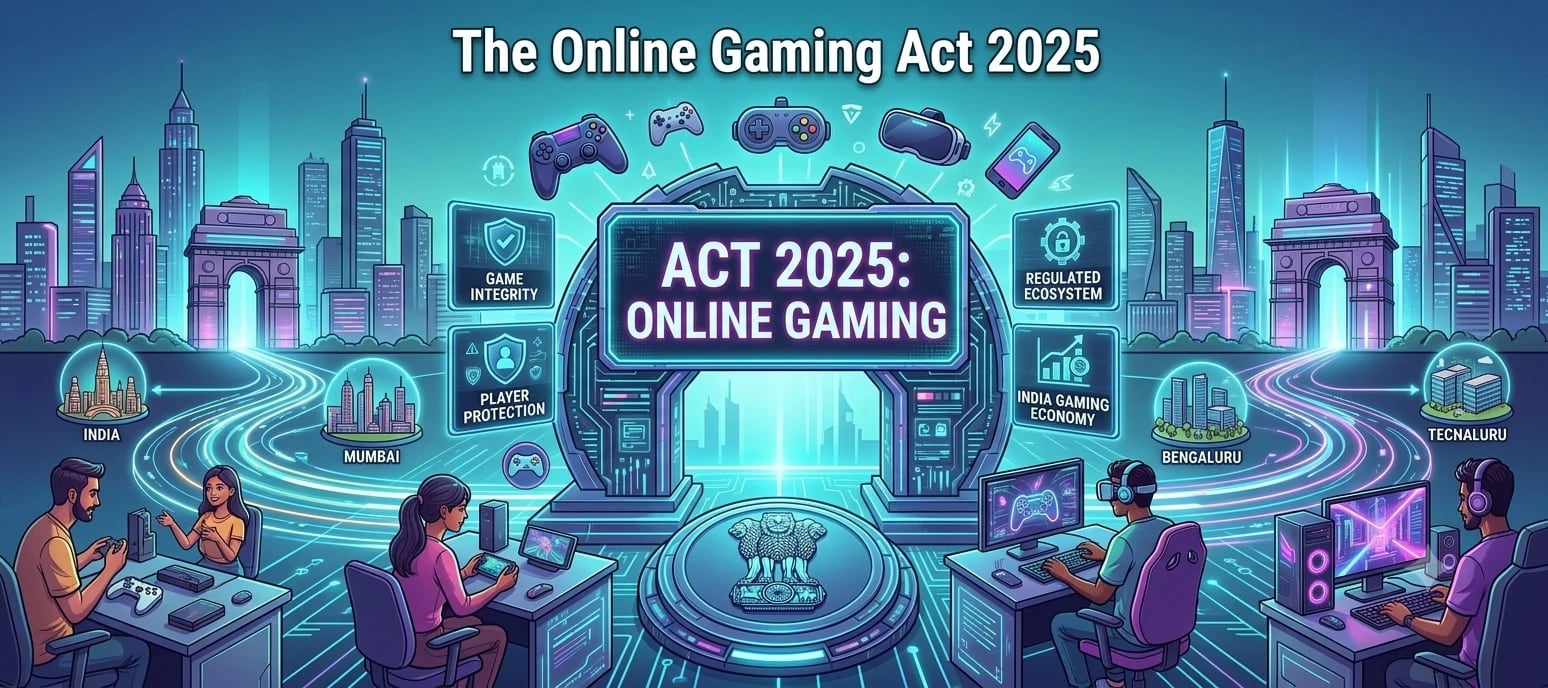
- The Online Gaming Act 2025 bans online money games, whether of skill or chance, and promotes e-sports and online social games.
- The Act and the Online Gaming Rules, 2026 came into force on 1 May 2026.
- Fantasy sports and online rummy played for money stakes fall within the ban.
- Challenges to the Act have been transferred to the Supreme Court, which was moving towards final hearings in 2026.
In August 2025, India’s real-money gaming industry, worth thousands of crores and employing tens of thousands of people, was effectively shut down in under 72 hours. The Promotion and Regulation of Online Gaming Bill, 2025 was introduced in Parliament on 20 August, passed by both Houses within two days and received Presidential assent on 22 August 2025 (Wikipedia).
The Online Gaming Act 2025 (often called PROGA) bans online money games outright, whether based on skill or chance, while promoting e-sports and social games. This guide explains what the law bans and allows, the penalties, the Rules that came into force in 2026, the constitutional challenge before the Supreme Court, and the legal options for gaming startups and investors.
What the Online Gaming Act 2025 does
The Act has two halves. The first promotes e-sports and online social games, recognising them as legitimate sectors for development. The second prohibits online money games and everything around them.
The implementing Promotion and Regulation of Online Gaming Rules, 2026 were notified on 22 April 2026, and the Act and Rules came into force on 1 May 2026 (PIB; GALA Law). The Rules set up a regulator, the Online Gaming Authority of India (OGAI), and classify games into online money games, e-sports and online social games (A2Z Taxcorp).
The most striking feature is that the ban doesn’t distinguish between skill and chance. For decades, Indian courts treated games of skill, such as rummy, as outside gambling laws, starting with R.M.D. Chamarbaugwala (1957) and State of Andhra Pradesh v. K. Satyanarayana (1968). The Act sets that distinction aside for online games played for money: online money games are prohibited regardless of whether skill or chance predominates.
What’s banned and what’s still allowed
Banned: offering, operating or facilitating an online money game, meaning a game in which a user deposits money or stakes in the expectation of winning money or other stakes. The Act also bans advertising and promoting online money games, and prohibits banks, payment systems and financial institutions from processing transactions for them (Outlook Respawn).
Allowed and promoted:
- E-sports: competitive games played as organised sporting competitions, which the Act treats as a sport to be developed.
- Online social games: games played for entertainment, skill development or education, without stakes or winnings in money.
- Ad-supported and subscription models: games that earn through advertising, cosmetics or subscriptions without a money-for-winnings loop are generally outside the money-game prohibition, but the structure must be checked carefully.
The grey zone is real. “Free” games with paid entry tickets, tokens convertible to cash, or prize pools funded by users risk being treated as online money games. The OGAI can decide how a game is categorised, and startups should seek that clarity rather than guess.
Penalties, enforcement and who is liable
The Online Gaming Act 2025 carries serious criminal penalties. As enacted:
| Offence | Punishment under the Act |
|---|---|
| Offering or operating an online money game | Up to 3 years’ imprisonment, a fine up to ₹1 crore, or both |
| Advertising or promoting an online money game | Up to 2 years’ imprisonment, a fine up to ₹50 lakh, or both |
| Facilitating payments for online money games | Up to 3 years’ imprisonment, a fine up to ₹1 crore, or both |
| Repeat offences | Enhanced punishment, with longer imprisonment and higher fines |
The core offences are cognisable and non-bailable, and where a company commits an offence, its officers in charge can also be held liable. Enforcement has gone beyond prosecutions: banks withdrew payment services within days of the Act’s publication, investors recorded write-offs, and enforcement agencies have acted against operators (Lexology / GALA). Influencers and celebrities who promote banned games are exposed under the advertising provisions, and blocking orders under Section 69A of the IT Act remain available against offshore apps.
What it means for gaming startups and investors
- Real-money gaming operators have had to shut down or pivot to free-to-play, social or e-sports models, and wind down user wallets. Refunding user balances properly is both a legal and a reputational necessity; unclear wind-downs invite consumer complaints.
- Investors face write-downs, and their shareholder agreements may come into play: material adverse change clauses, information rights, and decisions on whether to fund a pivot. Founder-level terms matter too; see our guide to founders’ agreements in India.
- E-sports and social gaming startups have a clearer runway, but they need tight product design so that no feature turns them into an online money game. Interface design is regulated too; see our guide to dark patterns in Indian apps. Protect the brand early with trademark registration.
- Advertising, payments and marketing partners must screen gaming clients carefully, because facilitation and promotion are themselves offences.
- Employees and vendors of shut-down operators have ordinary contract and labour law claims for dues.
For e-sports and social gaming founders, compliance is now a product decision as much as a legal one. Build a written classification memo for every game you launch, explaining why it isn’t an online money game. Keep payment flows separate from gameplay rewards, avoid in-game currencies that can be cashed out, and make sure tournament prize money comes from sponsors or the organiser rather than from players’ entry fees pooled as stakes. Review your influencer and affiliate contracts too, so that partners don’t promote offshore betting apps alongside your brand. Games with young players also carry data duties: see the children’s data rules in our DPDP Act compliance checklist. In our view, a startup that can show the Online Gaming Authority a clear paper trail of good-faith design choices is in a far stronger position if its game is ever questioned.
If a gaming business is pivoting or raising money again, see how early-stage instruments work in India in our guide to SAFE notes, iSAFEs and CCDs.
The Supreme Court challenge and legal remedies
Operators challenged the Act in the Karnataka, Madhya Pradesh and Delhi High Courts. In September 2025, the Supreme Court transferred all these challenges to itself and directed that fresh challenges be filed only before it (Lawbeat). The matter is before a bench led by the Chief Justice, and as of August 2026 the Court was moving toward final hearings (Outlook Respawn). Check the latest order before relying on this position.
The key legal questions are:
- Legislative competence. Betting and gambling are State List subjects under the Constitution. Did Parliament have the power to ban online money games nationwide?
- Article 19(1)(g). Is a blanket ban on skill-based games a reasonable restriction on the right to carry on a business, given decades of precedent treating skill games as legitimate?
- Proportionality. Could the government’s concerns about addiction, fraud and money laundering have been met by regulation rather than prohibition?
Remedies for businesses right now: seek a categorisation decision from the OGAI before launching any game with a payment component; challenge adverse regulatory decisions through the mechanisms in the Rules and, where needed, by writ petition; and wind down legacy money-gaming operations in a documented, user-protective way. For users: recover wallet balances through the operator’s grievance process and, if that fails, the consumer commissions. Report offshore betting apps through cybercrime.gov.in.
Quick answers
Is real-money gaming legal in India after 2025?
No. The Online Gaming Act 2025 bans online money games, whether of skill or chance, from 1 May 2026, subject to the pending Supreme Court challenge.
Are fantasy sports and online rummy banned?
If played for money stakes, yes, they fall within the ban on online money games.
Can e-sports startups operate in India?
Yes. E-sports and online social games are permitted and promoted, provided no stake-for-winnings element turns them into online money games.
Related reading: the Sahyog portal and content takedowns for how platforms handle government notices; also children’s data and AI chatbots; also India’s Online Gaming Act for UK gaming companies.
Final word
At Halverton & Co., we work as legal counsel for startups, founders and technology-driven businesses on online gaming regulation, e-sports and social gaming compliance, and gaming investments. We practise in Jharkhand, Maharashtra and before the Supreme Court of India, and act as fractional legal counsel for companies that need senior legal support without a full in-house team. Halverton & Co.: Where tech needs law!
Write to us at office@halvertonandco.com, or get in touch, to discuss your situation.
This article reflects the law and developments reported up to early October 2026. Rules in this area change often; please take advice on your specific facts before acting.
Sources
Related practice area
Technology & AI Law
Contracts, data protection and AI policies for products that handle other people’s data.
View the practice areaComments
No account needed. Comments are reviewed before they appear, so yours will show here once approved. Please do not share confidential details or describe your own legal matter: replies are general discussion, not legal advice, and do not create an advocate-client relationship. For your own situation, write to office@halvertonandco.com.