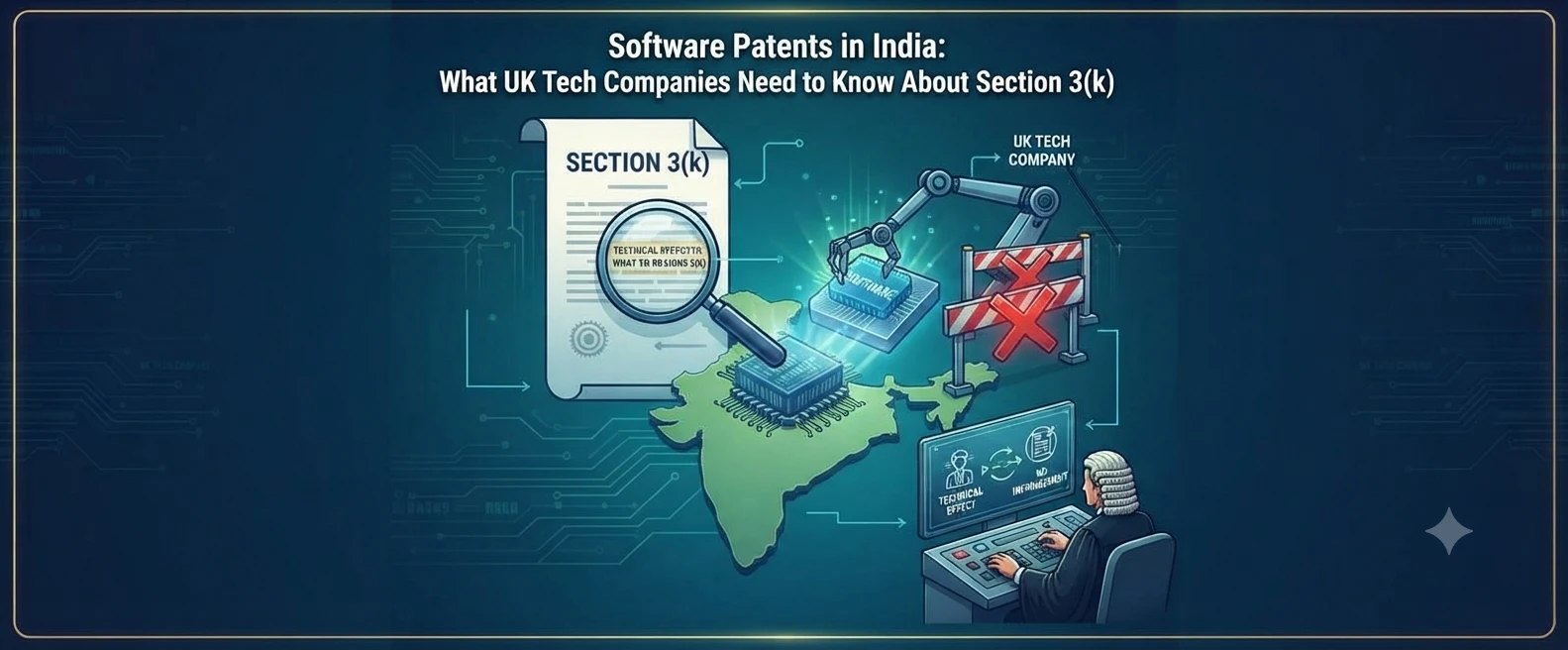
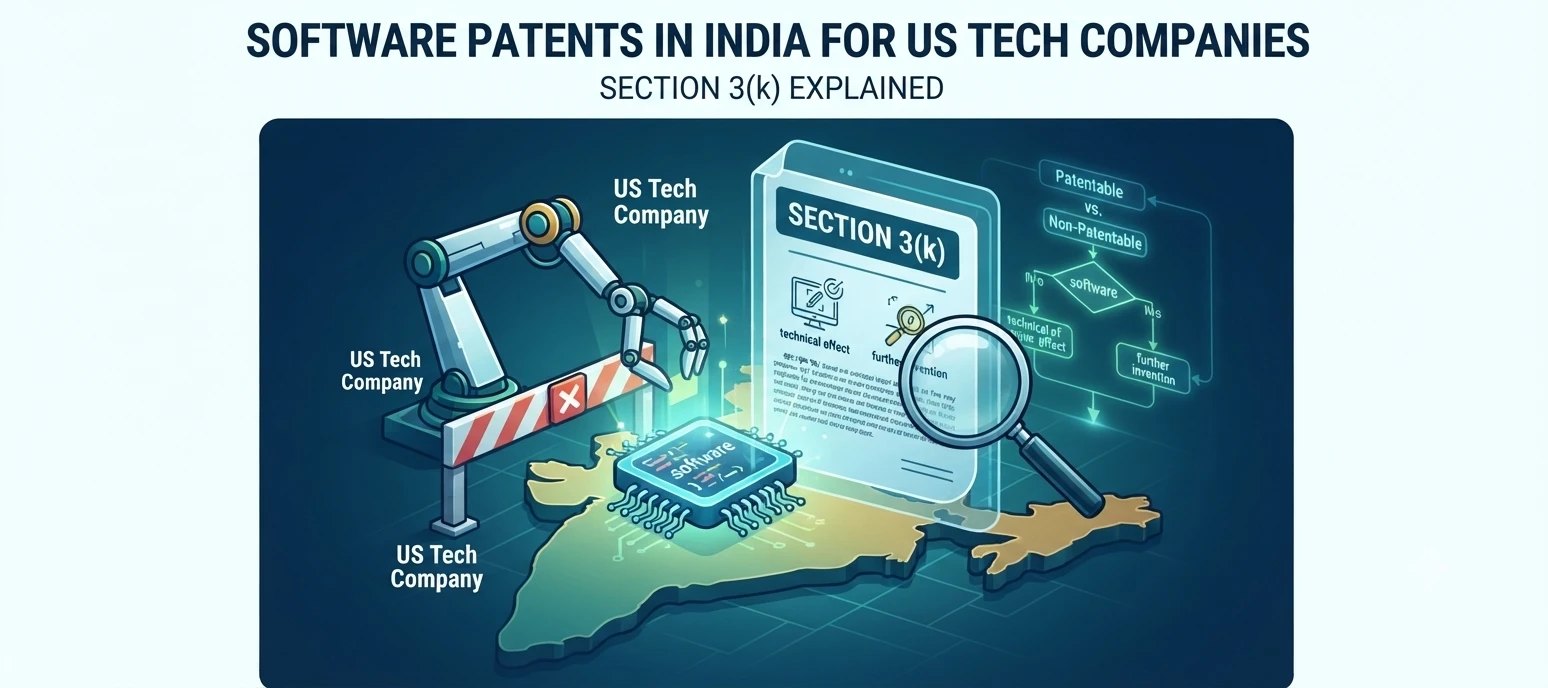
US tech companies used to treat India as a market where software patents simply weren’t available. That was never quite true, and it’s less true every year. India excludes a “computer programme per se” from patentability, but its courts and Patent Office now accept that software-implemented inventions with a genuine technical effect can be patented.
This guide explains software patents in India for US tech companies: what Section 3(k) says, how Indian courts and the 2025 examination guidelines apply it, how the Indian test differs from the US Alice framework, and how to file and prosecute effectively. For the basics from an Indian founder’s perspective, see our guide to patenting software in India under Section 3(k).
What Section 3(k) says
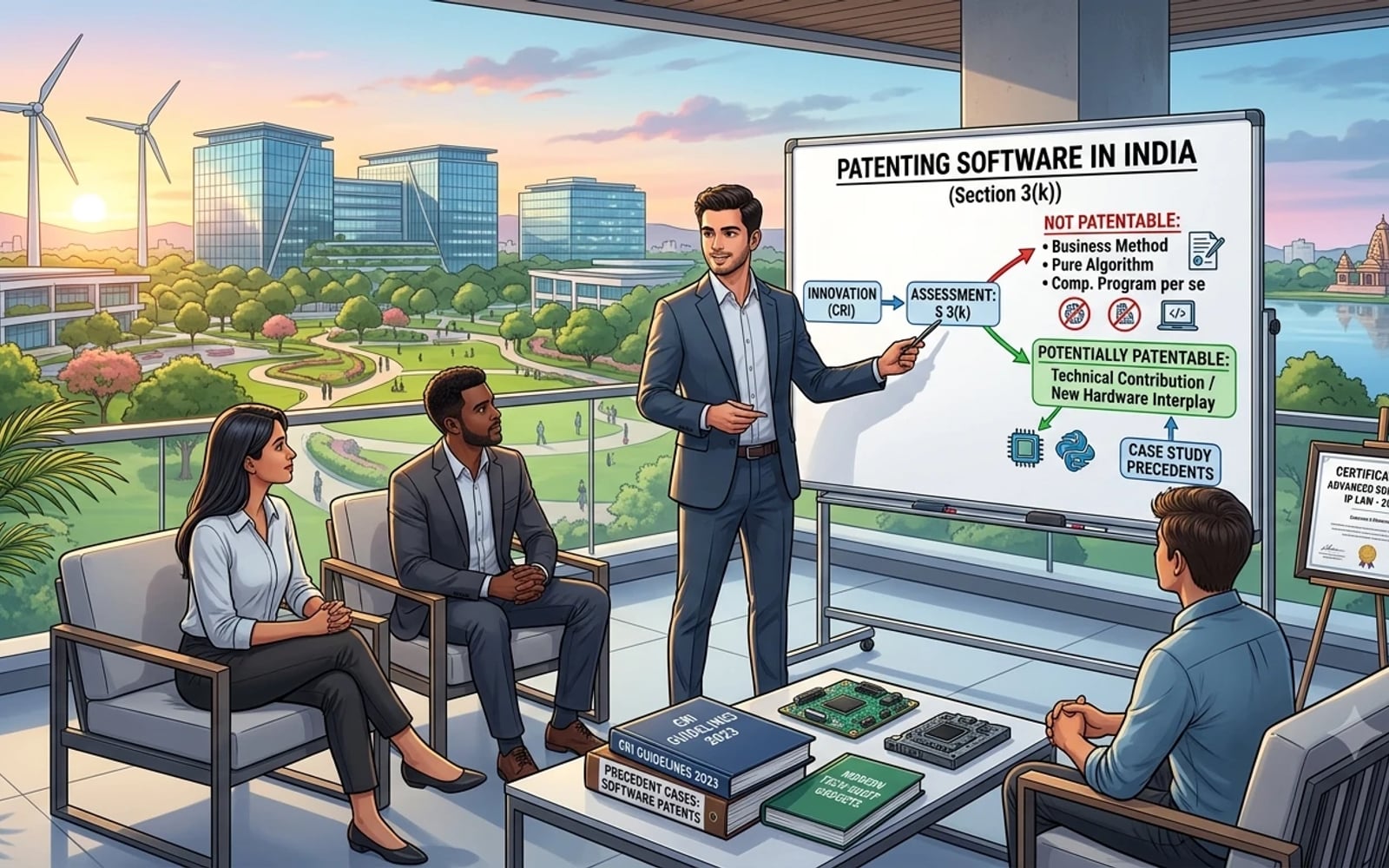
Section 3(k) of India’s Patents Act, 1970 lists things that are not inventions: “a mathematical or business method or a computer programme per se or algorithms”. The words “per se” apply only to computer programs. Business methods are excluded outright, and mathematical methods and algorithms are excluded as abstract ideas, though their technical implementation may still qualify.
For US companies, the exclusion of business methods is the biggest difference from US practice. Inventions that a US examiner might accept after an Alice analysis, such as new pricing systems or financial workflows, are unlikely to survive in India, however they are drafted. Indian courts have held that the business method exclusion is absolute.
A software patent application in India must also meet the usual tests of novelty, inventive step and industrial application. Indian law defines inventive step as involving a technical advance or economic significance that is not obvious to a person skilled in the art.
The technical effect test in Indian courts
The key concept for software patents in India is “technical effect” or “technical contribution”. In Ferid Allani v. Union of India (2019), the Delhi High Court held that inventions based on computer programs can be patentable if they show a technical effect or technical contribution. Later decisions refined the test.
In reported decisions including Raytheon (Delhi High Court, 2023), the court held that requiring novel hardware has no legal basis, and that what matters is the technical effect. In the Microsoft decisions (2023 and 2024), the courts said the effect must be specific and credible and go beyond ordinary computing. In Ab Initio (2024), the Delhi High Court accepted that making a processor compute faster or more efficiently is a technical effect. And in a 2025 database case, the Madras High Court confirmed that a computer-related invention is not excluded merely because it lacks novel hardware, if it makes a technical contribution. Check the reported citations before relying on any of these in a filing.
In practice, the test for software patents in India is closer to the European “technical character” approach than to the US Alice framework. Arguments that work at the USPTO, focused on whether a claim is directed to an abstract idea, need to be reframed for Indian examiners around the technical problem solved and the technical effect achieved. For US companies, the practical message is that inventions improving how computers, networks or systems work, such as performance, security, data processing, resource allocation or control of devices, are good candidates for software patents in India. Inventions whose novelty lies in the commercial outcome are not.
| US (Alice framework) | India (Section 3(k)) | |
|---|---|---|
| Core question | Is the claim directed to an abstract idea, and is there an inventive concept? | Does the invention show a technical effect or technical contribution beyond a program per se? |
| Business methods | Case by case after Alice | Excluded outright |
| Novel hardware | Not required | Not required |
| Beauregard claims | Common | Standalone program product or storage medium claims treated as a program per se |
The CRI Guidelines 2025 and AI inventions
On July 29, 2025, the Indian Patent Office notified new Guidelines for Examination of Computer Related Inventions, replacing the 2017 version. The guidelines bring the court decisions into examination practice, with step-by-step tests, flowcharts and examples for each limb of Section 3(k).
Several points matter to US applicants. Examiners judge the substance of the claim, not its form, so adding “a processor and a memory” to a business method won’t help. Claims to a computer program product or storage medium standing alone are treated as a computer program per se, unlike in US practice, where Beauregard claims are common. Method and system claims can both be granted.
AI-assisted inventions can be patented, but AI-generated inventions with minimal human input cannot, because an AI can’t be the true and first inventor under Section 6. AI and machine learning inventions also face stricter disclosure expectations: in 2025, the Madras High Court upheld the refusal of an AI application that didn’t teach how the invention worked. For AI authorship questions on the copyright side, see our guide to AI copyright in India vs the US.
Filing routes and drafting tips for US companies
Most US companies enter India through the PCT national phase, which in India must be entered within 31 months of the priority date. Direct Paris Convention filings within 12 months of the US priority filing are also possible. After filing, a request for examination must be made, and the applicant must respond to the First Examination Report within the statutory period, with a hearing if objections remain.
Drafting is decisive. Before national phase entry, review the claims for Indian practice: remove standalone computer-readable medium claims, emphasize the technical problem and technical effect in the description, and add dependent claims that capture the specific technical implementation. Avoid business language in the claims. Because amendments in India must stay within the original disclosure, the US specification should ideally describe technical effects in detail from the start.
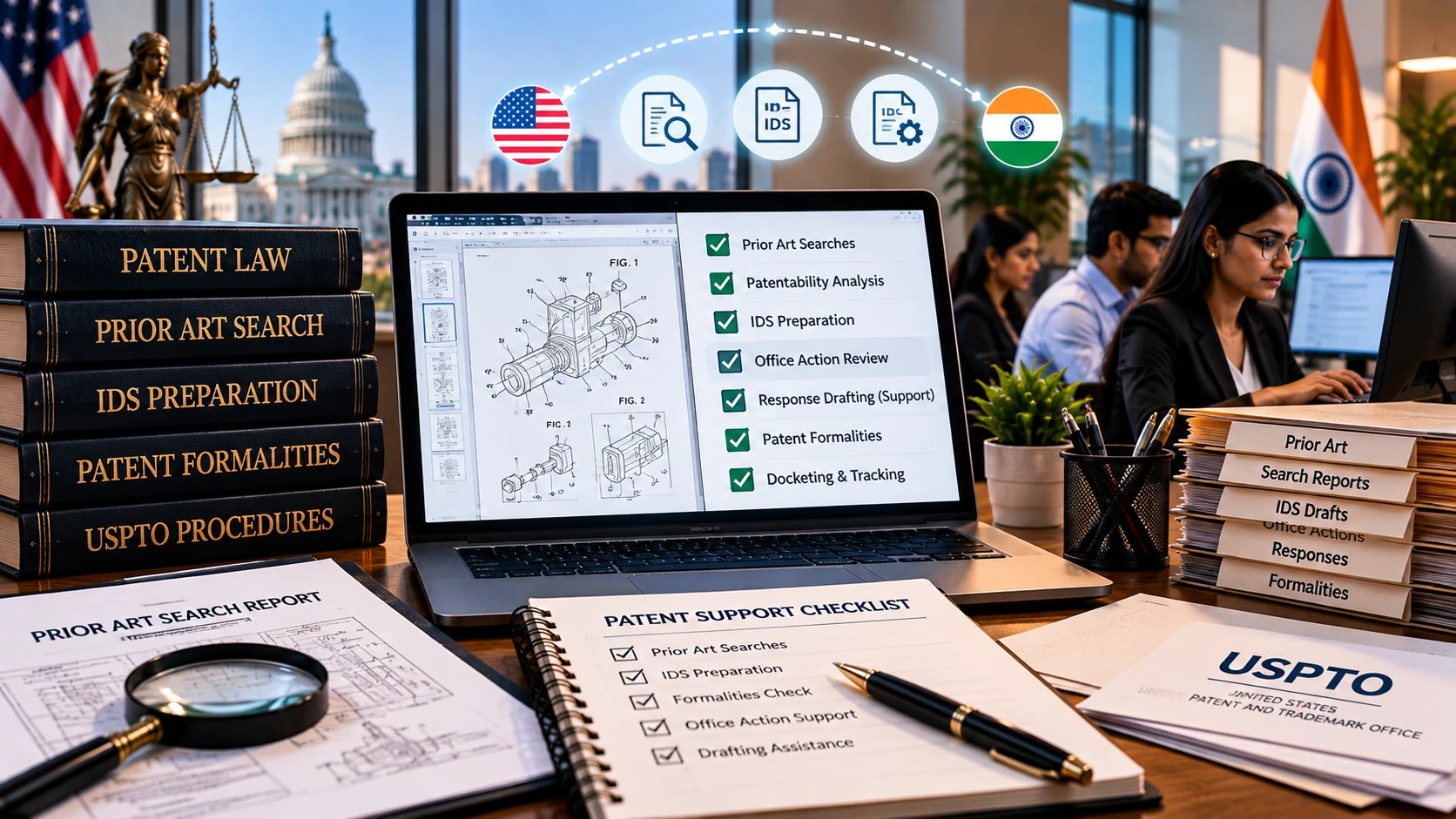
Costs are generally modest compared with US prosecution, which makes software patents in India a sensible addition to an international portfolio for core technologies. Plan for examination timing too, because objections and hearings can take months, and a faster track is available in some cases. Indian procedure also has some unique requirements. Applicants must file Form 3, which gives details of corresponding foreign applications, and must keep it updated. And patentees must file statements of working of the patent in India periodically (confirm the current Form 27 frequency). Missing these requirements can create problems later, including in enforcement. Support work such as searches and IDS preparation is covered in our guide to patent paralegal outsourcing. If Indian developers contribute to the invention, see IP assignment in India.
Enforcement, remedies and quick answers
Once granted, software patents in India can be enforced in the courts, with remedies including injunctions, damages or an account of profits. Indian courts have shown growing willingness to award significant damages in technology patent cases, and the Delhi and Madras High Courts have specialized IP Divisions. Software patent applications refused by the Controller can be appealed to the High Court.
Competitors can oppose applications before grant and within one year after grant, and can seek revocation, including on the ground that the invention is excluded by Section 3(k). US companies should therefore draft and prosecute with enforcement in mind, including claims whose infringement can be detected from outside a competitor’s product.
Quick answers
Can software be patented in India?
Yes, if the invention shows a technical effect or technical contribution. Computer programs per se and business methods are excluded.
Are US Beauregard claims allowed in India?
Standalone computer program product or storage medium claims are treated as a computer program per se and are generally not allowed.
When must a US PCT application enter India?
Within 31 months of the priority date.
Related reading: software patents in India for UK tech companies; also Indian patent prosecution for US firms and patent deadlines under India’s 2024 patent rules; also filing in India after a US provisional patent; also whether you can patent AI.
Final word
Halverton & Co. is an Indian law firm that advises on Indian law, including software and AI patent strategy, PCT national phase in India and Section 3(k) objections. We practice in Jharkhand, Maharashtra and before the Supreme Court of India, and we work alongside US counsel, who advise on US law. Halverton & Co.: Where tech needs law! If you have a question about Indian law, write to us at office@halvertonandco.com, or get in touch.
This article reflects developments reported up to early October 2026. It is for general information only, is not legal advice, and does not create an attorney-client relationship. Halverton & Co. is an Indian law firm and does not advise on US law.
Related practice area
Intellectual Property
Trade marks, copyright, patents and designs. Searched, filed, licensed and enforced under Indian law.
View the practice areaComments
No account needed. Comments are reviewed before they appear, so yours will show here once approved. Please do not share confidential details or describe your own legal matter: replies are general discussion, not legal advice, and do not create an advocate-client relationship. For your own situation, write to office@halvertonandco.com.