Key takeaways
- The UK protects trade secrets through the Trade Secrets (Enforcement, etc.) Regulations 2018 and breach of confidence.
- India has no dedicated statute, so protection comes from contract, equity and copyright, and a 2024 Law Commission report recommended a law.
- Post-employment non-competes are generally void in India, but confidentiality obligations are enforceable.
- Use clear NDAs, need-to-know access, segmented work and records of reasonable steps.
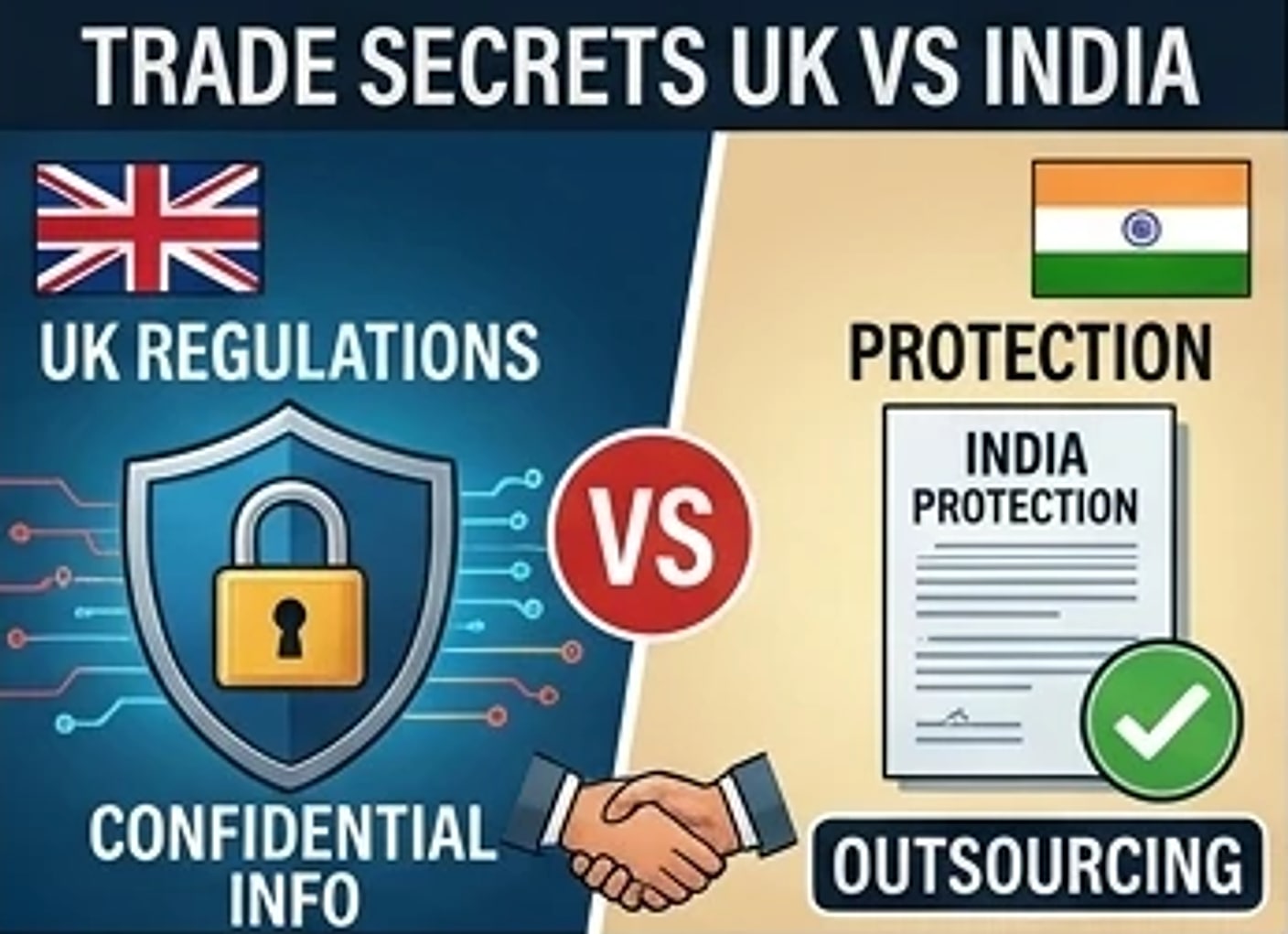
Trade secrets UK India differences matter the moment a UK company starts sending code, formulas, customer lists or product plans to a team in India. The UK has a statute and a long line of case law on confidential information. India has neither a trade secrets statute nor, until recently, much policy attention, but its courts do protect confidence through contract, equity and copyright.
A UK business that assumes the same protection travels with the data may be disappointed. This post compares the two systems in plain terms, then turns to the practical part: how to set up an outsourcing arrangement so that you can prove you took reasonable steps, and so that you have a fast route to an injunction if something leaks. It is written by an Indian firm for UK readers, so UK points should be confirmed with UK advisers. Trade secrets UK India differences are real: the UK has a statute and India relies on contract and equity.
The UK position
The UK has two layers. The first is the long-standing equitable action for breach of confidence. The second is the Trade Secrets (Enforcement, etc.) Regulations 2018, which put the EU Trade Secrets Directive into UK law. The Trade Secrets (Enforcement, etc.) Regulations 2018 define a trade secret as information that is secret, has commercial value because it is secret, and has been subject to reasonable steps to keep it secret by the person lawfully in control. Trade secrets UK India comparisons start with the UK’s two layers. Reasonable steps to keep information secret is the test that decides cases.
The Regulations set out when acquisition, use or disclosure is unlawful, and when it is lawful, for example independent discovery or reverse engineering. They give courts powers to grant injunctions, order delivery up or destruction of infringing goods, and award damages. They also contain rules to protect secrets from being exposed during court proceedings, and a six-year limitation period.
In practice many UK claims are still pleaded as breach of confidence, often together with the Regulations. Courts have been willing to grant interim injunctions quickly where there is clear evidence of copying. The reasonable steps requirement is the one that decides cases: if you did not protect it, the court may say it isn’t a trade secret. The Regulations aren’t the only route, so trade secrets UK India lawyers also plead breach of confidence.
The Indian position
India has no dedicated statute. Protection comes from several sources: contractual confidentiality terms; the equitable doctrine of breach of confidence; the Copyright Act for source code and documents; and, in limited ways, the Information Technology Act. Courts have granted injunctions against former employees and business partners based on these. Under Indian law, trade secrets UK India clients ask about are protected through breach of confidence India courts recognise. The Law Commission of India Report 289 trade secrets work recommended a statute.
A Law Commission report, No. 289, in 2024 examined trade secrets and economic espionage and recommended a specific law. As of the research for this post, we have not confirmed that a bill has been passed, so assume that the position is still judge-made. Check for any new legislation before relying on it.
The Contract Act adds a twist. Section 27 makes agreements in restraint of trade void, so post-employment non-competes are generally unenforceable in India. Confidentiality obligations, by contrast, are enforceable, and courts distinguish between restraining someone from working and restraining them from using confidential information. Section 27 affects trade secrets UK India outsourcing, since non-competes are void.
Where the two systems differ
The first difference is the definition. The UK has a statutory test with three limbs. India relies on case law that asks whether the information is confidential, was imparted in circumstances of confidence and has been misused. Both ask for secrecy and a confidential setting, but the UK test makes reasonable steps explicit. The biggest trade secrets UK India difference is the statutory definition.
| Point | UK | India |
|---|---|---|
| Source of law | Trade Secrets Regulations 2018 and breach of confidence | Contract, equity, Copyright Act |
| Definition | Secret, valuable, reasonable steps | Case law on confidence |
| Post-employment non-compete | Possible if reasonable | Generally void, Section 27 |
| Policy | Statute in force | Law Commission recommended a statute |
The second is remedies and procedure. The UK Regulations give detailed remedies and rules to protect secrecy in litigation. In India, the same results are usually reached through general civil procedure: injunctions, delivery up, damages or an account of profits, and local commissioners for inspection. The relief is similar but less codified.
The third is enforcement across borders. A UK judgment does not automatically get enforced in India. India recognises UK judgments as decrees of a superior court of a reciprocating territory, which means they can be executed with an application, though the process takes time. For a leak in India, it is often quicker to sue in India. That points to getting Indian-law terms right in the contract.
Protecting secrets when you outsource
Start with the contract. Use a clear NDA and confidentiality clause in the services agreement that says what is confidential, restricts use to the project, bars reverse engineering, and survives termination. Make the vendor responsible for its staff and contractors, and require every person with access to sign an individual confidentiality and IP assignment undertaking governed by Indian law. For trade secrets UK India outsourcing, begin with the contract.
Control access in practice. An outsourcing NDA need-to-know access policy means only the people who need the information see it, only in the system you control, with logging and no local copies. Use secure environments, virtual desktops or watermarked documents. Break up sensitive projects so no single vendor has the whole picture. Keep a record of what you shared and who received it.
Plan for leaks. Choose a governing law and forum with enforcement in mind: for injunctions against Indian individuals or companies, an Indian court may be the practical choice, even if the contract is governed by English law. Include audit rights, an obligation to notify you of breaches and a return and destruction clause. Document your reasonable steps: that record is the evidence you need under UK and Indian law alike. Keep records, since trade secrets UK India disputes turn on reasonable steps.
Questions people ask
A practical test of any outsourcing set-up: if the vendor’s developer walked out with the code tomorrow, could you prove what you protected and act within 48 hours? A test for trade secrets UK India outsourcing: could you act in 48 hours?
Related reading: trade secret protection for source code in India, NDA enforceability in India, employee source code theft in India, UK GDPR and outsourcing to India: five clauses, offshore data processing in India for UK clients and outsourced IT legal support for UK tech companies; also the DTSA and foreign trade secret theft.
Quick answers
Does India have trade secrets law like the UK Regulations?
No dedicated statute. Indian courts protect confidential information through contract, breach of confidence and copyright, and a Law Commission report in 2024 recommended a specific law. The UK has the Trade Secrets (Enforcement, etc.) Regulations 2018 as well as the common law.
How can I protect trade secrets when outsourcing to India?
Use a clear NDA and IP terms under Indian law, limit access on a need-to-know basis in controlled systems, segment sensitive work, keep audit records and plan where you would seek an injunction.
Can I stop a former contractor in India working for a competitor?
Usually not through a non-compete, because Indian law makes post-term restraints of trade void, but you can enforce confidentiality and IP terms against misuse of your information.
Does India have trade secrets law like the UK?
Not a dedicated statute. Indian courts protect confidence through contract, equity and copyright.
Final word
Halverton & Co. is an Indian law firm advising UK companies, founders, investors and law firms on Indian law, including Indian-law support on confidentiality, IP assignment and technology contracts for UK businesses that outsource to India, alongside UK solicitors. We practise in Jharkhand, Maharashtra and before the Supreme Court of India, and work alongside your UK solicitors, who advise on English law. Halverton & Co.: Where tech needs law! If you have a question about Indian law, write to us at office@halvertonandco.com, or get in touch.
This article reflects developments reported up to 31 October 2026. It is for general information only, is not legal advice, and does not create a solicitor-client relationship. Halverton & Co. is an Indian law firm, is not authorised or regulated by the Solicitors Regulation Authority, and does not advise on English law; UK-law points should be confirmed with UK advisers.
Sources
Related practice area
Intellectual Property
Trade marks, copyright, patents and designs. Searched, filed, licensed and enforced under Indian law.
View the practice areaComments
No account needed. Comments are reviewed before they appear, so yours will show here once approved. Please do not share confidential details or describe your own legal matter: replies are general discussion, not legal advice, and do not create an advocate-client relationship. For your own situation, write to office@halvertonandco.com.