
Key takeaways
- Federal Decree-Law No. 45 of 2021 is the UAE’s federal data protection law, supervised by the UAE Data Office.
- Secondary summaries say it applies to processing of data of people in the UAE, including by organisations outside the UAE.
- The DIFC and ADGM have separate regimes; the status of the executive regulations is uncertain, so penalties and procedures are unclear.
- Map UAE users, update consent and privacy notices, review vendors and take UAE advice.
If your Indian app has users in the UAE, the UAE’s federal data protection law may apply to you even though you are based in India. Federal Decree-Law No. 45 of 2021 on the protection of personal data is meant to apply to processing of the personal data of people in the UAE, including by organisations based outside the UAE. The UAE PDPL Indian app question matters for startups, because UAE users are a major market for Indian consumer and fintech products.
This guide explains the scope of the law, the exceptions for free zones, the main duties for an app, the uncertainty about the executive regulations and penalties, how it compares with India’s DPDP Act, and a practical plan. It is written by an Indian law firm. UAE legal points, including the current status of the regulations, must be confirmed with UAE-licensed counsel.
What the UAE PDPL covers
The UAE’s Personal Data Protection Law, issued as Federal Decree-Law No. 45 of 2021, is the country’s first federal data protection statute. It sets out principles for lawful, fair and transparent processing, rights for individuals, duties for controllers and processors, rules on cross-border transfers and breach notification. It is administered by the UAE Data Office, set up under a separate decree-law.
It excludes some areas. Reports say that the law does not cover government data, certain health and banking data governed by other laws, and personal data processed in financial free zones that have their own data protection regimes. The Dubai International Financial Centre and Abu Dhabi Global Market have their own laws and regulators. An Indian company with a DIFC or ADGM entity should check the free zone’s regime too.
The law is general and technology neutral. It applies to any controller or processor that handles personal data in the way the law describes, including apps, websites, platforms and service providers. For an Indian app, the first question is whether the app’s processing falls in scope, and for that you need to look at who the users are, where they are and what you collect. Scope is the first question in any UAE PDPL Indian app review.
Does it reach an Indian app
According to secondary summaries, the law applies to processing of personal data of data subjects inside the UAE, even where the controller or processor is outside the country. If an Indian app targets UAE users, accepts UAE sign-ups, shows prices in dirhams or markets in Arabic, there is a strong argument that the UAE data protection law foreign companies must follow applies to its processing of those users’ data. That is the heart of the UAE PDPL Indian app issue.
The question is less clear for an app that merely happens to have a few UAE users. The law’s wording and the executive regulations should settle the point, but they have not been confirmed in the sources reviewed. Treat targeting as the main trigger. If you have UAE marketing, a UAE entity, UAE payment methods or UAE-specific features, assume the law may apply, and plan accordingly.
Also check India’s own law. The Digital Personal Data Protection Act, 2023 applies to processing of digital personal data in India and to processing outside India in connection with offering goods or services to people in India. If your Indian app processes UAE users’ data in India, the DPDP Act applies as well as the UAE law, and you will need to satisfy both. The UAE PDPL Indian app analysis is therefore a dual-law exercise.
Main duties for an app
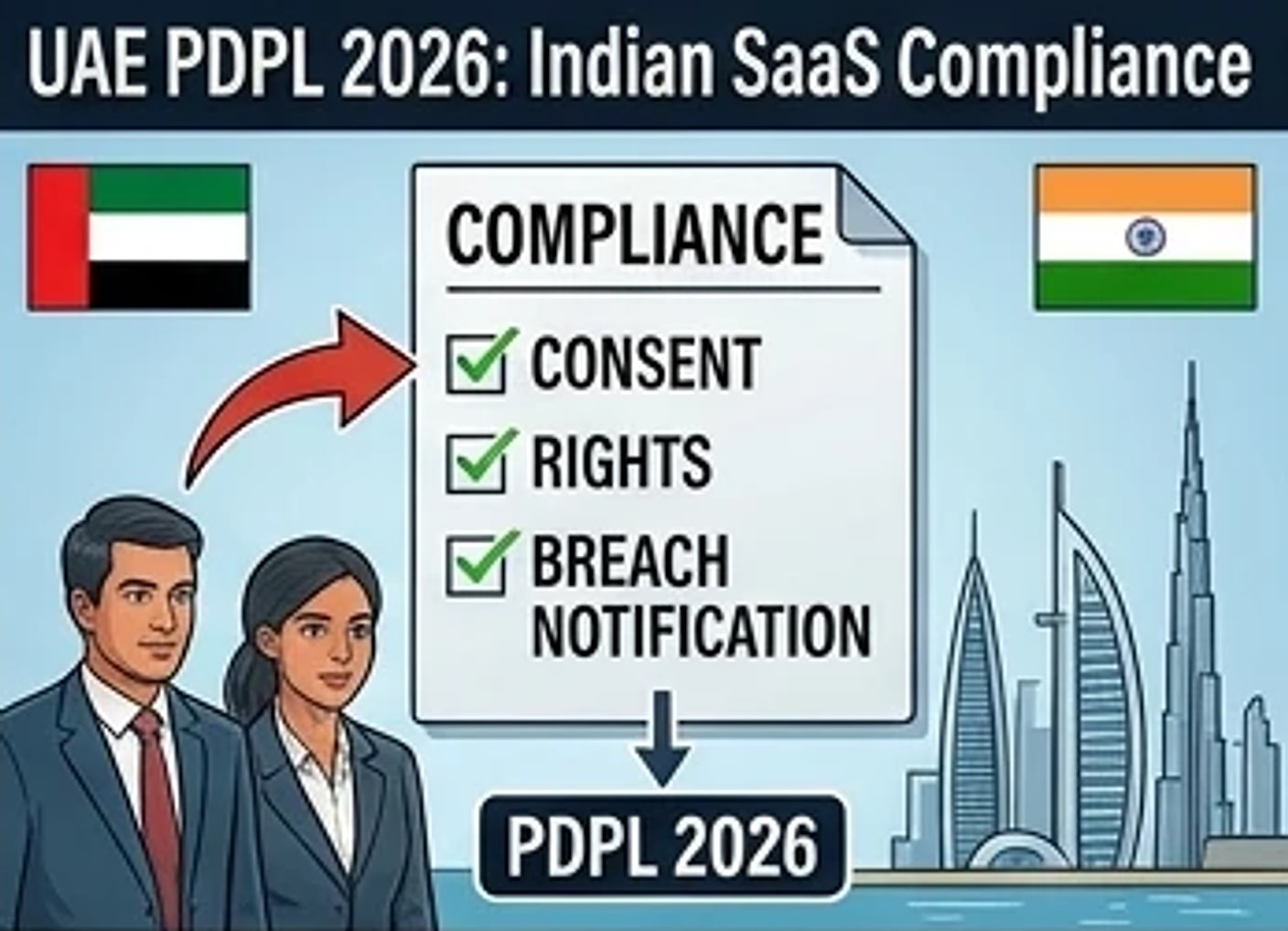
Lawful basis and consent are central. The UAE law generally requires consent for processing, with defined exceptions, and the consent must be clear, specific and capable of withdrawal. The PDPL consent requirements for an app mean a plain-language notice at sign-up, separate choices for marketing, no pre-ticked boxes and a record of consent. Consider Arabic and English versions for UAE users.
| Duty | What to do | Note |
|---|---|---|
| Lawful basis and consent | Clear, specific consent with a record | Withdrawable |
| Purpose and minimisation | Collect only what you need | Limit retention |
| Rights | Access, correction, deletion, objection | Set up a process |
| Security and breach | Safeguards and notice to the UAE Data Office | Details await regulations |
| Transfers | Adequacy or safeguards | Check vendor contracts |
Other duties include processing only what is needed for stated purposes, keeping data accurate and secure, limiting retention and respecting individual rights such as access, correction, deletion and objection. Controllers must carry out risk assessments in certain cases, notify breaches to the UAE Data Office and, in some cases, appoint a data protection officer. Cross-border transfers are allowed to countries with adequate protection or under safeguards.
Contracts with vendors matter. If you use cloud providers or analytics tools outside the UAE, you need processor agreements, and transfers to India must meet the law’s conditions. Keep a record of processing, a privacy notice that matches what you do and a process for users’ requests. If your app handles children’s data, payments or biometrics, the standards are higher and you should take advice before launch. A UAE PDPL Indian app review should include vendor contracts.
The uncertainty: regulations and penalties
Sources disagree on the status of the executive regulations. The law required them within six months, and some guides say they have still not been issued, while others cite Cabinet decisions that are not consistent. Because penalties and procedures depend on the regulations, enforcement remains uncertain. Commentators say that the general principles bind now, but the detail of fines and processes is unclear. Check the UAE Data Office and the Official Gazette for the current position.
Do not treat uncertainty as permission. Regulators can issue guidance, and platforms and enterprise customers already ask vendors about UAE data protection. UAE banks, telecoms and government entities include data protection terms in contracts. A privacy-ready app is easier to sell. If a customer or investor asks about compliance, you need an answer.
Keep an eye on the free zone regimes and on any new Federal rules. The DIFC and ADGM rules are detailed and enforced, and a DIFC or ADGM company processing personal data must follow them. A DIFC ADGM data protection Indian company entity is subject to those laws as well. Track developments from regulators, law firms and the Data Office. Build a compliance baseline that can be adapted when the regulations arrive.
Next steps and quick answers
Map your UAE users and data, update your privacy notice and consent screens, review vendors and transfers, set up a process for user requests and breaches, and get UAE advice on scope. Align the work with your DPDP Act compliance so that you build once. This is general information, not legal advice. Treat the UAE PDPL Indian app exercise as an ongoing project.
Related reading: Dubai AI startups and Indian users’ data, India’s DPDP Act for US SaaS companies, DPDP Act compliance checklist, outsourcing to India under UK GDPR, is scraping Indian websites for AI training legal, UK SaaS terms for Indian users and Indian laws that apply to a Dubai company; also AI startups in Dubai using Indian data; also UAE PDPL compliance for Indian SaaS firms; also UAE data localisation.
Quick answers
Does the UAE PDPL apply to an Indian app?
It may, if the app processes the personal data of people in the UAE, especially if it targets UAE users. Secondary summaries say the law has extraterritorial reach, but the executive regulations are still uncertain, so take UAE advice.
Do free zones like DIFC and ADGM follow the federal law?
No. They have their own data protection laws and regulators. A company in those zones should follow the free zone regime, and may also have to consider the federal law for onshore activity.
What should an Indian app do first about UAE data protection?
Find out how many UAE users you have and what data you collect, update privacy notices and consent, review vendor contracts and transfers, and speak to UAE counsel about scope and regulations.
Have the executive regulations been issued?
Sources disagree. Some say they have still not been issued and others cite Cabinet decisions that are inconsistent. Check the UAE Data Office and the Official Gazette.
Do DIFC and ADGM follow the federal law?
No. They have their own data protection laws and regulators.
Final word
Halverton & Co. is an Indian law firm advising NRIs, founders, investors and businesses in Dubai and across the UAE on Indian law, including data protection and privacy compliance across India and the UAE, technology and app regulation, and cross-border contracts. We practise in Jharkhand, Maharashtra and before the Supreme Court of India, and work alongside UAE-licensed counsel, who advise on UAE law. Halverton & Co.: Where tech needs law! If you have a question about Indian law, write to us at office@halvertonandco.com, or get in touch.
This article reflects developments reported up to 31 October 2026. It is for general information only, is not legal advice, and does not create an advocate-client relationship. Halverton & Co. is an Indian law firm and does not advise on UAE law; UAE-law points should be confirmed with UAE-licensed counsel.
Sources
Related practice area
Technology & AI Law
Contracts, data protection and AI policies for products that handle other people’s data.
View the practice areaComments
No account needed. Comments are reviewed before they appear, so yours will show here once approved. Please do not share confidential details or describe your own legal matter: replies are general discussion, not legal advice, and do not create an advocate-client relationship. For your own situation, write to office@halvertonandco.com.