Key takeaways
- The UAE has no stand-alone deepfake offence and uses Federal Decree-Law No. 34 of 2021 and penal provisions on defamation, privacy, extortion and false information.
- Reported penalties include fines of AED 250,000 to 500,000 and prison terms for digital defamation, but figures should be checked against the Gazette.
- India combines IT Act and BNS offences with 2026 IT Rules takedown duties and personality rights orders.
- Report early in both countries and keep evidence.
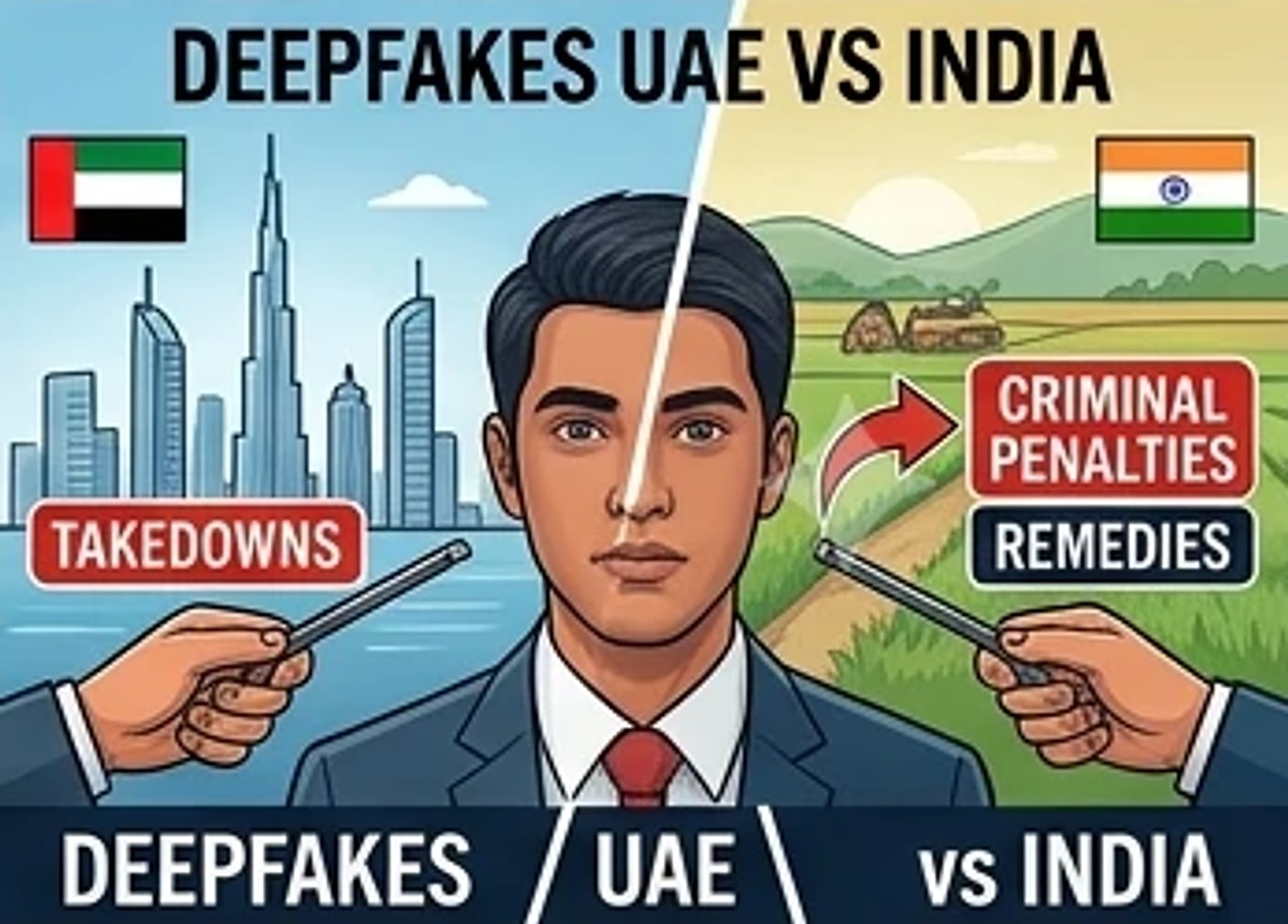
There is no single deepfake law UAE victims can point to. Cases are handled under the general cybercrime law, Federal Decree-Law No. 34 of 2021, and the penal code, using offences such as defamation, extortion, privacy violation and spreading false information. The penalties can be severe, and the authorities have issued public warnings about AI-made fake videos and voices.
India has a different mix: the Information Technology Act and the new Bharatiya Nyaya Sanhita for offences, 2026 amendments to the IT Rules for takedowns, and court-made personality rights. For an Indian living in Dubai, or a Dubai business with Indian customers, the question is practical: where do you report, how fast can content be removed, and what can you ask a court for? Below is a side by side, with caution on penalty figures that come from news and law firm reports. Deepfake law UAE victims rely on is mostly the cybercrime law, with UAE cybercrime law deepfake penalties set by courts.
How UAE law reaches deepfakes
UAE cybercrime law deepfake cases rely on the Federal Decree-Law No. 34 of 2021 on combatting rumours and cybercrimes, in force since January 2022 and amended since. It does not create a stand-alone offence called deepfake. Instead, prosecutors use provisions on defamation, insulting others online, invasion of privacy, forgery of electronic documents, threats, extortion, and publishing false information that harms public order or reputation. Deepfake law UAE prosecutors use is the cybercrime decree-law.
If a deepfake is used to extort money or threaten someone, extortion and threat provisions apply. If it puts a person’s face on indecent content, the privacy and morality offences come into play. If it is used to deceive a bank or a customer, fraud provisions are available. The legal label depends on the harm and the use.
Officials have said openly that AI fakes are a priority. The UAE Cybersecurity Council has warned the public about deepfake videos and audio cloning, and police have urged people to report suspicious content. The practical point is that the system is willing to use existing law against deepfake misuse, even without a special statute. So deepfake law UAE authorities enforce is general, but practical.
Penalties reported in the UAE
Figures vary by source, and we have not checked them against the Gazette, so treat what follows as indicative. Reports say that digital defamation under the cybercrime law can bring a prison sentence of up to a year and a fine of between AED 250,000 and AED 500,000, with heavier penalties if the content was altered, for example by deepfake technology, to defame. The Federal Decree-Law 34 of 2021 defamation fine is therefore substantial. Deepfake law UAE penalties are reported to be heavy.
Other penalties scale with the crime. Spreading false information that stirs public unrest or harms state institutions carries higher minimums, reported at at least two years’ imprisonment and AED 200,000, in some circumstances. Creating fake accounts, websites or emails to impersonate someone can bring jail and fines up to AED 200,000 and, in some reports, more. Courts can also order blocking of offending sites.
Deepfake extortion UAE prosecutors treat as a serious offence, and the penalty depends on the threat and the sum demanded. Sentencing is for the court, and amounts depend on the facts. A victim should not try to guess the outcome. The point is that a reported case isn’t a pointless exercise: the law provides real consequences.
Remedies in India
India’s route runs through several laws. The IT Act, 2000 covers impersonation and cheating by personation (section 66D), identity theft (66C), violation of privacy (66E) and obscene content (67 and 67A). The Bharatiya Nyaya Sanhita adds defamation, forgery, criminal intimidation and extortion. A deepfake used for fraud can attract cheating provisions. Compared with deepfake law UAE offers, India has a separate regulatory layer.
For takedowns, the IT Rules, 2021 as amended in 2026 define synthetically generated information and require labelling and faster removal. Reports describe a three-hour window in some cases and two hours for non-consensual intimate imagery, though sources differ on the triggers. A grievance officer and an appellate committee give routes of complaint if the platform does not act, and our post on deepfake removal in India walks through them.
Courts add a third layer. Personality rights orders from the Delhi and Bombay High Courts have restrained AI voice and image cloning and directed takedowns. Private individuals can seek injunctions based on privacy and defamation. India’s India deepfake IT Rules takedown comparison with the UAE is basically speed and variety of tools: India offers regulated timelines and civil injunctions, the UAE offers strong criminal enforcement.
Which route to use and how to report
In practice, use both when there’s a link to both countries. If you or the content are in the UAE, report to Dubai Police through the eCrime portal or a station, and to the platform. Keep the URLs, screenshots, timestamps and any messages. Ask for a case number. Report deepfake Dubai Police eCrime users can reach online, and save the confirmation. Under deepfake law UAE police take reports through eCrime.
| If you are in | Report to | Also do |
|---|---|---|
| The UAE | Dubai Police eCrime service or a station | Report to the platform, keep evidence |
| India | Platform grievance officer and cybercrime.gov.in | Appellate committee or court if needed |
| Both | Both systems | Coordinate evidence and counsel |
If the target or the platform is in India, file with the platform’s grievance officer, on the national cybercrime portal and, if needed, in the High Court. A Dubai-based Indian can often do both: a criminal report in the UAE and a takedown request in India. Coordination matters, because evidence is shared across the two.
Don’t ignore time. Content spreads in hours. Act the same day, preserve evidence before it disappears, and avoid confronting the creator directly. For a business, brief your communications team and your lawyers in both countries. UAE lawyers handle UAE law, Indian lawyers handle Indian law, and neither should guess about the other. Both deepfake law UAE and Indian routes need fast evidence.
Questions people ask
Both systems are catching up with the technology. The sensible reaction is to report early and keep records, since both countries rely heavily on evidence. Deepfake law UAE and Indian law are catching up.
Related reading: deepfake removal in India under the 2026 IT Rules, deepfakes and personality rights in India, AI voice cloning in India, AI voice and likeness law: ELVIS, NO FAKES and India, AI-generated content labelling in India and platform liability for deepfakes.
Quick answers
Is there a deepfake law UAE residents can rely on?
There is no stand-alone deepfake offence. Deepfakes are prosecuted under the cybercrime law (Federal Decree-Law No. 34 of 2021) and penal provisions on defamation, privacy, extortion and false information, with substantial fines and prison terms reported.
Where do I report a deepfake in Dubai?
Report to Dubai Police through the eCrime service or a station, and to the platform hosting the content. Keep evidence and ask for a reference number.
How does India deal with deepfakes differently?
India combines IT Act and BNS offences with 2026 IT Rules takedown and labelling duties and court-made personality rights orders, giving faster platform removal timelines than the UAE system.
Is there a deepfake law in the UAE?
Not a stand-alone one. Deepfakes are prosecuted under the cybercrime law and penal code.
Final word
Halverton & Co. is an Indian law firm advising NRIs, founders, investors and businesses in Dubai and across the UAE on Indian law, including Indian-law support for Indian victims and businesses with deepfake or content issues, alongside UAE-licensed counsel. We practise in Jharkhand, Maharashtra and before the Supreme Court of India, and work alongside UAE-licensed counsel, who advise on UAE law. Halverton & Co.: Where tech needs law! If you have a question about Indian law, write to us at office@halvertonandco.com, or get in touch.
This article reflects developments reported up to 31 October 2026. It is for general information only, is not legal advice, and does not create an advocate-client relationship. Halverton & Co. is an Indian law firm and does not advise on UAE law; UAE-law points should be confirmed with UAE-licensed counsel.
Sources
Related practice area
Technology & AI Law
Contracts, data protection and AI policies for products that handle other people’s data.
View the practice areaComments
No account needed. Comments are reviewed before they appear, so yours will show here once approved. Please do not share confidential details or describe your own legal matter: replies are general discussion, not legal advice, and do not create an advocate-client relationship. For your own situation, write to office@halvertonandco.com.