Choosing an offshore legal support partner is a bit like hiring a senior associate you’ll rarely meet in person. The right partner quietly makes your firm faster and more profitable. The wrong one creates ethics headaches, missed deadlines and unhappy clients.
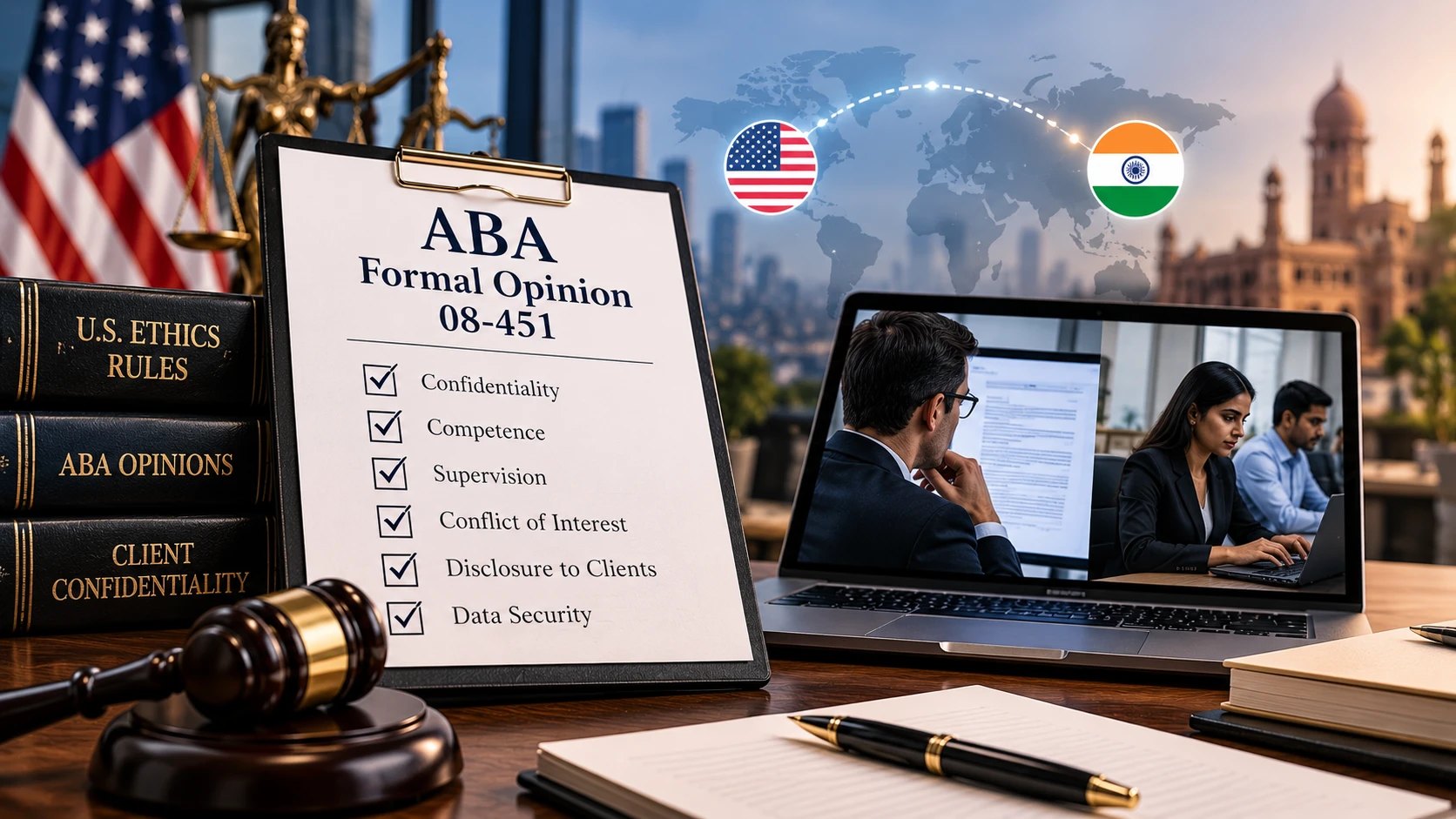
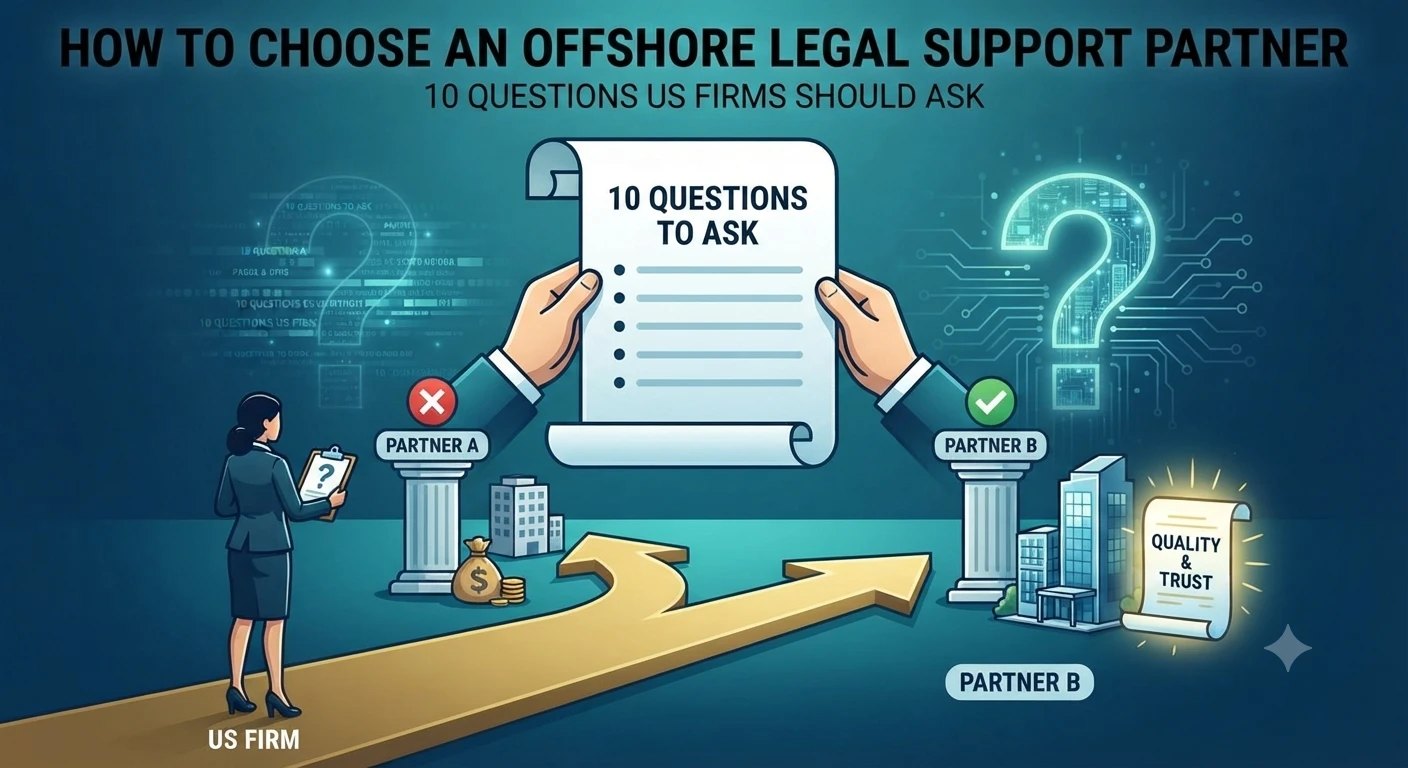
This guide gives US law firms and in-house legal teams 10 practical questions to ask before choosing an offshore legal support partner, grouped into ethics, quality, security and commercial terms, with a recommended approach to running a pilot. Start with our ABA 08-451 compliance checklist for the ethics framework.
| # | Question | Group |
|---|---|---|
| 1 | How will your work fit our ABA 08-451 obligations? | Ethics and supervision |
| 2 | How do you avoid unauthorized practice? | Ethics and supervision |
| 3 | How do you handle conflicts? | Ethics and supervision |
| 4 | Who will actually do the work? | Quality and expertise |
| 5 | How do you ensure quality? | Quality and expertise |
| 6 | Can you show us relevant work? | Quality and expertise |
| 7 | How do you protect our clients’ confidential information? | Security and confidentiality |
| 8 | What happens if there is a security incident? | Security and confidentiality |
| 9 | How do you price, and how will we bill clients? | Commercial terms and communication |
| 10 | How will we communicate, and what are your turnaround times? | Commercial terms and communication |
Ethics and supervision: questions 1 to 3
Question 1: How will your work fit our ABA 08-451 obligations?
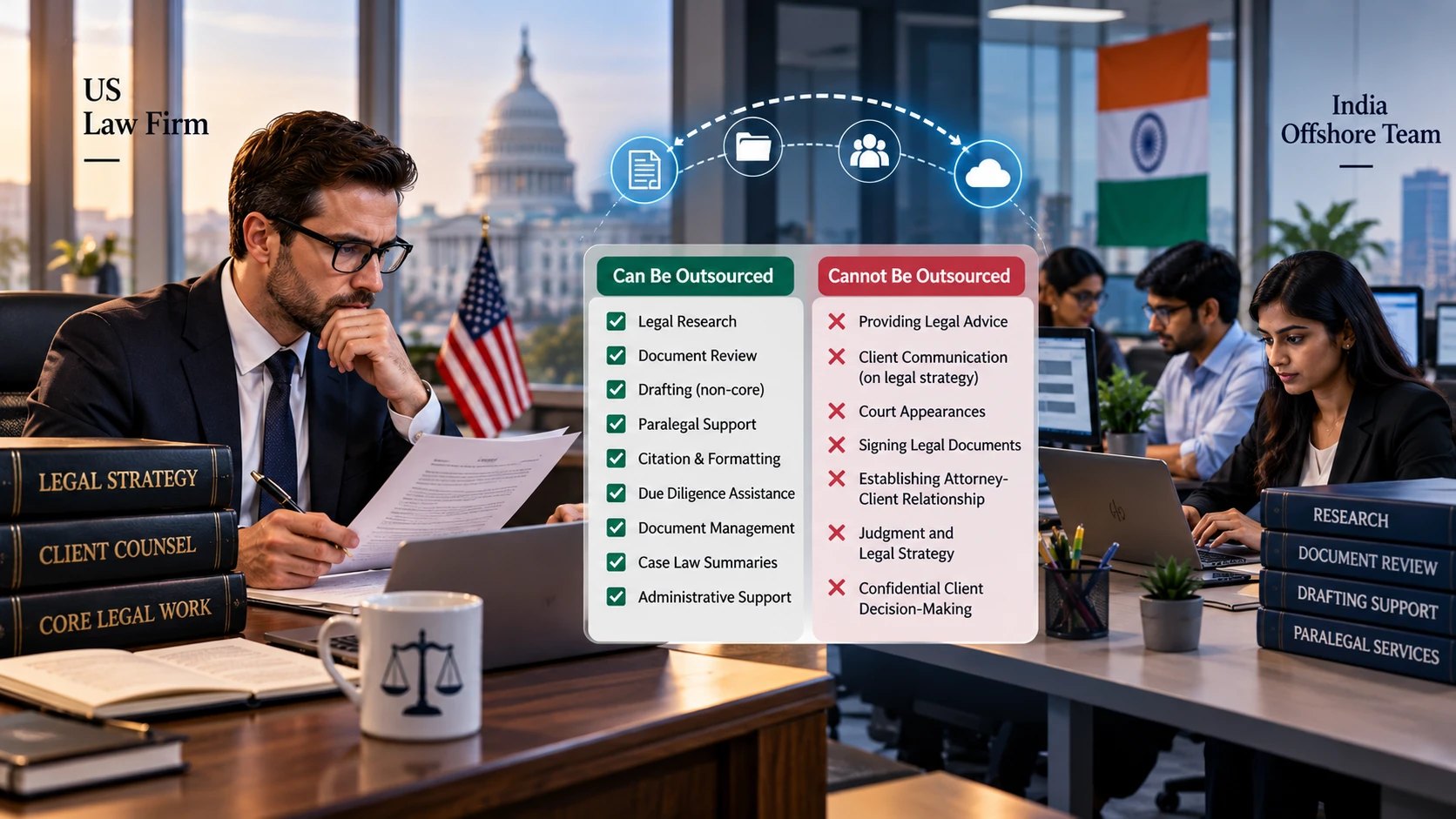
Under ABA Formal Opinion 08-451, a lawyer may outsource legal or nonlegal support services, provided the lawyer remains ultimately responsible for competent legal services to the client. A good partner understands this and builds its process around your supervision.
Question 2: How do you avoid unauthorized practice?
An offshore legal support partner should be clear that its team works under the direction of US-licensed attorneys, never holds itself out as US counsel, and never gives legal advice directly to your clients. Foreign contractors must not be presented as licensed US lawyers. See our guide to offshore paralegal services for US law firms for the line between support and practice.
Ask, too, how the partner documents supervision: who receives instructions, how questions are escalated, and how your attorneys sign off. An offshore legal support partner that can show you its process is far more credible than one that simply promises quality.
Question 3: How do you handle conflicts?
Ask whether the partner runs conflict checks for each new matter and how it separates work for different clients. State bar opinions following ABA 08-451 list conflict checks among the outsourcing lawyer’s obligations.
Quality and expertise: questions 4 to 6
Question 4: Who will actually do the work?
Ask about the team’s legal education, experience with US work, and the specific people assigned to your matters. The ABA’s guidance suggests assessing education and relevant experience before assigning work. An offshore legal support partner trained in a common-law system, such as India’s, will understand precedent, statutory interpretation and drafting conventions.
Question 5: How do you ensure quality?
Look for written processes: instructions templates, checklists, second-level review, error tracking and feedback loops. For high-risk work such as docketing, ask whether every deadline is independently double-checked; see our guide to trademark docketing outsourcing. Continuity matters as well. Ask how the partner retains staff and transfers knowledge when team members change, because a stable team that knows your matters and preferences is one of the biggest advantages of a long-term offshore legal support partner.
Question 6: Can you show us relevant work?
Ask for anonymized samples of research memos, document review outputs, trademark search reports or contract redlines, and for references from other US clients. For specialist work, see our guides to patent paralegal outsourcing and contract review outsourcing. Verify any references or client numbers a provider gives you.
Security and confidentiality: questions 7 and 8
Question 7: How do you protect our clients’ confidential information?
Confidentiality agreements are strongly advisable in outsourcing relationships. Ask about individual confidentiality undertakings for every team member, secure systems with access controls, restrictions on downloading and printing, and how documents are returned or destroyed at the end of a matter.
Question 8: What happens if there’s a security incident?
Ask for the partner’s incident response process and notification timelines, which must be short enough for you to meet your own obligations to clients and regulators. In India, organizations must also report specified cyber incidents to CERT-In within six hours under directions issued in 2022; see our guide to the CERT-In 6-hour rule. Ask whether the partner can work inside your own document management and review platforms, so that client data stays in systems you control. For regulated data, such as health or financial information, confirm that the partner will sign the agreements your US obligations require, and that your client contracts permit offshore processing. Our guides to Indian AI teams and US client data and India’s DPDP Act for US SaaS companies explain the Indian data rules.
Commercial terms and communication: questions 9 and 10
Question 9: How do you price, and how will we bill clients?
Fixed fees, monthly retainers and per-task pricing are common. Fixed pricing helps you avoid fee-sharing concerns and makes it easier to quote predictable fees to clients. Remember that bills to clients for outsourced work must be reasonable and must not misrepresent who did the work. Ask about minimum commitments and notice periods as well, so you can scale the relationship up or down as your workload changes.
Question 10: How will we communicate, and what are your turnaround times?
Agree a primary contact, working hours that overlap with your day, a channel for urgent questions, and written turnaround times for each type of work. Time zones are an advantage when work handed off at the end of the US day comes back the next morning. Language and writing quality matter too: ask for writing samples in the format your attorneys use, such as research memos or redlines, before committing.
Finally, ask how the partner handles scope changes and peak periods. A good offshore legal support partner can scale up for a large document review or due diligence exercise without compromising quality, and will tell you honestly when a deadline isn’t achievable. Ask also about the legal framework: which country’s law governs the agreement, where disputes are resolved, and whether the partner carries professional liability insurance. Arbitration seated in a New York Convention country is often a practical choice for cross-border service agreements.
Running a pilot, and quick answers
The best way to choose an offshore legal support partner is to test one. Run a pilot of one to three months with a defined scope, such as research memos for one practice group, trademark docketing for part of a portfolio, or first-pass contract review against a playbook. Involve the attorneys who will actually use the work, because their feedback is the best measure of value. Measure accuracy, turnaround, communication and the attorney time saved. Review every deliverable carefully during the pilot, then decide whether to expand.
Put the arrangement on a written agreement from day one, covering confidentiality, data security, quality standards, intellectual property in work product, termination and dispute resolution. If problems arise, the agreement gives you remedies, but a well-run pilot means they rarely do.
Quick answers
What should a US law firm look for in an offshore legal support partner?
Understanding of ABA 08-451, clear supervision processes, qualified staff, strong confidentiality and data security, transparent pricing and reliable communication.
Is it ethical to use offshore legal support?
Yes, under ABA Formal Opinion 08-451, if the lawyer supervises, protects confidentiality, checks conflicts and remains responsible to the client.
How should we start?
With a short, defined pilot, measured on accuracy, turnaround and attorney time saved.
Related reading: what the SRA expects from UK law firms and reserved legal activities; also Indian patent prosecution for US firms; also hiring a virtual paralegal from India and outsourced legal research costs for US law firms.
Final word
Halverton & Co. is an Indian law firm. We do not provide US legal advice or represent clients before US courts or the USPTO, and nothing in this article is an offer of services. If you have a question about the Indian side of an offshore arrangement, such as Indian law, contracts or data protection, you can write to us at office@halvertonandco.com, or get in touch. Halverton & Co.: Where tech needs law!
This article reflects developments reported up to early October 2026. It is for general information only, is not legal advice, and does not create an attorney-client relationship. Halverton & Co. is an Indian law firm and does not advise on US law.
Related practice area
Startups & Venture
From incorporation to term sheet. The documents a company needs to be fundable.
View the practice areaComments
No account needed. Comments are reviewed before they appear, so yours will show here once approved. Please do not share confidential details or describe your own legal matter: replies are general discussion, not legal advice, and do not create an advocate-client relationship. For your own situation, write to office@halvertonandco.com.