Key takeaways
- Section 5 of the FTC Act reaches false or unsubstantiated claims about AI, and the FTC has said there is no AI exemption from existing law.
- Operation AI Comply (September 2024) and later cases such as Workado show a focus on overstated capability and accuracy claims.
- Advertisers need a reasonable basis for objective claims at the time they make them, usually documented testing.
- An Indian SaaS firm selling to US customers should keep a claims file and have US counsel review marketing.
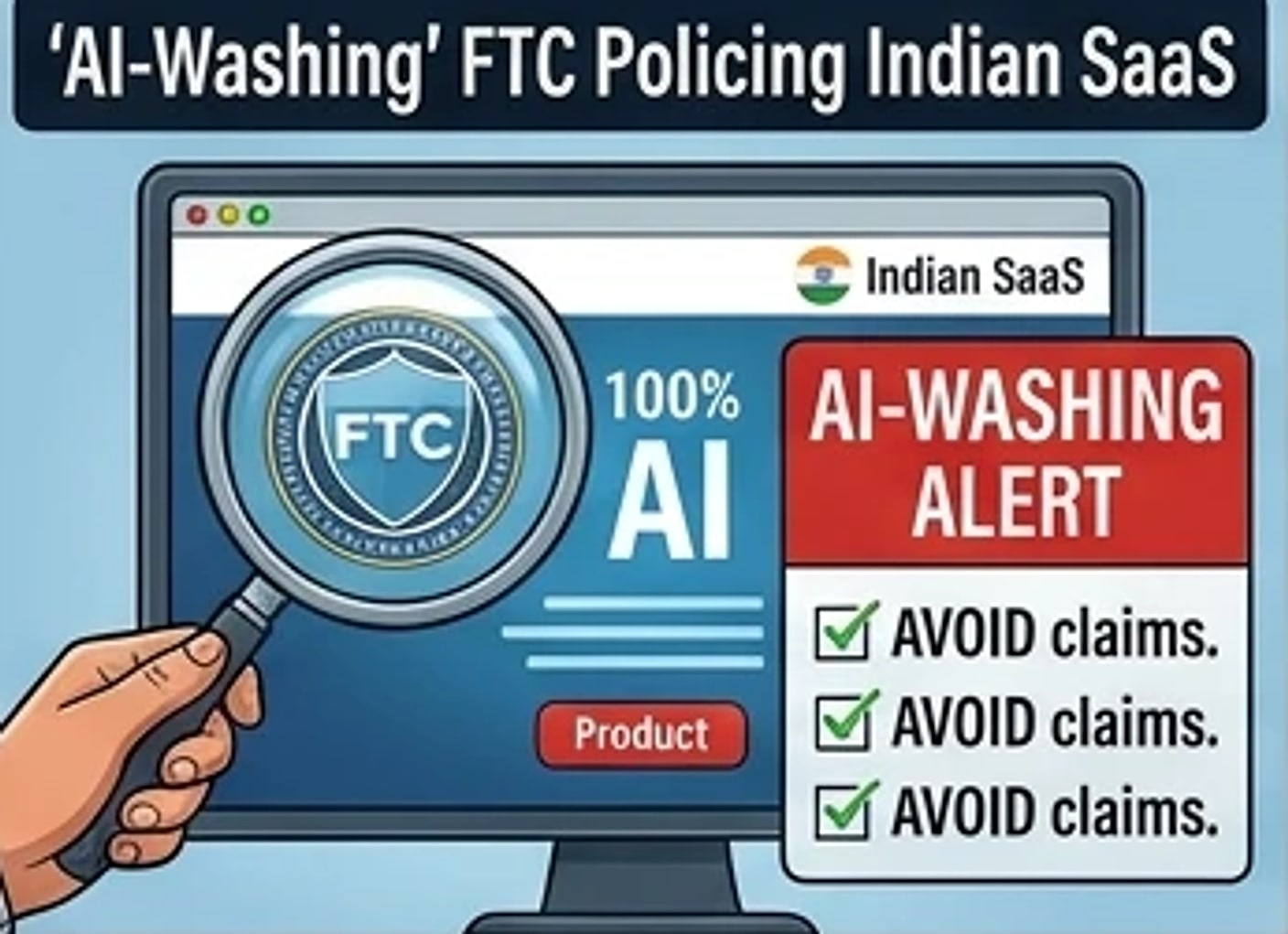
AI washing FTC enforcement is no longer a theoretical risk for a SaaS company. Calling a product “AI-powered” when it isn’t, or claiming accuracy or savings you can’t prove, is a deceptive practice under the FTC Act. The agency said so plainly in 2024 and has brought cases since, against both large and tiny companies. Indian SaaS firms selling to US customers are in scope the moment a US buyer sees the website.
The pattern across the cases is not exotic. Companies said a product could do something it couldn’t, said it was automated when people did the work, or put a number on performance without testing. Here is what the FTC has actually done, the rule it applies, and a short checklist for a marketing team before the next launch page goes live. Facts about recent actions come from public sources and should be checked against the FTC’s own releases. AI washing FTC enforcement already covers Section 5 FTC Act deceptive AI claims made online.
What AI washing means to a regulator
The phrase is borrowed from greenwashing. It describes exaggerating or inventing the role of AI in a product or service to sell it, raise money or look modern. The FTC doesn’t need a special AI law to act. Section 5 of the FTC Act prohibits unfair or deceptive acts or practices, and a false or unsubstantiated claim about AI is deceptive like any other. AI washing FTC cases rely on plain deception law.
The agency has framed it as “there is no AI exemption from the laws on the books.” That means the usual tests apply. Is the claim likely to mislead a reasonable consumer or business buyer, and is it material to the purchase? If so, the seller needs a reasonable basis for it before making it.
Other regulators are looking too. The SEC has brought cases against investment advisers and companies for false statements about AI capabilities, and state attorneys general are active. The AI washing FTC story is part of a wider shift to treat AI claims like any other claim that must be true. The AI washing FTC trend is part of a wider shift.
What the FTC has done so far
In September 2024 the FTC announced Operation AI Comply, a set of actions against companies using AI claims to deceive. They included DoNotPay, which marketed an AI “robot lawyer” without proof it matched a human lawyer, and several schemes that promised income from AI-powered online stores. The FTC Operation AI Comply cases showed that overpromising was the theme, not the technology. AI washing FTC actions under Operation AI Comply targeted overpromising.
Later actions followed. In 2025 the FTC took action against Workado over its claim that its AI content detector was highly accurate, with the agency saying the claim was not backed by competent testing. That Workado AI detector accuracy claim case is useful for SaaS firms because it concerns a numeric performance claim, the kind that marketing teams like to put in bold.
Other cases involved facial recognition and security screening products said to be more accurate or capable than evidence showed. Public details, penalties and settlement terms differ, so read the orders. The message is consistent: say what the tool can really do, and have the tests to show it. The Workado case shows AI washing FTC risk for numeric claims.
The substantiation rule
The FTC’s substantiation doctrine says an advertiser must have a reasonable basis for its claims at the time it makes them. For objective performance claims, such as accuracy rates, time saved, or “works like a human”, that usually means competent and reliable evidence, often tests. A good-faith belief isn’t enough. Substantiation of AI claims is judged by what the evidence would convince experts of. AI washing FTC enforcement uses the substantiation doctrine.
Disclosures matter too. If a product’s output is checked or produced by humans, calling it fully automated may mislead. If AI is only a small part of the function, saying “AI-powered” without qualification might overstate it. And if you train on user data, saying nothing about it can be a separate deception issue.
Penalties vary: orders to stop claims, refunds to customers, bans on certain conduct and, in some cases, money. Where the company is based abroad, the FTC can still act if US buyers are harmed, and a settlement may bind the company and its officers. This is why an Indian SaaS firm should not treat US advertising law as optional. AI washing FTC orders can bind foreign companies serving US buyers.
A checklist for Indian SaaS marketing
Before you publish an AI claim for US audiences, ask five questions. What does the AI actually do in this feature? Can we show it, with test results? Does a human review or generate any of the output? Is there a number in the claim, and where did it come from? Are the limits disclosed clearly, not buried? A marketing team that can answer all five has done most of the work. Before you publish, run an AI washing FTC check on each claim.
| Question | Why it matters | Evidence |
|---|---|---|
| What does the AI actually do? | Overstating capability is deceptive | Product documentation |
| Is there a number in the claim? | Needs competent testing | Test method and results |
| Does a human do part of the work? | Disclose human involvement | Process description |
| Are limits disclosed? | Avoid misleading impressions | Clear disclosures |
Keep a claims file. For each claim, store the test method, dataset, results, date and who signed off. Update it when the product changes. If the FTC or a customer asks, you can show the basis immediately. That file is also useful in diligence for investors and acquirers, who now ask about AI claims.
Align sales, product and legal. Sales decks and demos make claims too, and demos can mislead if they show hand-picked results. Train sales on what can and can’t be said. And for Indian SaaS US customers AI marketing should be reviewed by US counsel before launch, since US standards, state law and industry rules apply to the US audience whatever your home rules say. Review Indian SaaS US customers AI marketing with US counsel. AI washing FTC rules apply to the US audience.
Questions people ask
A last practical tip: swap adjectives for evidence. “Reduces review time by 30% in our test of 500 contracts” is safer and often more persuasive than “revolutionary AI”.
Related reading: the DPDP Act for US SaaS companies, SaaS terms for Indian users, AI hallucination sanctions for lawyers, dark patterns and the CCPA guidelines, ASCI influencer guidelines and GST on SaaS sold to India; also COPPA compliance for Indian apps; also the AI executive order and state AI laws.
Quick answers
What is AI washing FTC enforcement about?
It is the FTC’s use of Section 5 of the FTC Act against false or unsubstantiated claims about AI in products and services, including overstated capabilities, accuracy and automation. Cases include Operation AI Comply actions and the Workado detector case.
Does the FTC apply to an Indian SaaS company?
It can, if the company’s marketing reaches and harms US customers. Being based in India doesn’t remove the need to substantiate claims for US buyers.
How do I substantiate an AI performance claim?
Have competent and reliable evidence before making the claim, usually documented testing, keep a claims file, disclose limits and human involvement, and update claims when the product changes.
Does the FTC apply to an Indian company?
It can if the marketing reaches and harms US customers.
Final word
Halverton & Co. is an Indian law firm advising US companies, founders, investors and law firms on Indian law, including Indian SaaS contracts, product claims and compliance for Indian technology companies selling to US customers, alongside US counsel. We practise in Jharkhand, Maharashtra and before the Supreme Court of India, and work alongside US counsel, who advise on US law. Halverton & Co.: Where tech needs law! If you have a question about Indian law, write to us at office@halvertonandco.com, or get in touch.
This article reflects developments reported up to 31 October 2026. It is for general information only, is not legal advice, and does not create an attorney-client relationship. Halverton & Co. is an Indian law firm and does not advise on US law; US-law points should be confirmed with US counsel.
Related practice area
Technology & AI Law
Contracts, data protection and AI policies for products that handle other people’s data.
View the practice areaComments
No account needed. Comments are reviewed before they appear, so yours will show here once approved. Please do not share confidential details or describe your own legal matter: replies are general discussion, not legal advice, and do not create an advocate-client relationship. For your own situation, write to office@halvertonandco.com.