Key takeaways
- The FTC began enforcing the platform duties of the TAKE IT DOWN Act on 19 May 2026.
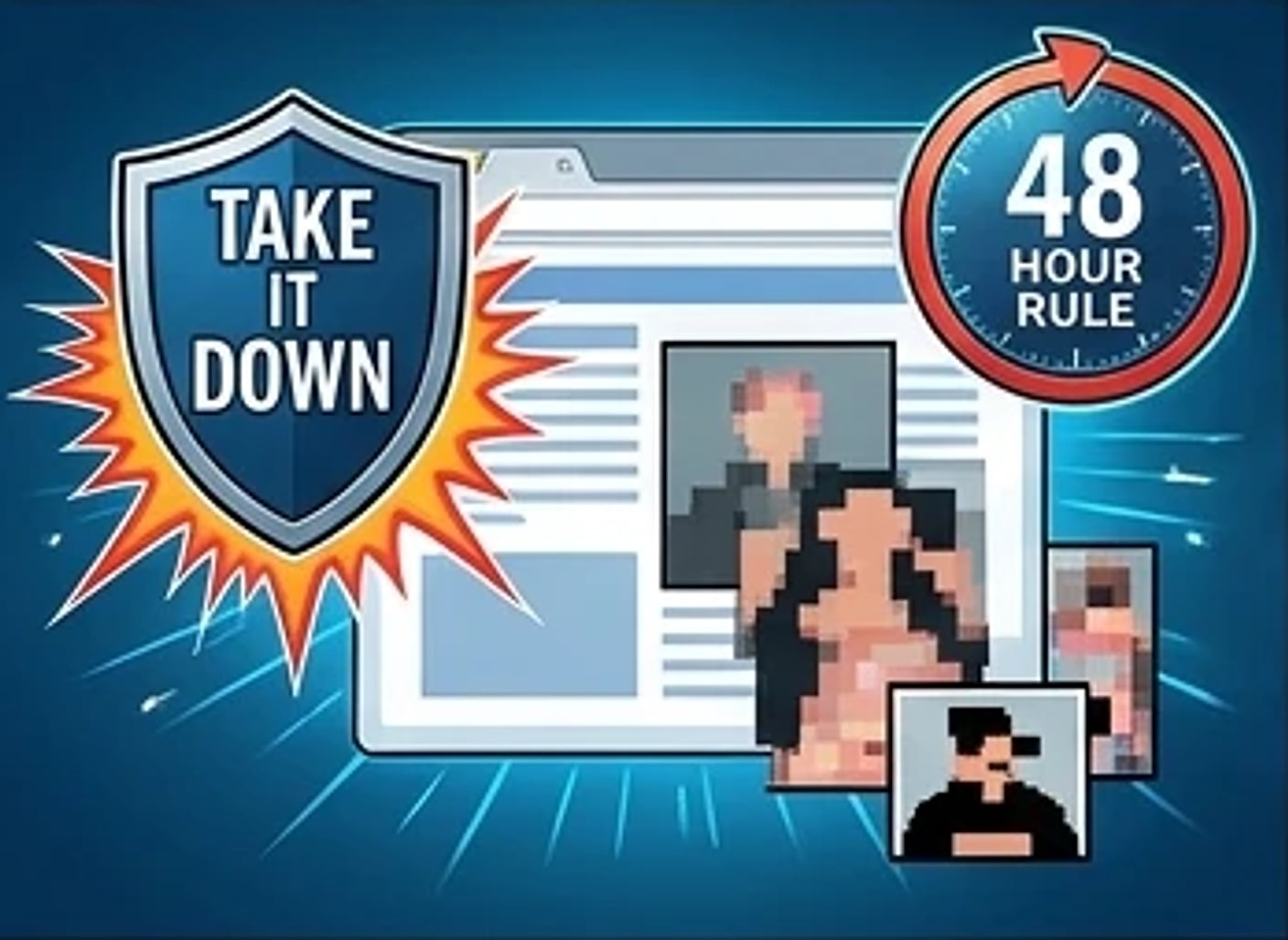
- A covered platform must remove a reported non-consensual intimate image, and known identical copies, within 48 hours of a valid request.
- The FTC has said civil penalties can reach $53,088 per violation.
- A team in India needs a rota that covers weekends and US time zones, and a log to prove each step.
TAKE IT DOWN Act compliance stopped being a future task on 19 May 2026, the day the FTC began enforcing the platform duties. If your product lets users upload or share images and video, and a US person can see them, the clock is now 48 hours: remove a reported non-consensual intimate image within two days of a valid request, plus any known identical copies.
A lot of the products that must now comply are built, run or moderated by teams in India. That adds some wrinkles: time zones, weekend rosters, two legal systems with different takedown windows. Here is the law in working terms, then what an Indian engineering and trust-and-safety team actually has to build. TAKE IT DOWN Act compliance is as much about operations as law.
What the Act requires of platforms
The Act was signed in May 2025. Its criminal provisions against publishing non-consensual intimate imagery, including AI-made deepfakes, applied first. The platform side had a one year runway and became enforceable on 19 May 2026. The FTC treats a failure as an unfair or deceptive practice, and has said civil penalties can run to $53,088 per violation. TAKE IT DOWN Act compliance starts with knowing the two core duties. The FTC civil penalty per violation is reported at $53,088.
Two duties matter most. A platform has to provide a clear and conspicuous way for people to ask for removal. And after a valid request it has to take the content down, and make reasonable efforts to remove known identical copies, within 48 hours. The 48-hour removal non-consensual intimate images rule is the one that decides whether you are compliant on a bad Tuesday.
The FTC has already written to big platforms and set up a complaint page for people who can’t find a removal process. Early attention is on AI image tools. Don’t assume a small or new service is below the radar.
Who counts as a covered platform
The Act reaches a covered platform: a website, online service or app that serves the public and primarily provides a forum for user-generated content, such as messaging, video, image sharing, forums or social features, or that regularly deals in such content. The covered platform TAKE IT DOWN Act definition leaves out broadband providers, email and some sites that mostly host their own editorial content. For TAKE IT DOWN Act compliance, the key question is whether your service is a covered platform.
If your Indian team is building a social app, a dating app, a creator platform, a community feature inside a game, or an AI image generator with a share function, assume you are in. A business app where users only exchange files privately with their own colleagues is a harder call. Get a US lawyer to decide, and write the reasoning down.
Location of the server or the team doesn’t save you. The test is whether you serve US users. A Bengaluru start-up with a US app store listing is just as exposed as a Californian one.
Turning a request into a 48-hour workflow
Start with the form. A valid removal request should carry a physical or electronic signature, identify the image and give enough information to find it, include a good-faith statement that it was shared without consent, and give contact details. Build a simple web form with those fields, make it easy to find from the report menu, and send an acknowledgment automatically. The notice and removal process platform users see has to be obvious. The valid removal request elements are few: a signature, identification of the image, a statement of non-consent and contact details.
| Step | What to build | Owner |
|---|---|---|
| Intake | Clear removal form with signature, location of the image and a statement of non-consent | Product |
| Clock | Timestamp on receipt, alerts at 12, 24 and 36 hours | Trust and safety |
| Removal | Take down the image and known identical copies | Moderation |
| Prevention | Hashing to block re-uploads | Engineering |
| Records | Log decisions, times and reviewers | Compliance |
Then the clock. The 48 hours run from a valid request, and the FTC has urged trackers and escalation rules. Put a timestamp on receipt, assign a named reviewer, and set alerts at 12, 24 and 36 hours. Weekends and Indian public holidays are where teams slip. A follow-the-sun rota or an on-call reviewer in a US time zone usually fixes it.
Finally, the copies. Use hashing to catch known identical copies and block re-uploads, and log each action. Keep the log: if the FTC asks, you need to show who decided, when, and what was removed. Take down first and argue later; the Act protects good-faith removals. This is the part of TAKE IT DOWN Act compliance that teams usually get wrong first: the weekend.
Where Indian law lines up
India’s IT Rules were amended in 2026 with their own takedown windows, reported at three hours for certain orders and two hours for non-consensual intimate imagery. Those clocks start differently, but the lesson is the same: fast, documented removal. One workflow that meets the shorter Indian clock will usually meet the 48-hour US one. A shorter Indian clock makes TAKE IT DOWN Act compliance easier, not harder.
Data protection sits behind all of this. Handling a victim’s request means handling sensitive personal data, which the DPDP Act and US privacy rules both care about. Limit who can see the files, keep reviewer access logged, and don’t copy images into tickets or chat.
Abuse of the form is a real risk too. People file false requests to take down legitimate content. The Act has a good-faith safe harbour for removals, but that doesn’t remove the need for a quick human check on obvious misuse and a way to restore content later if the claim fails. Good TAKE IT DOWN Act compliance also means a way to reverse a mistaken takedown.
Questions people ask
None of the pieces is technically hard. The difficulty is making them reliable when nobody is looking, and that’s an operations problem more than a legal one. TAKE IT DOWN Act compliance won’t be solved with a policy page alone.
Related reading: deepfake removal in India under the 2026 IT Rules, platform liability for deepfakes, Section 230 and India’s IT Rules, AI-generated content labelling in India and deepfakes and personality rights in India.
Quick answers
When did TAKE IT DOWN Act compliance become mandatory for platforms?
The platform notice-and-removal duties became enforceable by the FTC on 19 May 2026. The criminal provisions applied earlier.
How fast must a platform remove content under the TAKE IT DOWN Act?
Within 48 hours of receiving a valid removal request, and the platform must also make reasonable efforts to remove known identical copies.
Does the Act apply to a platform built in India?
Yes if the service is available to people in the United States and meets the covered platform definition. Where the team or servers sit doesn’t change that.
Does the Act apply to a platform built in India?
Yes if the service is available to people in the US and meets the covered platform definition.
Final word
Halverton & Co. is an Indian law firm advising US companies, founders, investors and law firms on Indian law, including Indian technology contracts, IT Rules and data protection compliance for platforms with Indian engineering and trust-and-safety teams, alongside US counsel. We practise in Jharkhand, Maharashtra and before the Supreme Court of India, and work alongside US counsel, who advise on US law. Halverton & Co.: Where tech needs law! If you have a question about Indian law, write to us at office@halvertonandco.com, or get in touch.
This article reflects developments reported up to 31 October 2026. It is for general information only, is not legal advice, and does not create an attorney-client relationship. Halverton & Co. is an Indian law firm and does not advise on US law; US-law points should be confirmed with US counsel.
Sources
Related practice area
Technology & AI Law
Contracts, data protection and AI policies for products that handle other people’s data.
View the practice areaComments
No account needed. Comments are reviewed before they appear, so yours will show here once approved. Please do not share confidential details or describe your own legal matter: replies are general discussion, not legal advice, and do not create an advocate-client relationship. For your own situation, write to office@halvertonandco.com.