Key takeaways
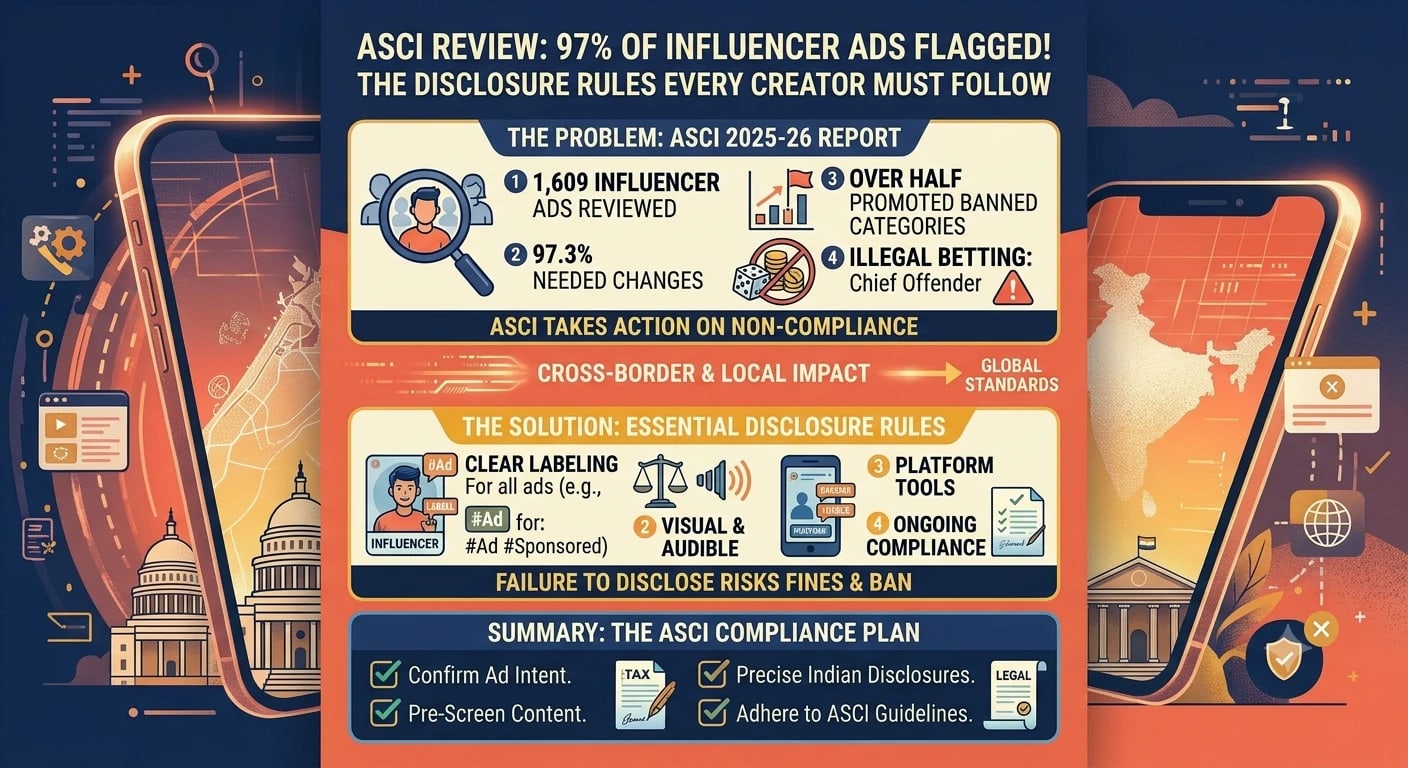
- ASCI’s 2025-26 report reportedly processed 1,609 influencer ads for violations, and 97.3% needed modification.
- Illegal betting accounted for about 54% of influencer violations, ahead of personal care and electronics.
- Disclose any material connection upfront with a clear label such as ad or sponsored, in the post itself.
- Verify the product is legal and the claims are provable before you accept a campaign.
ASCI’s report for 2025-26 should worry every Indian creator. The Advertising Standards Council of India processed 1,609 influencer advertisements for violations in the year, and 97.3% needed modification, according to reports of its annual complaints report. More than half of the flagged influencer ads, about 54%, promoted illegal betting. The ASCI influencer guidelines 2026 position is simple: disclose clearly, and do not promote what the law forbids.
This guide explains what the report found, what the disclosure rules require, how the law backs ASCI, which categories are banned or restricted, the penalties and a checklist for creators and agencies. The ASCI figures come from press coverage and its press release, so check the report itself before quoting exact numbers. This is general information, not legal advice.
What ASCI found in 2025-26
ASCI’s annual complaints report for 2025-26 says it handled 1,609 influencer advertisements for violations, and that 97.3% of them needed to be modified or withdrawn. The report also shows that illegal betting accounted for 54% of influencer violations, followed by personal care at about 17%, then electronics, food and beverages and fashion. Reports also say that digital media accounted for almost all the advertisements that ASCI scrutinised. In other words, 97.3% of influencer ads reviewed had to change. The ASCI influencer guidelines 2026 landscape is shaped by these numbers.
Offshore betting was the most violative sector overall. Different outlets give different case counts for it, because they use different date ranges, so quote the number from the report itself. The pattern is clear: many creators accept paid promotions without checking whether the product is legal or whether the post follows the disclosure rules, and brands rely on creators to follow the rules without supervision.
ASCI is a self-regulatory body. It cannot fine creators itself, but it names breaches, asks for changes, escalates to regulators and publishes its findings. Its decisions carry weight with platforms, brands and the Central Consumer Protection Authority, which can act under the Consumer Protection Act. A post that ASCI flags is a warning that a regulator may follow.
The disclosure rules in practice
ASCI’s influencer advertising guidelines say that any material connection between an influencer and a brand must be disclosed. That includes payment, free products, discounts, affiliate links, family or business ties and any other benefit. The disclosure must be upfront, prominent and easy to see and hear, in the same language as the post, and it must not be hidden in a pile of hashtags. That is the heart of the ASCI influencer guidelines 2026 for creators.
Use clear labels. ASCI has recommended labels such as “advertisement”, “ad”, “sponsored”, “collaboration”, “partnership” or “paid promotion”. Vague tags such as “thanks”, “#sp”, “#collab” alone or buried hashtags are not enough. For videos and reels, the label should appear in the video itself and, for longer content, be repeated, not only in the caption. Check ASCI’s current guidance for the exact placement and duration rules for images, video and live streams. The right influencer disclosure label India creators should use is a plain word such as ad or sponsored.
| Do | Do not | Why |
|---|---|---|
| Use ad, advertisement, sponsored, collaboration or paid promotion | Rely on thanks or a lone #collab | Labels must be clear |
| Put the label in the video itself | Hide it in a pile of hashtags | Prominence is required |
| Disclose gifts, discounts and affiliate links | Treat free products as undisclosed | Any material connection counts |
| Verify claims in writing | Repeat claims you cannot prove | Substantiation is required |
Disclosure is only part of compliance. The claims in the post must be true and substantiated. A creator who says that a product cures a condition, guarantees weight loss or earns money without evidence breaches the rules even with a disclosure label. Creators should ask brands for claim substantiation in writing and avoid repeating claims that they cannot verify. Learning how to disclose paid partnership India rules require is the baseline.
The law behind ASCI
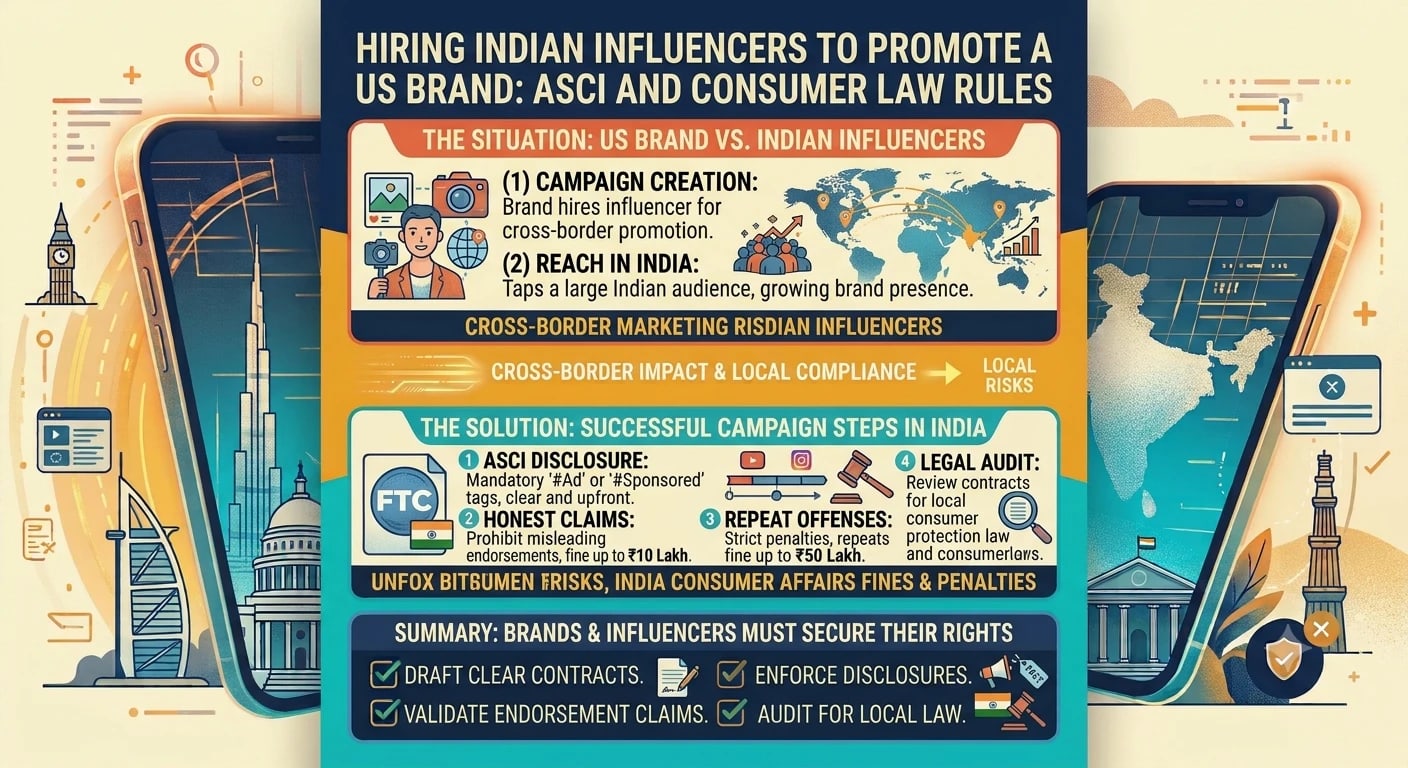
The Consumer Protection Act, 2019 gives legal force to the principle of honest advertising. Section 21 lets the Central Consumer Protection Authority fine a manufacturer or endorser up to ₹10 lakh for a false or misleading advertisement, and up to ₹50 lakh for later contraventions, and bar an endorser from endorsing for a period. An endorser is not liable if they exercised due diligence to verify the claims. Sources differ on the length of repeat bans, so check the Act. Legal backing is what gives the ASCI influencer guidelines 2026 real force.
The Department of Consumer Affairs issued Endorsement Know-hows in 2023, with the CCPA’s 2022 Guidelines for Prevention of Misleading Advertisements and Endorsements. They require celebrities and influencers to disclose material connections, to endorse only what reflects their genuine opinion and to do due diligence. Following the Endorsement Know-hows disclosure rules also helps with ASCI compliance.
Other laws can apply. The Promotion and Regulation of Online Gaming Act, 2025 restricts real-money online gaming and its advertising, which is why offshore betting promotions are illegal and why ASCI flags them. Tax rules may treat free products or benefits as taxable perquisites for the creator. Brands that pay creators from abroad also face foreign exchange compliance. Illegal betting influencer ads India has seen are a legal risk for both creator and brand.
Banned and restricted categories
Do not promote offshore betting, illegal gambling or real-money gaming that the law prohibits. Do not promote products with claims banned by law, such as miracle cures that violate the Drugs and Magic Remedies (Objectionable Advertisements) Act, 1954. Do not promote tobacco or alcohol brands through surrogate advertising where the law restricts it. If a product is regulated, ask the brand for its licence number and check it. Banned categories are the biggest risk under the ASCI influencer guidelines 2026.
Some categories are allowed but regulated. Financial products need the right disclaimers and regulator approvals, and promotions for securities or investment advice by unregistered persons can breach SEBI rules. Crypto promotions need ASCI’s virtual digital asset disclaimer. Health and wellness claims need evidence, and children’s products have strict rules. Using minors in ads attracts extra requirements.
A good check is simple: would this ad survive a regulator’s review? If the product is illegal, the claim is unproven or the disclosure is missing, decline the deal. Creators who work with agencies should ask for a written clearance from the agency’s legal team, and agencies should keep a record of what they checked. A single flagged post can damage trust with followers and brands.
Next steps and quick answers
Adopt a checklist for every paid post: verify the product is legal, ask for claim evidence, add a clear label in the content, save the contract and brief, and keep screenshots of the published post. If ASCI contacts you, respond quickly and fix the content. This is general information, not legal advice. Build the ASCI influencer guidelines 2026 into every brief.
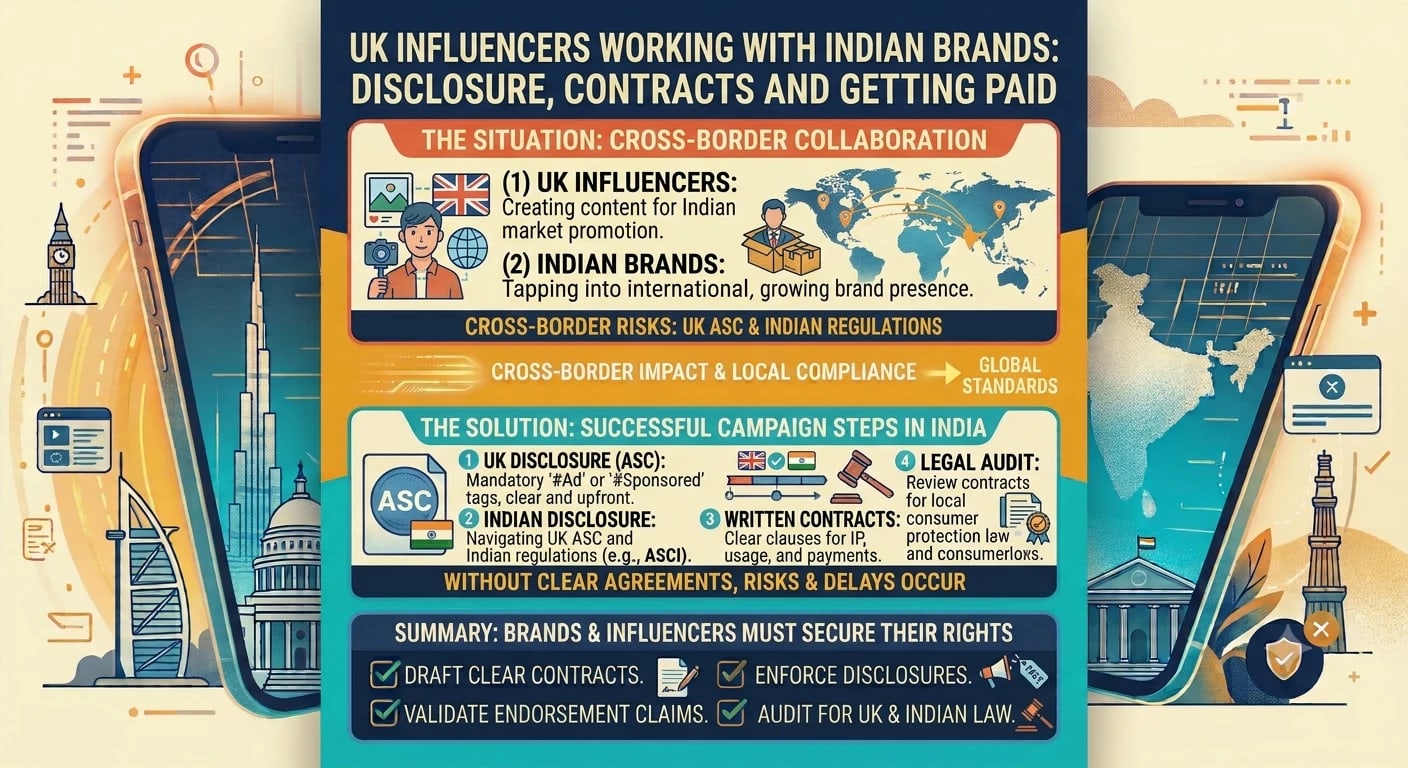
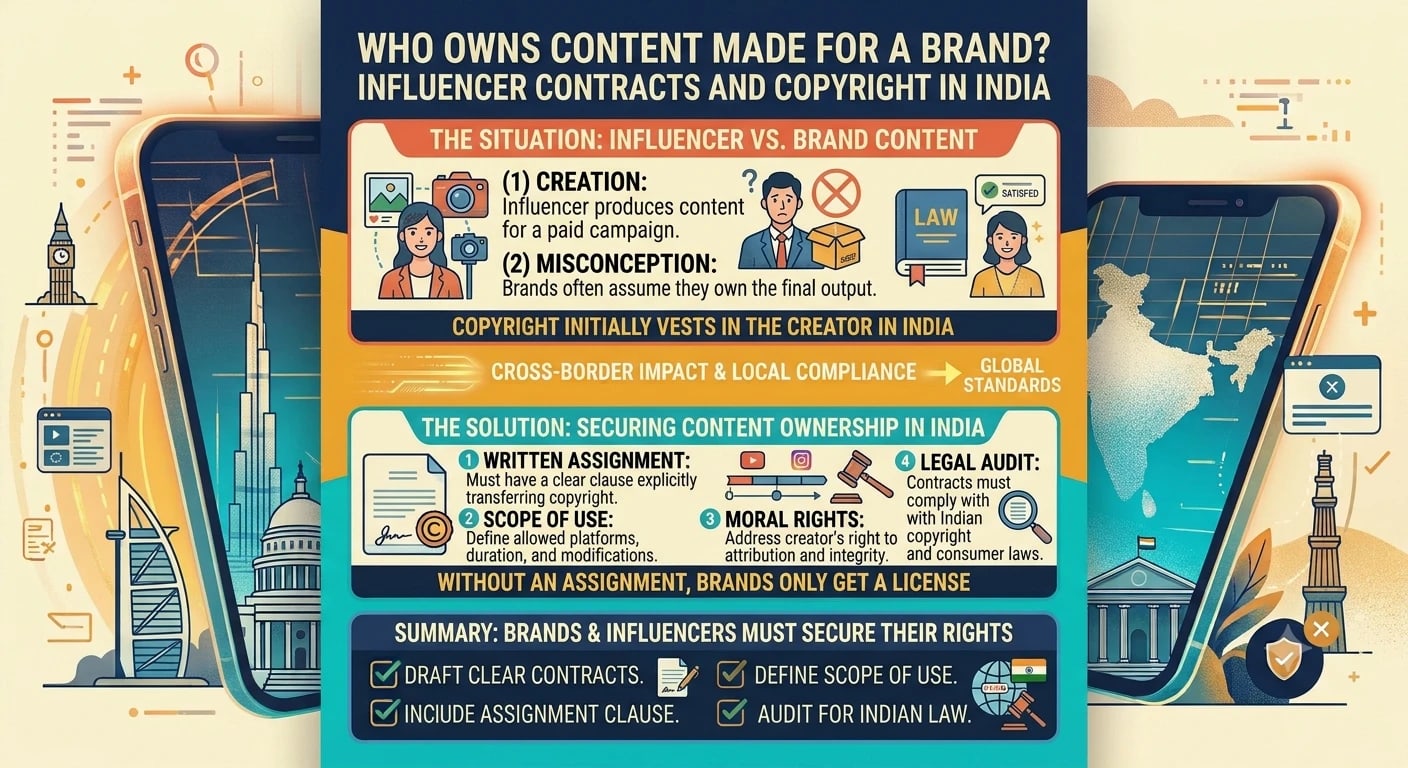
Related reading: hiring Indian influencers for a US brand, who owns influencer content made for a brand, UK influencers working with Indian brands, Dubai crypto influencers and VARA rules, dark patterns and the CCPA guidelines, ads inside AI answers and Indian advertising law and the Online Gaming Act, 2025; also crypto influencer law in India and AI voice cloning in India; also crypto affiliate programmes in Dubai and India.
Quick answers
What did ASCI find about influencer ads in 2025-26?
ASCI reportedly handled 1,609 influencer ads for violations and 97.3% needed modification, with illegal betting accounting for 54% of influencer violations. Check the report for exact figures.
How do I disclose a paid partnership in India?
Use a clear label such as ad, advertisement, sponsored or paid promotion, placed upfront and visibly in the post itself, in the same language, not buried in hashtags. For videos, put it in the video, and check ASCI’s current placement rules.
Can influencers be fined for misleading ads in India?
Yes. The CCPA can fine endorsers up to ₹10 lakh and up to ₹50 lakh for repeat contraventions under the Consumer Protection Act, 2019, subject to a due diligence defence, and ASCI can name and escalate violations.
Can ASCI fine me?
ASCI is self-regulatory and cannot fine you, but it names breaches and escalates to regulators. The Consumer Protection Authority can fine endorsers up to ₹10 lakh and ₹50 lakh for repeat cases.
Are the 1,609 ads the whole market?
No. They are the influencer ads that ASCI processed for violations in 2025-26, according to reports of its annual report. Check the report for exact figures.
Final word
Halverton & Co. is an Indian law firm advising founders, startups, technology companies and investors on Indian law, including advertising and influencer law, consumer protection compliance, and creator and brand contracts. We practise in Jharkhand, Maharashtra and before the Supreme Court of India, and act as fractional legal counsel for technology-driven businesses. Halverton & Co.: Where tech needs law! If you have a question about Indian law, write to us at office@halvertonandco.com, or get in touch.
This article reflects developments reported up to 31 October 2026. It is for general information only, is not legal advice, and does not create an advocate-client relationship. Halverton & Co. is an Indian law firm.
Sources
Related practice area
Intellectual Property
Trade marks, copyright, patents and designs. Searched, filed, licensed and enforced under Indian law.
View the practice areaComments
No account needed. Comments are reviewed before they appear, so yours will show here once approved. Please do not share confidential details or describe your own legal matter: replies are general discussion, not legal advice, and do not create an advocate-client relationship. For your own situation, write to office@halvertonandco.com.