Key takeaways
- Choose governing law with care and consider arbitration with a neutral seat for business customers.
- Foreign suppliers of online services to Indian customers may need to register for GST and charge IGST; confirm with an Indian adviser.
- The DPDP Act applies to processing outside India that relates to offering services to people in India.
- Keep liability caps fair, and name a grievance officer where the IT Rules apply.
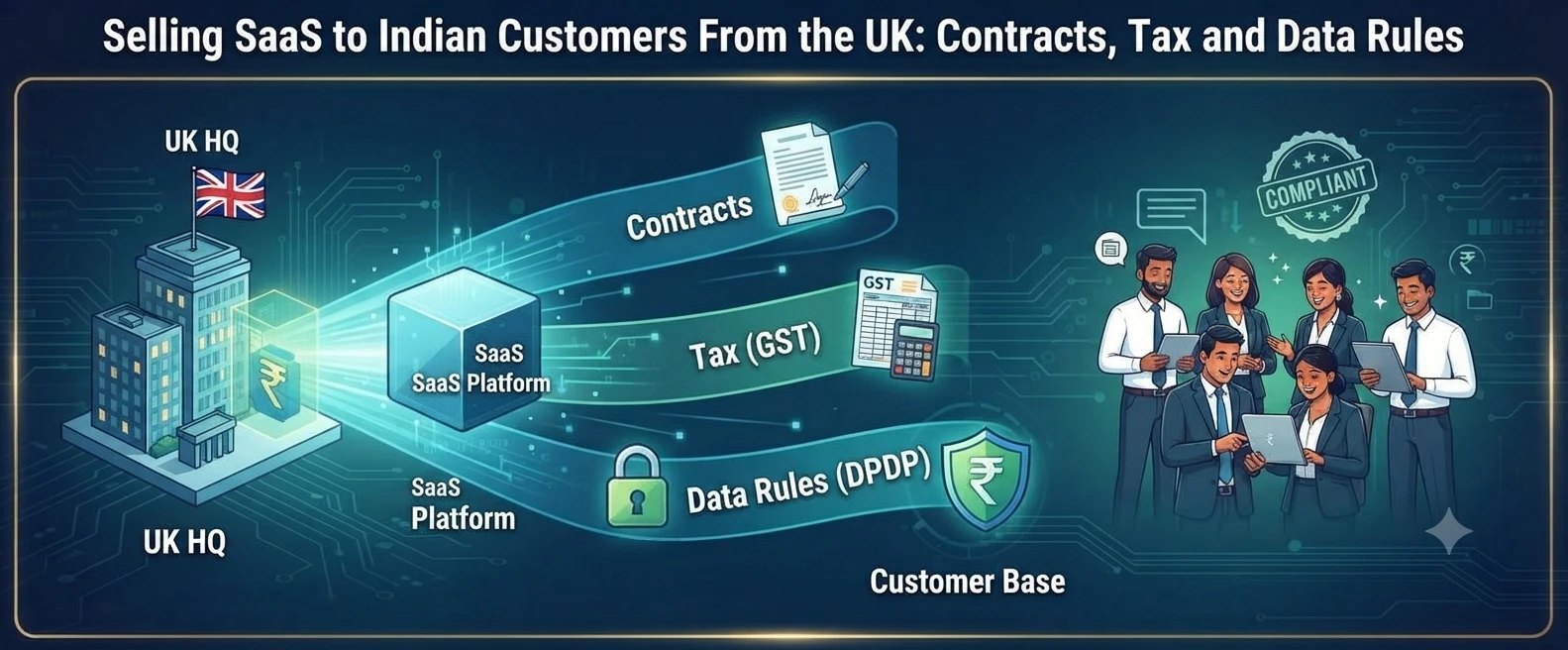
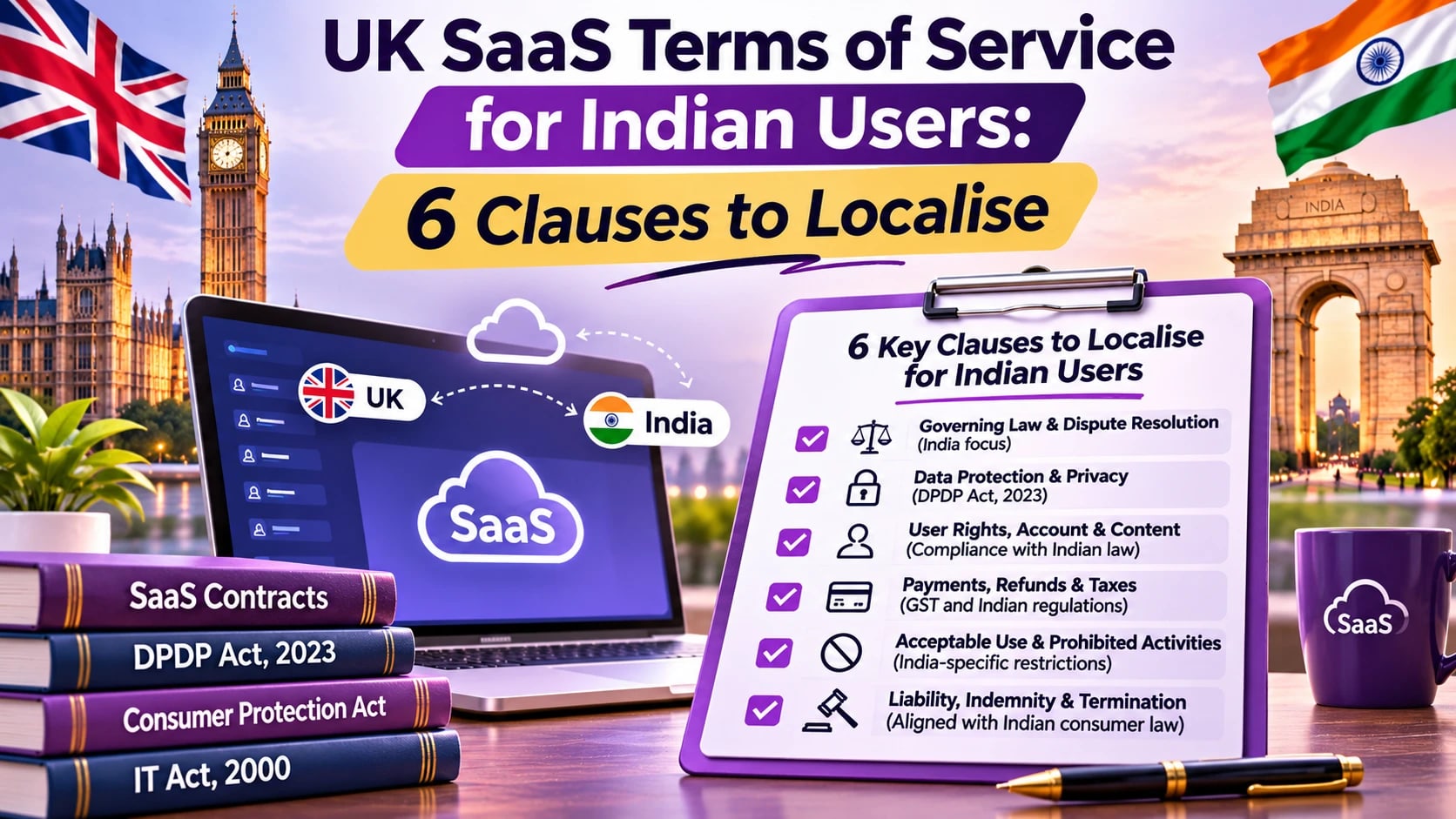
A UK SaaS company that signs up Indian users often copies its UK terms of service and hopes for the best. That is risky. Indian law treats consumers and small businesses differently from the UK, and several rules, on tax, payments, data and content, affect what your terms should say. Six clauses are worth localising for any serious plan to serve SaaS terms India users will actually be bound by.
This guide goes through the six clauses: governing law and disputes, pricing and tax, payments and billing, data protection and privacy, liability and unfair terms, and the intermediary and content provisions. It also covers how to present the terms so they are enforceable. It is written by an Indian law firm for UK readers. UK law points should be confirmed with UK advisers.
Clause 1: governing law and disputes
Choose a governing law, but know its limits. Many UK SaaS companies choose English law and courts. For business customers, that can work, though an Indian counterparty may resist and enforcement of a UK judgment in India requires a separate step. For individual consumers, Indian consumer law rules may apply regardless of the contract, and a consumer can generally bring a complaint before an Indian consumer commission where they live. Governing law is the first of the six clauses for SaaS terms India users.
| Clause | Localise for India | Key law |
|---|---|---|
| 1. Governing law and disputes | Arbitration with a neutral seat; consumer rights | Arbitration Act, 1996; Consumer Protection Act |
| 2. Pricing and tax | GST on online services | CGST and IGST Acts |
| 3. Payments | Recurring payment authentication and refunds | RBI rules |
| 4. Data protection | Notice and consent for Indian users | DPDP Act, 2023 |
| 5. Liability | Fair caps; no exclusion of fraud | Contract Act; Consumer Protection Act |
| 6. Intermediary terms | Grievance officer and takedown process | IT Rules, 2021 |
Consider arbitration for business customers, with a neutral seat such as London or Singapore, and make sure the clause is clear about the rules, language and number of arbitrators. An arbitral award can be enforced in India under the Arbitration and Conciliation Act, 1996, where India recognises the seat’s country, which is often simpler than enforcing a court judgment. For small deals, an online dispute process or a mediation step before a formal claim may be practical.
Make acceptance clear. Indian law recognises electronic contracts under the Information Technology Act, 2000, and click-wrap acceptance, where users click to agree after seeing the terms, is stronger than a link in a footer. Keep records of the version accepted, the time and the user. Provide the terms in English, and consider Hindi or other languages for consumer-facing products. Clear acceptance supports the SaaS terms of service India customers are held to.
Clauses 2 and 3: pricing, tax and payments
Clause 2 is pricing and tax. A foreign company that supplies online services to Indian customers may have to register for GST in India under the rules for online information and database access or retrieval services, known as OIDAR, and charge IGST at 18% on supplies to non-registered persons. Business customers who are registered may account for tax themselves under reverse charge. State whether your prices are inclusive or exclusive of taxes, and say how invoices will be issued. Confirm the GST on SaaS foreign company India position with an Indian adviser. Tax terms are the second clause in SaaS terms India users sign.
The equalisation levy on certain digital services has been reduced or removed in recent years, but check the current position. Tax withholding may also arise on payments to a foreign company by Indian businesses, depending on the type of payment and treaty, and your customers may ask you for a tax residency certificate. Put a clause on who bears withholding taxes, so that a customer does not simply deduct and short-pay you.
Clause 3 is payments and billing. The Reserve Bank’s rules on recurring card payments require additional authentication and customer consent for e-mandates above set limits, and card tokenisation rules affect how you store cards. If you bill monthly, expect failed renewals if your gateway is not compliant. RBI recurring payments SaaS India rules affect your billing flow, so use an Indian-compliant gateway or a local payment partner, and explain renewals, refunds and cancellation clearly in the terms.
Clause 4: data protection and privacy
Indian users’ personal data is subject to the Digital Personal Data Protection Act, 2023, which applies to processing in India and to processing outside India in connection with offering goods or services to people in India. A UK SaaS company serving Indian users is within scope, and it needs a notice that says what data it collects, why, how users can withdraw consent and how to complain. The DPDP privacy notice SaaS companies publish should be clear and available in plain language. Privacy is the fourth clause in SaaS terms India users accept.
Align your terms and privacy notice. Consent must be free, specific, informed and unambiguous, and given by a clear affirmative action. Children’s data needs verifiable parental consent, and the Act restricts tracking and targeted advertising aimed at children. Name a contact for grievances. If you are a processor for business customers, your data processing agreement should say who is the data fiduciary and who handles requests.
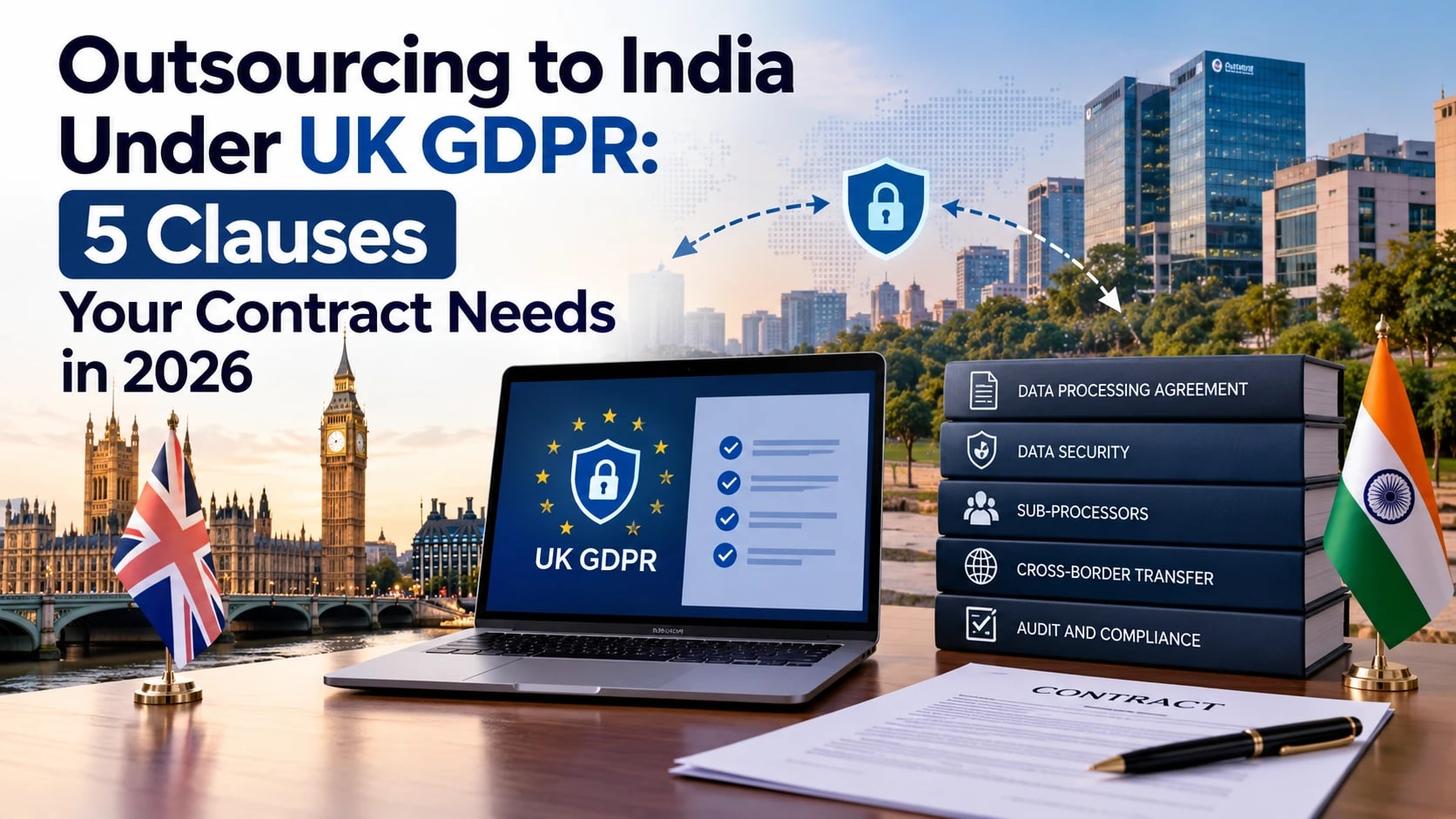
Mind transfers and security. The Act allows transfers of personal data outside India except to countries restricted by the government, and sets duties on security safeguards and breach notification to the Data Protection Board and affected people. The DPDP Rules, 2025 add operational detail with phased commencement. Reconcile this with UK GDPR obligations for your UK operations, since the two regimes can apply at the same time to the same product.
Clauses 5 and 6: liability and intermediary terms
Clause 5 is liability. Indian courts enforce reasonable limitation of liability clauses between businesses, but Sections 73 and 74 of the Indian Contract Act, 1872 limit damages and penalties, and Section 23 voids terms that are against public policy. For consumers, the Consumer Protection Act, 2019 defines unfair contracts, such as terms that impose excessive security deposits, penalties or one-sided termination rights. Unfair contract terms Consumer Protection Act India rules mean one-sided consumer terms can be struck down. Fair liability terms keep SaaS terms India users accept enforceable.
Make the limitation fair. Cap liability at fees paid, exclude indirect losses, but do not exclude liability for fraud, wilful misconduct or matters that the law does not allow you to exclude. Avoid auto-renewal and cancellation terms that surprise users, because they can attract complaints. State warranties and service levels honestly and offer a clear refund policy.
Clause 6 covers intermediary duties. If your service lets users post or share content, the Information Technology (Intermediary Guidelines and Digital Media Ethics Code) Rules, 2021, as amended in 2026, require terms that tell users not to host unlawful content, and require a grievance officer, an acknowledgement of complaints within 24 hours and resolution within the set period, which was cut to 7 days from 20 February 2026 as reported. Name the officer in your terms and set up a takedown process. Check whether the safe harbour applies to you.
Next steps and quick answers
Audit your current terms against the six clauses, decide which need an Indian version, check your GST and payments set-up, update your privacy notice and name a grievance contact. Keep versions and acceptance records. This is general information, not legal advice. Revisit your SaaS terms India users see each year.
Related reading: selling SaaS in India from the UK, India’s DPDP Act for UK businesses, outsourcing to India under UK GDPR, the UK-India trade deal: a legal checklist, dark patterns and the CCPA guidelines, the Ofcom ruling and Indian apps with UK users and DPDP Act compliance checklist; also GST on SaaS sold to India; also AI-washing and the FTC; also electronic signatures in India and terms and conditions for an Indian website; also SaaS terms for Indian customers from the UK.
Quick answers
Do UK SaaS companies need separate terms for Indian users?
Not always separate documents, but the terms should be localised for governing law, tax, payments, data protection, liability and intermediary duties. Check how Indian consumer and tax law apply to your customers.
Does a UK SaaS company have to charge GST to Indian customers?
Often, yes, for online services supplied to non-registered Indian customers, through GST registration under the OIDAR rules, at 18%. Business customers may account for tax under reverse charge. Take Indian tax advice.
Are click-wrap terms enforceable in India?
Generally yes, if the user clearly accepts the terms after seeing them and you keep records, under the Information Technology Act, 2000. Unfair consumer terms can still be struck down under consumer law.
Are click-wrap terms enforceable in India?
Generally yes if the user clearly accepts the terms after seeing them and you keep records, under the Information Technology Act, 2000. Unfair consumer terms can still be struck down.
Do I need a grievance officer?
If your service hosts user content you are likely an intermediary and must name a grievance officer under the IT Rules. Check with Indian counsel.
Final word
Halverton & Co. is an Indian law firm advising UK companies, founders, investors and law firms on Indian law, including SaaS and technology contracts, data protection compliance, consumer and tax compliance for foreign companies selling into India. We practise in Jharkhand, Maharashtra and before the Supreme Court of India, and work alongside your UK solicitors, who advise on English law. Halverton & Co.: Where tech needs law! If you have a question about Indian law, write to us at office@halvertonandco.com, or get in touch.
This article reflects developments reported up to 31 October 2026. It is for general information only, is not legal advice, and does not create a solicitor-client relationship. Halverton & Co. is an Indian law firm, is not authorised or regulated by the Solicitors Regulation Authority, and does not advise on English law; UK-law points should be confirmed with UK advisers.
Sources
Related practice area
Technology & AI Law
Contracts, data protection and AI policies for products that handle other people’s data.
View the practice areaComments
No account needed. Comments are reviewed before they appear, so yours will show here once approved. Please do not share confidential details or describe your own legal matter: replies are general discussion, not legal advice, and do not create an advocate-client relationship. For your own situation, write to office@halvertonandco.com.