Key takeaways
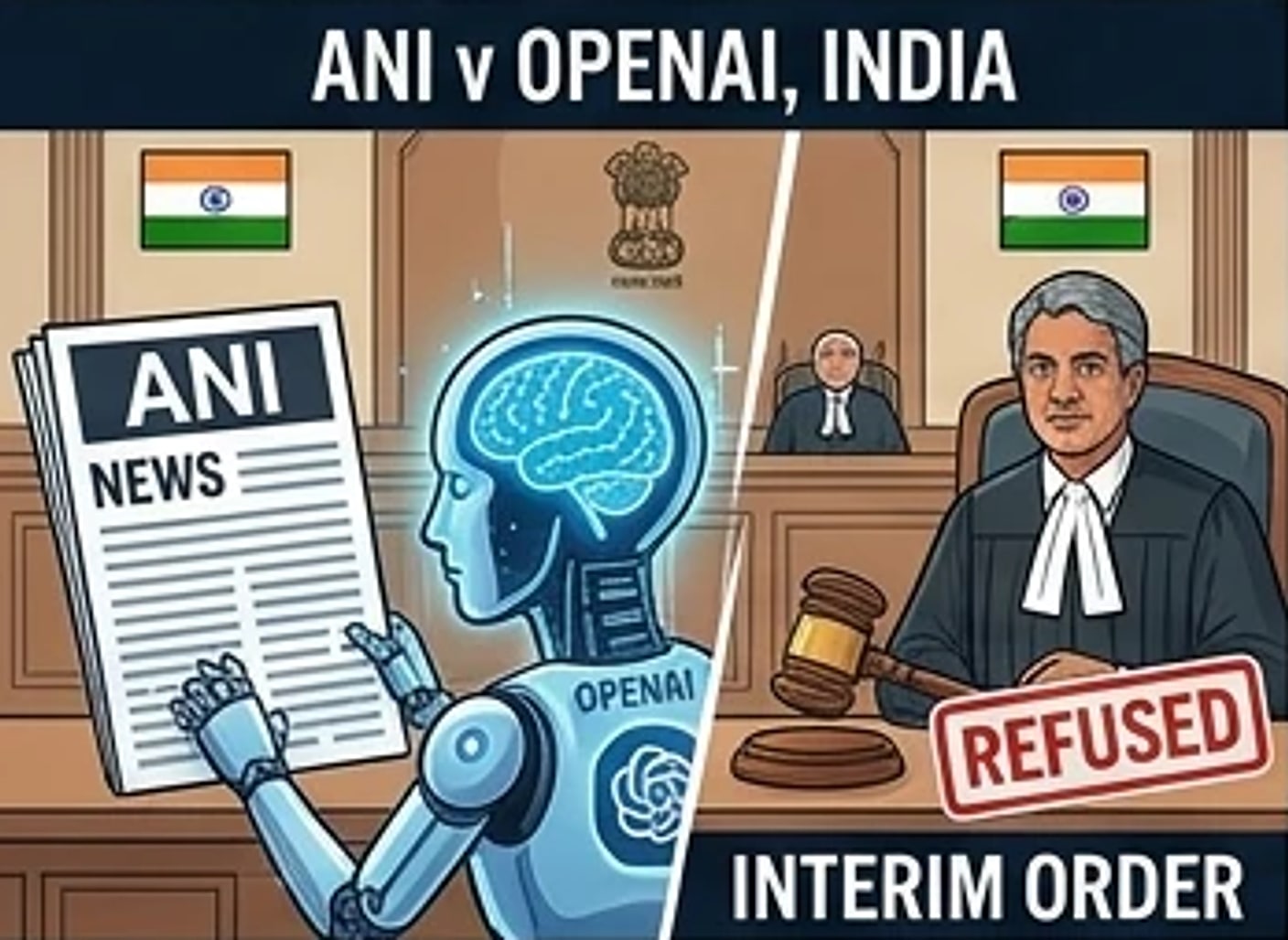
- On 24 July 2026 the Delhi High Court refused ANI an interim injunction against OpenAI, according to press and law firm reports.
- It is reported to have found no prima facie infringement and to have treated training as arguably within fair dealing under Section 52(1)(a).
- It rejected OpenAI’s jurisdiction objection, relying on ANI’s business in Delhi under Section 62(2).
- The order is interim only, and the suit continues.
The ANI v OpenAI interim order, passed by the Delhi High Court on 24 July 2026, is the first Indian ruling to deal head-on with AI training and copyright, and it went OpenAI’s way. Justice Amit Bansal declined to stop OpenAI from using ANI’s news content to train ChatGPT. Many readers took that as the end of the story. It isn’t. It is an interim decision on a request for urgent relief, and the suit itself carries on.
A caution before we start. We haven’t seen the full judgment, so what follows is built from press and law firm reports of the order, which agree on the main points and differ on some details. Read the order before you quote it. With that said, here is what the court seems to have decided, why, and what it means if you build, buy or publish in this space. Here is the ANI v OpenAI interim order in plain terms, and why Delhi High Court OpenAI fair dealing reasoning is the part people argue about.
What ANI asked for and what the court said
ANI, a news agency, sued OpenAI in November 2024. It said ChatGPT was trained on its copyrighted wire copy without a licence, that the model stores and can reproduce it, and that outputs sometimes copy or closely paraphrase its stories. It asked for an interim injunction to stop OpenAI from using its content while the case ran. Think of the ANI v OpenAI interim order as a decision about timing, not about the whole case.
In the ANI v OpenAI interim order, the court refused. Reports say it found no prima facie infringement on the material before it. It held that, at this stage, OpenAI’s use of ANI’s content for training could fall within the fair dealing exception in Section 52(1)(a) of the Copyright Act, 1957, and that ANI had not shown systematic reproduction of its works in ChatGPT’s answers. The ANI v OpenAI interim order is reported to turn on no prima facie infringement ChatGPT training could be shown at this stage.
Two features matter. This was a request for temporary relief, which uses a lower bar than a final decision, and the court only needed a prima facie view. And the order did not decide whether training on copyrighted works is lawful in all cases. It decided that ANI hadn’t made out a case for stopping it now.
The fair dealing reasoning
Section 52(1)(a) lists acts that are not infringement, including fair dealing for private or personal use, research, criticism or review, and reporting current events. The court is reported to have treated OpenAI’s storing and using ANI content to train a model as capable of falling within that exception on the facts before it, with press accounts mentioning the first limb of the clause. The ANI v OpenAI interim order leans on Section 52(1)(a) in a way publishers dislike.
Reports also say the court viewed training as prima facie transformative, since the model learns patterns and doesn’t simply republish the articles. That is language familiar from US fair use cases, but India has no general fair use doctrine. It has a closed list of fair dealing categories, so the Delhi High Court fair dealing OpenAI reasoning stretches those categories to cover a new use.
That is why it matters, and why it is controversial. Publishers argue the closed list wasn’t written for machine learning at scale. AI developers say the court recognised that learning from public text is different from copying it for readers. Both sides will watch the full judgment and any appeal for the exact wording of the AI training Section 52(1)(a) interim analysis. Both sides will study the ANI v OpenAI interim order for its exact wording on training.
Jurisdiction and balance of convenience
OpenAI argued that its servers and operations are outside India, so the Delhi court was the wrong forum. The court is reported to have rejected that, relying on ANI’s principal place of business in Delhi under Section 62(2) of the Copyright Act, which lets a plaintiff sue where it carries on business. The ANI v OpenAI jurisdiction Section 62(2) point is useful to every Indian rights holder: you can sue a foreign defendant at home. The ANI v OpenAI interim order also rejects the argument that Delhi is the wrong forum.
| Question | Interim order | Still open |
|---|---|---|
| Injunction | Refused | Trial and appeal |
| Fair dealing, Section 52(1)(a) | Training arguably within it at this stage | Final view |
| Jurisdiction | Delhi court can hear it, Section 62(2) | None on this point |
| Whether training needs a licence | Not decided | Courts and policy |
On balance of convenience, the court was moved by the harm an injunction might cause. Reports say it spoke of irreparable injury to OpenAI and public interest in AI development, against ANI’s ability to be compensated in money if it later wins. Judges often weigh interim relief this way, and a stop order on a widely used AI system is a heavy step.
Notice what is absent. The court did not say ANI was wrong on the law. It said ANI hadn’t shown enough, at this stage, to justify an injunction. That distinction decides what the order is worth as authority. That narrow reading of the ANI v OpenAI interim order is what lawyers on both sides repeat.
What the ANI v OpenAI interim order does not decide
It doesn’t settle whether training on copyrighted material needs a licence in India. The suit continues, with questions on storage, reproduction in outputs, and whether memorised passages breach the Act. The court’s observations are for the interim application only, a point that commentators repeat. The ANI v OpenAI interim order doesn’t decide the licence question.
It doesn’t bind other courts the way a final judgment would. Another Delhi bench, a Division Bench on appeal or the Supreme Court may see things differently. And government policy is moving: the DPIIT working paper floats a mandatory licence for AI training. If that becomes law, it could change the answer regardless of what fair dealing allows.
For publishers, the practical message is to keep the evidence. If a model reproduces your text closely, document it, because the court looked for systematic reproduction. For AI companies, the order is helpful but not a licence to ignore rights holders. Use cautiously, and document data sources. See also our posts on AI training data licensing and the DPIIT proposal. In short, ANI v OpenAI what happens next depends on trial, appeal and policy, and the ANI v OpenAI interim order is only one step.
Questions people ask
A final thought. People sometimes call this a win for AI or a loss for publishers. It is better read as a gap: the court found the law doesn’t clearly stop training, and Parliament may be asked to fill that gap. The ANI v OpenAI interim order is better read as a gap than a verdict.
Related reading: ANI v OpenAI and AI training in India, the DPIIT AI copyright working paper, India’s AI copyright licence proposal, AI training data licensing with Indian publishers, the DABUS order and AI authorship and AI copyright in India and the US compared.
Quick answers
What did the ANI v OpenAI interim order decide?
On 24 July 2026 the Delhi High Court refused ANI an interim injunction against OpenAI. Reports say it found no prima facie infringement, treated training as arguably within fair dealing, and held it had jurisdiction because ANI carries on business in Delhi.
Does the order mean AI training is legal in India?
No. It is an interim order on a request for urgent relief and doesn’t finally decide the question. The suit continues and other courts or a change in the law could produce a different result.
What happens next in ANI v OpenAI?
The suit goes on towards trial, and either side can challenge the order on appeal. Watch for the full judgment, any appeal and DPIIT’s AI copyright proposals.
Is AI training legal in India after this order?
The order does not decide that. It is an interim ruling, and the suit and any appeal continue.
Final word
Halverton & Co. is an Indian law firm advising founders, startups, technology companies and investors on Indian law, including copyright, AI and technology disputes for Indian and foreign companies, including AI training data and licensing. We practise in Jharkhand, Maharashtra and before the Supreme Court of India, and act as fractional legal counsel for technology-driven businesses. Halverton & Co.: Where tech needs law! If you have a question about Indian law, write to us at office@halvertonandco.com, or get in touch.
This article reflects developments reported up to 31 October 2026. It is for general information only, is not legal advice, and does not create an advocate-client relationship. Halverton & Co. is an Indian law firm.
Sources
Related practice area
Technology & AI Law
Contracts, data protection and AI policies for products that handle other people’s data.
View the practice areaComments
No account needed. Comments are reviewed before they appear, so yours will show here once approved. Please do not share confidential details or describe your own legal matter: replies are general discussion, not legal advice, and do not create an advocate-client relationship. For your own situation, write to office@halvertonandco.com.