Key takeaways
- In November 2025 the High Court held that Stable Diffusion was not an infringing copy because it does not store Getty’s works, and Getty was granted permission to appeal on secondary infringement.
- The appeal hearing is expected to begin on 10 November 2026 according to reports, but it may slip into 2027, so check the listing.
- India’s ANI v. OpenAI interim order of 24 July 2026 reportedly treated training as fair dealing at the prima facie stage; ANI’s appeal is pending.
- UK companies should map training data, review warranties and indemnities, and test outputs for logos and watermarks.
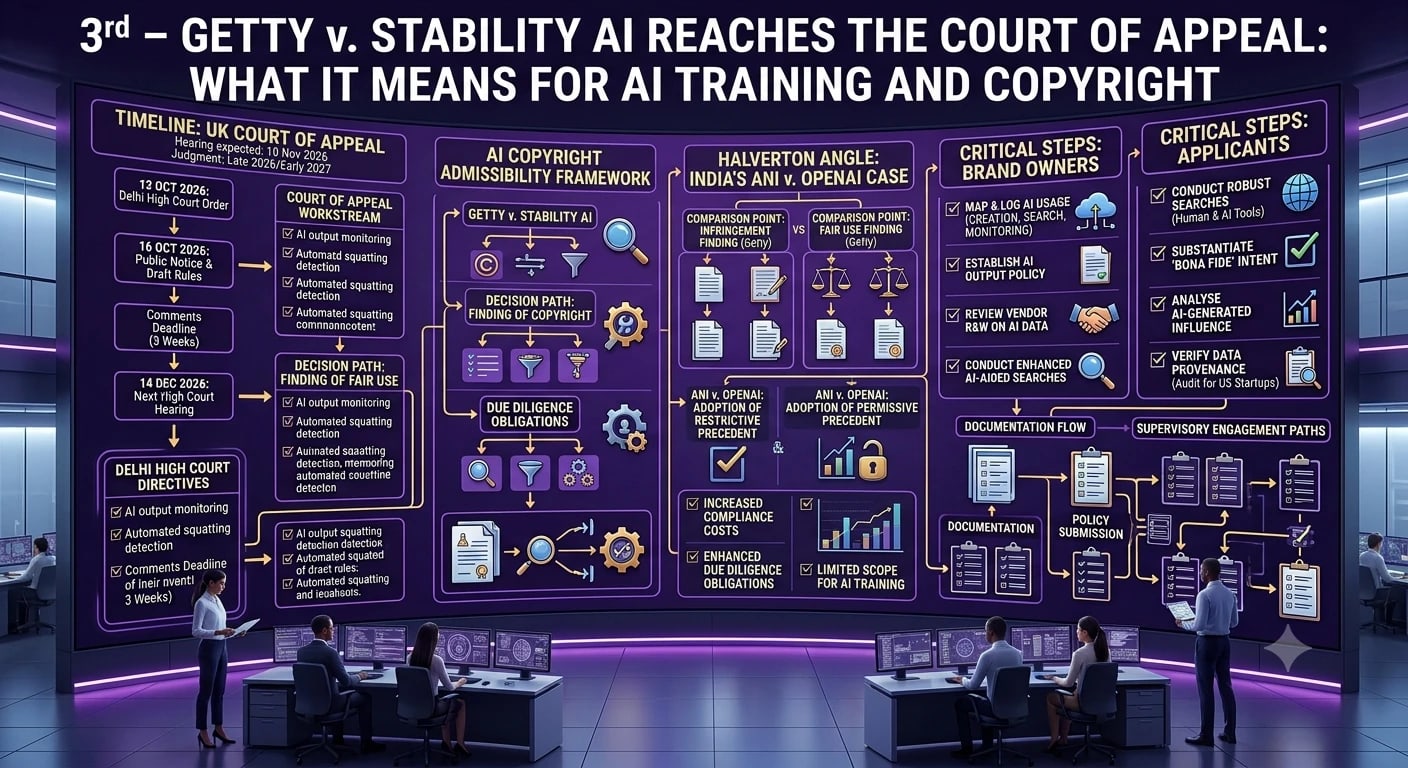
The Getty v Stability AI appeal is the next big test of how UK copyright law treats trained AI models. After the High Court largely sided with Stability AI in November 2025, Getty Images was granted permission to appeal on one of the hardest questions in the case: whether an AI model can be an infringing copy of the works it was trained on. The Court of Appeal hearing is expected to begin on 10 November 2026, though some reports suggest it could slip into 2027, so check the listing before relying on the date.
This guide explains what the High Court decided, what the appeal is about, how India’s ANI v. OpenAI case compares, and what UK companies that build, buy or license AI should do while the law is uncertain. It is written by an Indian law firm for UK readers. English law points are for your solicitors or barristers to confirm.
What the High Court decided
Getty Images sued Stability AI in the UK over the Stable Diffusion image generator. By the time of trial in mid-2025, Getty had dropped its main claims that the training itself and the generated images infringed copyright, partly because the training was said to have taken place outside the UK. What remained were claims of secondary infringement, trade mark infringement and passing off.
In a judgment of 4 November 2025, Joanna Smith J held that the Stable Diffusion model does not store or reproduce Getty’s works, so it is not an infringing copy within the Copyright, Designs and Patents Act 1988. Secondary infringement therefore failed. The court found trade mark infringement only in limited respects, linked to Getty-style watermarks appearing in some outputs from earlier versions of the model, and rejected much of the rest.
The result was described as mixed but largely in Stability AI’s favour. It did not decide whether training on copyright works without a licence is lawful in the UK, because that claim was no longer before the court. This limit matters for anyone reading the case as a general ruling on AI training. The Getty v Stability AI appeal addresses only what remains.
What the appeal will decide
Getty was granted permission to appeal on the secondary infringement ground. The central question is whether an AI model, which holds learned weights rather than stored images, can be an ’infringing copy’ under sections 22 and 23 of the CDPA. The High Court accepted that a model can be an ’article’, a term that covers intangible items, but held that it was not an infringing copy because it never held a copy of the works.
A ruling for Getty could open the way for rights holders to argue that distributing or importing a model trained on their works is itself secondary infringement. A ruling for Stability AI would confirm that model weights are not copies, and push disputes towards the training stage, outputs and licensing. Reports say Stability AI was refused permission by the High Court to appeal the trade mark findings and would need to ask the Court of Appeal.
Timing is uncertain. Reports suggest a hearing in November 2026, with judgment late in 2026 or in 2027, but listings change and the hearing may slip. Whatever the outcome, a further appeal to the Supreme Court is possible. UK businesses should plan for a period in which the law is unsettled rather than wait for a final answer from the Getty v Stability AI appeal.
How India compares: ANI v. OpenAI
India has its own test case. In ANI v. OpenAI, the Delhi High Court on 24 July 2026 refused ANI an interim injunction, reportedly holding at the prima facie stage that OpenAI’s storage of ANI’s articles to train ChatGPT falls within the fair dealing provisions of Section 52 of the Copyright Act, 1957. The court did hold that the suit could be heard in Delhi. ANI has appealed, and the Division Bench issued notice in September 2026.
The comparison is useful but not simple. The Indian ruling is an interim, prima facie view on training, while the UK appeal is a final question about models as copies. India’s Section 52 lists specific permitted acts, whereas the UK has a narrow text and data mining exception limited to non-commercial research. Both systems are watching each other and the US, where cases have turned on fair use.
| Point | Getty v. Stability AI (UK) | ANI v. OpenAI (India) |
|---|---|---|
| Court and stage | Court of Appeal, on permission granted to Getty | Delhi High Court; interim order of 24 July 2026, appeal pending |
| Main question | Whether a trained model is an infringing copy under sections 22 and 23 of the CDPA | Whether training on articles is fair dealing under Section 52 |
| Result so far | High Court held the model was not an infringing copy | Interim injunction refused on a prima facie view |
| Final answer? | No, pending appeal | No, interim only |
For a UK company working in India, the lesson is that Indian courts are open to hearing AI training claims and will decide on Indian statutory language. A model trained in the UK and deployed in India may be tested under Indian law. Keep this in mind alongside the Getty v Stability AI appeal, because a ruling in one country will not bind the other.
Practical steps for UK AI companies
Map your training data. Keep a record of what was used, where it came from, under what licence and where the training took place, because location affected the UK analysis in Getty. Separate licensed, public domain and scraped material. Investors, customers and insurers increasingly ask for this, and the record will help you respond quickly if a claim arrives.
Review your contracts. If you license models or data, check warranties and indemnities on IP, and decide how much risk you are willing to carry. If you buy AI tools, ask suppliers about training data, output filters and indemnities. Include a clause that deals with changes in the law, so that the parties know what happens if the Court of Appeal changes the position.
Manage outputs. The trade mark findings in Getty came from watermarks reproduced in outputs. Test your models for reproduction of logos, watermarks and near-copies of known works, and add filters or review where needed. Prepare a take-down and complaints process. If you sell into India, consider Indian trade mark and copyright exposure for outputs seen there, as well as UK exposure.
Next steps and quick answers
In the next weeks, confirm the hearing date, speak to your UK solicitors about your own position, and set a review point once the Court of Appeal gives judgment. If you use or build models for India, add an Indian-law review to your plan, because the ANI case may change quickly too. Keep records and avoid public statements that go beyond what you can prove.
Related reading: ANI v. OpenAI and fair dealing in India, AI and copyright in India and the US compared, computer-generated works and AI copyright in India and the UK, who owns AI model weights and datasets: UK startups and Indian teams, AI outputs that show your watermark, AI training data provenance audits and DPIIT’s AI copyright working paper; also whether AI art can be copyrighted after Thaler; also Section 9(3) CDPA and AI.
Quick answers
What is the Getty v Stability AI appeal about?
It concerns whether an AI model can be an ’infringing copy’ under UK copyright law, even though it does not store the works it was trained on. Getty was granted permission to appeal the High Court’s ruling on secondary infringement.
When is the Getty v Stability AI appeal hearing?
It is expected to begin on 10 November 2026, with judgment late in 2026 or in 2027, but some reports suggest it could slip into 2027. Check the Court of Appeal listing.
How does India’s ANI v. OpenAI case compare?
In July 2026 the Delhi High Court refused ANI interim relief, reportedly treating the training as fair dealing at the prima facie stage. ANI has appealed, so neither country has a final answer yet.
Will the Court of Appeal decide whether AI training is lawful?
Not directly. Getty dropped its training claims before the High Court trial, so the appeal concerns secondary infringement and whether a model can be an infringing copy.
Should UK companies wait for the judgment?
No. Plan for a period of uncertainty: record training data, review contracts and test outputs now, and review the plan once judgment is given.
Final word
Halverton & Co. is an Indian law firm advising UK companies, founders, investors and law firms on Indian law, including copyright and AI law, technology contracts, data and licensing, and cross-border IP disputes involving India. We practise in Jharkhand, Maharashtra and before the Supreme Court of India, and work alongside your UK solicitors, who advise on English law. Halverton & Co.: Where tech needs law! If you have a question about Indian law, write to us at office@halvertonandco.com, or get in touch.
This article reflects developments reported up to late October 2026. It is for general information only, is not legal advice, and does not create a solicitor-client relationship. Halverton & Co. is an Indian law firm, is not authorised or regulated by the Solicitors Regulation Authority, and does not advise on English law; UK-law points should be confirmed with UK advisers.
Sources
Related practice area
Technology & AI Law
Contracts, data protection and AI policies for products that handle other people’s data.
View the practice areaComments
No account needed. Comments are reviewed before they appear, so yours will show here once approved. Please do not share confidential details or describe your own legal matter: replies are general discussion, not legal advice, and do not create an advocate-client relationship. For your own situation, write to office@halvertonandco.com.