Key takeaways
- Copyright in a reel has layers: the video, script, music and the creator’s likeness can each have a different position.
- Section 17(b) of the Copyright Act can make the commissioner the first owner of a commissioned film or photograph unless there is a contrary agreement.
- An assignment must be in writing under Section 19, with rights, duration and territory stated, or defaults of five years and India may apply.
- Use a short written contract covering ownership, usage, whitelisting, music, edits and end of term.
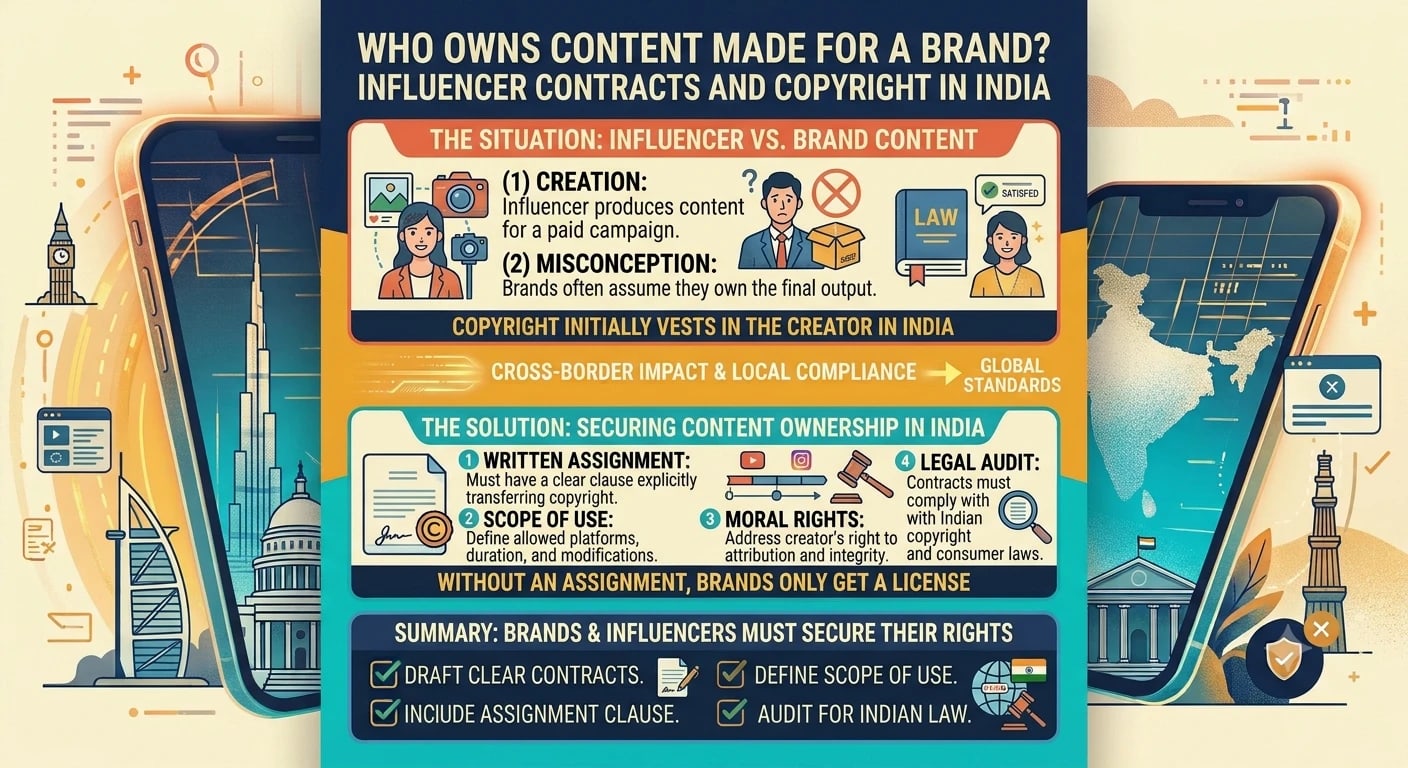
Many brands assume that if they pay an influencer for a reel, they own it. Many influencers assume the opposite, that they keep every right. Both assumptions can be wrong. Influencer content ownership India disputes arise because copyright law has special rules for commissioned work, and because the content has several layers: video, music, script, voice and face. A written agreement settles it, and a vague brief invites a dispute.
This guide explains who the first owner of copyright is, what the Copyright Act says about commissioned films and photographs, why assignment and licence are different, which clauses matter for usage rights and paid amplification, and a short checklist. It is general information for brands and creators. Always take advice on important contracts.
Who is the first owner
Under the Copyright Act, 1957, the author is the first owner of copyright in a work. An influencer who films, edits and posts a reel is usually the author of the video and its creative elements. If the influencer is an employee of the brand and creates the work in the course of employment, the employer is the first owner under Section 17(c). Most influencers are independent contractors, not employees. This starting rule shapes influencer content ownership India disputes.
A reel often has several rights in it. The video is a cinematograph film. The script and captions are literary works. The background music is a separate musical work and sound recording owned by others. The influencer’s face, voice and name raise personality and publicity rights. Even if the brand owns the video, it may not own the music or the right to use the person’s likeness in other ways.
This layered structure explains why the brand’s assumption of ownership can fail. Who owns the final file is one question. Who may use it, where, for how long and in what form is another. Treat them separately in your agreement, and do not rely on custom or on the fact that the brand paid.
What section 17(b) does and does not do
Section 17(b) of the Copyright Act has a special rule for commissioned works. For a photograph taken, a painting or portrait drawn, an engraving or a cinematograph film made for valuable consideration at the instance of a person, that person is the first owner of the copyright, in the absence of any agreement to the contrary. A video that a brand pays an influencer to make could fall within it. That is the rule for commissioned work under Section 17(b), which brands often misread.
That rule is a default, and it has limits. It applies to the listed kinds of works, not to music, scripts or other literary and musical works, and it can be displaced by agreement. Whether a particular reel was made at the instance of the brand depends on the facts: a detailed brief and paid commission point that way, a creator’s own idea that a brand later sponsors points the other way. The rule does not cover likeness or trade mark rights.
So the statement that without a written assignment copyright stays with the influencer is not always correct, and the statement that the brand always owns the content is also not correct. The safe approach is to write down who owns what. Do not leave the answer to the Act’s default, because disputes about whether a work was commissioned are costly and uncertain. The honest answer to influencer content ownership India questions is: it depends on the agreement.
Assignment versus licence
An assignment transfers ownership. Under Section 19, it must be in writing and signed by the assignor and should identify the work, the rights assigned, the duration and the territory. If the duration is not stated, it is treated as five years, and if the territory is not stated, it is presumed to be India. If the assignee does not use the rights within a year, the assignment may lapse unless the contract says otherwise. A copyright assignment under Section 19 must be in writing. Choosing between them is central to influencer content ownership India deals.
| Point | Assignment | Licence |
|---|---|---|
| Effect | Transfers ownership | Permits stated uses; creator keeps ownership |
| Form | Written and signed under Section 19 | Written, to avoid disputes |
| Defaults if silent | Five years and India; lapse if unused for a year | None; unlisted uses need permission |
| Best for | Brand wants full control | Organic posts and paid amplification |
A licence lets the brand use the content for stated purposes while the influencer remains the owner. Most influencer deals work best as licences: the brand may post the content on its channels for a period, run it as a paid ad, put it on its website and in email, in set territories. Anything outside the licence needs further permission. Licences can be exclusive or non-exclusive, and the contract should say.
Moral rights stay with the creator even after assignment. Section 57 gives an author the right to claim authorship and to object to distortion or mutilation that harms their honour or reputation. Brands should not heavily edit or place the content in a context that damages the creator. The contract can set a process for edits and approvals. Understanding the difference between copyright in influencer videos India law recognises and a licence is key.
Contract clauses that settle it
Include a clear ownership clause. State whether the brand owns the final content, only has a licence or something in between, and cover each layer: video, script, music and likeness. Set out the usage rights: channels, formats, territory, duration, paid media and any right to edit. Distinguish organic posting from paid amplification, often called whitelisting, where the brand runs ads through the influencer’s handle. Whitelisting should carry separate permission and fee. Add a whitelisting clause in influencer contract templates. Clear drafting prevents influencer content ownership India disputes.
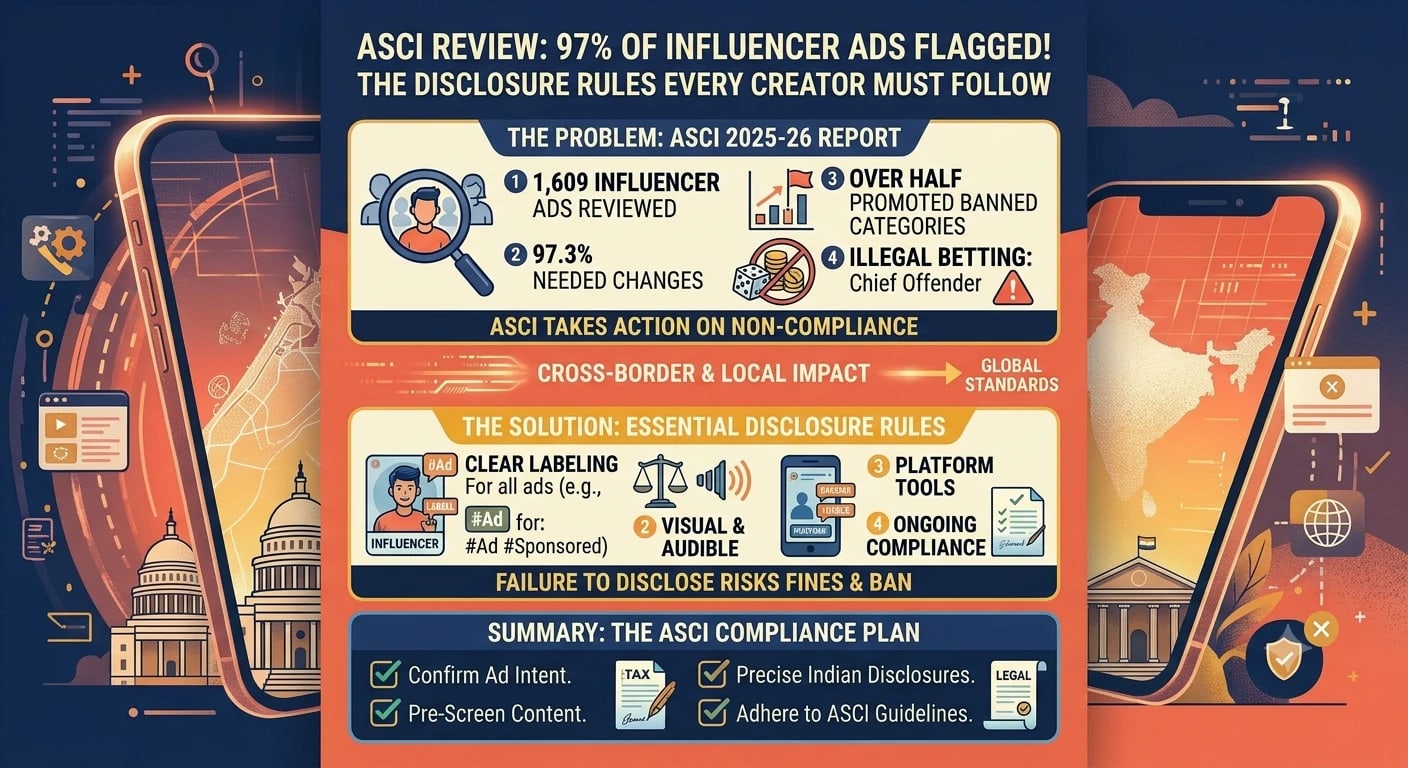
Deal with music, third-party material and warranties. The influencer should warrant that the content is original except for materials supplied by the brand and that music is cleared. If the brand supplies the song or product images, it should confirm its rights. Add disclosure obligations under ASCI and consumer law, approval steps, deadlines for takedown if there is a claim and indemnities that match who controls what.
Cover the end of the deal. Say what happens when the licence ends: whether the brand must take down the content, whether archive posts may stay and whether the influencer may keep the post on their profile and portfolio. Provide for termination, exclusivity and non-compete limits that are reasonable, since Section 27 of the Contract Act makes unreasonable post-contract restraints void. A brand usage rights influencer contract should be short, clear and signed before shooting starts.
Next steps and quick answers
Before the next campaign, brands should update their template to include ownership, usage, whitelisting, music and likeness clauses, and creators should insist on a written agreement that matches the real deal. Keep the signed brief and approvals. This is general information, not legal advice. Review influencer content ownership India terms before each shoot.
Related reading: hiring Indian influencers for a US brand, UK influencers working with Indian brands, ASCI influencer disclosure rules, exclusive and non-exclusive copyright licences, who owns code written by Indian developers, using Bollywood songs in Instagram reels and freelancing from Dubai for Indian clients; also what all rights reserved means in law.
Quick answers
Who owns the copyright in an influencer video made for a brand in India?
It depends on the agreement. Under Section 17(b) of the Copyright Act, a commissioned film or photograph can belong to the person who commissioned it for valuable consideration, absent a contrary agreement, but music, scripts and likeness are not covered, so a written contract is essential.
What is the difference between assignment and licence in an influencer contract?
An assignment transfers ownership, must be in writing and should state rights, duration and territory. A licence lets the brand use the content for stated purposes while the creator stays the owner.
Can a brand run paid ads using an influencer’s post without extra permission?
Not unless the contract allows it. Paid amplification or whitelisting should be agreed separately, with a fee, scope and duration.
Does the brand own the reel because it paid for it?
Not always. Section 17(b) can make the person who commissions a film or photograph for payment the first owner absent a contrary agreement, but it does not cover music, scripts or likeness, so a written contract is essential.
What is whitelisting?
The brand runs ads through the influencer’s handle. It should be agreed separately with its own fee, scope and duration.
Final word
Halverton & Co. is an Indian law firm advising founders, startups, technology companies and investors on Indian law, including influencer and brand contracts, copyright assignment and licensing, and media and advertising law. We practise in Jharkhand, Maharashtra and before the Supreme Court of India, and act as fractional legal counsel for technology-driven businesses. Halverton & Co.: Where tech needs law! If you have a question about Indian law, write to us at office@halvertonandco.com, or get in touch.
This article reflects developments reported up to 31 October 2026. It is for general information only, is not legal advice, and does not create an advocate-client relationship. Halverton & Co. is an Indian law firm.
Sources
Related practice area
Intellectual Property
Trade marks, copyright, patents and designs. Searched, filed, licensed and enforced under Indian law.
View the practice areaComments
No account needed. Comments are reviewed before they appear, so yours will show here once approved. Please do not share confidential details or describe your own legal matter: replies are general discussion, not legal advice, and do not create an advocate-client relationship. For your own situation, write to office@halvertonandco.com.