Key takeaways
- The Consumer Protection Act, 2019 lets the CCPA fine a manufacturer or endorser up to ₹10 lakh and up to ₹50 lakh for repeat contraventions.
- Endorsement Know-hows and ASCI rules require upfront disclosure of any material connection.
- A brand that supplies or approves claims can be exposed, so use written claim approvals and substantiation.
- Pay through banks with invoices, and check GST, withholding and Section 194R points with Indian advisers.
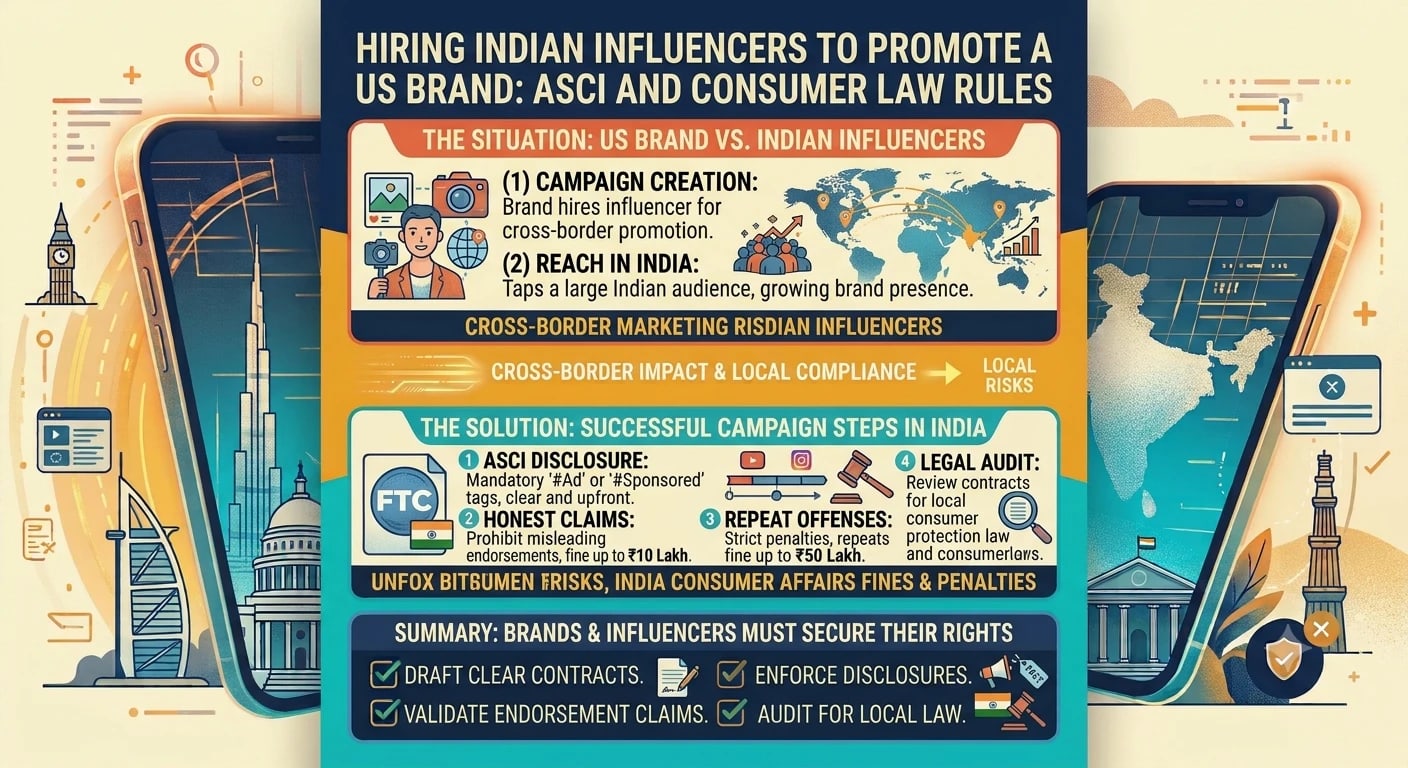
A US brand that hires Indian influencers to reach Indian consumers is subject to Indian advertising and consumer law, even if the brand has no office in India. The influencer marketing India rules brand teams must follow come from two places: the Consumer Protection Act, 2019, enforced by the Central Consumer Protection Authority, and the self-regulatory codes of the Advertising Standards Council of India. The penalties can reach ₹10 lakh for a misleading endorsement and ₹50 lakh for repeat cases.
This guide explains who is liable, what disclosure requires, how ASCI works with the law, what US brands should put in influencer contracts, how payment and tax work and a due diligence checklist. It is written by an Indian law firm for US readers. US law points, including FTC endorsement rules, should be confirmed with US counsel.
Who is liable and for what
Under Section 21 of the Consumer Protection Act, 2019, the Central Consumer Protection Authority can order the discontinuation or modification of a false or misleading advertisement and can impose a penalty of up to ₹10 lakh on a manufacturer or an endorser, and up to ₹50 lakh for subsequent contraventions. It may also prohibit an endorser from endorsing for up to a year, with longer periods for repeat cases. An endorser is not liable if they exercised due diligence to verify the claims. The Consumer Protection Act endorsement penalty applies to endorsers and manufacturers alike. A misleading endorsement fine ₹10 lakh can be imposed on a first contravention.
| Provision | What it allows | Note |
|---|---|---|
| Section 21(2), Consumer Protection Act, 2019 | Fine up to ₹10 lakh | First contravention |
| Section 21(2), repeat | Fine up to ₹50 lakh | Subsequent contraventions |
| Section 21(3) | Endorser can be barred from endorsing for a period | Length differs by source |
| Section 21(5) | No liability if due diligence was exercised | Keep verification records |
A brand is exposed through the advertisement itself. A misleading claim made by an influencer in a brand-directed post is the brand’s advertisement. The brand may be liable even if it is a foreign company, if the advertisement targets Indian consumers, and the authority can act against the entity it can reach, including local importers, distributors and platforms. Courts and regulators look at control: who wrote the script and who approved the claims.
Both parties therefore need to take care. The influencer must verify what they say, and the brand must supply accurate claims and substantiation. Influencers have been named in CCPA proceedings, and brands have been asked to withdraw advertisements. For US brands asking about influencer marketing India rules brand compliance, the practical lesson is to treat the influencer’s post like any other ad in the Indian market.
Disclosure and ASCI standards
The Department of Consumer Affairs’ Endorsement Know-hows, issued in 2023 together with the CCPA’s 2022 guidelines on misleading advertisements and endorsements, require anyone with a material connection to a brand to disclose it. That includes payment, free products, discounts, affiliate links, family or business ties. The disclosure must be clear, prominent and in the same language as the post. It should not be buried among hashtags. The CCPA endorsement guidelines 2022 set the legal baseline. These disclosure duties are central to influencer marketing India rules brand teams follow.
ASCI’s influencer advertising guidelines set the same expectation in more detail, with labels such as advertisement, ad, sponsored, collaboration or partnership and placement rules for different formats. In its 2025-26 report, ASCI handled 1,609 influencer advertisements, and 97.3% needed modification, with illegal betting leading the violations. ASCI can name violators and refer matters to regulators. Check the current guidelines and report before you finalise your brief. Treat ASCI influencer guidelines for US brands as binding in practice.
The US rules are separate. The FTC’s endorsement guides require disclosure for US audiences, and a campaign aimed at Indian audiences must meet Indian standards. If a post reaches both, follow the stricter. Also check category rules: health, finance, crypto, alcohol, betting and children’s products have specific restrictions, and real-money online gaming is restricted by the Promotion and Regulation of Online Gaming Act, 2025.
Contract clauses for US brands
Write a full agreement. Include the scope and deliverables, approval rights for scripts and posts, an obligation to follow the disclosure rules with the exact label to use, and a ban on claims not supplied by the brand. Say who is responsible for substantiating claims, and require the brand to give written claim approvals. Add warranties about originality and music clearance, and keep a record of approvals. The contract is where influencer marketing India rules brand compliance becomes enforceable.
Deal with IP and usage. Decide whether the brand owns the content or licenses it, for what channels and how long. The Copyright Act, 1957 treats a film or photograph commissioned for payment as owned by the commissioner unless there is an agreement to the contrary, but music and likeness are separate, so spell it out. Include rights for paid amplification, approval for edits and removal on request if a regulator or platform asks.
Allocate risk. Provide for takedown within hours if there is a complaint, cooperation with regulators and platforms, indemnities that match each party’s control and termination rights if the influencer breaches the rules. Include confidentiality, exclusivity that is reasonable, a code of conduct and a morality clause. Choose governing law and a forum, and consider arbitration, bearing in mind that Indian courts will apply Indian consumer law to ads aimed at Indian consumers.
Payment, tax and foreign exchange
Paying an Indian influencer from the US involves foreign exchange and tax rules. The influencer is exporting services and should receive payment through banking channels, usually in foreign currency or rupees through an authorised dealer bank, with the right purpose code. The influencer will usually issue invoices and may charge GST on export of services at a zero rate with a letter of undertaking. Check with an Indian adviser. To pay Indian influencer from the US, use a bank remittance with an invoice.
If you are paying through an Indian entity or agency, the entity may need to deduct tax at source on payments to the influencer. Free products and other benefits given to influencers can be treated as business perquisites, and Section 194R of the Income-tax Act, 1961, carried into the 2025 Act, may require tax deduction on benefits above a threshold. Ask an Indian tax adviser how it applies to gifts and samples.
Keep records for the US side too. Your US tax treatment of payments to non-US persons, withholding and forms such as W-8BEN are matters for US tax counsel. Where possible, avoid paying in cryptocurrency or through informal channels, which can cause problems in India under foreign exchange and tax rules. Use a written agreement, invoices and bank transfers that you can show to auditors and regulators. Payment practices complete the influencer marketing India rules brand checklist.
Next steps and quick answers
Before you launch, check whether your product and claims are legal in India, prepare an influencer brief with approved claims and disclosure labels, sign a contract, and monitor posts after publication. Keep screenshots and approvals. If a regulator or ASCI contacts you, respond promptly and fix the content. This is general information, not legal advice. Revisit influencer marketing India rules brand compliance for each campaign.
Related reading: ASCI influencer disclosure rules, who owns influencer content made for a brand, UK influencers working with Indian brands, keyword advertising and trade marks in India, ads inside AI answers and Indian advertising law, dark patterns and the CCPA guidelines and hiring contractors in India from the US; also crypto influencer law in India.
Quick answers
What Indian rules apply when a US brand hires an Indian influencer?
The Consumer Protection Act, 2019, the CCPA’s 2022 endorsement guidelines and the Department of Consumer Affairs’ Endorsement Know-hows, plus ASCI’s influencer guidelines, apply to ads aimed at Indian consumers, along with category rules and foreign exchange and tax rules.
What are the penalties for a misleading endorsement in India?
The CCPA can impose up to ₹10 lakh on a manufacturer or endorser, up to ₹50 lakh for repeat cases, and can bar an endorser for a period. Endorsers have a due diligence defence.
Is the brand responsible for what the influencer says?
Often yes, especially where the brand supplied or approved the claims. Both brand and influencer can face action, so use written claim approvals and a clear disclosure label.
Is a foreign brand liable under Indian consumer law?
Where the advertisement targets Indian consumers, the authority can act against the entities it can reach, including local partners and platforms. Take Indian advice.
Do I need a W-8BEN from an Indian influencer?
US withholding and forms are matters for US tax counsel, and W-8BEN is commonly used to document foreign status.
Final word
Halverton & Co. is an Indian law firm advising US companies, founders, investors and law firms on Indian law, including advertising, influencer and consumer protection law in India, brand contracts and market entry advice for US brands. We practise in Jharkhand, Maharashtra and before the Supreme Court of India, and work alongside US counsel, who advise on US law. Halverton & Co.: Where tech needs law! If you have a question about Indian law, write to us at office@halvertonandco.com, or get in touch.
This article reflects developments reported up to 31 October 2026. It is for general information only, is not legal advice, and does not create an attorney-client relationship. Halverton & Co. is an Indian law firm and does not advise on US law; US-law points should be confirmed with US counsel.
Sources
Related practice area
Intellectual Property
Trade marks, copyright, patents and designs. Searched, filed, licensed and enforced under Indian law.
View the practice areaComments
No account needed. Comments are reviewed before they appear, so yours will show here once approved. Please do not share confidential details or describe your own legal matter: replies are general discussion, not legal advice, and do not create an advocate-client relationship. For your own situation, write to office@halvertonandco.com.