Key takeaways
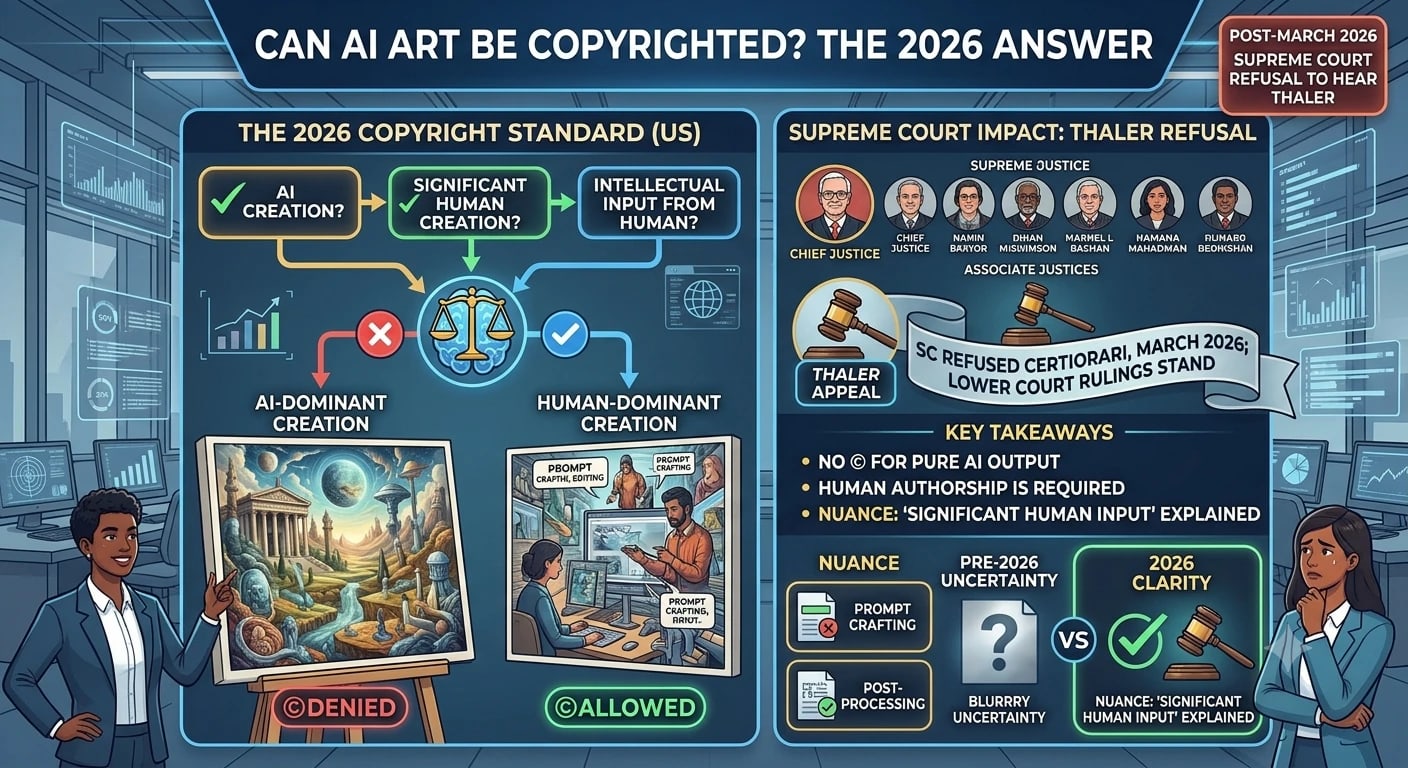
- The US Supreme Court declined to hear Thaler v. Perlmutter on 2 March 2026, leaving the D.C. Circuit’s human authorship ruling in place.
- Art generated entirely by AI, with no human creative input, cannot be copyrighted in the US.
- Human-authored elements of AI-assisted works, such as selection, arrangement and edits, can be protected, and AI material must be disclosed and disclaimed when registering.
- Other countries differ, and contracts and trade marks fill gaps where copyright does not apply.
Can AI art be copyrighted? Under current US law, art that is generated entirely by an AI system, with no human creative input, cannot be copyrighted. On 2 March 2026, the US Supreme Court declined to hear Thaler v. Perlmutter, which leaves the D.C. Circuit’s ruling in place: the Copyright Act requires a human author. The harder question, for most creators, is how much human involvement is enough.
This guide explains what the Thaler case decided, what the Supreme Court’s refusal does and does not mean, how the Copyright Office treats AI-assisted works, how other countries compare, and what creators and companies should do. It is written by an Indian law firm for a US audience. US copyright points should be confirmed with US counsel.
What Thaler v. Perlmutter decided
Stephen Thaler built an AI system he calls the Creativity Machine. It produced an image titled A Recent Entrance to Paradise. Thaler applied to register the work and named the machine as the author, with himself as owner. The Copyright Office refused, a district court agreed and in March 2025 the D.C. Circuit affirmed, holding that the Copyright Act requires that a work be authored by a human being.
The case was narrow. Thaler told the Office that the image was made autonomously, with no human creative contribution, and he did not argue that he himself was the author. So the court did not decide how much human guidance, prompting or editing makes an AI-assisted work protectable. It decided only that a machine cannot be the author, and that works generated autonomously by AI have no human author.
That narrow holding is why the answer to can AI art be copyrighted is not simply no. A work that a person creates with AI tools may be protected to the extent of the human’s own creative contribution. The line between those two situations is where the real disputes will arise, and the Thaler ruling gives only a starting point.
What the Supreme Court refusal means
On 2 March 2026, the Supreme Court denied the petition for certiorari in Thaler v. Perlmutter. A denial is not a ruling on the merits. It does not mean that the Court agrees with the D.C. Circuit. It means the Court chose not to take the case, so the D.C. Circuit’s decision stands for the parties and remains an influential authority, though it is not a nationwide Supreme Court precedent.
In practice, the Copyright Office and most courts will follow the human authorship rule. The Office has applied the same position for years, and the Thaler litigation confirmed it. A creator who files an application listing an AI system as author, or who says that the image was made with no human creative input, should expect refusal. The refusal also removes pressure for a quick resolution of the harder questions. For anyone asking can AI art be copyrighted, that is the practical rule today.
Other cases continue. Allen v. Perlmutter, in Colorado, involves an artist who used an AI tool with many prompts and edits and who challenges a refusal to register. It may address the gap that Thaler left, namely how much human control over the output is enough. Until such cases are decided, creators should plan for uncertainty and keep records.
AI-assisted works and the Copyright Office
The Copyright Office has said that copyright protects the human-authored elements of a work that uses AI. Its guidance and its 2025 report on copyrightability take the view that prompts alone are generally not enough, because the user does not control how the system turns a prompt into an output. Human selection, arrangement and modification of AI output, or human-made material that is incorporated into a work, can be protected.
The Office applied this in earlier decisions. In 2023 it registered a graphic novel, Zarya of the Dawn, for the human-written text and the selection and arrangement of the images, but not for the individual Midjourney images. It also refused registration of an image made through repeated prompting after the creator argued that his many iterations showed authorship. Check the current guidance for the latest positions.
| Situation | Position | What to do |
|---|---|---|
| Output generated entirely by AI | No copyright; no human author | Do not claim authorship; use contracts and trade marks |
| Prompts only | Generally not enough, because the user does not control the output | Add real human creative work |
| Human selection and arrangement of AI material | The selection and arrangement can be protected | Document your choices |
| Human edits or human-made material added | The human contribution can be protected | Disclose and disclaim the AI parts when registering |
Applicants must disclose AI-generated material that is more than minimal and disclaim it in the application, and explain the human contribution. Failure to disclose can lead to cancellation of a registration. If you use AI to make part of a work, describe clearly which parts you wrote, drew, edited or arranged yourself. Keep drafts, prompts and editing history, because they are your evidence of human authorship.
How other countries compare
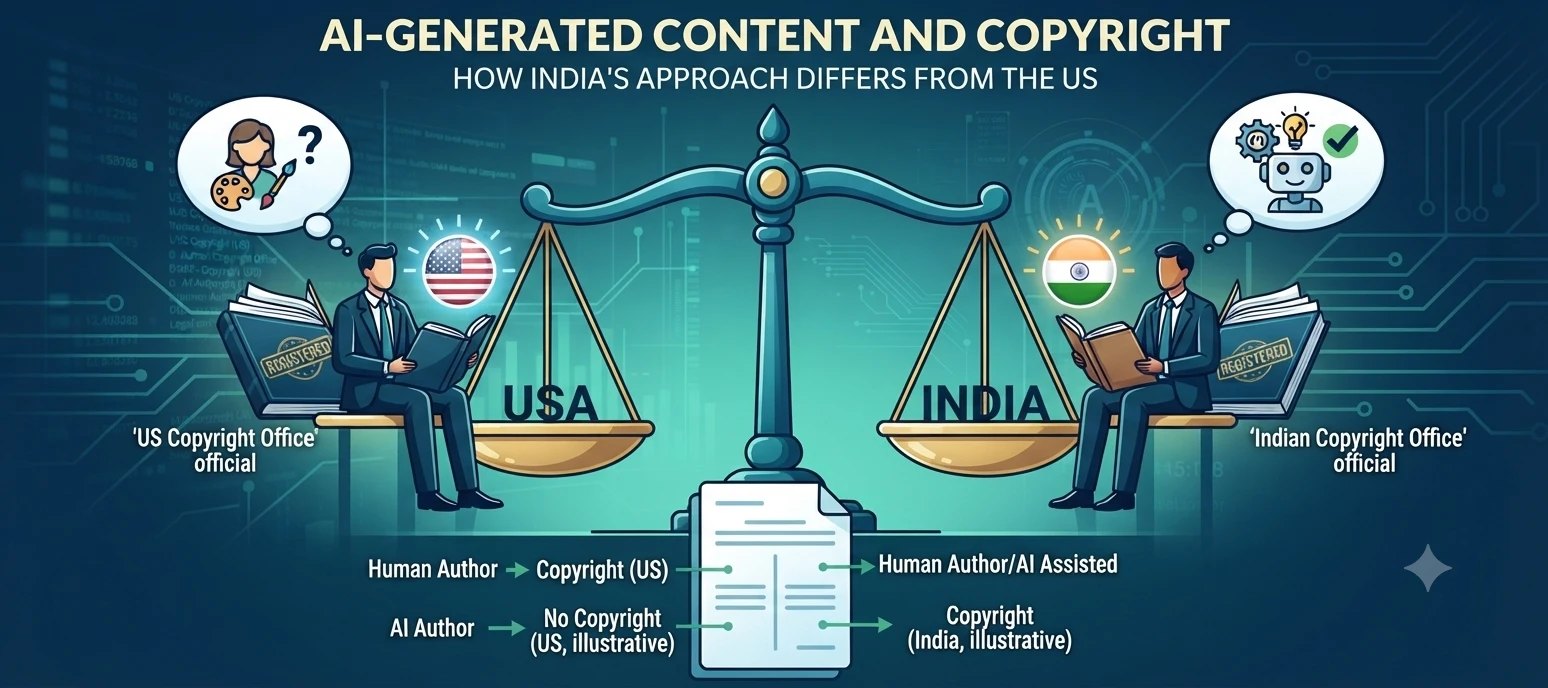
The answer to can AI art be copyrighted differs by country. The UK Copyright, Designs and Patents Act 1988 has a provision on computer-generated works that treats the person who made the arrangements for creation as the author, though the government has been reviewing it. India’s Copyright Act, 1957 includes a similar idea for computer-generated works, which has not been tested in a ruling on modern generative AI.
China’s courts have taken a more flexible view in some cases. A Beijing court held in 2023 that an image generated with an AI tool and many prompts and parameters was protectable because the user’s choices showed intellectual input. Other jurisdictions are still developing. This patchwork means that a work protected in one country may be unprotected in another, and a global product needs a plan for each market.
For companies selling AI art or using it in products, contracts become the main protection. Check the terms of the AI tool, because they may grant you ownership of outputs or only a licence. Add warranties from freelancers on AI use, and clauses that say who owns or may use AI-assisted outputs. For US readers, a US copyright lawyer should advise on registration, and an Indian lawyer on Indian use. The answer to can AI art be copyrighted also depends on the country where you sell.
Next steps and quick answers
If you create with AI, add meaningful human authorship, such as writing, drawing, compositing and editing, and document it. Disclose AI use when you register. Do not rely on copyright alone: use trade marks for names and logos, contracts for ownership and trade secrets for processes. Review your AI tool’s terms, and revisit your policy after the next decisions arrive. This is general information, not legal advice.
Related reading: AI and copyright in India and the US compared, ANI v. OpenAI and fair dealing, computer-generated works and AI copyright in India and the UK, AI-generated content and copyright in India, Getty v. Stability AI at the Court of Appeal, AI music lawsuits and generative AI startups and trade marking an AI-generated logo; also the DABUS copyright order in India and who owns code written with AI.
Quick answers
Can AI art be copyrighted in the US?
Not if it is generated entirely by AI with no human creative input. The Supreme Court declined to review Thaler v. Perlmutter in March 2026, leaving the human authorship rule in place. Human-authored elements of AI-assisted works can be protected.
Does the Supreme Court’s refusal create national law?
No. A denial of certiorari does not decide the merits. The D.C. Circuit ruling stands and is influential, but it is not a Supreme Court precedent.
Can I register art I made with Midjourney or similar tools?
Possibly for your own human contribution, such as selection, arrangement or edits, but not for the AI-generated images themselves. You must disclose and disclaim the AI-generated parts in the application.
Does a Supreme Court refusal change US law?
No. A denial of certiorari is not a ruling on the merits, but it leaves the D.C. Circuit’s decision in place, and the Copyright Office applies the same human authorship rule.
Can I copyright a Midjourney image I prompted many times?
The Copyright Office has said prompts alone are generally not enough. Human selection, arrangement and edits may be protected, so keep records and add your own creative work.
Final word
Halverton & Co. is an Indian law firm advising US companies, founders, investors and law firms on Indian law, including copyright and AI law, technology and licensing agreements, and cross-border IP advice for creators and companies with India links. We practise in Jharkhand, Maharashtra and before the Supreme Court of India, and work alongside US counsel, who advise on US law. Halverton & Co.: Where tech needs law! If you have a question about Indian law, write to us at office@halvertonandco.com, or get in touch.
This article reflects developments reported up to 31 October 2026. It is for general information only, is not legal advice, and does not create an attorney-client relationship. Halverton & Co. is an Indian law firm and does not advise on US law; US-law points should be confirmed with US counsel.
Sources
Related practice area
Technology & AI Law
Contracts, data protection and AI policies for products that handle other people’s data.
View the practice areaComments
No account needed. Comments are reviewed before they appear, so yours will show here once approved. Please do not share confidential details or describe your own legal matter: replies are general discussion, not legal advice, and do not create an advocate-client relationship. For your own situation, write to office@halvertonandco.com.