Key takeaways
- Section 9(3) of the UK Copyright, Designs and Patents Act 1988 and Section 2(d)(vi) of India’s Copyright Act both address computer-generated works.
- The UK government’s March 2026 report prefers repealing section 9(3), while still protecting AI-assisted works.
- India has not proposed repeal. Its debate focuses on a licensing model for AI training proposed by DPIIT.
- In both countries, documenting human creative input is the safest way to support protection.
The UK and India share something unusual in copyright law. Both have statutory provisions naming an author for “computer-generated works”, written long before generative AI existed. As AI tools now produce text, images, music and code at scale, both countries are deciding what to do with those provisions, and they’re heading in different directions.
This guide compares how India and the UK treat computer-generated works and AI copyright: the statutory provisions, the UK government’s 2026 report, India’s DPIIT proposals and court cases, the training data question, and what it all means for businesses creating content across both markets. UK-law points should be reviewed by a UK IP solicitor. For the US comparison, see our guide to AI copyright in India vs the US.
Two similar provisions on computer-generated works
In the UK, section 9(3) of the Copyright, Designs and Patents Act 1988 provides that, for a literary, dramatic, musical or artistic work which is computer-generated, the author is taken to be the person by whom the arrangements necessary for the creation of the work are undertaken. The protection lasts for 50 years and applies to works generated by computer in circumstances where there is no human author.
India’s equivalent is Section 2(d)(vi) of the Copyright Act, 1957, which provides that for a computer-generated literary, dramatic, musical or artistic work, the author is the person who causes the work to be created. The wording differs, but the idea is the same: a human or company behind the machine is treated as the author.
The two provisions also differ in duration. In the UK, protection for computer-generated works lasts 50 years from creation, shorter than for human-authored works. India doesn’t set a separate term for computer-generated works, which raises its own questions about how long such protection lasts. Both provisions face the same tension. Copyright traditionally protects original works reflecting human creativity. In the UK, the government has noted an apparent contradiction between section 9(3), which applies to works without a human author, and the originality standard associated with human qualities. In India, the Supreme Court’s “modicum of creativity” test in Eastern Book Company v. D.B. Modak (2008) raises a similar question for purely machine-made output.
The UK: heading towards removing section 9(3)
On 18 March 2026, the UK government published its Report on Copyright and Artificial Intelligence, following the December 2024 consultation, as required by the Data (Use and Access) Act 2025. On computer-generated works, its preferred option remains to repeal section 9(3), leaving AI-assisted works protected where they reflect human intellectual creation.
The government hasn’t removed it yet. It proposes to continue monitoring the use and impact of protection for wholly computer-generated works, so the final decision has been deferred. Removal wouldn’t leave a gap for everything: AI-assisted works that meet the originality test remain protected, and entrepreneurial works such as sound recordings remain protected even if AI-generated.
On training, the UK has stepped back. A broad text and data mining exception with an opt-out, previously the government’s preferred option, is no longer its preferred way forward. There’s no immediate reform on AI training in the UK.
India: keeping the provision, proposing a licence for training
India hasn’t proposed repealing Section 2(d)(vi). Instead, its policy debate has focused on AI training. A DPIIT committee published Part I of a working paper on generative AI and copyright in December 2025, proposing a “hybrid model”: a mandatory blanket licence allowing AI developers to train on all lawfully accessed copyrighted works, coupled with a statutory right to remuneration for rights holders. A second paper on the copyrightability and authorship of AI outputs is expected. See our guide to the DPIIT AI copyright working paper.
India’s courts are also active. In ANI v. OpenAI, the Delhi High Court refused interim relief on 24 July 2026, holding prima facie that storing and using ANI’s works to train models fell within fair dealing under Section 52(1)(a) of the Copyright Act. ANI has appealed, and the appeal was listed for 8 December 2026; see our guide to ANI v. OpenAI and fair dealing.
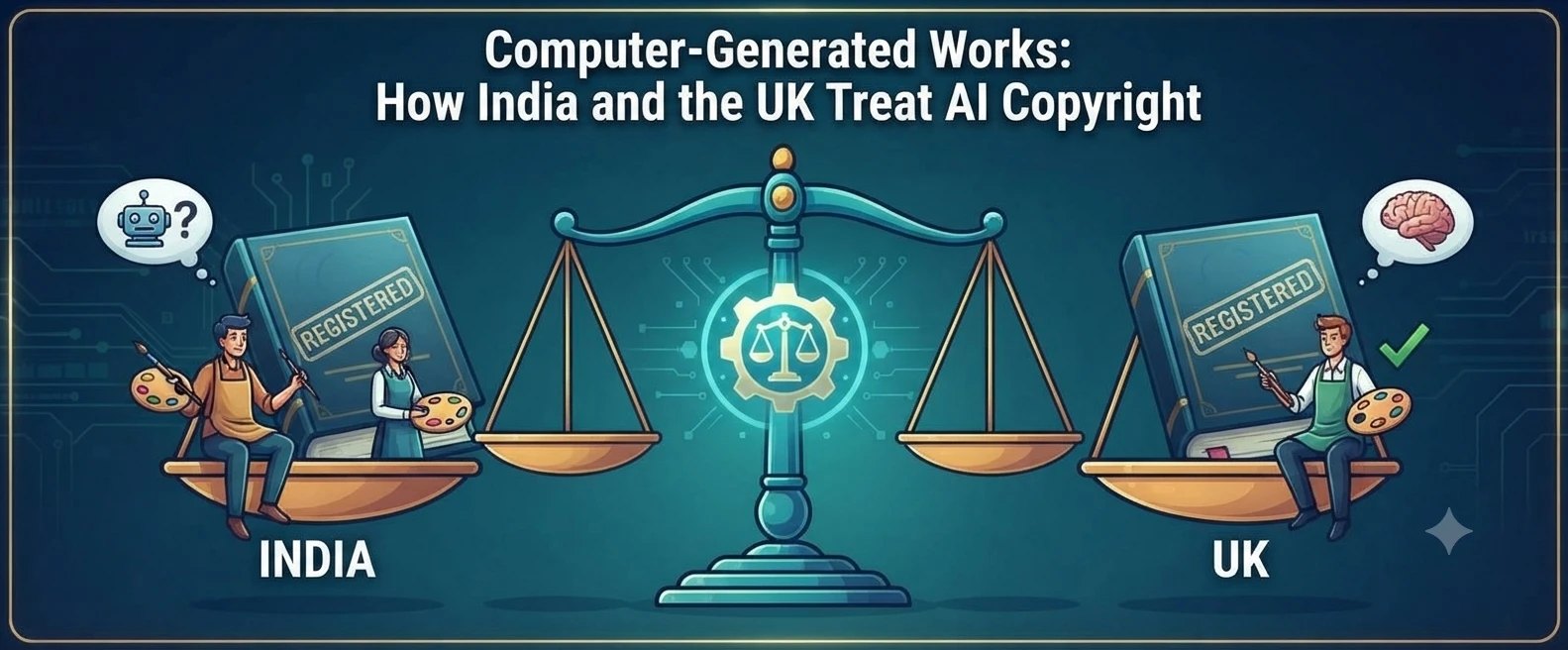
So, on computer-generated works, the UK is moving away from protecting purely AI-made content, while India retains a statutory authorship rule but still requires originality. On training, the UK has stepped back from an exception, while India is considering a statutory licence and its courts have, for now, treated training as potentially fair dealing.
| United Kingdom | India | |
|---|---|---|
| Provision | Section 9(3) CDPA 1988 | Section 2(d)(vi) Copyright Act, 1957 |
| Author | Person making the necessary arrangements | Person who causes the work to be created |
| Term | 50 years from creation | No separate term |
| Policy direction | Preferred option is to repeal; decision deferred | No proposal to repeal; DPIIT licence proposal for training |
| AI training | No broad exception; no immediate reform | Interim ruling treats training as potentially fair dealing, under appeal |
What it means for businesses working across both markets
The two countries’ differences matter most for businesses that license content, such as publishers, media companies and software firms, because a work that is clearly protected in one country may have uncertain status in the other. For businesses creating content with AI in both countries, the safest approach is the same: document human creative contribution, such as prompts, drafts, edits and selection decisions. That supports protection as AI-assisted works under the UK’s originality test, whether or not section 9(3) survives, and under India’s originality requirement and Section 2(d)(vi).
Don’t assume AI-generated content is protected anywhere. Check that AI tools’ terms let you use outputs commercially, and make sure contracts with agencies, freelancers and AI vendors deal with who owns AI-assisted output, disclosure of AI use, and infringement risk. Indian rules on labelling synthetic media also apply; see our guide to labelling AI-generated content and to AI-generated content and copyright in India.
For AI developers and rights holders, the training rules differ significantly. In the UK, the existing exceptions are narrow, and litigation and licensing remain the main routes. In India, the interim ruling in ANI v. OpenAI is favourable to developers but under appeal, and a statutory royalty system may follow. Document how training data was obtained, respect paywalls and opt-outs, and avoid unlawfully obtained sources in both countries.
Remedies, outlook and quick answers
In both countries, ordinary copyright remedies apply to AI outputs that copy protected works: injunctions, damages, accounts of profits and takedowns. India also provides criminal penalties for knowing infringement. The outlook is for continued change. The UK may legislate to remove section 9(3) and is consulting further on transparency and deepfakes, while India awaits the next DPIIT paper and the outcome of the ANI v. OpenAI appeal. Businesses creating or relying on computer-generated works in both markets should review their AI content policies at least annually. Check for any UK legislation or consultation on section 9(3) published after March 2026.
Quick answers
Are computer-generated works protected in the UK?
Section 9(3) CDPA currently protects them, but the UK government’s 2026 report says its preferred option is to repeal it, while continuing to protect AI-assisted works.
How does India treat computer-generated works?
Section 2(d)(vi) of India’s Copyright Act makes the person who causes the work to be created its author, but originality is still required.
Is AI training lawful in India and the UK?
In India, the Delhi High Court held prima facie in 2026 that it can be fair dealing, under appeal. In the UK, there’s no broad training exception and no immediate reform.
Related reading: deepfakes of UK creators and brands: Indian courts vs UK law; also who owns the AI model: IP for UK startups building in India; also Getty v. Stability AI at the Court of Appeal; also whether AI art can be copyrighted after Thaler.
Final word
Halverton & Co. is an Indian law firm that advises on Indian law, including AI copyright, content licensing and AI training data issues in India. We practise in Jharkhand, Maharashtra and before the Supreme Court of India, and we work alongside your UK solicitors, who advise on English law. Halverton & Co.: Where tech needs law! If you have a question about Indian law, write to us at office@halvertonandco.com, or get in touch.
This article reflects developments reported up to early October 2026. It is for general information only, is not legal advice, and does not create a solicitor-client relationship. Halverton & Co. is an Indian law firm, is not authorised or regulated by the Solicitors Regulation Authority, and does not advise on English law or UK tax.
Sources
Related practice area
Intellectual Property
Trade marks, copyright, patents and designs. Searched, filed, licensed and enforced under Indian law.
View the practice areaComments
No account needed. Comments are reviewed before they appear, so yours will show here once approved. Please do not share confidential details or describe your own legal matter: replies are general discussion, not legal advice, and do not create an advocate-client relationship. For your own situation, write to office@halvertonandco.com.