Key takeaways
- Section 230 gives broad, mostly unconditional immunity, while India’s Section 79 safe harbour depends on conditions.
- In Shreya Singhal (2015) the Supreme Court read actual knowledge as a court order or government notification, not a private complaint.
- The IT Rules add due diligence duties and, from 2026, tighter takedown windows.
- US platforms need Indian officers, logs of every notice and a plan for orders that conflict with US law.
Section 230 India comparisons come up in every board meeting of a US platform thinking about the Indian market. At home, Section 230 of the Communications Decency Act gives a platform broad immunity for what users post. In India there is a shield, but it is conditional, narrower and easier to lose. A company that moves its US compliance playbook to India unchanged will be surprised.
India’s safe harbour is in Section 79 of the Information Technology Act, 2000, supported by the IT Rules, 2021, amended again in 2026. Here is how the two systems differ in practice, what the Supreme Court said in Shreya Singhal, and what US platforms actually need to do. This is not US law advice; the US side of each comparison should be checked with US counsel. Section 230 India comparisons start with one point: safe harbour Section 79 IT Act is conditional.
How Section 230 works
Section 230(c)(1) says that a provider or user of an interactive computer service isn’t to be treated as the publisher or speaker of information provided by someone else. In practice, platforms are generally not liable for user content, even if they know about it, with exceptions for federal criminal law, intellectual property and a few other areas. Section 230(c)(2) protects good-faith moderation. Section 230 India debates start from the US text.
The immunity is largely unconditional. A platform doesn’t have to follow a notice and takedown process to keep it. That is the feature people mean when they call it a unique American shield. It is also why US platforms often arrive in other markets with policies built around discretion, not obligation.
Debates in Congress and the courts about narrowing it continue, but the core remains. The contrast with India is sharp. The Section 230 India question is really about conditions versus immunity.
How India’s safe harbour works
Section 79 of the IT Act exempts an intermediary from liability for third party content, but only if conditions are met: it doesn’t initiate the transmission, select the receiver or modify the content; it observes due diligence; and it removes or disables access to unlawful content on actual knowledge, or on a notice from the government or a court. Fail those conditions and the protection goes. That is the heart of the safe harbour Section 79 IT Act regime. Under Section 79 of the IT Act, safe harbour Section 79 IT Act rules depend on conditions. Shreya Singhal actual knowledge means a court order.
In Shreya Singhal v Union of India (2015), the Supreme Court read the “actual knowledge” requirement narrowly. A platform is obliged to act when it receives a court order or a government notification in line with the law, not merely a private complaint. That was a speech-protective reading, and it limits a platform’s duty to take down on private notice, at least under Section 79(3)(b).
But the rules have layered obligations on top. The IT Rules, 2021 require significant due diligence: published rules, a grievance officer in India, compliance officers for the largest platforms, deadlines for resolving complaints and, from the 2026 amendment, tighter takedown windows. A platform that doesn’t follow the Rules risks losing safe harbour altogether. The IT Rules 2021 due diligence intermediary duties sit on top of that.
Where the two systems differ most
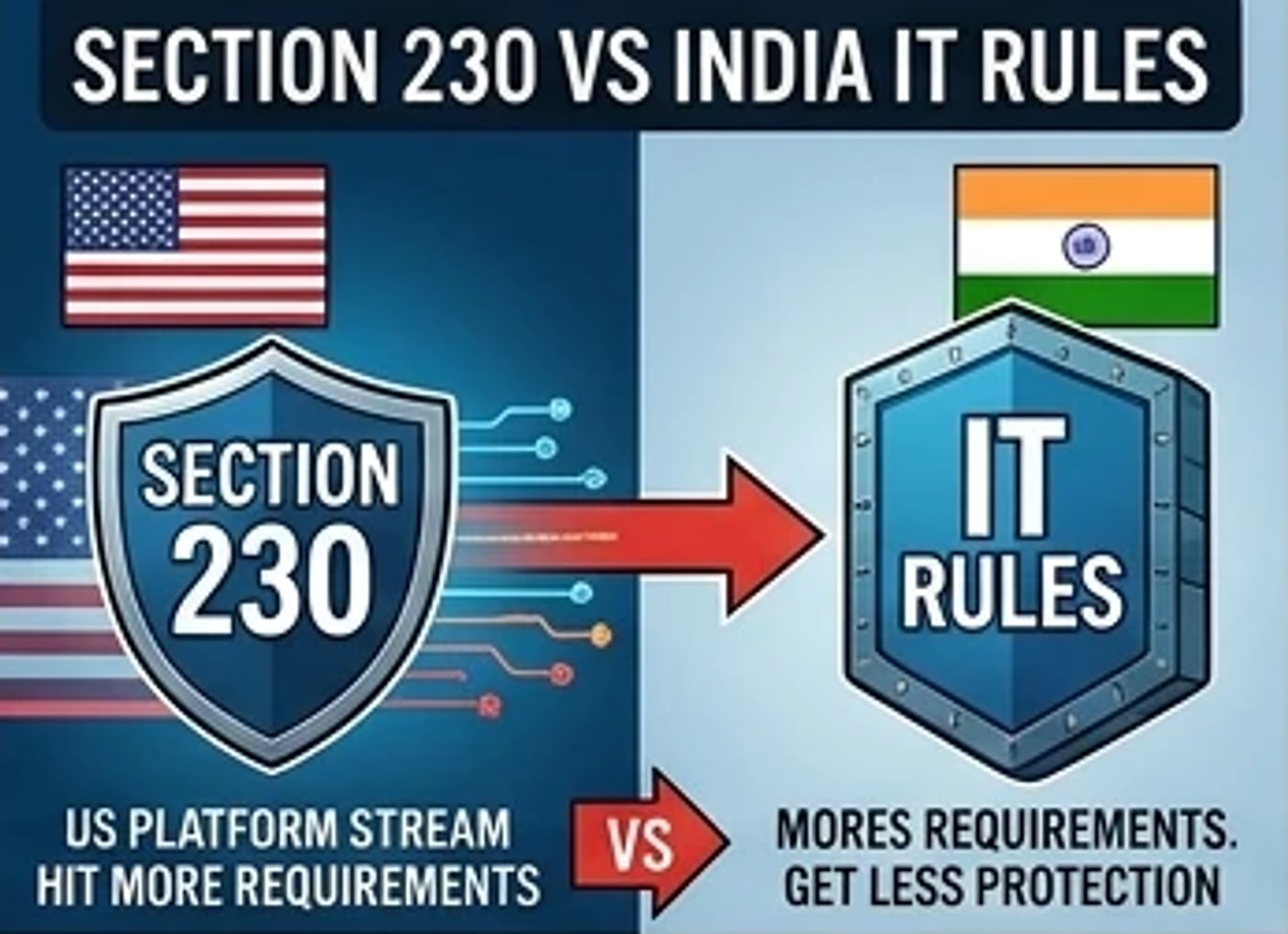
Condition versus immunity is the first difference. In the US a platform keeps protection without any process. In India, protection depends on due diligence and prompt compliance with orders. The Section 230 India gap is really about whether the shield is a right or a reward for good behaviour. The Section 230 India gap is the largest difference between the two systems.
| Point | Section 230 (US) | Section 79 (India) |
|---|---|---|
| Nature of protection | Broad, mostly unconditional | Conditional on due diligence |
| Takedown trigger | No process required | Court order or government notification (Shreya Singhal) |
| Local officers | Not required | Required under IT Rules |
| Loss of protection | Rare | Failure of due diligence |
Speed is the second. The IT Rules amended in 2026 reportedly cut some takedown windows to three hours, and to two for non-consensual intimate imagery, though commentary differs on what triggers the clock. Compare that with a US platform’s ordinary discretion over timing. Our post on the 3-hour takedown goes through the steps.
Local presence is the third. Large platforms must appoint India-based officers, publish contact details and answer to the Grievance Appellate Committee. And the fourth, state action: the government can issue blocking directions and notices, including through the Sahyog portal, and challenges by platforms have met mixed results in court. A company that says it only follows US law isn’t going to be comfortable. US platform liability India user content can follow a failure to act, and the three-hour takedown IT Rules platforms must meet applies to some orders.
What US platforms must do in India
First, check whether you are an intermediary under the Act and what category you fall into: ordinary, social media or significant social media intermediary. The category decides which obligations apply. Then appoint the required officers, publish terms and a grievance channel, and set up a team that can receive and act on orders within the stated time. For a US platform, Section 230 India differences mean local officers and records.
Second, build a record. Log every notice, order and complaint, the decision and the time taken. If a dispute arises over whether you kept safe harbour, those records are your evidence. Train moderators on the difference between a court or government order and a private complaint, and route them correctly.
Third, plan for conflict. An Indian order may require removal of content that is lawful in the US. Decide in advance how you will respond, what you will geo-block and how you will challenge an order you think is overbroad. Get both Indian and US advice before taking a public position. Do not assume Section 230 India style immunity applies to your Indian users.
Questions people ask
None of this is a reason to avoid India. It is a reason to treat compliance as part of the launch, not a clean-up job after the first notice. Section 230 India is a reason to build compliance in from the start.
Related reading: AI intermediaries and safe harbour in India, binding MeitY advisories and safe harbour, the Sahyog portal and content takedowns, deepfake removal in India, TAKE IT DOWN Act compliance for platforms built in India and platform liability for deepfakes.
Quick answers
How is Section 230 India different from US law?
Section 230 gives broad, mostly unconditional immunity. India’s safe harbour under Section 79 of the IT Act depends on meeting conditions, including due diligence under the IT Rules and acting on court or government orders, and can be lost.
What did Shreya Singhal decide about intermediary liability?
The Supreme Court held that for Section 79, “actual knowledge” means a court order or government notification, not a private complaint, and struck down Section 66A.
Can a US platform lose safe harbour in India?
Yes. If it fails the due diligence rules or ignores valid orders, it can lose Section 79 protection and face liability for user content.
Can a US platform lose safe harbour in India?
Yes. Failing due diligence or ignoring valid orders can lose Section 79 protection.
Final word
Halverton & Co. is an Indian law firm advising US companies, founders, investors and law firms on Indian law, including IT Rules, platform compliance and Indian litigation for US technology companies, working alongside US counsel. We practise in Jharkhand, Maharashtra and before the Supreme Court of India, and work alongside US counsel, who advise on US law. Halverton & Co.: Where tech needs law! If you have a question about Indian law, write to us at office@halvertonandco.com, or get in touch.
This article reflects developments reported up to 31 October 2026. It is for general information only, is not legal advice, and does not create an attorney-client relationship. Halverton & Co. is an Indian law firm and does not advise on US law; US-law points should be confirmed with US counsel.
Sources
Related practice area
Technology & AI Law
Contracts, data protection and AI policies for products that handle other people’s data.
View the practice areaComments
No account needed. Comments are reviewed before they appear, so yours will show here once approved. Please do not share confidential details or describe your own legal matter: replies are general discussion, not legal advice, and do not create an advocate-client relationship. For your own situation, write to office@halvertonandco.com.