Key takeaways
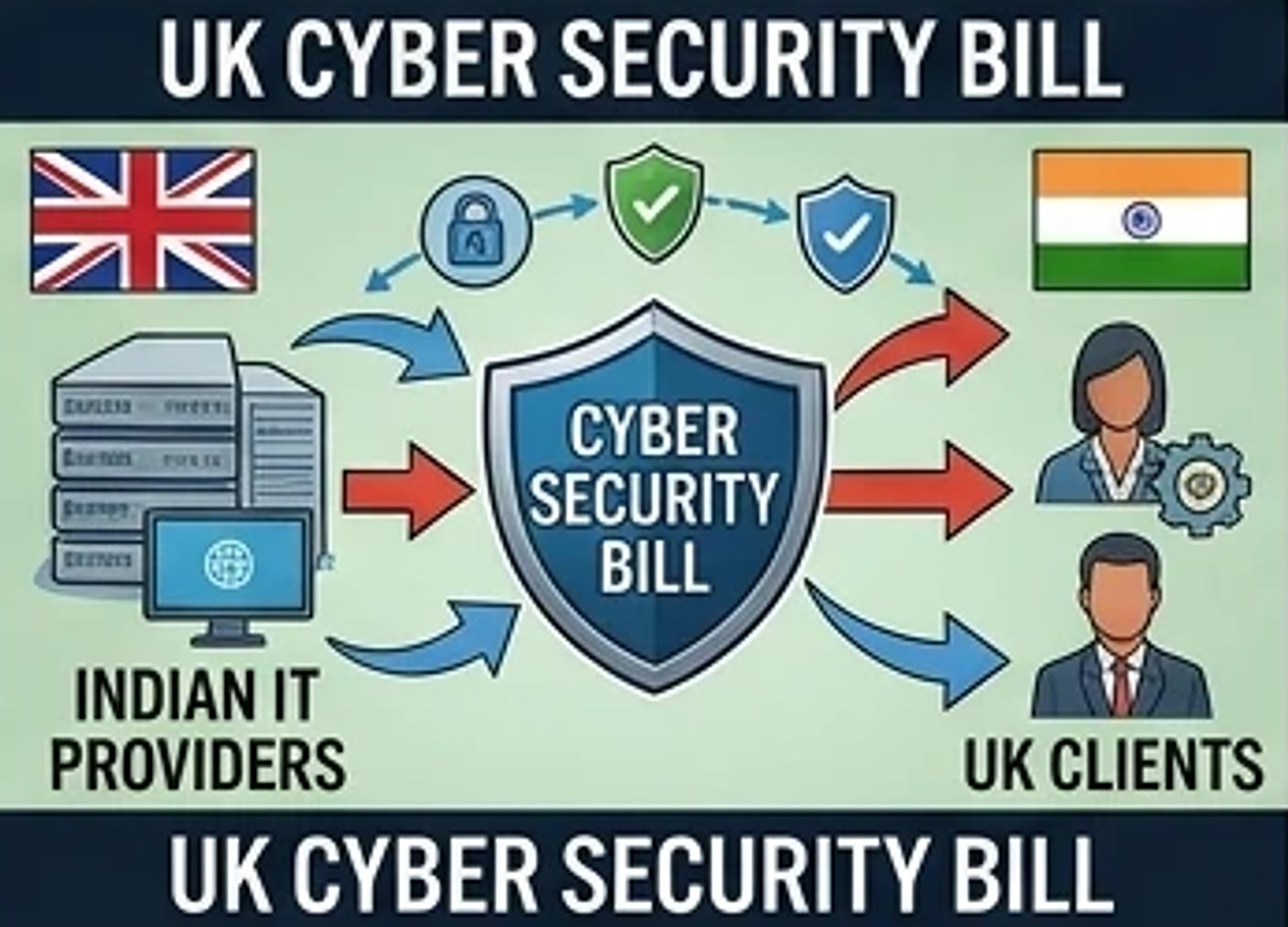
- The Bill would update the NIS Regulations to cover managed service providers and data centres, including overseas providers that serve the UK.
- Summaries say overseas providers would need to register with the ICO and nominate a UK representative.
- Reported incident reporting is an initial notice within 24 hours and a full report within 72 hours.
- Check the Bill’s current stage on the Parliament site, because wording and fines may change in the Lords.
If you provide managed IT services to UK clients from India, the Cyber Security and Resilience Bill is a bill to read, not skim. It would extend the UK’s Network and Information Systems Regulations to managed service providers and data centres, wherever they are established, if they provide services into the UK. That is a large step: a call centre or a cloud operations team in Pune could find itself directly regulated by a UK regulator.
The Bill hasn’t become law. Sources show it passed the Commons in June 2026 and moved to the House of Lords, though some commentary written later still describes it as something to prepare for. We can’t confirm the latest stage from where we sit, so check the UK Parliament bill page before relying on anything below. The practical question is what to do now, with the uncertainty about wording and timing. The Cyber Security and Resilience Bill matters to Indian providers because it reaches overseas managed service providers. Its Cyber Security and Resilience Bill Lords stage may change the text.
What the bill would do
The Cyber Security and Resilience (Network and Information Systems) Bill, introduced in November 2025, updates the NIS Regulations 2018, the UK’s main cyber law for essential services. It widens the set of regulated entities to include managed service providers, data centres and certain other suppliers, tightens incident reporting, and gives regulators and the Secretary of State new powers, including to designate critical suppliers. The Cyber Security and Resilience Bill would update the NIS Regulations.
The reasoning is that large cyber incidents increasingly come through suppliers. An attack on one provider can reach hundreds of customers. By regulating the supply chain directly, the government wants better security and faster information-sharing. Managed service providers NIS Regulations coverage is the main change for IT services firms.
Details have shifted as the Bill moved through Parliament. Reports say the Commons completed its stages in June 2026, with the Bill introduced in the Lords shortly after. Amendments in the Lords could change scope, thresholds and penalties. Treat the version you read today as provisional.
Are Indian IT providers in scope
According to law firm summaries, the Bill would apply to managed service providers and data centre operators whether or not they are established in the UK, if they provide services into the UK. Providers outside the UK would have to register with the ICO and nominate a UK representative. Estimates mention that around 900 to 1,100 managed service providers might be covered. Under the Cyber Security and Resilience Bill, an overseas managed service provider needs a UK representative overseas provider ICO registration. That is one of the headline points.
A managed service provider, in broad terms, provides services relating to the provision of IT services, such as management of IT systems, networks or security, through ongoing support involving access to a customer’s systems. Many Indian IT service companies do that: managed infrastructure, SOC and monitoring, application support with admin access, service desk with remote access. Whether your service qualifies depends on the final definition and thresholds, which exclude small providers.
Is your Indian IT service provider UK client relationship caught? Look at three things: what you do (ongoing managed services with access to client systems), for whom (UK customers), and how large you are. If the answers are yes, yes and above the threshold, start planning. If you are a subcontractor to a UK prime, you may be regulated or flowed down obligations. Check with a UK adviser. Scope under the Cyber Security and Resilience Bill depends on thresholds.
Incident reporting and penalties
The Bill uses a two-stage reporting model. Summaries say regulated entities must give an initial notification within 24 hours of becoming aware of a significant incident, and a fuller report within 72 hours. That differs from EU NIS2, which has a later final report, and it is tighter than many contracts today. The incident reporting 24 hours 72 hours clocks run alongside others, such as CERT-In’s six hours for incidents in India and the UK GDPR’s 72 hours to the ICO for personal data breaches. Reporting under the Cyber Security and Resilience Bill is two-stage.
| Regime | Clock | Recipient |
|---|---|---|
| Cyber Security and Resilience Bill (proposed) | Initial notice 24 hours, full report 72 hours | Regulator and NCSC |
| UK GDPR | 72 hours | ICO |
| CERT-In (India) | Six hours | CERT-In |
| DPDP Rules (as reported) | Without delay, detailed report in 72 hours | Data Protection Board |
Customers affected by an incident may also need to be told as soon as reasonably practicable. That has contract implications for providers and their clients. Many UK customers will push the obligation down in their contracts, and may demand shorter periods than the law gives.
On penalties, sources disagree. One summary describes fines of up to £10 million or 2% of turnover for less serious breaches, with daily fines of up to £100,000 for continuing non-compliance. Another refers to penalties reaching 10% of global annual revenue for certain violations. These probably describe different tiers, but verify against the Bill’s text. Either way, the numbers justify attention for a mid-sized provider.
How to prepare now
Do a scope check. List services you provide to UK customers that look like managed services, the customers, the systems you access and your headcount and turnover. Ask UK counsel whether you are likely to be a regulated managed service provider and, if so, what thresholds apply. Document the analysis. To prepare for the Cyber Security and Resilience Bill, start with a scope check.
Tighten incident response. If you already have a plan for CERT-In and customer notification, extend it to a 24-hour initial notice for UK customers and the regulator. Define who decides what is significant, how information is collected quickly, and who talks to the regulator. Run a table-top exercise with a UK client. Align logging and detection so you can know about an incident in time to report it.
Review contracts and security. Expect UK customers to ask about NIS-style controls, supply chain security and cooperation clauses. Update your standard terms, subcontractor flow-downs and security addenda. Watch the ICO and the Bill for the registration process and UK representative requirement, and plan for a UK entity or appointed representative if needed. Our posts on the UK ransomware payment ban and on DPDP breach notification compared with UK GDPR cover the related clocks. The Cyber Security and Resilience Bill also affects contracts.
Questions people ask
The central message for a founder: assume the supply chain will be regulated, and make the shortest incident reporting clock your default. Assume the Cyber Security and Resilience Bill will regulate suppliers.
Related reading: the UK ransomware payment ban, the CERT-In six-hour rule for startups, DPDP breach notification vs UK GDPR, offshore data processing in India for UK clients, UK GDPR and outsourcing to India and a ransomware attack in India: the first 24 hours; also processor liability under the UK GDPR.
Quick answers
What is the Cyber Security and Resilience Bill?
It is a UK bill that would update the NIS Regulations 2018, bringing managed service providers, data centres and some other suppliers into regulation, tightening incident reporting and strengthening regulators’ powers. It had passed the Commons by June 2026, according to reports, and was moving through the Lords.
Would an Indian IT provider to UK clients be covered?
Possibly. According to summaries, managed service providers that provide services into the UK would be covered even if established overseas, and would need to register with the ICO and nominate a UK representative, subject to thresholds in the final text.
What are the incident reporting deadlines?
Summaries say an initial notification within 24 hours of awareness and a full report within 72 hours. Check the Bill as it stands when you plan.
Is the Bill law yet?
Not as far as the sources reviewed show. Check the UK Parliament bill page.
Final word
Halverton & Co. is an Indian law firm advising UK companies, founders, investors and law firms on Indian law, including cyber incident readiness, CERT-In and contracts for Indian IT service providers with UK clients, alongside UK counsel. We practise in Jharkhand, Maharashtra and before the Supreme Court of India, and work alongside your UK solicitors, who advise on English law. Halverton & Co.: Where tech needs law! If you have a question about Indian law, write to us at office@halvertonandco.com, or get in touch.
This article reflects developments reported up to 31 October 2026. It is for general information only, is not legal advice, and does not create a solicitor-client relationship. Halverton & Co. is an Indian law firm, is not authorised or regulated by the Solicitors Regulation Authority, and does not advise on English law; UK-law points should be confirmed with UK advisers.
Sources
Related practice area
Technology & AI Law
Contracts, data protection and AI policies for products that handle other people’s data.
View the practice areaComments
No account needed. Comments are reviewed before they appear, so yours will show here once approved. Please do not share confidential details or describe your own legal matter: replies are general discussion, not legal advice, and do not create an advocate-client relationship. For your own situation, write to office@halvertonandco.com.