Key takeaways
- On 30 October 2026 a Divisional Court dismissed Meta, TikTok and X’s challenges to Ofcom’s information notices under section 100 of the Online Safety Act 2023.
- Meta’s separate challenge to Ofcom’s fees and fines calculation is still awaiting judgment.
- The Act applies to services with links to the UK, including apps based in India.
- Ofcom can fine up to £18 million or 10% of qualifying worldwide revenue and seek business disruption orders.
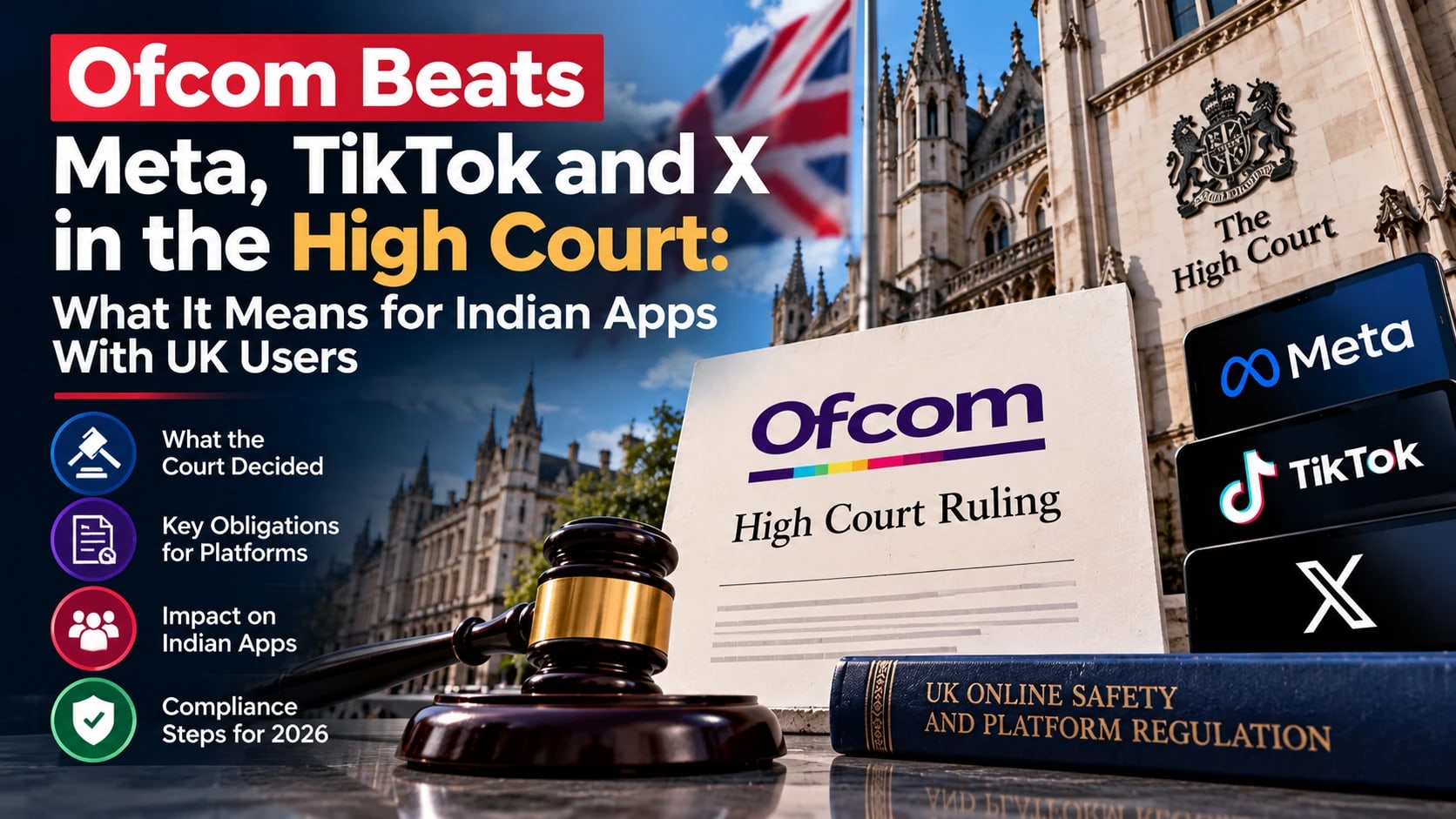
The Ofcom High Court ruling Meta TikTok X faced on 30 October 2026 is a warning to any platform with UK users, including Indian apps. A Divisional Court dismissed challenges by Meta, TikTok and X to information notices that Ofcom issued under the Online Safety Act 2023, rejecting arguments that the demands were disproportionate. A separate challenge by Meta about how Ofcom calculates fees and potential fines is still waiting for judgment.
This guide explains what the court decided, what the Online Safety Act requires of services with UK users, how it can reach Indian apps, what Ofcom can do if you do not comply, and a practical compliance plan. It is written by an Indian law firm for UK readers. UK regulatory points should be confirmed with UK counsel, and the judgment itself should be read, because the details of the ruling are reported from news coverage.
What the High Court decided
On 30 October 2026, the Divisional Court of the High Court, reported as made up of Lord Justice Singh and Mrs Justice Collins Rice, dismissed three joined claims brought by Meta and WhatsApp, X Internet Unlimited Company and TikTok Information Technologies UK against Ofcom. The claims challenged information notices that Ofcom issued in February 2026 under section 100 of the Online Safety Act 2023. The companies argued that the notices were disproportionate. The court rejected that argument.
The result is a significant win for Ofcom’s information-gathering powers. Section 100 lets Ofcom require regulated services to give it information it needs for its online safety functions, and the court’s refusal to interfere suggests that large and detailed requests can be lawful where they are linked to Ofcom’s duties. A reported neutral citation is [2026] EWHC 2779 (Admin), but check the judgment for the exact citation and reasoning. The Ofcom High Court ruling Meta TikTok X faced shows that proportionality challenges are hard to win.
Not everything is decided. Meta has a separate challenge to how Ofcom calculates fees and the maximum potential fines, in which Ofcom uses worldwide revenue. The hearing took place in October 2026, and judgment is awaited. Companies and commentators will watch that decision because it affects the fee burden and the size of the maximum penalty for any company, large or small. The Ofcom High Court ruling Meta TikTok X won or lost on notices is only part of the picture.
What the Online Safety Act requires
The Online Safety Act 2023 applies to user-to-user services, such as social media, messaging and forums, and to search services, that have links with the UK. Providers must carry out risk assessments for illegal content, take steps to prevent and remove illegal content, protect children where children are likely to use the service, and provide reporting and complaints tools. Larger and higher-risk services have extra duties. The Ofcom High Court ruling Meta TikTok X contested concerns duties of exactly this kind.
A service has links with the UK if it has a significant number of UK users, if the UK is a target market, or if it is capable of being used in the UK and there is a material risk of significant harm to UK users. The Act does not require a UK office. Ofcom has said it will focus on services with the biggest reach and risk, but smaller services are also in scope, and it has begun enforcement.
Ofcom also collects fees from providers above a revenue threshold and can demand information, as the court case shows. Providers must keep records and respond to information notices accurately and on time. Failure to comply, or giving false or incomplete information, can be an offence. These obligations apply whether the provider is in the UK or elsewhere.
How it reaches Indian apps
An Indian app that has UK users, such as a social platform, a dating app, a messaging service, a gaming community or a user-generated content site, may be in scope. Being based in India does not remove the duty if the service has links with the UK. Many Indian startups with diaspora users in the UK, or global ambitions, should check their position early, before Ofcom writes to them.
The practical steps are the same as for any regulated service. Determine whether you are a user-to-user or search service, estimate UK users, assess illegal content risks and risks to children, and decide what controls you need: moderation, reporting, age assurance where required, terms of service and complaints. Keep a record of the risk assessment and the decisions that follow from it. Use the Ofcom High Court ruling Meta TikTok X faced as a prompt to review your own plan.
Indian law also applies. The Information Technology Act, 2000 and the IT Rules, 2021, as amended, set content and takedown duties for intermediaries in India, and the Digital Personal Data Protection Act, 2023 governs personal data. UK and Indian rules may conflict or overlap, for example on content removal and data transfers. Plan your policies so that they satisfy both, and take advice where requirements differ.
What Ofcom can do
Ofcom can issue information notices, require audits and interviews, give provisional and final notices of contravention, and impose fines of up to £18 million or 10% of qualifying worldwide revenue, whichever is greater. It can also apply to court for business disruption measures, such as orders that require payment providers or advertisers to stop working with a non-compliant service, or that require internet service providers to block access.
| Power | What it allows | Note |
|---|---|---|
| Information notices | Require information for online safety functions | Section 100; upheld in the High Court on 30 October 2026 |
| Fines | Up to £18 million or 10% of qualifying worldwide revenue | Whichever is greater |
| Business disruption | Court orders affecting payment, advertising or access | For non-compliant services |
| Criminal liability | For senior managers in some cases | Such as failing to comply with notices |
Senior managers can face criminal liability in some cases, such as failing to comply with information notices or with duties on child safety after notice. Ofcom has opened investigations, including into services based outside the UK, and has made clear that location is not a defence. A foreign provider that ignores Ofcom risks fines and blocking, even though enforcement abroad is harder.
The best defence is engagement. If you receive an information notice, respond accurately and on time, seek clarification if the request is unclear, and escalate to counsel. If you are unsure about your status, consider speaking to Ofcom early. The latest judgment suggests that challenges based on proportionality face a high bar, so cooperation and good records are a safer path. Read the Ofcom High Court ruling Meta TikTok X case in full when the judgment is published.
Next steps and quick answers
Check whether your app has links with the UK, assess your risks, put the main controls in place, prepare a response process for Ofcom notices and name a person in charge. Read the judgment when it is available, and watch for the decision in Meta’s fee challenge. If you operate from India, align UK and Indian compliance. This is general information, not legal advice.
Related reading: whether an AI product is an AI intermediary in India, India’s DPDP Act for UK businesses, deepfakes and personality rights in the UK and India, platform liability for deepfakes: lessons from Grok, labelling AI-generated content under the IT Rules 2026, the draft IT Rules change on binding advisories and Indian scam call centres: options for UK victims; also Online Safety Act age checks for Indian apps; also Ofcom Online Safety Act fines.
Quick answers
What did the High Court decide in the Ofcom case?
On 30 October 2026, a Divisional Court dismissed challenges by Meta, TikTok and X to Ofcom’s information notices under section 100 of the Online Safety Act 2023, rejecting arguments that the demands were disproportionate.
Does the Online Safety Act apply to Indian apps?
It can, if the app has links with the UK, such as a significant number of UK users or a UK target market. Location outside the UK does not remove the duties.
What are Ofcom’s maximum penalties?
Fines of up to £18 million or 10% of qualifying worldwide revenue, whichever is greater, plus possible court orders to disrupt a non-compliant service’s business or access.
Did the High Court decide Meta’s fees challenge?
No. Meta’s separate challenge to how Ofcom calculates fees and maximum fines is still awaiting judgment, according to reports.
Does the Online Safety Act apply to a small Indian app?
It can, if the app has links with the UK, such as a significant number of UK users or a UK target market. Ofcom prioritises the largest and riskiest services, but smaller services are in scope.
Final word
Halverton & Co. is an Indian law firm advising UK companies, founders, investors and law firms on Indian law, including technology and platform regulation, intermediary compliance in India and the UK, data protection, and cross-border advice for apps with UK users. We practise in Jharkhand, Maharashtra and before the Supreme Court of India, and work alongside your UK solicitors, who advise on English law. Halverton & Co.: Where tech needs law! If you have a question about Indian law, write to us at office@halvertonandco.com, or get in touch.
This article reflects developments reported up to 31 October 2026. It is for general information only, is not legal advice, and does not create a solicitor-client relationship. Halverton & Co. is an Indian law firm, is not authorised or regulated by the Solicitors Regulation Authority, and does not advise on English law; UK-law points should be confirmed with UK advisers.
Sources
Related practice area
Technology & AI Law
Contracts, data protection and AI policies for products that handle other people’s data.
View the practice areaComments
No account needed. Comments are reviewed before they appear, so yours will show here once approved. Please do not share confidential details or describe your own legal matter: replies are general discussion, not legal advice, and do not create an advocate-client relationship. For your own situation, write to office@halvertonandco.com.