India’s gig economy runs on millions of people who deliver groceries in ten minutes, drive cabs, fix air conditioners and cut hair through apps. For years, the law treated almost all of them as neither employees nor anything else: “partners” with no statutory social security at all. That has now changed.
With the labour codes in force from 21 November 2025, the Code on Social Security formally recognises gig and platform workers and puts specific obligations on the aggregators who engage them. This guide explains what the Social Security Code requires of aggregators, what the final rules say, how state gig worker laws fit in, and the legal risks and remedies that delivery, mobility and services startups need to understand. For the wider picture, see our guide to the new labour codes for startups.
Who counts as a gig worker, platform worker and aggregator
The Code on Social Security, 2020 introduces three linked definitions. A gig worker is someone who performs work or participates in a work arrangement and earns from it outside a traditional employer-employee relationship. A platform worker is someone who works through an online platform to provide services to individuals or organisations. An aggregator is a digital intermediary or marketplace that connects buyers or users of a service with the service provider.
Historically, gig and platform workers were counted as informal labour, excluded from statutes such as the Payment of Wages Act, the Minimum Wages Act, the EPF Act and the ESI Act. The Social Security Code doesn’t turn gig workers into employees. Instead, it creates a separate social security framework for them, funded partly by aggregators.
The definitions are broad. Food and grocery delivery, ride-hailing, logistics, home services, beauty services, freelance marketplaces and many quick-commerce models are likely to be aggregators. Startups that engage independent contractors through their own apps should check carefully whether they fall within the definition.
What aggregators must do under the Social Security Code
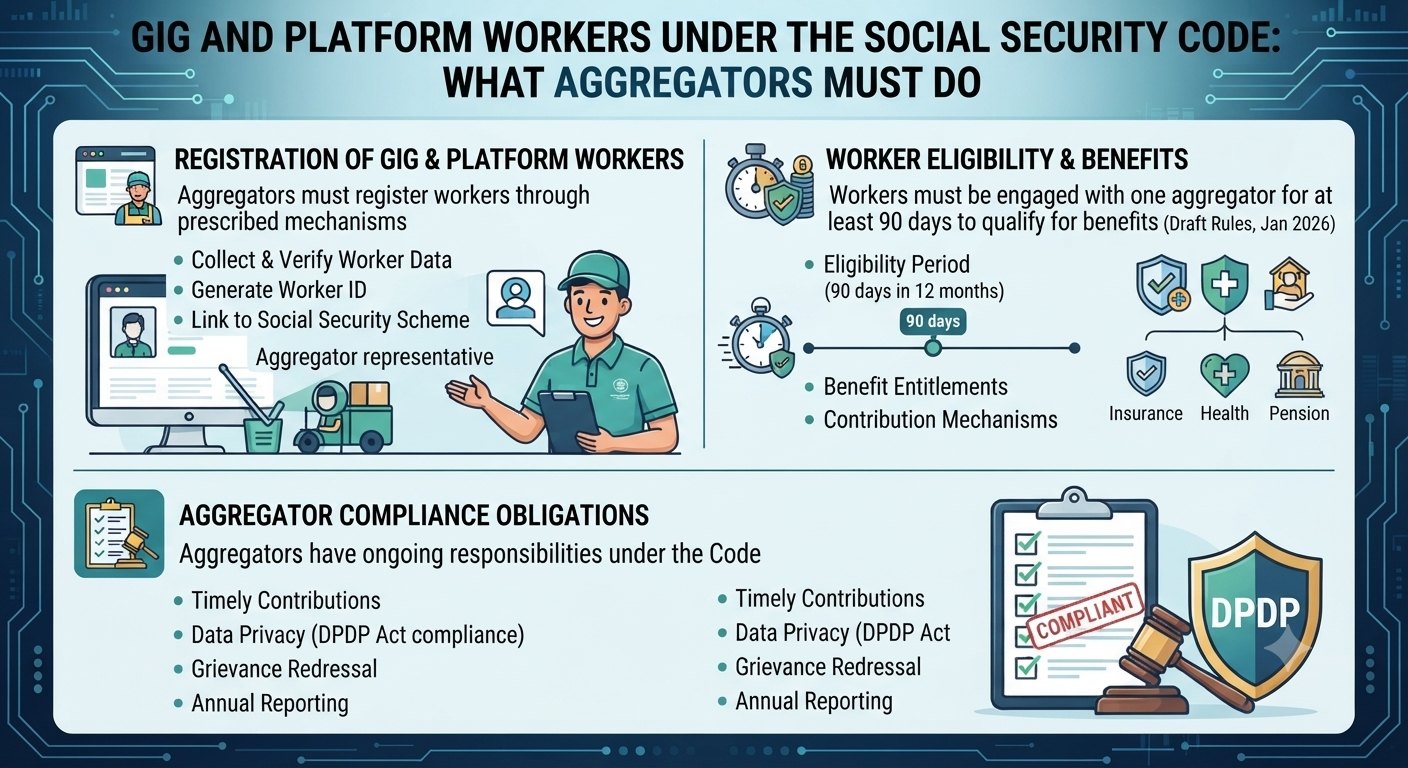
The first obligation is registration. Under the rules, aggregators must register gig and platform workers on a designated government portal and regularly update exit details, and registration is Aadhaar-linked, so workers can carry their social security entitlements across platforms and states. The final central rules, notified on 8 May 2026, give aggregators 45 days to register workers who were already on their platforms when the rules took effect (MediaNama).
The second obligation is financial. The Code provides for a social security fund for gig and platform workers, to which aggregators contribute. Under the Code, the contribution is between 1% and 2% of the aggregator’s annual turnover, capped at 5% of the amount paid or payable by the aggregator to gig and platform workers, with the exact rate notified by the government. The fund is meant to finance benefits such as life and disability cover, accident insurance, health and maternity benefits and old-age protection.
The third obligation is cooperation with the system: sharing data with the government, keeping records of engagement and payments, and following schemes notified for gig workers. A dedicated Social Security Fund serves as the financial backbone of the framework, so that the cost of financing doesn’t fall on workers themselves.
| Obligation | What it means in practice |
|---|---|
| Registration | Register gig and platform workers on the government portal; existing workers within 45 days of the final rules |
| Contribution | 1% to 2% of annual turnover, capped at 5% of payments to gig and platform workers, at the notified rate |
| Records and data | Keep engagement and payment records, share data as required, follow notified schemes |
Eligibility rules, and state gig worker laws
Eligibility for benefits depends on how long a person works with aggregators. Draft central rules published on 30 December 2025 proposed that a worker must be engaged with a single aggregator for at least 90 days, or 120 days across multiple aggregators, in a financial year, and the final Social Security (Central) Rules 2026 keep those thresholds. Aggregators will need systems that track engagement days per worker accurately, because those numbers decide who gets benefits.
Several states have gone further with their own laws. Rajasthan passed a platform-based gig workers law in 2023, and Karnataka’s Platform Based Gig Workers (Social Security and Welfare) Act is considered more comprehensive than Rajasthan’s. State laws can add welfare boards, cess or fee obligations, transparency duties about automated decisions, and grievance mechanisms. A gig platform operating in several states may therefore face both the central Social Security Code and one or more state regimes, each with its own registration and contribution rules.
For founders, the practical effect is that the cost of engaging gig and platform workers is rising, and it needs to be built into unit economics now rather than discovered later. Pricing, delivery fees and incentive structures should be modelled with the social security contribution included. This patchwork is one of the biggest compliance challenges for gig economy startups in 2026. Building a single compliance system that can meet the strictest applicable rules, rather than a separate process for each state, usually works out cheaper.
Classification risk, contracts and data
The Social Security Code doesn’t settle the bigger question of whether some gig workers are really employees. If a platform controls when and how people work, sets their pay unilaterally, monitors them closely and restricts them from working elsewhere, there’s a risk that a court or authority will treat them as employees under the other labour codes, with far greater obligations such as the wage definition and gratuity rules we explain in our guide to the new labour codes. Startups should review their partner agreements and operating practices to make sure the reality matches the “independent partner” label.
Contracts with gig workers should also be updated. They should explain how pay is calculated, how deactivation works and how workers can raise grievances, and should be consistent with any transparency obligations in state laws. Opaque deactivation by algorithm, without explanation or appeal, is increasingly a source of legal and reputational risk, and the same fairness thinking appears in the rules on dark patterns.
Data is the third piece. Registering workers, tracking engagement and sharing data with government portals all involve personal data, so aggregators should align these processes with the Digital Personal Data Protection Act, 2023, whose main obligations apply from 13 May 2027. Our DPDP Act compliance checklist is a good starting point.
Remedies, enforcement and quick answers
For aggregators, non-compliance with registration or contribution obligations can lead to penalties under the Social Security Code and recovery of unpaid contributions with interest. Proceedings for social security dues are subject to a five-year limitation period, so liabilities can build up quietly. For gig and platform workers, the remedies include registering on the portal to access benefits, complaining to the authorities under the Code and applicable state laws, using the platform’s grievance process, and, where a worker believes they’re really an employee, raising a claim under the relevant labour codes. Disputes over deactivation and pay are increasingly ending up before labour authorities and courts, so aggregators with clear, fair processes are in the strongest position.
Quick answers
Do aggregators have to pay towards gig workers’ social security?
Yes. Under the Social Security Code, aggregators contribute 1% to 2% of annual turnover, capped at 5% of payments to gig and platform workers, at the rate the government notifies.
How long must a gig worker work to get benefits?
Under the central rules, 90 days with a single aggregator, or 120 days across multiple aggregators, in a financial year.
Are gig workers now employees?
No. The Code gives them separate social security, but whether a particular worker is really an employee still depends on the facts.
Related reading: hiring contractors in India from the US.
Final word
At Halverton & Co., we work with founders, startups and technology-driven businesses on gig economy compliance, the labour codes, platform contracts and worker disputes. We practise in Jharkhand, Maharashtra and before the Supreme Court of India, and act as fractional legal counsel for companies that need senior legal support without a full in-house legal team. Halverton & Co. is built on a simple idea: Where tech needs law! If this issue affects your business, write to us at office@halvertonandco.com, or get in touch, and we’ll help you work out where you stand.
This article reflects the law and developments reported up to early October 2026. It is for general information only and is not legal advice. Please take advice on your specific facts before acting.
Related practice area
Startups & Venture
From incorporation to term sheet. The documents a company needs to be fundable.
View the practice areaComments
No account needed. Comments are reviewed before they appear, so yours will show here once approved. Please do not share confidential details or describe your own legal matter: replies are general discussion, not legal advice, and do not create an advocate-client relationship. For your own situation, write to office@halvertonandco.com.