Ask any corporate lawyer about mergers in India and you’ll hear the same complaint: the law is fine, but the process is slow. A regular merger scheme goes through the National Company Law Tribunal, with hearings, notices and objections that can stretch a simple internal restructuring across a year or more. The fast-track merger route under Section 233 of the Companies Act was meant to fix that, and the Corporate Laws (Amendment) Bill, 2026 makes it significantly easier to use.
This guide explains how the fast-track merger route works today, what the 2026 Bill changes, why it matters for reverse flips and group restructuring, and the remedies available when a fast-track merger runs into objections.
How the fast-track merger route works today
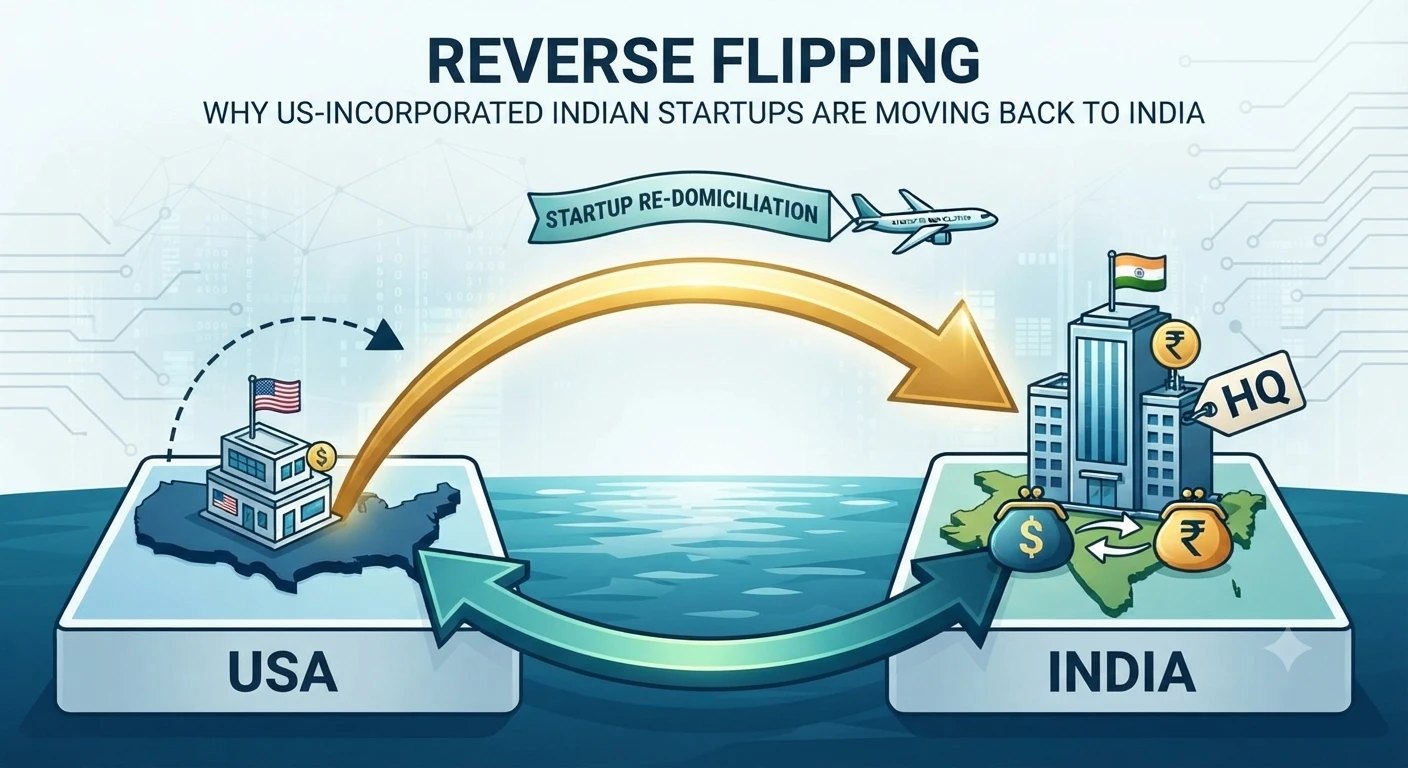
Section 233 of the Companies Act, 2013 allows certain mergers to be approved by the Regional Director of the Ministry of Corporate Affairs rather than the NCLT. The route is available for specified classes of companies, including mergers between small companies, between a holding company and its wholly owned subsidiary, and involving startups. Since 17 September 2024, a foreign holding company can also merge into its Indian wholly owned subsidiary through this route, subject to RBI requirements, which is the legal basis for most fast-track reverse flips (TaxGuru). Commentary differs on whether prior RBI approval is still needed after the RBI’s May 2026 amendment (EY), so confirm the position before you file.
The process is document-heavy but predictable. The companies circulate a notice of the proposed scheme to the Registrar of Companies and the Official Liquidator, who can object or comment. The scheme is then approved at a meeting of members and by creditors, a declaration of solvency is filed, and the scheme is sent to the Regional Director. If the Regional Director is satisfied that the scheme is in the public interest and in the interest of creditors, it is confirmed. If not, the Regional Director can refer it to the NCLT, which then deals with it like a regular scheme.
The sticking point in practice has been the approval thresholds. Today, the scheme must be approved by members holding at least 90% of the total number of shares, and by creditors representing nine-tenths in value. In a startup with angel investors, former employees holding ESOP shares and a long tail of small shareholders, getting 90% of the total shareholding to vote in favour can be almost impossible.
What the Corporate Laws Amendment Bill 2026 changes
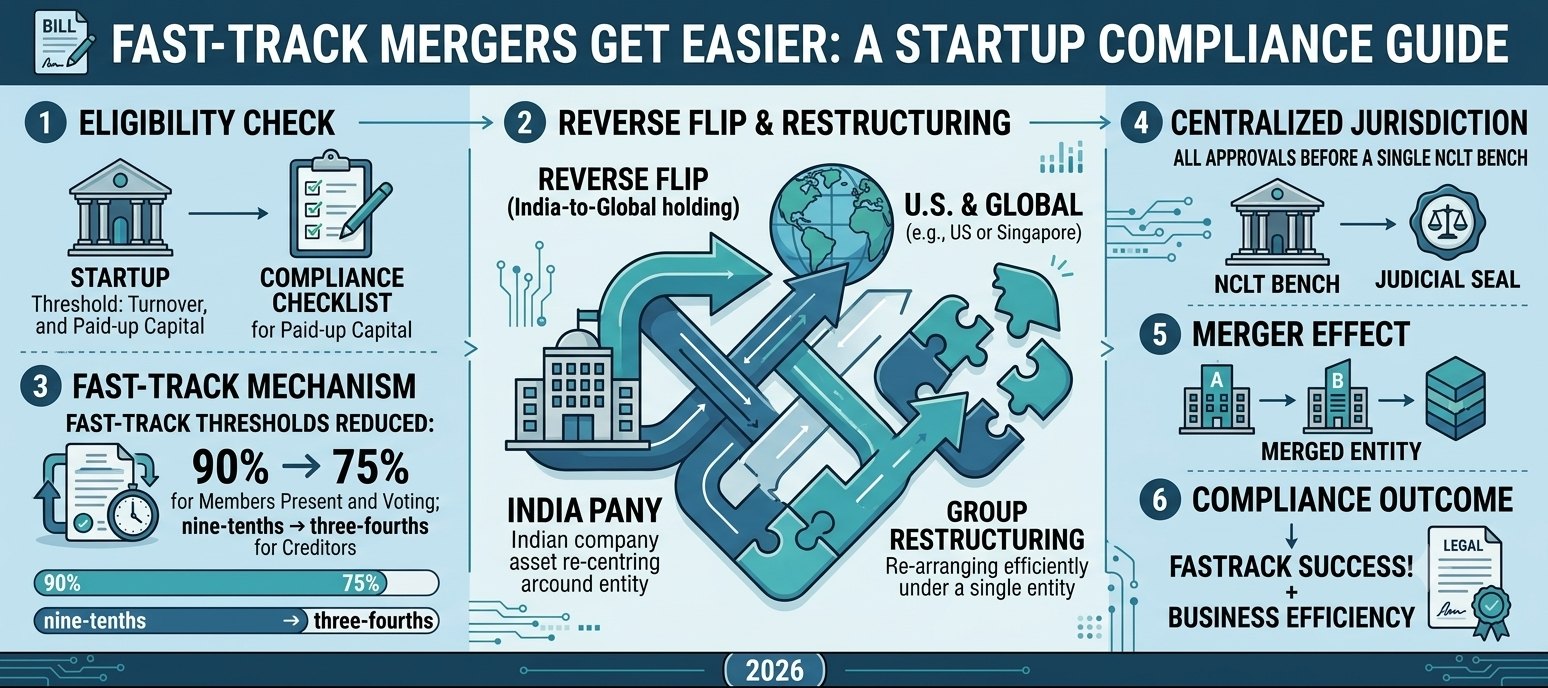
The Corporate Laws (Amendment) Bill, 2026 targets exactly that problem. It cuts the fast-track merger approval thresholds from 90% of members to 75% of members present and voting, and from nine-tenths to three-fourths of creditors, and it centralises jurisdiction before a single NCLT bench. The stated aim is to prevent a small minority from delaying routine corporate restructurings while retaining shareholder oversight.
| Current law | Under the Bill | |
|---|---|---|
| Members | 90% of the total number of shares | 75% of members present and voting |
| Creditors | Nine-tenths in value | Three-fourths |
| NCLT jurisdiction | Not centralised | A single NCLT bench |
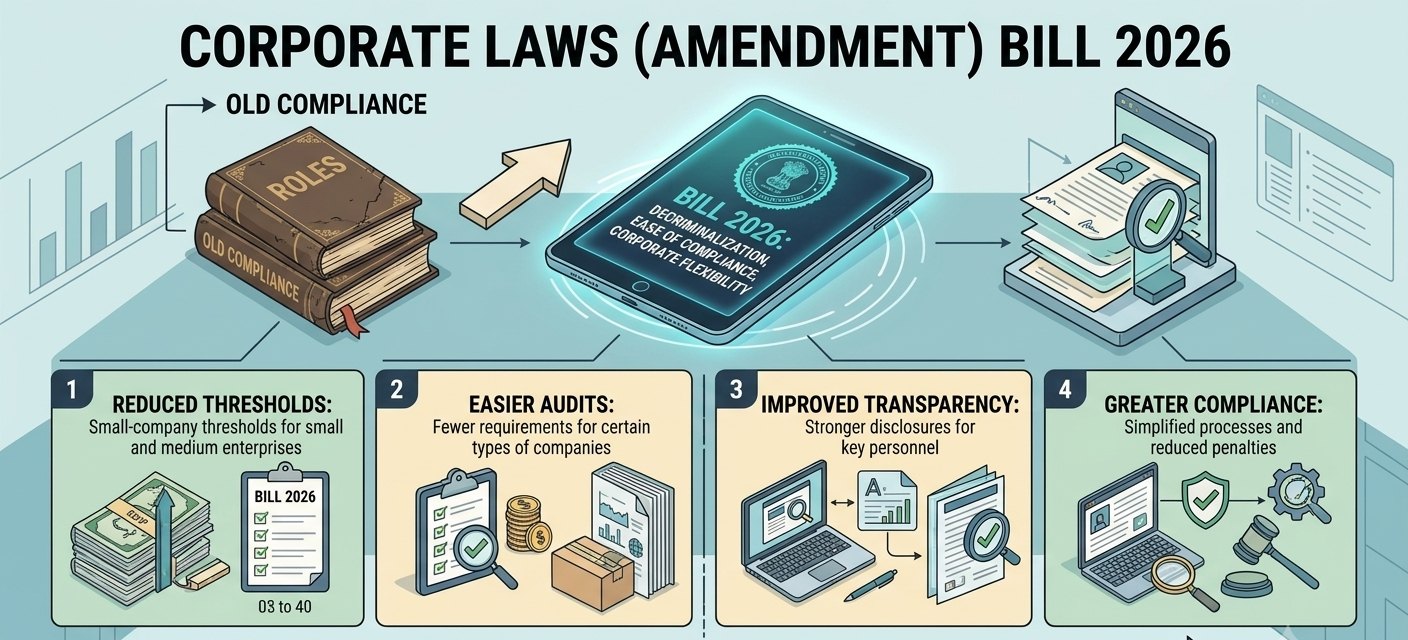
The difference between “90% of total shares” and “75% of those present and voting” is enormous. Under the current test, a shareholder who simply doesn’t respond counts against you. Under the proposed test, the decision rests with the shareholders who actually participate. Combined with the doubling of the small company thresholds in the same Bill, far more startups will be able to use the fast-track merger route for internal reorganisations. See our overview of the Corporate Laws Amendment Bill 2026.
The Joint Parliamentary Committee backed the Bill in its report tabled on 3 August 2026. Until the Bill is enacted and notified, the current 90% and nine-tenths thresholds still apply, so any fast-track merger filed now must meet the existing standard.
Why it matters for reverse flips and group restructuring
For reverse flips, the change is significant. Startups moving their holding company from Singapore, Delaware or another jurisdiction back to India often have a widely spread cap table, including foreign funds, angels, employees and early backers who may be hard to reach. Commentators note that, for PE-backed structures and reverse flips, the lower thresholds meaningfully reduce the friction in using statutory mergers rather than contractual restructuring routes. Our guide to reverse flipping in India covers the tax and FEMA side.
Fast-track mergers are also the natural tool for ordinary group restructuring. Startups that have accumulated subsidiaries through acquisitions, product spin-outs or regulatory structuring often want to collapse them into one entity before a funding round or IPO. A fast-track merger of a wholly owned subsidiary into its parent avoids NCLT hearings and can be completed far more quickly.
There are still limits. The fast-track merger route doesn’t fix tax: a cross-border merger can be tax-neutral in India if the statutory conditions are met, but shareholders may face tax in their home countries. FEMA compliance, sectoral caps and Press Note 3 approvals for investors from countries sharing a land border with India continue to apply. Stamp duty on the merger also depends on the state where the transferee company’s registered office is located.
Planning a fast-track merger in 2026: a practical approach
Start with eligibility. Check whether both companies fall within the classes that can use Section 233, and whether any company is listed, has public deposits, or faces proceedings that would make the fast-track merger route unsuitable. For cross-border mergers, plan the RBI application early, because it sits on the critical path.
Next, map your shareholder and creditor base. Even with the proposed lower thresholds, you’ll need a clear view of who can vote, how to reach them, and whether any shareholder agreements give investors veto rights over mergers. Investor consent rights in a shareholders’ agreement can block a scheme even if the statutory threshold is met, so negotiate those consents in parallel. Founder-level terms matter too; see our guide to founders’ agreements in India.
Finally, prepare the scheme properly. A well-drafted scheme, accurate valuation reports, a clean declaration of solvency and complete responses to the Registrar and Official Liquidator are what keep a fast-track merger on the fast track. Sloppy filings are the most common reason Regional Directors refer schemes to the NCLT.
Objections, legal remedies and quick answers
If the Registrar or Official Liquidator objects, or the Regional Director isn’t satisfied that the scheme is fair, the matter can be referred to the NCLT, which can approve, modify or reject the scheme as if it had been filed there from the start. The companies can respond to objections in writing and should do so fully, because an unanswered objection is almost certain to trigger a referral. An order of the NCLT can be appealed to the NCLAT under Section 421. Dissenting shareholders and creditors can raise objections during the process, and minority shareholders retain the right to petition the NCLT for oppression and mismanagement under Sections 241 and 242 where a merger is used unfairly against them.
Quick answers
What is a fast-track merger in India?
A merger under Section 233 of the Companies Act that is approved by the Regional Director instead of the NCLT, available for specified classes such as small companies, holding companies and their wholly owned subsidiaries, and startups.
What thresholds does the 2026 Bill propose?
75% of members present and voting, and three-fourths of creditors, instead of the current 90% of total shares and nine-tenths of creditors.
Can a reverse flip use the fast-track merger route?
Yes. Since September 2024, a foreign holding company can merge into its Indian wholly owned subsidiary through the fast-track route, subject to RBI requirements.
Related reading: setting up an Indian subsidiary; also reverse flip from Delaware to India; also setting up a Dubai crypto holding company.
Final word
At Halverton & Co., we work with founders, startups and technology-driven businesses on mergers, group restructuring, reverse flips and NCLT proceedings. We practise in Jharkhand, Maharashtra and before the Supreme Court of India, and act as fractional legal counsel for companies that need senior legal support without a full in-house legal team. Halverton & Co. is built on a simple idea: Where tech needs law! If this issue affects your business, write to us at office@halvertonandco.com, or get in touch, and we’ll help you work out where you stand.
This article reflects the law and developments reported up to early October 2026. Please take advice on your specific facts before acting.
Related practice area
Startups & Venture
From incorporation to term sheet. The documents a company needs to be fundable.
View the practice areaComments
No account needed. Comments are reviewed before they appear, so yours will show here once approved. Please do not share confidential details or describe your own legal matter: replies are general discussion, not legal advice, and do not create an advocate-client relationship. For your own situation, write to office@halvertonandco.com.