On 21 November 2025, India switched on the four labour codes that had been sitting on the statute book for five years. For large companies with HR departments, it meant months of work. For startups, it often meant a founder or office manager discovering, sometime in early 2026, that the salary structure they’d copied from another startup no longer worked.
Ten months on, the dust is settling. This guide explains what the labour codes for startups actually change, with a focus on payroll and the 50% wage rule, fixed-term employment, layoffs and compliance, and the remedies available to employers and employees when labour disputes arise.
The four labour codes in brief
The Code on Wages, 2019, the Industrial Relations Code, 2020, the Code on Social Security, 2020 and the Occupational Safety, Health and Working Conditions Code, 2020 came into force together on 21 November 2025. Together they consolidate 29 central labour laws. The government says the number of rules has fallen from 1,436 to 351 and the number of registers from 84 to 8.
The labour codes came into force before all their detailed rules were ready. The central government notified the final Central Rules under all four codes on 8 May 2026, fully operationalising the reforms (KPMG), and many states have notified their own rules on different dates. Because labour is a concurrent subject, the rules that apply to your startup depend partly on the state in which you operate, so a company with offices in Bengaluru, Pune and Ranchi may need to follow three sets of state rules.
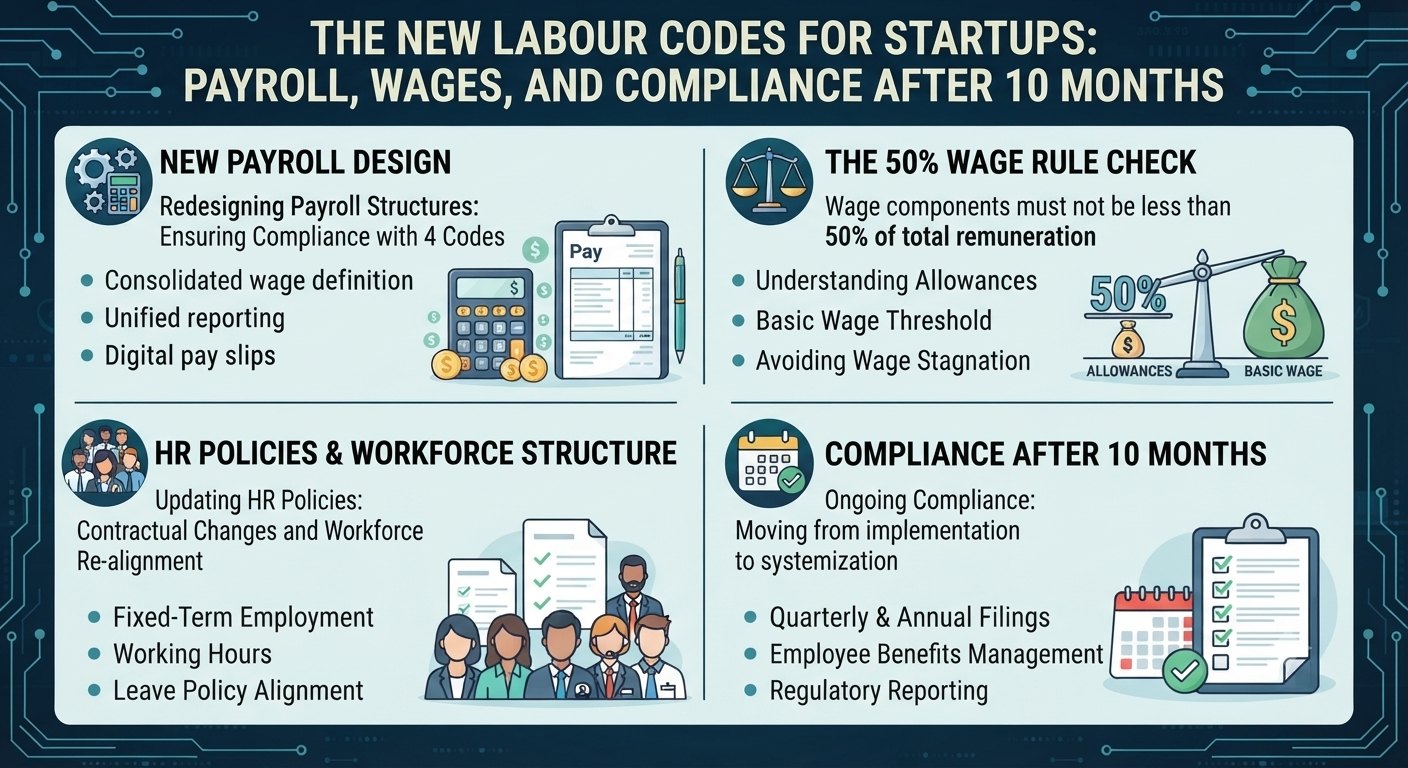
Ten months in, companies have moved from understanding the legislation to redesigning payroll, workforce structures, HR policies and compliance systems. For startups, the changes that matter most are in payroll, fixed-term hiring, layoffs and gig work.
The 50% wage rule and what it does to startup payroll
The change that hits startup payroll hardest is the new definition of “wages”. Under the labour codes, there is a 50% ceiling on specified exclusions from wages. In practice, if allowances such as HRA, conveyance and special allowances add up to more than half of total remuneration, the excess is added back to “wages”.
Why does that matter? Because provident fund contributions, gratuity and several other benefits are calculated on wages. Many startups kept basic pay low, often 25% to 40% of CTC, and paid the rest as allowances to reduce PF and gratuity costs. Under the 50% wage rule, those structures increase the wage base, raising employer PF contributions and gratuity liabilities, and sometimes reducing employees’ take-home pay if the CTC stays the same.
The practical fix is to restructure salary components so that wages make up at least half of remuneration, and to communicate the change to employees clearly. Some startups have chosen to hold take-home pay constant and absorb the higher PF cost; others have kept CTC constant and explained the higher retirement savings to employees. Either way, offer letters and payroll systems should be updated, because the old structures are now a compliance risk. Tax planning around the new wage base also changed; see our guide to the Income-tax Act 2025 for startups.
Fixed-term employees, leave, layoffs and other key changes
Startups that hire on fixed-term contracts need to look closely at the codes. Fixed-term employees are entitled to the same benefits as permanent workers, including leave, medical and social security, and the Code on Social Security makes them eligible for gratuity on a pro-rata basis after one year of service rather than the usual five. Using rolling fixed-term contracts to avoid benefits no longer works.
On leave, eligible workers get one day of leave for every 20 days worked. On industrial relations, the Industrial Relations Code raises the threshold for prior government approval for layoffs, retrenchment and closure from 100 to 300 workers, which gives growing startups more flexibility in a downturn, though retrenchment compensation, notice and fair procedure still apply. Closing a company has its own rules; see our guide to shutting down a startup legally.
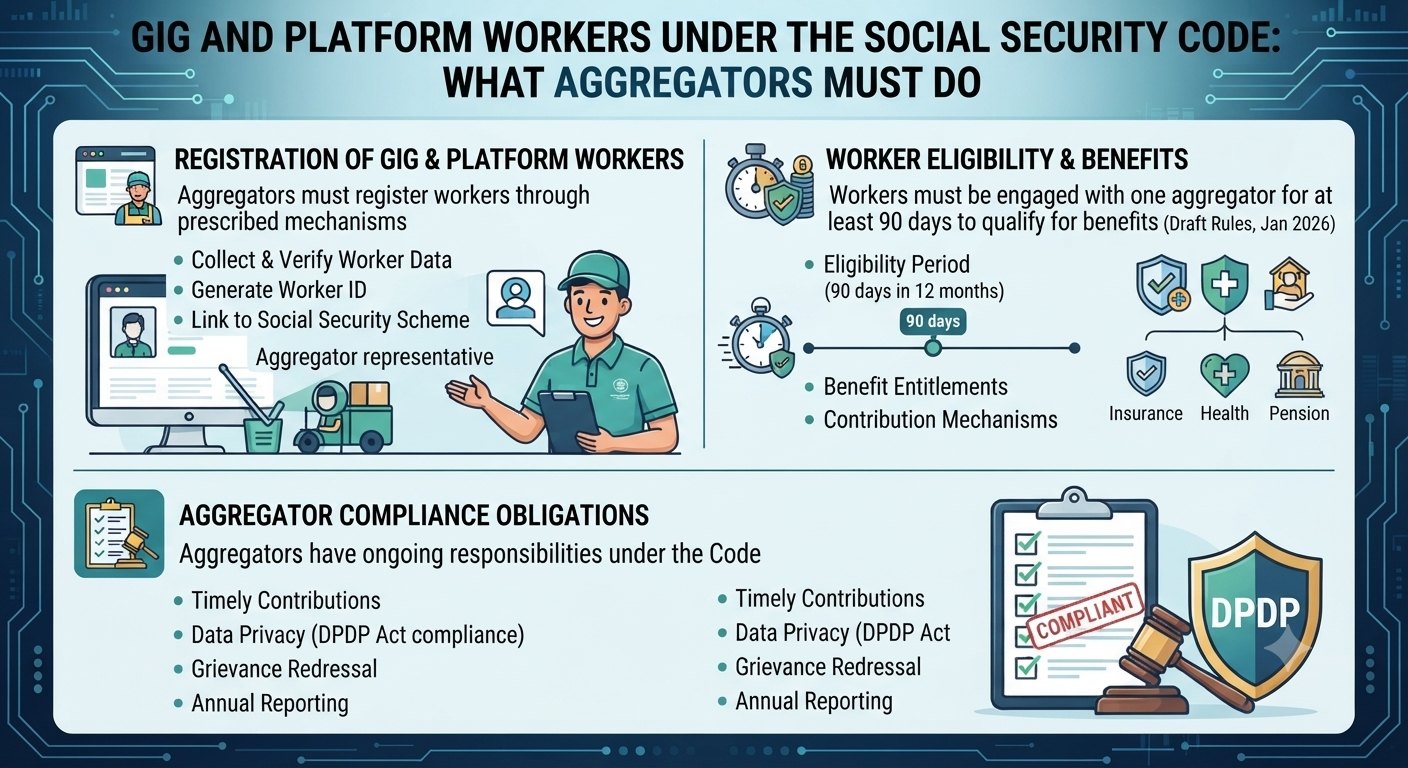
The codes also expand social security to newer forms of work. Gig and platform workers are brought into a structured social-security framework, with aggregators required to register them through prescribed mechanisms. For delivery, mobility, home services and quick-commerce startups, that is a major new compliance area in its own right; see our guide to gig and platform workers under the Social Security Code.
A labour code compliance plan for startups
Begin with a payroll audit. Check every salary structure against the 50% wage rule, recalculate PF and gratuity on the new wage base, and update payroll software, offer letters and appointment letters. Next, review how you hire. List everyone working for you: employees, fixed-term staff, interns, consultants, contract labour and gig workers, and confirm that each is correctly classified and that fixed-term staff receive equal benefits.
Then update your policies. Leave, working hours, overtime, grievance redressal and termination procedures should match the codes and your state’s rules. Larger startups crossing the thresholds for standing orders or grievance redressal committees should put those in place. Registrations under the new codes, returns and the reduced set of registers should also be brought up to date. Employee data collected for compliance also engages data protection law; see our DPDP Act compliance checklist.
It also helps to assign ownership. In many startups, labour compliance falls between the founder, the finance lead and an outsourced payroll provider, and nobody owns it. Under the new labour codes, that gap is risky. Name one person responsible for labour code compliance, give them a simple calendar of registrations, returns and renewals for each state you operate in, and review it every quarter. When you open an office in a new state, check that state’s rules under the new labour codes before you hire the first employee there. Finally, keep records. The codes rely heavily on digital compliance and inspection, and good records are the best defence when a former employee disputes their dues or an inspector visits.
Labour disputes, legal remedies and quick answers
The labour codes bring a more facilitative approach to enforcement, with inspectors acting as inspector-cum-facilitators and compounding available for many first-time offences, but employee claims remain real. Employees can claim unpaid wages, gratuity and other dues before the authorities under the codes, raise individual disputes about termination, and approach the industrial tribunal where disputes aren’t resolved. Under the Code on Social Security, proceedings for social security dues are subject to a five-year limitation period. For startups, the most common disputes involve final settlement of dues, gratuity for fixed-term staff and the wage base used for PF, which is why getting payroll right now is far cheaper than defending claims later.
Quick answers
When did the new labour codes come into force?
On 21 November 2025, all four codes together.
What is the 50% wage rule?
Exclusions from wages, such as certain allowances, can’t exceed 50% of total remuneration. Any excess is added back to wages for PF, gratuity and other benefits.
Do fixed-term employees get gratuity under the labour codes?
Yes. Fixed-term employees are eligible for gratuity on a pro-rata basis after one year of service.
Related reading: AI in hiring and employee monitoring; also hiring contractors in India from the US; also hiring developers in India from the UK; also seconding UK staff to India; also paying Indian developers from a Dubai Web3 company.
Final word
At Halverton & Co., we work with founders, startups and technology-driven businesses on labour code compliance, employment contracts, payroll restructuring and employment disputes. We practise in Jharkhand, Maharashtra and before the Supreme Court of India, and act as fractional legal counsel for companies that need senior legal support without a full in-house legal team. Halverton & Co. is built on a simple idea: Where tech needs law! If this issue affects your business, write to us at office@halvertonandco.com, or get in touch, and we’ll help you work out where you stand.
This article reflects the law and developments reported up to early October 2026. Please take advice on your specific facts before acting.
Related practice area
Startups & Venture
From incorporation to term sheet. The documents a company needs to be fundable.
View the practice areaComments
No account needed. Comments are reviewed before they appear, so yours will show here once approved. Please do not share confidential details or describe your own legal matter: replies are general discussion, not legal advice, and do not create an advocate-client relationship. For your own situation, write to office@halvertonandco.com.