Key takeaways
- File a provisional to secure a date, then a complete specification within twelve months.
- Request examination with Form 18, answer the First Examination Report and prepare for a hearing.
- Startups can request expedited examination and pay reduced fees if recognised by DPIIT.
- Confirm current deadlines and fees, which changed under the 2024 Rules.
If you are asking how to file patent in India, the short answer is that the process runs through seven stages: prior art search, filing a provisional or complete application, publication, request for examination, response to the examination report, opposition windows and grant. Each stage has its own forms and clocks under the Patents Act, 1970 and the Patents Rules, 2003. Missing a clock can end an application, so a calendar matters from day one.
This guide walks through the process in order for founders, inventors and foreign companies. It explains the provisional application, the forms most applicants meet, startup fee advantages, examination and the FER, opposition and grant. It is written by an Indian law firm and is general information, not advice on your invention. Fees and rules change, so confirm current figures on the Indian Patent Office website.
Before you file
Start with the question of whether your invention is patentable in India. It must be new, involve an inventive step, be capable of industrial application and not fall within the exclusions in Sections 3 and 4 of the Act. Software, algorithms and business methods are the most frequent problem, because Section 3(k) excludes a computer programme per se, a mathematical or business method and an algorithm. A claim framed around a technical effect has a better chance. Knowing how to file patent in India before you disclose the invention is the single most useful habit for an inventor.
Do a prior art search before spending on drafting. Search Indian and foreign patent databases and academic papers. A search will not give certainty, but it can show whether your idea is already known. Do not disclose the invention publicly before filing, since an earlier disclosure can destroy novelty, although the Act has narrow grace provisions for certain disclosures.
Decide who the applicant and inventors are. The applicant can be an individual, company or institution, and every true inventor must be named. If the invention was made in India, remember the foreign filing rule in Section 39: you generally need permission before filing abroad first. Plan the sequence of filings so that you do not break it.
Provisional and complete applications
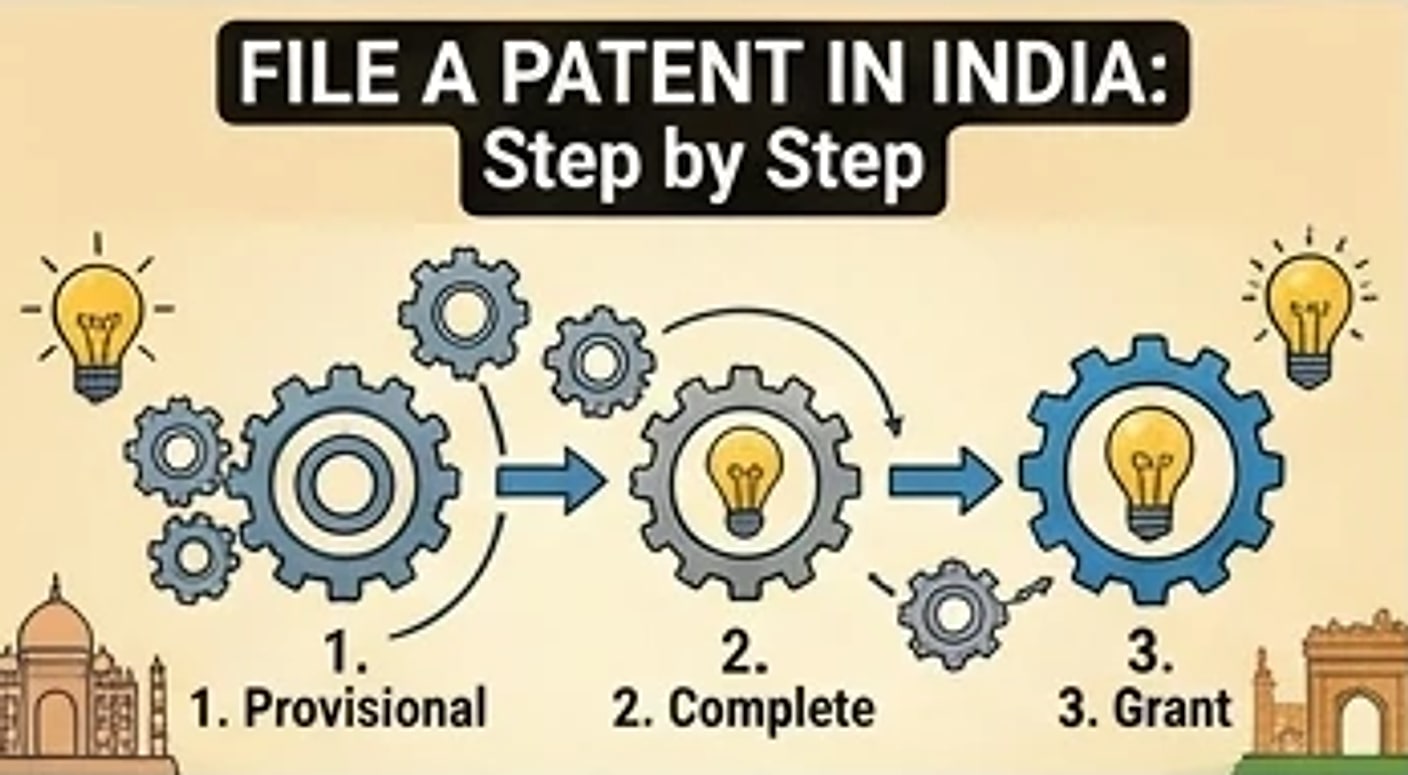
A provisional patent application India offers is a placeholder that gives you a filing date when your invention is still being developed. It describes the invention but does not need claims. You must then file a complete specification within twelve months of the provisional, and the priority date remains the date of the provisional. A weak provisional gives weak priority, so describe the invention fully rather than briefly.
The complete specification contains the title, field, background, summary, detailed description, claims and abstract. Claims define the scope of protection, so they deserve most of the drafting effort. The usual forms are Form 1 (application), Form 2 (specification), Form 3 (statement about foreign filings, where relevant), Form 5 (declaration of inventorship) and Form 26 if you use an agent. Check the current forms list and any Form 28 for small entities and startups. Anyone learning how to file patent in India should read the Form 18 request for examination deadline as carefully as the filing date.
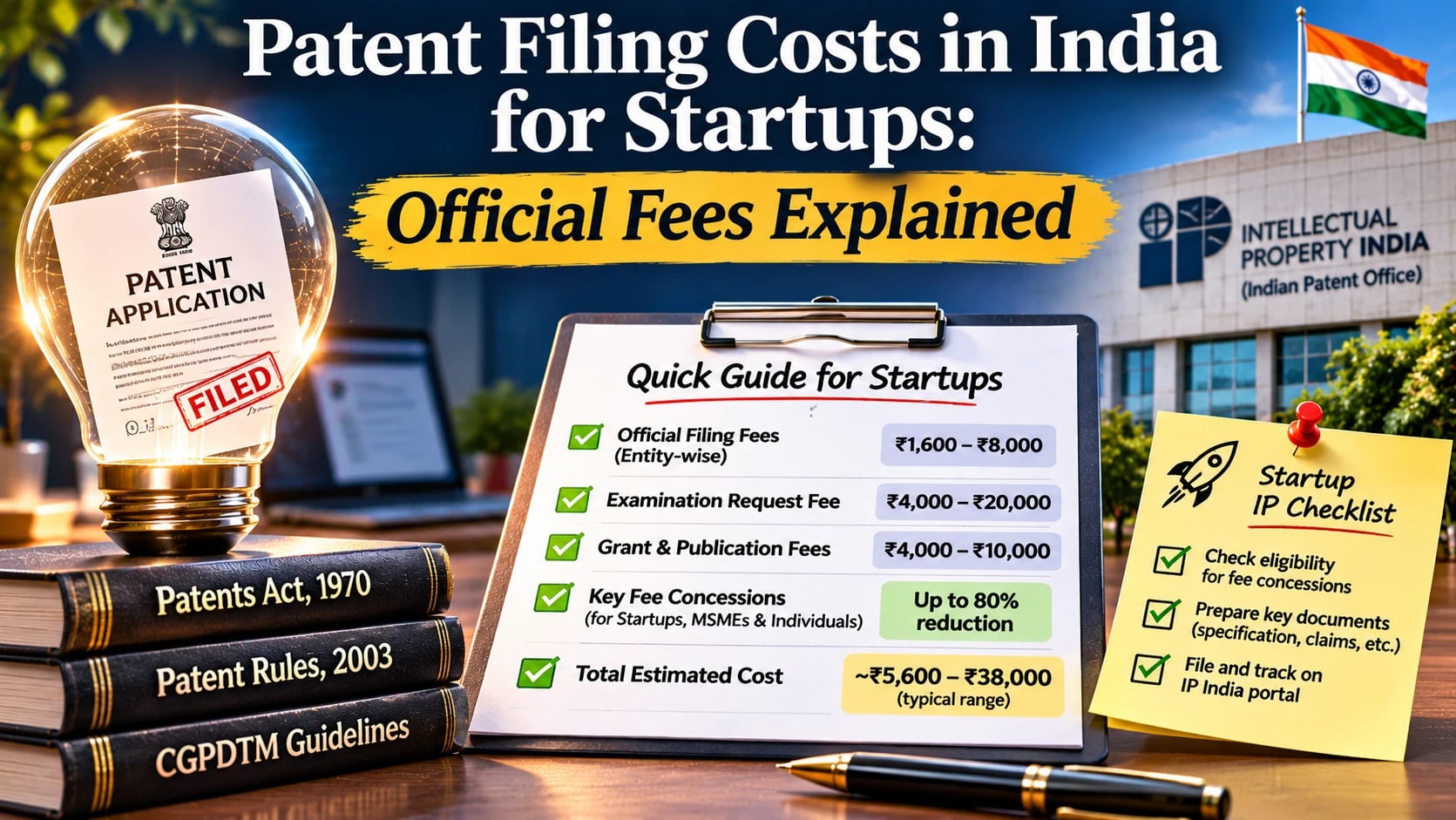
Fees depend on the applicant category. The patent filing fees for startups India offers are reduced compared with large entities, and small entities also receive a lower rate. Startups should have recognition from DPIIT and keep the certificate ready. Fee tables change, so confirm them in the First Schedule of the Rules. The filing can be made online through the Indian Patent Office e-filing portal.
Publication and examination
Applications are normally published eighteen months from the filing or priority date, and the content becomes public. You can request early publication, which helps if you want to start enforcing sooner or to speed examination. After publication, third parties can submit representations, which is the pre-grant opposition route under Section 25(1). A pre-grant opposition Section 25(1) filing can delay your application, so be ready to respond. The question of how to file patent in India does not end at filing, because publication and examination bring their own steps.
| Stage | What happens | Check |
|---|---|---|
| Provisional or complete filing | Priority date set; complete within 12 months of a provisional | Forms 1, 2, 3, 5, 26 |
| Publication | Normally after 18 months, or earlier on request | Early publication option |
| Request for examination | Form 18 within the allowed period | Expedited route for startups |
| First Examination Report | Objections to answer | Reply period |
| Grant and opposition | Post-grant opposition within 12 months | Renewals from year three |
Examination begins only when you file Form 18, the request for examination, within the time allowed by the Rules, which has historically been forty-eight months from the priority or filing date, so check the current period. Startups and some other categories can request expedited examination, which can shorten the wait considerably. Without a request for examination the application is treated as withdrawn.
The examiner issues a First Examination Report (FER) listing objections on novelty, inventive step, clarity, unity and exclusions. The First Examination Report patent India applicants receive is not a refusal. You file a reply with arguments and amended claims within the period allowed, which has been six months with a possible extension, again check the Rules. A hearing may follow. Many applications are granted after one or two rounds of reply.
Opposition, grant and renewal
Once the Controller is satisfied, the patent is granted and published in the Patent Journal. After grant, any interested person may file a post-grant opposition within twelve months of the publication of grant under Section 25(2). The patent term is twenty years from the date of filing the complete application, subject to payment of annual renewal fees from the third year.
Working of the patent also matters. Patentees must file a statement of working on how the invention is worked in India, and failures can lead to penalties or compulsory licence proceedings. Keep records of manufacturing, imports and licensing. Foreign applicants who use the PCT route should enter the Indian national phase within thirty-one months of the priority date, with a request for examination to follow.
Plan the budget in stages: search, drafting, filing, publication, examination fees, attorney time for the reply and renewals. Keep a docket of every date. If you are comparing countries, remember that Indian examination can be slower than other offices and that outcomes depend heavily on drafting. Good drafting at the start saves costs later. A budget for how to file patent in India should cover official fees, drafting, the reply to the FER and renewals.
Next steps and quick answers
To file, run a search, prepare a provisional or complete specification, choose the applicant category, file the forms online and diarise publication, Form 18 and reply dates. Take advice before you disclose or file abroad. This is general information, not legal advice. This is the practical answer to how to file patent in India for a startup with a first invention.
Related reading: patent filing costs in India for startups, filing in India after a US provisional, patent deadlines in India under the 2024 rules, software patents and Section 3(k), patent opposition in India and DPIIT startup recognition; also Form 27 and the patent working statement and free patent search in India.
Quick answers
How do I file a patent in India?
File an application with the Indian Patent Office, either a provisional followed by a complete specification within twelve months or a complete specification directly, then request examination with Form 18 and reply to the FER.
How much does it cost to file a patent in India?
Fees depend on applicant category and pages. Startups and small entities pay reduced official fees. Confirm the current schedule, then add attorney costs.
How long does it take to get a patent in India?
It varies widely. Expedited examination can shorten it, but many applications take several years from filing to grant.
Do I need a provisional application?
It is optional, but it gives an early filing date while you develop the invention. A weak provisional gives weak priority.
Final word
Halverton & Co. is an Indian law firm advising founders, startups, technology companies and investors on Indian law, including patent filing and prosecution in India, startup IP strategy and cross-border patent support. We practise in Jharkhand, Maharashtra and before the Supreme Court of India, and act as fractional legal counsel for technology-driven businesses. Halverton & Co.: Where tech needs law! If you have a question about Indian law, write to us at office@halvertonandco.com, or get in touch.
This article reflects developments reported up to 31 October 2026. It is for general information only, is not legal advice, and does not create an advocate-client relationship. Halverton & Co. is an Indian law firm.
Sources
Related practice area
Intellectual Property
Trade marks, copyright, patents and designs. Searched, filed, licensed and enforced under Indian law.
View the practice areaComments
No account needed. Comments are reviewed before they appear, so yours will show here once approved. Please do not share confidential details or describe your own legal matter: replies are general discussion, not legal advice, and do not create an advocate-client relationship. For your own situation, write to office@halvertonandco.com.