Key takeaways
- A pre-grant opposition under Section 25(1) can be filed by any person after publication and before grant.
- A post-grant opposition under Section 25(2) can be filed by a person interested within twelve months of publication of the grant.
- Revocation under Section 64 is a High Court action and can also be raised as a counter-claim in an infringement suit.
- Commentary on the 2024 Rule 55 changes reports a prima facie screen, a two-month reply period and a fee, so a pre-grant filing needs a well-evidenced case.
A UK company that sees a competitor’s patent application appear in India has more options than it may think. Indian law lets a foreign business use patent opposition India foreign company routes to challenge an application before grant, challenge a granted patent soon after, or seek revocation in the High Court. Each route has different timing, cost and strategic value.
This guide explains patent opposition India foreign company options for UK businesses: the pre-grant representation, post-grant opposition, revocation, the grounds available, how the 2024 rule changes affect pre-grant opposition, who can file and how a foreign company does it in practice. UK patent points should be confirmed with UK advisers, and the guide is general information, not advice on a specific patent.
The three routes to challenge an Indian patent
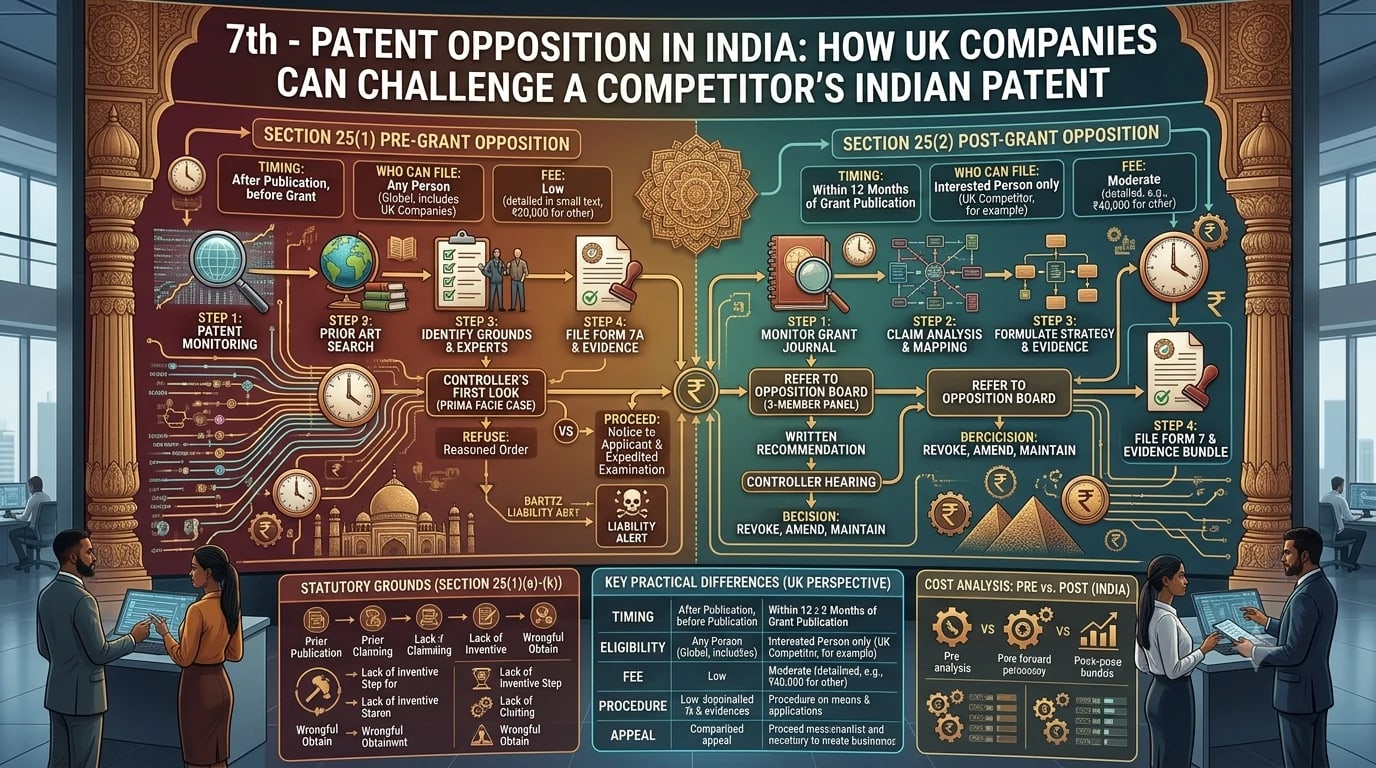
The Patents Act, 1970 gives three main ways to attack a patent or application. A pre-grant opposition under Section 25(1) can be filed by any person after the application is published and before the patent is granted. A post-grant opposition under Section 25(2) can be filed by any person interested within twelve months of the publication of the grant. A revocation petition under Section 64 can be brought before the High Court by a person interested at any time after grant, or as a counter-claim in an infringement suit.
| Route | Who can file | When | Forum |
|---|---|---|---|
| Pre-grant opposition, Section 25(1) | Any person | After publication and before grant | Controller of Patents |
| Post-grant opposition, Section 25(2) | Any person interested | Within 12 months of publication of grant | Opposition Board and Controller |
| Revocation, Section 64 | Person interested, or counter-claim | Any time after grant | High Court |
The routes differ in cost, speed and effect. Pre-grant opposition is relatively inexpensive and can delay or stop the grant. Post-grant opposition is heard by an Opposition Board and decided by the Controller. Revocation is a court action with full evidence and cross-examination, with the highest cost and the most thorough outcome.
For a UK company, a patent opposition India foreign company strategy starts by choosing the right route for the commercial aim. A company that wants to keep a market open might file a pre-grant opposition. A company already sued in India may use revocation as a defence.
Pre-grant opposition under Section 25(1)
Any person may file a representation by way of opposition on Form 7A, after publication and before grant. It does not require the opponent to show a commercial interest, so a foreign company, an association or an individual can file. The representation sets out the grounds and the supporting prior art, and the Controller considers it during examination.
The Patents (Amendment) Rules, 2024 changed Rule 55. Commentary reports that a pre-grant opposition is now taken up only if a prima facie case is established in the representation, that the applicant’s time to reply is reduced from three months to two, and that opponents pay a fee, reported at ₹4,000 for individuals, small entities, startups and educational institutions and ₹20,000 for others. These changes aim to reduce frivolous oppositions, so a patent opposition India foreign company filing needs a well-evidenced case from the start. Check the Rules for the current text.
Good practice is to file once the application is published and before the first examination report issues, and to include clear claim charts matching prior art to each claim. A thin representation may be rejected without a hearing, and there may be no second chance to add evidence.
A practical point for UK companies is how to assemble the prior art file. Start with your own patents and publications, search the Indian Patent Office’s published applications and journal, and use international databases. Look at the family of the Indian patent abroad: statements made to the UK Intellectual Property Office, the EPO or the US Patent Office, and any amendments made to overcome objections, may contradict what is claimed in India. Such inconsistencies are persuasive in a patent opposition India foreign company file.
Post-grant opposition and revocation
Post-grant opposition under Section 25(2) is open to a person interested for twelve months from the date the grant is published in the Patent Office Journal. A competitor is plainly a person interested. The Controller constitutes an Opposition Board of three examiners to review the notice and the patentee’s reply, and the Controller then decides after a hearing.
Since the Intellectual Property Appellate Board was abolished in 2021, appeals from the Controller’s decisions go to the High Court. A losing party can appeal under Section 117A. Opposition proceedings are written and then oral, usually with affidavit evidence, and can take years in total, although timelines vary by office and case.
Revocation under Section 64 is a petition to a High Court, and the Delhi High Court’s IP Division hears many of these. Grounds are broadly similar to opposition grounds, and the court can hear expert evidence. If the patentee sues you for infringement, a counter-claim for revocation is usually the primary defence. A patent opposition India foreign company plan should therefore consider both administrative and court routes.
Grounds, evidence and procedure for a foreign challenger
The grounds in Section 25 include that the invention was wrongfully obtained, was published before the priority date, was publicly known or used in India, is obvious, is not an invention or not patentable under the Act, is insufficiently described, or that the applicant failed to disclose foreign filing information required by Section 8. Indian-specific grounds are often powerful: Section 3(d) for new forms of known substances and Section 3(k) for computer programmes and business methods.
A foreign company can file through an Indian patent agent or advocate on a power of attorney, and must provide an address for service in India. It does not need an Indian subsidiary. Gather prior art early, including UK and European documents, translations where needed, and expert declarations. Use publicly available file wrappers from other offices, because inconsistent statements by the patentee are persuasive.
Keep confidentiality in mind. A pre-grant filing alerts the applicant to your interest, and an opposition in India may influence settlement talks or related disputes elsewhere. Coordinate with UK and European counsel, so that arguments made in India do not conflict with positions taken before the UK Intellectual Property Office, the EPO or UK courts.
Cost and timing planning helps. Pre-grant opposition is usually the cheapest tool and has a high effect where the art is strong. Post-grant opposition costs more and takes longer. Revocation is the most expensive but yields a binding court decision. Many disputes settle after a well-prepared opposition is filed, because the patentee faces the risk of losing claims. Ask your Indian counsel to estimate each route and to explain how a decision in one forum may affect the others.
Strategy, remedies and quick answers
Start by monitoring. Set up watches on competitors’ Indian filings, because the window for pre-grant opposition closes at grant and the post-grant window closes after twelve months. Decide early whether the aim is to stop the patent, narrow it or gain negotiating weight. A narrowing outcome can be commercially enough. Budget for an Indian agent, searches and expert fees, and set expectations about timing. If a patent has already been granted and the twelve months have passed, revocation remains available but costs more. If you are accused of infringement, consider revocation, non-infringement and invalidity together. Keep records of the dates in the Patent Office Journal. For any patent opposition India foreign company matter, ask Indian counsel to confirm the current Rule 55 procedure, fees and hearing practice before filing, since the 2024 amendments are recent. Settlement is common, so keep options open and preserve the evidence you have gathered.
Related reading: patent deadlines under India’s 2024 patent rules, software patents in India for UK tech companies, can you patent software in India? Section 3(k), Indian patent prosecution: Form 3 and Form 27, trade mark show cause hearings in India, enforcing a UK judgment or award in India and the India-UK trade deal: a legal checklist.
Quick answers
Can a foreign company file a patent opposition in India?
Yes. A pre-grant opposition under Section 25(1) can be filed by any person, and a post-grant opposition under Section 25(2) by any person interested. A foreign company files through an Indian agent or advocate with an address for service in India.
How long do I have to oppose an Indian patent after grant?
Twelve months from the date the grant is published in the Patent Office Journal for post-grant opposition. After that, revocation before the High Court under Section 64 remains available.
Did the 2024 rules change pre-grant opposition?
Commentary says Rule 55 now requires a prima facie case before an opposition is taken up, shortens the applicant’s reply time to two months and introduces a fee. Check the current Rules before filing.
Can a UK company file without an Indian subsidiary?
Yes. It can file through an Indian patent agent or advocate on a power of attorney and must give an address for service in India.
Did the 2024 rules change pre-grant opposition?
Commentary says Rule 55 now requires a prima facie case, shortens the applicant’s reply time to two months and adds a fee. Check the current Rules before filing.
Final word
Halverton & Co. is an Indian law firm advising UK companies, founders, investors and law firms on Indian law, including Indian patent opposition, revocation and infringement strategy for UK and European technology and life sciences companies. We practise in Jharkhand, Maharashtra and before the Supreme Court of India, and work alongside your UK solicitors, who advise on English law. Halverton & Co.: Where tech needs law! If you have a question about Indian law, write to us at office@halvertonandco.com, or get in touch.
This article reflects developments reported up to late October 2026. It is for general information only, is not legal advice, and does not create a solicitor-client relationship. Halverton & Co. is an Indian law firm, is not authorised or regulated by the Solicitors Regulation Authority, and does not advise on English law; UK-law points should be confirmed with UK advisers.
Sources
Related practice area
Intellectual Property
Trade marks, copyright, patents and designs. Searched, filed, licensed and enforced under Indian law.
View the practice areaComments
No account needed. Comments are reviewed before they appear, so yours will show here once approved. Please do not share confidential details or describe your own legal matter: replies are general discussion, not legal advice, and do not create an advocate-client relationship. For your own situation, write to office@halvertonandco.com.