Key takeaways
- Token issuance in Dubai is regulated by VARA under Dubai Law No. 4 of 2022 and its rulebooks.
- Financial services for an issuer’s token offer to people in India are a listed activity requiring FIU-IND registration under the PMLA.
- Fixed returns, guaranteed buybacks or recruitment rewards can look like an unregulated deposit or money circulation scheme in India.
- Either use FIU-registered infrastructure for Indian participants or exclude Indian residents effectively.
Dubai has become one of the world’s busiest places to launch a token. Founders choose it for VARA’s issuance framework, its investor community and its visibility. And many of those founders, and many of their early buyers, are Indian.
But selling tokens to people in India raises Indian legal risks that are easy to overlook: anti-money laundering registration, laws against unregulated deposit and investment schemes, tax for buyers, and the rules on promotion. This guide explains what Dubai-based founders need to know about a token launch involving Indian investors. UAE-law points should be confirmed with UAE counsel.
The Dubai side: VARA’s issuance framework
In Dubai, VARA regulates virtual asset issuance alongside exchanges, brokers and other services, under Dubai Law No. 4 of 2022 and its rulebooks. VARA’s rules on token issuance were tightened in 2026 (TradingView / Coinpedia), and the UAE’s federal framework also changed with a new Capital Market Authority licensing decision in February 2026 (Neos Legal). VARA’s rulebooks also strictly limit marketing of virtual assets to licensed VASPs (Databird Journal).
Many founders choose Dubai for a token launch because VARA’s framework gives them a recognised path to market, which can reassure exchanges, market makers and institutional investors. So a token launch in Dubai needs UAE legal structuring: deciding which regulator applies, whether the token is a virtual asset or a security, what disclosures are required, and how distribution and marketing will work. That’s work for UAE counsel.
What VARA approval doesn’t do is decide the position under Indian law for sales to people in India. That depends on Indian rules, which apply to activity directed at India regardless of where the issuer is.
India’s anti-money laundering rules for token launches
Since March 2023, India has treated “virtual digital asset service providers” as reporting entities under the Prevention of Money-laundering Act, 2002. One of the five listed activities is participation in, and provision of financial services related to, an issuer’s offer and sale of a virtual digital asset. Exchanges, launchpads and service providers that run token sales for Indian buyers can fall squarely within that definition.
VDA service providers must register with FIU-IND, carry out KYC and customer due diligence, file suspicious transaction reports and keep records. FIU-IND has enforced these rules against offshore platforms serving Indian users, blocking apps and imposing penalties (CryptoTimes).
Founders should map every party involved in the token launch: the issuer, launchpads, market makers, custodians, exchanges and marketing partners, and check which of them deal with Indian participants. For a token launch from Dubai, the question is whether the issuer or its launch partners are providing these services to people in India. Using an FIU-registered platform for Indian participants, or excluding Indian residents from the sale, are the two main ways to manage the risk.
Investment scheme and securities risks in India
Beyond anti-money laundering, Indian law has several statutes aimed at schemes that collect money from the public. The Banning of Unregulated Deposit Schemes Act, 2019 prohibits unregulated deposit-taking schemes, with criminal penalties. The Prize Chits and Money Circulation Schemes (Banning) Act, 1978 targets schemes based on recruiting new members. And SEBI’s powers over collective investment schemes can apply where money is pooled with a promise of returns from a managed enterprise.
A token launch that promises fixed returns, yield from the issuer’s activities, buybacks at guaranteed prices or rewards for recruiting others can look like one of these schemes from an Indian regulator’s point of view, whatever it’s called. Token economics designed for Dubai’s framework should be reviewed against these Indian statutes before Indian investors are accepted.
| Law | Why it can apply | Practical step |
|---|---|---|
| Prevention of Money-laundering Act, 2002 (FIU-IND) | Providing financial services for an issuer’s offer and sale of a VDA is a listed activity | Use FIU-registered infrastructure for Indian participants, or exclude Indian residents |
| Banning of Unregulated Deposit Schemes Act, 2019 | Prohibits unregulated deposit-taking, with criminal penalties | Review token economics for fixed returns or guaranteed buybacks |
| Prize Chits and Money Circulation Schemes (Banning) Act, 1978 | Targets schemes based on recruiting new members | Avoid rewards for recruiting others |
| SEBI powers over collective investment schemes | Pooled money with a promise of returns from a managed enterprise | Document real utility and avoid language about returns |
| Income tax | 30% on gains, 1% TDS above thresholds, Schedule FA for tokens on foreign platforms | Give Indian buyers clear tax disclosures |
Structure matters too. A token whose value depends on the issuer’s efforts and promises profits to buyers is more likely to raise investment scheme concerns in India than a token that provides genuine access to a working product. Documenting the token’s utility, and avoiding language about returns, helps. Fraud prosecutions are the other end of the spectrum. Indian police and the Enforcement Directorate have pursued token schemes that turned out to be fraudulent, often charging promoters under cheating and money-laundering laws. Founders should make sure their marketing claims are accurate and their token’s utility is real.
Tax for Indian buyers, and marketing to India
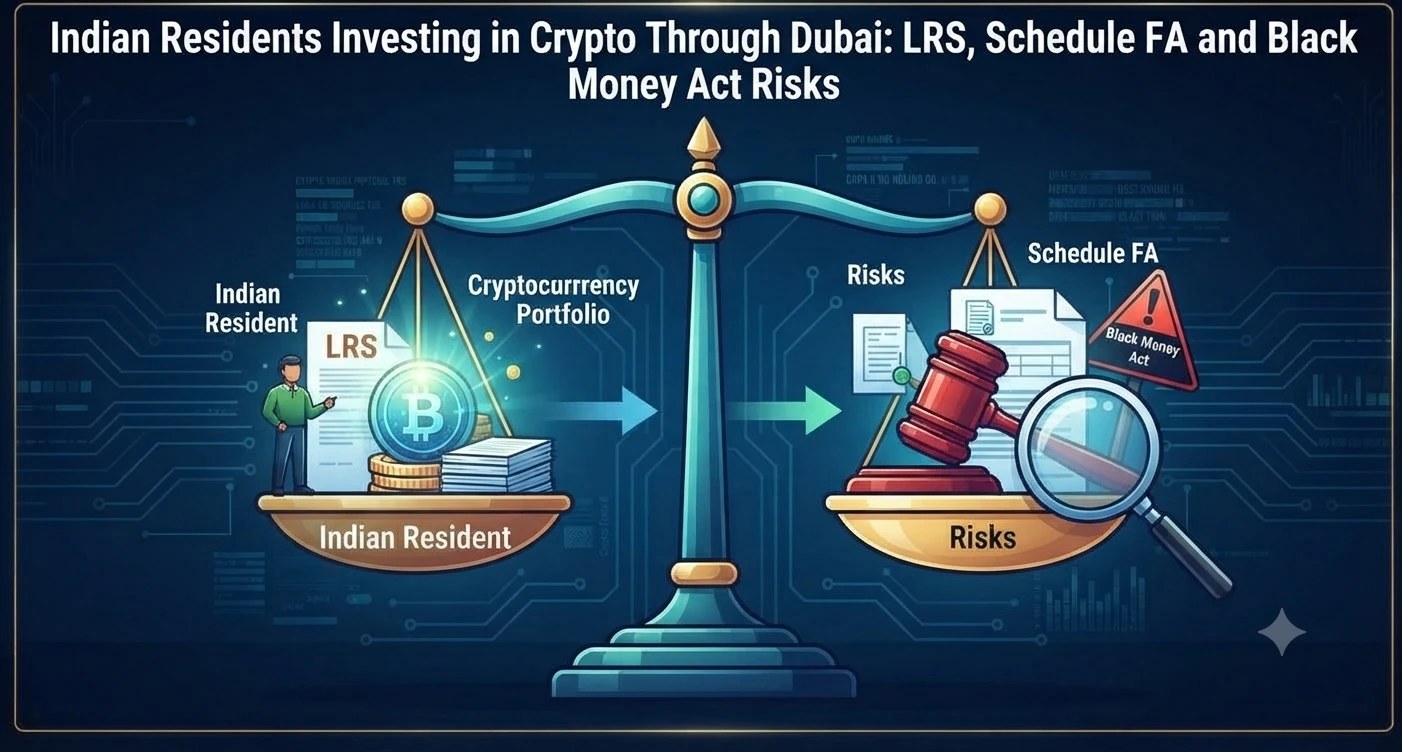
For Indian buyers, tokens are virtual digital assets. Gains on sale are taxed at 30%, and India’s 1% TDS applies to transfers above thresholds. Indian residents must also disclose tokens held on foreign platforms as foreign assets in Schedule FA of their tax returns. Founders who explain these points clearly to Indian participants build trust, and those who imply tax-free gains create problems for their investors.
Airdrops and community rewards aimed at Indian users can also create Indian tax events for recipients, which founders should mention in their communications. Marketing to India is where token launches most often go wrong. Influencer campaigns aimed at Indian audiences, Telegram groups promising returns, and referral schemes all attract attention from Indian regulators. Indian consumer protection law also restricts misleading advertisements, and celebrity or influencer endorsements of misleading financial claims can expose the endorsers too.
Indian founders based in Dubai should also consider their own Indian position: tokens received as founders may be taxable in India if they’re resident, and their overseas investment in the issuing entity must comply with FEMA. If you decide to exclude Indian residents, make the exclusion real: KYC that captures residence, geographic restrictions, terms that prohibit Indian participation, and marketing that doesn’t target Indian audiences.
A practical approach and remedies
A sensible approach for a token launch from Dubai is to decide early whether Indian residents can participate. If they can, use FIU-registered infrastructure for Indian participants, review the token’s economics against India’s deposit, money circulation and collective investment scheme laws, prepare clear tax disclosures, and design marketing that doesn’t overpromise. If they can’t, build and document an effective exclusion. If Indian regulators or police raise questions, respond promptly with advice, provide documentation of the token’s structure and your compliance steps, and avoid public statements before taking advice. Getting the Indian side right protects both the founders and the Indian investors who are often a token’s most enthusiastic early supporters.
Related reading: why Dubai exchanges also need FIU-IND registration, FIU-IND registration for crypto exchanges and Web3 businesses, the UAE’s September 2026 deadline, Dubai vs GIFT City for crypto and Web3 businesses, setting up a Dubai holding company as an Indian founder, using an Indian exchange’s Dubai entity and building a Web3 startup with an Indian team; also Web3 trade marks in India and the UAE; also the VARA and Securitize tokenisation MoU; also VARA token issuance guidance 2026; also smart contract liability for Indian developers.
Quick answers
Can a Dubai token launch accept Indian investors?
It can, but Indian rules on anti-money laundering registration, unregulated schemes and tax must be considered, or Indian residents should be effectively excluded.
Does FIU-IND registration apply to token sales?
Providing financial services for an issuer’s offer and sale of VDAs to people in India is a listed activity under India’s PMLA rules for VDA service providers.
How are Indian buyers taxed on tokens?
Gains are taxed at 30%, with 1% TDS on transfers above thresholds, and tokens held abroad must be disclosed in Schedule FA.
What are the main ways to manage Indian risk in a token launch?
Use FIU-registered infrastructure for Indian participants, or exclude Indian residents and make the exclusion real: KYC that captures residence, geographic restrictions, terms that prohibit Indian participation and marketing that does not target Indian audiences.
Can token features look like an unregulated scheme in India?
Yes. Fixed returns, yield from the issuer’s activities, buybacks at guaranteed prices or rewards for recruiting others can look like a deposit, money circulation or collective investment scheme to an Indian regulator, whatever the token is called.
Final word
Halverton & Co. is an Indian law firm advising NRIs, founders, investors and businesses in Dubai and across the UAE on Indian law, including token launch structuring for Indian investors, PMLA and FIU-IND compliance, and regulatory risk reviews. We practise in Jharkhand, Maharashtra and before the Supreme Court of India, and work alongside UAE-licensed counsel, who advise on UAE law. Halverton & Co.: Where tech needs law! If you have a question about Indian law, write to us at office@halvertonandco.com, or get in touch.
This article reflects developments reported up to early October 2026. It is for general information only, is not legal advice, and does not create an advocate-client relationship. Halverton & Co. is an Indian law firm and does not advise on UAE law; UAE-law points should be confirmed with UAE-licensed counsel.
Sources
Related practice area
Crypto, Web3 & Digital Assets
Advice for virtual digital asset businesses on registration, reporting and structure.
View the practice areaComments
No account needed. Comments are reviewed before they appear, so yours will show here once approved. Please do not share confidential details or describe your own legal matter: replies are general discussion, not legal advice, and do not create an advocate-client relationship. For your own situation, write to office@halvertonandco.com.