Key takeaways
- Under India’s Copyright Act, 1957, freelancers own the code they write unless they assign it in writing.
- Section 19 defaults can undermine an assignment that does not state worldwide territory and full duration, or exclude the one-year lapse rule.
- Patent assignments must be in writing, and developers may be co-inventors.
- Gaps are usually fixed with confirmatory assignments before a funding round or exit.
It’s often an investor’s lawyer who asks first. During due diligence for a seed or Series A round, a simple question appears on the checklist: “Please confirm that the company owns all intellectual property in its software.” For a UK start-up whose product was partly built by developers in India, the honest answer is sometimes: “We think so.”
IP assignment works differently under Indian law, and template contracts drafted for the UK don’t always do the job. This guide explains who owns code written by Indian developers, the specific traps in Indian copyright law, how to structure IP assignment properly, and how to fix gaps before they derail a deal. The comparison with UK law is general; take UK advice on the English-law side. For the US-facing version, see IP assignment in India for US startups.
Who owns code written in India?
Under India’s Copyright Act, 1957, the author of a work is the first owner of copyright, subject to exceptions. The main exception, in Section 17(c), is for works made in the course of employment under a contract of service: the employer owns them, unless there’s an agreement to the contrary. Freelancers and consultants working under a contract for services aren’t employees, so they own the copyright in the code they write unless they assign it.
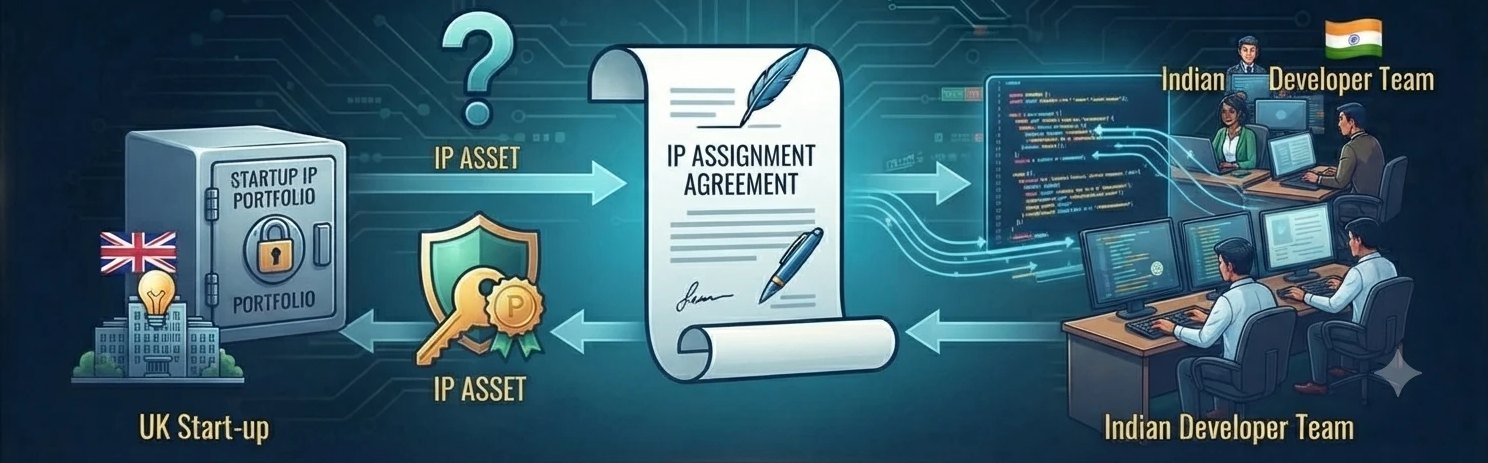
That rule also catches many UK start-ups that work with Indian development agencies. The agency’s employees’ work belongs to the agency, not to the client, so unless the agency assigns the IP to you, your start-up may only have a licence, or an argument for one, rather than ownership.
UK start-ups sometimes assume that choosing English law in the contract solves the problem. It helps with contractual obligations, but questions about the ownership and transfer of copyright in India are still governed by Indian law, so the IP assignment must satisfy Indian requirements as well. The position is similar in principle to UK law, where commissioned works also belong to the author unless assigned. But Indian law adds formal requirements for assignments that UK templates often don’t address, which is where the real risk lies.
The Section 19 traps in Indian copyright assignments
Section 19 of the Copyright Act requires an assignment to be in writing and signed by the assignor, and it should identify the work and the rights assigned, the duration and the territorial extent. Three default rules can undermine an assignment that doesn’t deal with them expressly.
First, if the assignee doesn’t exercise the assigned rights within one year, the assignment is deemed to have lapsed, unless the agreement provides otherwise. Second, if the duration isn’t stated, it’s deemed to be five years. Third, if the territory isn’t stated, it’s presumed to extend only to India. An assignment that’s silent on these points could, in the worst case, leave a UK start-up with Indian rights for five years that lapse if not used.
| If the assignment is silent on... | Indian law presumes... |
|---|---|
| Exercise of the rights | The assignment lapses if the rights are not exercised within one year |
| Duration | Five years |
| Territory | India only |
The fix is simple but must be deliberate: state that the IP assignment is worldwide, for the full term of copyright, and that the one-year lapse provision doesn’t apply. Use present words of assignment (“hereby assigns”), cover future works, and include a further-assurances clause obliging the developer to sign confirmatory documents.
Patents, moral rights and other IP
If an Indian developer contributes to a patentable invention, they may be a co-inventor. India’s Patents Act requires patent assignments to be in writing to be effective, and they should be registered. Your agreement should require developers to assign inventions and sign the documents needed for filings in the UK and elsewhere.
There’s also a filing trap. Under Section 39 of the Patents Act, a person resident in India must not file a patent application outside India without first filing in India or obtaining a foreign filing permit. If your Indian developers invent something, check this before filing at the UKIPO or the EPO. Our guides to software patents in India and patenting software in India under Section 3(k) explain what Indian law treats as patentable.
Moral rights deserve attention too. Under Section 57 of India’s Copyright Act, authors keep the right to claim authorship and to object to distortion of their work, even after assigning copyright. Software contracts commonly include a waiver or a covenant not to assert moral rights, to the extent the law allows.
How to structure IP assignment properly
For employees of your own Indian subsidiary, the employment contract should confirm ownership of work made in the course of employment, include an express IP assignment for anything outside that scope, and cover inventions and confidentiality. The subsidiary should then assign the IP to the UK parent under the intercompany agreement; see our guide to setting up a company in India from the UK.
For freelancers, use a services agreement with a present, worldwide, full-term assignment excluding the Section 19 defaults, a moral rights waiver, a further-assurances clause and confidentiality. For agencies, require the agency to assign everything to you and to confirm that its own staff and subcontractors have assigned their rights to it. For employer-of-record arrangements, make sure the EOR assigns the developers’ IP to your UK company; see our guide to hiring developers in India from the UK.
Open-source code is part of the picture too: record which open-source components are used and under which licences, because some licences impose obligations that investors will ask about. Investors’ due diligence questionnaires typically ask for a list of everyone who has contributed to the codebase, copies of their agreements, and confirmation that IP assignment has been completed. Preparing this list early, and keeping it updated, makes any funding round much smoother; see our guide to legal due diligence on Indian startups.
Practical steps matter as much as paperwork. Keep code in repositories your company owns, not developers’ personal accounts. Pay invoices on time, because unpaid developers are the ones most likely to dispute ownership. And keep a register of who has worked on the product and which agreement covers them, which will save days in due diligence. Founder-level IP and equity should be settled too; see our guide to founders’ agreements in India.
Fixing gaps, remedies and quick answers
If you find gaps, fix them before a funding round or exit forces you to. The usual remedy is a confirmatory IP assignment: a new agreement, signed by the developer or agency, assigning all past work in a form that meets Section 19, often for a modest payment. If a developer refuses, options include negotiation, relying on implied licence arguments, or, where the original contract supports it, seeking specific performance or an injunction.
If a former contractor misuses your code, you can bring a copyright claim in India, with remedies including injunctions and damages. Investors increasingly expect clean chains of title from day one, so a little care with IP assignment early saves a great deal of trouble later. Have Indian counsel review any sample assignment language before you use it.
Quick answers
Does a UK start-up own code written by an Indian freelancer?
Not automatically. The freelancer owns the copyright unless it’s validly assigned in writing in a way that meets Indian law.
What must an Indian copyright assignment include?
It should be written and signed, identify the work and rights, state worldwide territory and full duration, and exclude the one-year lapse rule.
Can we fix missing IP assignments before a funding round?
Yes. Confirmatory assignments signed by the developers or agency are the usual fix.
Related reading: software patents in India for UK tech companies; also paying Indian developers from a Dubai Web3 company; also who owns the AI model: IP for UK startups building in India; also exclusive and non-exclusive copyright licences between UK and Indian companies; also hiring a freelance developer from India.
Final word
Halverton & Co. is an Indian law firm that advises on Indian law, including IP assignment, chain-of-title clean-ups and IP due diligence for start-ups building in India. We practise in Jharkhand, Maharashtra and before the Supreme Court of India, and we work alongside your UK solicitors, who advise on English law. Halverton & Co.: Where tech needs law! If you have a question about Indian law, write to us at office@halvertonandco.com, or get in touch.
This article reflects developments reported up to early October 2026. It is for general information only, is not legal advice, and does not create a solicitor-client relationship. Halverton & Co. is an Indian law firm, is not authorised or regulated by the Solicitors Regulation Authority, and does not advise on English law.
Related practice area
Intellectual Property
Trade marks, copyright, patents and designs. Searched, filed, licensed and enforced under Indian law.
View the practice areaComments
No account needed. Comments are reviewed before they appear, so yours will show here once approved. Please do not share confidential details or describe your own legal matter: replies are general discussion, not legal advice, and do not create an advocate-client relationship. For your own situation, write to office@halvertonandco.com.