Key takeaways
- An Indian song has separate copyrights in the composition, lyrics and sound recording, and since the 2012 amendment composers and lyricists keep royalty rights for uses outside the film.
- IPRS licenses some uses of compositions and lyrics, and PPL India licenses public performance and broadcast of recordings; both are separate from the UK’s PRS and PPL.
- Synchronisation is negotiated directly with each owner, and online release needs worldwide rights.
- Identify every owner, get written licences, keep records and replace any song you cannot clear.
A UK filmmaker, YouTuber or advertiser who wants a Bollywood song faces a clearance puzzle. Indian law, like UK law, separates the sound recording from the composition and the lyrics, and each can have a different owner. To license Indian music UK content needs, you usually have to clear several rights, and a single licence for the recording alone will not cover the rest.
This guide explains the layers of rights, who licenses each one in India, how the Indian bodies such as IPRS and PPL India differ from the UK’s PPL and PRS, what a synchronisation licence is, and a practical clearance checklist. It is written by an Indian law firm for UK readers. UK licensing points should be confirmed with UK music clearance specialists.
The layers of rights in an Indian song
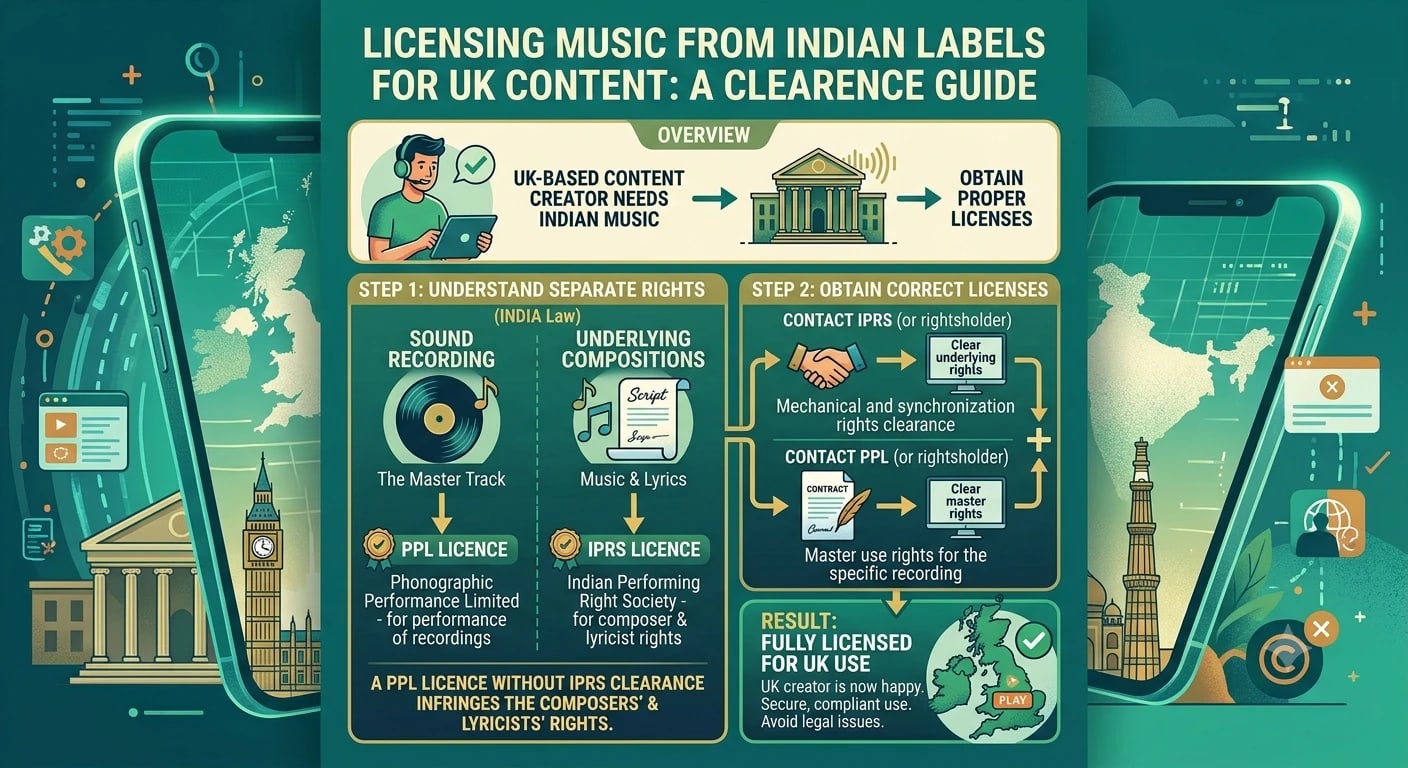
An Indian song usually has three layers. The musical composition belongs to the composer or their assignee, the lyrics to the lyricist or their assignee and the sound recording to the label or producer. The Copyright Act, 1957 treats them as separate works. A film song may also be part of a cinematograph film, which has its own copyright, held by the producer. Indian music rights lyrics composition recording are all separate and must be cleared separately. The layers decide how you license Indian music UK projects need.
Since the Copyright (Amendment) Act, 2012, composers and lyricists have a statutory right to royalties when their works are used outside the film, even if they assigned other rights to the film producer. That right cannot be waived, and it is usually administered through the Indian Performing Right Society, known as IPRS. So a label that owns the recording may still need a separate clearance for the composition and lyrics.
These layers matter for UK content because infringement can arise at any layer. A licence for the sound recording alone leaves the composition and lyrics uncleared, and a composition licence alone leaves the recording uncleared. The statement that a PPL licence without IPRS clearance infringes the composers’ and lyricists’ rights is a good summary of the problem, though the right body depends on the use.
Who licenses what in India
For compositions and lyrics, the main society is IPRS, which licenses public performance, communication to the public and some other uses of its members’ works, subject to the scope of its mandate. For sound recordings, licensing is done by labels directly and by bodies such as Phonographic Performance Limited in India, usually called PPL India, which licenses public performance and broadcast of recordings of its members. Singers and musicians have their own bodies, such as the Indian Singers’ and Musicians’ Rights Association. An IPRS licence for UK creators may cover some performance uses but not synchronisation. A PPL India sound recording licence covers recordings, not the composition. This split is why it takes several steps to license Indian music UK content can use.
| Layer | Owner | Typical licence |
|---|---|---|
| Composition | Composer or assignee | Sync licence; IPRS for some performance uses |
| Lyrics | Lyricist or assignee | Sync licence; IPRS for some performance uses |
| Sound recording | Label or producer | Master use licence; PPL India for performance and broadcast |
| Film | Producer | Film clips need a separate licence |
Do not confuse the Indian PPL with the UK’s PPL. Phonographic Performance Limited in the UK licenses public performance and broadcast of recordings in the UK, and PRS for Music licenses compositions in the UK. They are separate organisations from PPL India and IPRS. Some societies have reciprocal arrangements, but a UK licence does not normally cover use in India, and an Indian licence does not normally cover use in the UK.
Synchronisation, which means placing a song in a video, film or advertisement, is generally not handled by societies. It is negotiated directly with the label for the recording and with the publisher or owner for the composition and lyrics. Large Indian labels and music companies, such as those that hold big film catalogues, have licensing teams. Expect to deal with several parties and to be asked for details of the use.
Synchronisation and other uses in UK Content
For a film or advertisement, you need a synchronisation licence for the composition and lyrics and a master use licence for the recording. Agree the territory, term, media, number of uses and fee. A licence for the UK only does not allow worldwide online release. If your content goes on YouTube, Instagram or streaming platforms, say so, because those are global by default. A sync licence Bollywood song UK film producers need comes from the label and publisher. A UK team that wants to license Indian music UK audiences hear online must plan for worldwide rights.
For YouTube and social media, the platforms’ own licences with societies and labels cover some uses in some countries, but these licences are not a substitute for a sync licence if you use a song in an advertisement or a sponsored video. Content ID may still claim your video. If you plan monetised content, clear the music in advance, and keep the licences in a folder that you can show to the platform in case of a dispute. To clear Indian song for YouTube UK channels need, secure the sync licence first.
For live events and venues, public performance licences are different. In the UK, the venue usually holds PRS and PPL licences. If the event takes place in India, Indian licences from IPRS and PPL India may be needed. For remixes, covers and samples, you also need permission to adapt the work, and the author’s moral rights may be affected. Never assume that a cover version is free from clearance.
A clearance checklist
Step one: identify the song and its metadata, including the composer, lyricist, label, film and year. Step two: find the owners of each layer, using label catalogues, publisher information and society databases. Step three: ask each owner for a written licence stating the scope of use, territory, term and fee. Step four: check whether a society has a licensing mandate for your use, and take its licence where required. Use these steps whenever you license Indian music UK productions include.
Step five: agree credits and any restrictions, such as no use in political or offensive contexts. Step six: keep copies of all licences and invoices, and record the track names and timestamps in the content. Step seven: if the owner cannot be found, do not use the song. An orphan song is still protected, and an unlicensed use can lead to takedown, damages and a ban on the content.
Budget time and money. Clearances can take weeks, and fees depend on the song’s fame and the use. If a famous song is too expensive or too complex, consider commissioning original music or using an Indian production library that offers worldwide commercial licences. Work with a UK music clearance agent and an Indian lawyer if the music is central to your project.
Next steps and quick answers
Before you finalise an edit, list every song, record its owners and licences and confirm that the licence covers the UK and online release. Replace any song that you cannot clear. This is general information, not legal advice. Never publish before you license Indian music UK content depends on.
Related reading: using Bollywood songs in Instagram reels, exclusive and non-exclusive copyright licences, can AI-made music be copyrighted in India, AI music lawsuits and generative AI startups, UK influencers working with Indian brands, got a YouTube copyright strike in India and licensing UK technology to Indian companies; also copyright for music and film in the UAE.
Quick answers
How do I license Indian music for UK content?
Identify the owners of the composition, lyrics and recording, and obtain a synchronisation licence for the composition and lyrics and a master use licence for the recording. Societies such as IPRS may license some uses, but sync licences are negotiated directly.
Does a PPL licence cover Indian songs in my video?
No. A PPL licence relates to sound recordings and does not clear the composition and lyrics. In the UK, PPL and PRS are different bodies, and neither automatically covers Indian licensing or sync use.
What is the difference between IPRS and PPL India?
IPRS administers rights in compositions and lyrics, and PPL India licenses public performance and broadcast of sound recordings for its members. Both are separate from the UK’s PRS and PPL.
Can a UK PPL licence cover an Indian song?
No. UK PPL licenses recordings in the UK and does not clear the composition and lyrics or use in India.
What is a synchronisation licence?
Permission to place a song in a video, film or advertisement, negotiated directly with the owners of the composition and lyrics and, for the recording, a master use licence.
Final word
Halverton & Co. is an Indian law firm advising UK companies, founders, investors and law firms on Indian law, including music and media licensing, copyright clearance, cross-border content agreements and IP enforcement in India. We practise in Jharkhand, Maharashtra and before the Supreme Court of India, and work alongside your UK solicitors, who advise on English law. Halverton & Co.: Where tech needs law! If you have a question about Indian law, write to us at office@halvertonandco.com, or get in touch.
This article reflects developments reported up to 31 October 2026. It is for general information only, is not legal advice, and does not create a solicitor-client relationship. Halverton & Co. is an Indian law firm, is not authorised or regulated by the Solicitors Regulation Authority, and does not advise on English law; UK-law points should be confirmed with UK advisers.
Sources
Related practice area
Intellectual Property
Trade marks, copyright, patents and designs. Searched, filed, licensed and enforced under Indian law.
View the practice areaComments
No account needed. Comments are reviewed before they appear, so yours will show here once approved. Please do not share confidential details or describe your own legal matter: replies are general discussion, not legal advice, and do not create an advocate-client relationship. For your own situation, write to office@halvertonandco.com.