Key takeaways
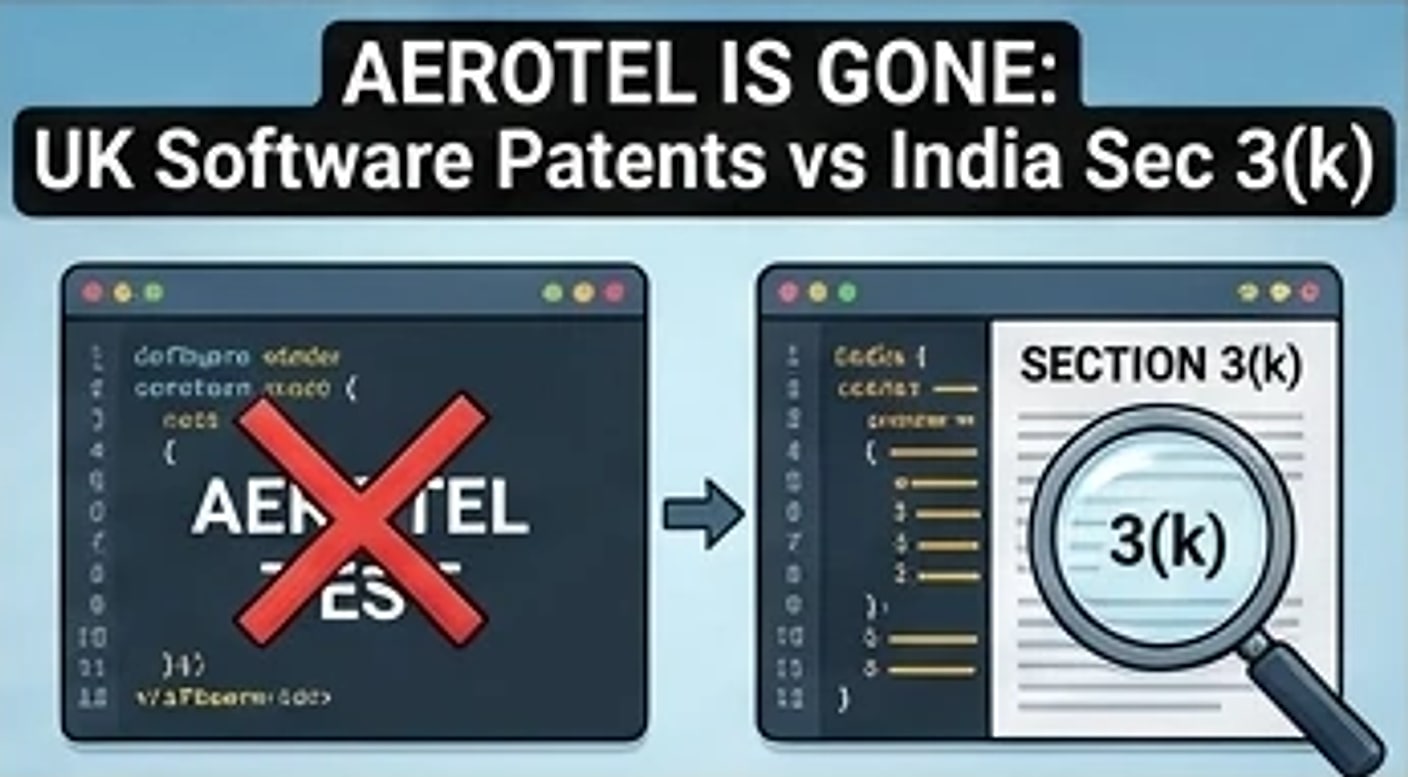
- Commentary says the UK Supreme Court abandoned the Aerotel test in Emotional Perception in February 2026 and aligned with the EPO’s G 1/19 approach.
- A claim that involves hardware is no longer excluded at the threshold, and non-technical features are set aside at inventive step.
- India applies Section 3(k) with a technical effect gloss developed in Delhi High Court decisions and guidelines.
- Draft around a technical problem, solution and effect to suit both systems.
For nearly twenty years, the Aerotel test decided whether a computer-implemented invention could be patented in the UK. In February 2026, the UK Supreme Court set it aside in Emotional Perception AI v Comptroller General of Patents, and law firm commentary says the court moved the UK closer to the European Patent Office’s approach in G 1/19. For UK businesses that build software in India or file patents in both countries, the change matters.
This guide explains the Aerotel test and why it was dropped, how UK software patents after Aerotel are assessed, and how India’s approach under Section 3(k) compares. It is written by an Indian law firm for UK readers. UK law points should be confirmed with a UK patent attorney, and the Supreme Court judgment should be read in full.
What the Aerotel test was
The Aerotel test came from the 2006 Court of Appeal decision in Aerotel v Telco and Macrossan. It had four steps: properly construe the claim, identify the actual contribution, ask whether the contribution falls solely within excluded subject matter and check whether the contribution is technical in nature. It was used by the UK Intellectual Property Office and the courts to apply the exclusion in section 1(2) of the Patents Act 1977 for programs for computers, as such.
The Aerotel test was criticised for being different from the EPO’s approach. The EPO asks whether a claim has a technical character, for example because it involves hardware, and then considers technical features at the inventive step stage. Applicants often found that a claim passed at the EPO but failed in the UK. The mismatch added cost for businesses that filed in both.
Commentators also said that Aerotel mixed the question of whether there is an invention with the separate questions of novelty and inventive step. That is part of the reasoning the Supreme Court is reported to have used in setting it aside. The case concerned an artificial neural network used to recommend music, a good example of the AI inventions that tested the older approach. Understanding the Aerotel test is still useful, because pending applications and old decisions were decided under it.
What Emotional Perception changed
Emotional Perception UKSC 2026, reported as [2026] UKSC 3, is described by Linklaters, Morgan Lewis and other firms as a decision that abandons Aerotel and aligns the UK with the approach in G 1/19. Under that approach, a claim that involves any form of hardware, such as a computer, is treated as an invention and is not excluded at the threshold. Non-technical features are then set aside when assessing inventive step, and the Pozzoli method remains relevant. This is the G 1/19 approach UK patents now follow.
The court is reported to have held that the artificial neural network was a computer program, but that the claim was to an invention and not excluded under the European Patent Convention article. It remitted the question of patentability to the UKIPO to apply the new approach. This means that the result for a particular claim depends on novelty and inventive step, not on a threshold exclusion alone.
What does it mean for UK software patents after Aerotel? Commentators say it opens a clearer path to patentability for AI and software inventions, while also shifting the battleground to the inventive step analysis. They expect UKIPO guidance to follow, because examiners were trained on Aerotel. Until guidance appears, treat practice as in transition and check the latest UKIPO practice notice.
India: section 3(k) and technical effect
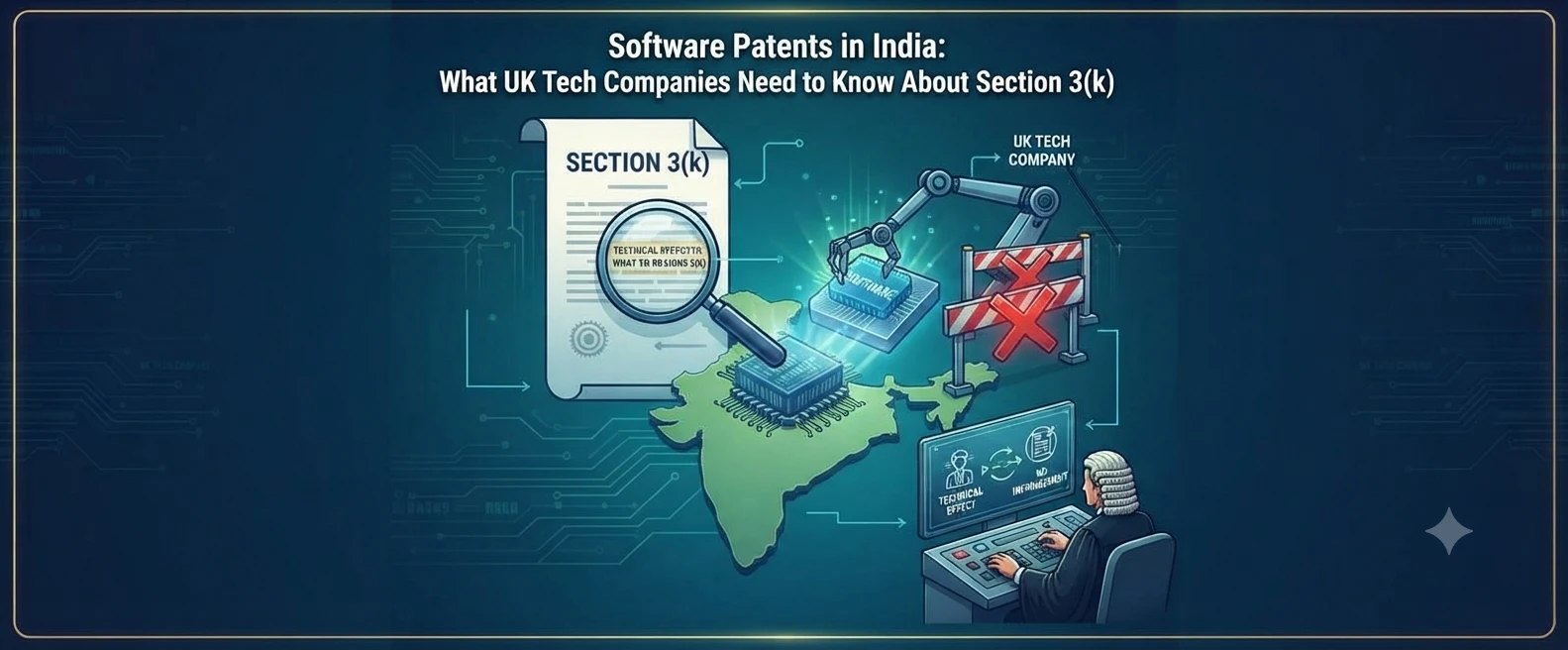
India’s approach is different in text. Section 3(k) of the Patents Act, 1970 excludes a mathematical or business method or a computer programme per se or algorithms. The words per se are important: Indian courts and guidelines have held that a computer programme with a technical effect or technical contribution may be patentable. Section 3(k) computer programme per se India cases turn on whether the claimed invention solves a technical problem in a technical way.
| Question | UK after Emotional Perception | India |
|---|---|---|
| Legal basis | Section 1(2) read with the EPC approach | Section 3(k) Patents Act |
| Threshold test | Does the claim involve hardware? | Is there a technical effect or contribution? |
| Non-technical features | Set aside at inventive step | Considered in examination |
| Drafting tip | Show a technical problem and solution | Show a technical effect |
Delhi High Court decisions have pushed the Indian Patent Office towards a technical effect approach, including Ferid Allani v Union of India, Microsoft Technology Licensing v Assistant Controller and Ericsson v Lava. The Patent Office has also issued guidelines for computer related inventions, and commentary says a revised set came in 2025. Check the current text, because examiners still raise Section 3(k) objections often.
Compared with the UK’s new approach, India still applies an exclusion with a technical effect gloss, while the UK applies a hardware threshold and then filters technical features at the inventive step stage. In both countries, drafting a claim around a technical problem, a technical solution and a measurable technical effect is the safest way to avoid objections. Technical effect software patent India examiners accept usually ties the program to a system improvement.
Practical drafting and strategy
If you file in both countries, align the specification. Describe the technical problem, the technical architecture, how data flows and what measurable effect results, such as lower latency or reduced memory use. Avoid claiming abstract business outcomes. Draft claims at different levels: method, system and storage medium, and consider fall-back claims that recite specific technical steps.
Think about timing and sequence. A priority filing in the UK or India can be followed within twelve months by the other, and PCT routes keep options open. If you are developing in India for a UK parent, check who owns inventions, whether employees and contractors have assigned rights and whether Indian foreign filing rules apply to inventions made in India. Review these points before you file abroad.
Keep a record of the technical contribution during development. Engineers’ notes, benchmarks and design documents help at the inventive step stage. Do not rely on the change in UK law alone. Examiners, courts and the EPO will still reject claims that lack an inventive technical contribution, and the new approach is only a few months old.
Next steps and quick answers
Review pending UK applications that were refused or narrowed under Aerotel, ask your UK attorney about refiling or reviving, align drafting practice with the technical effect approach and plan your India filings accordingly. This is general information, not legal advice.
Related reading: software patents and Section 3(k) in India, software patents in India for UK tech companies, whether you can patent AI: US and India compared, how to file a patent in India, filing in India after a UK or US priority filing and patent filing costs in India for startups.
Quick answers
Is the Aerotel test still law in the UK?
Commentary on the February 2026 Supreme Court decision in Emotional Perception says the court abandoned it and aligned the UK with the EPO’s G 1/19 approach. Read the judgment and UKIPO guidance.
Can software be patented in India?
Section 3(k) excludes computer programmes per se, but courts and guidelines allow patents for inventions with a technical effect or contribution.
How do the UK and Indian approaches differ?
The UK now asks whether a claim involves hardware and then filters technical features at inventive step. India applies the Section 3(k) exclusion and looks for technical effect.
Is the Aerotel test still used in the UK?
Commentary says it was abandoned in 2026 after Emotional Perception. Read the judgment and the latest UKIPO guidance.
Final word
Halverton & Co. is an Indian law firm advising UK companies, founders, investors and law firms on Indian law, including patent strategy for software and AI inventions in India, cross-border filing support and technology transfer. We practise in Jharkhand, Maharashtra and before the Supreme Court of India, and work alongside your UK solicitors, who advise on English law. Halverton & Co.: Where tech needs law! If you have a question about Indian law, write to us at office@halvertonandco.com, or get in touch.
This article reflects developments reported up to 31 October 2026. It is for general information only, is not legal advice, and does not create a solicitor-client relationship. Halverton & Co. is an Indian law firm, is not authorised or regulated by the Solicitors Regulation Authority, and does not advise on English law; UK-law points should be confirmed with UK advisers.
Sources
- Linklaters: Emotional Perception AI, Supreme Court overhauls decades of UK case law
- Morgan Lewis: UK Supreme Court resets approach to patentability of computer-implemented inventions
- Office of the Controller General of Patents, Designs and Trade Marks (IP India)
- EU IP Helpdesk: Indian Patent Office guidance on examining AI inventions (CRI Guidelines 2025)
Related practice area
Intellectual Property
Trade marks, copyright, patents and designs. Searched, filed, licensed and enforced under Indian law.
View the practice areaComments
No account needed. Comments are reviewed before they appear, so yours will show here once approved. Please do not share confidential details or describe your own legal matter: replies are general discussion, not legal advice, and do not create an advocate-client relationship. For your own situation, write to office@halvertonandco.com.