Key takeaways
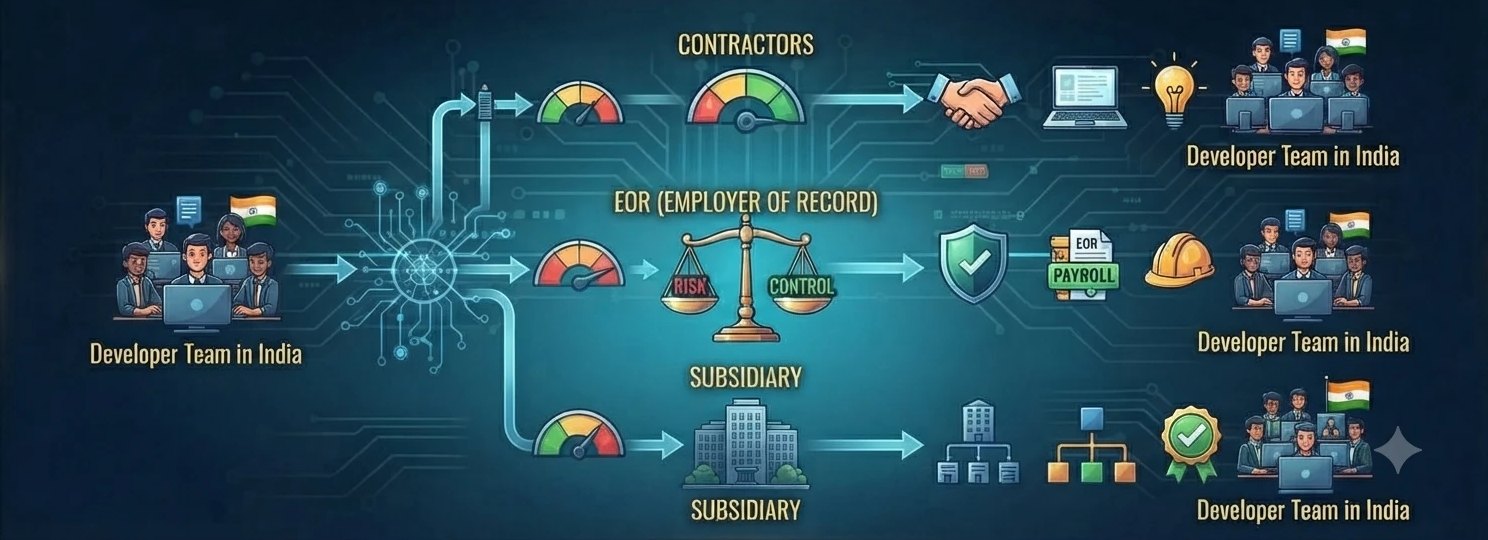
- Contractors suit early and flexible needs, an employer of record suits a small permanent team, and a subsidiary suits a large long-term team.
- A UK company owns code written by an Indian contractor only if it is validly assigned in writing under Indian copyright law.
- Developers hired through an employer of record are covered by India’s labour codes in force since 21 November 2025.
- Keep contracting authority in the UK to limit permanent establishment risk under the India-UK tax treaty.
British tech start-ups and scale-ups have a familiar problem: they need good engineers, and the UK market is expensive and competitive. India offers one of the deepest pools of software talent in the world, in a time zone that overlaps comfortably with the UK working day. So the question isn’t usually whether to hire in India, but how.
This guide explains the three main ways to hire developers in India from the UK: independent contractors, an employer of record, or your own Indian subsidiary. It covers the legal implications of each, with a focus on IP ownership, India’s labour codes and tax risk. UK-side issues, such as UK employment status and off-payroll rules, are outside this article; take UK advice on those.
Option one: independent contractors
Engaging developers in India directly as independent contractors is the quickest and cheapest way to start. You don’t need an Indian entity, and you can engage people through a written services agreement, or through a freelance platform plus your own contract. Contractors invoice you, take care of their own taxes, and you pay them through normal banking channels.
Many UK companies that hire developers in India from the UK start through freelance platforms. Platform terms may include some IP provisions, but they rarely address Indian copyright formalities in detail, so for key developers it’s worth signing your own agreement as well. The legal risk is in the details. Under Indian copyright law, a contractor owns the copyright in the code they write unless they assign it in writing, and Section 19 of the Copyright Act has specific requirements: an assignment that doesn’t state its duration is treated as lasting five years, one that doesn’t state territory is presumed to cover only India, and unexercised rights can lapse after a year. Your contract needs a present, worldwide, full-term assignment that excludes those defaults. See our guide to IP assignment for UK start-ups with Indian developers.
Classification is the other risk. If a contractor works full-time, exclusively for you, under your managers’ control and integrated into your team, Indian authorities may treat them as an employee. That brings statutory benefits and termination protections into play. For a fuller treatment, see our guide to hiring contractors in India from the US, which applies equally to UK companies on the Indian-law points.
Option two: an employer of record
An employer of record (EOR) is an Indian company that formally employs developers on your behalf, runs payroll, withholds tax, provides statutory benefits and handles employment compliance, while the developers work for you day to day. It’s a popular way to hire developers in India from the UK without setting up your own entity.
The main advantages are speed and compliance. You can hire employees in days rather than months, and the EOR handles the requirements of India’s labour codes, which came into force together on 21 November 2025, including the new wage definition, social security and leave rules; see our guide to the new labour codes for startups.
The legal points to check are IP and confidentiality. Employees’ work belongs to their employer, which is the EOR, not you, so the EOR contract must assign all IP created by the developers to your UK company, and the employees’ contracts must support that. Check also how the EOR handles termination, data protection and liability, and what happens if you later want to transfer the employees to your own entity.
Option three: your own Indian subsidiary
When your Indian team grows beyond a handful of people, or becomes central to the business, your own subsidiary usually makes more sense. A wholly owned Indian private limited company gives you direct control over hiring, culture, IP and costs, and is generally cheaper per head at scale than an EOR.
It also brings responsibilities: incorporation, at least one resident director, FEMA reporting of the UK parent’s investment, Indian tax and transfer pricing, labour code compliance and a full statutory compliance calendar; see our guide to setting up a company in India from the UK. The subsidiary typically provides development services to the UK parent under an intercompany agreement, priced at cost plus a markup, with IP assigned to the parent.
Cost comparisons should include more than salaries. EOR fees, employer social security contributions, equipment, office or co-working space, management time and legal and accounting costs all matter when you decide how to hire developers in India from the UK. Many UK companies follow a path: contractors for the first few hires, an EOR for a small permanent team, and a subsidiary once the team is large and long-term. Planning that path from the start makes each transition smoother.
| Contractors | Employer of record | Own subsidiary | |
|---|---|---|---|
| Speed | Fastest | Days | Weeks to months |
| Who employs | No one: independent | The EOR | Your Indian company |
| IP | Written assignment from each contractor | EOR assigns developers’ IP to you | Employment terms plus assignment to the UK parent |
| Main risk | Misclassification as employees | Contract gaps on IP and exit | Compliance burden and cost at small scale |
| Best for | Early and flexible needs | Small permanent team | Large, long-term team |
Tax and other risks when you hire developers in India from the UK
The main tax question for the UK company is whether its Indian activities create a permanent establishment in India, which would make some of its profits taxable there under the India-UK tax treaty. For development work, the risk is usually manageable, but it grows if Indian team members negotiate or conclude contracts with customers on the UK company’s behalf. Keep contracting authority in the UK.
Data protection is another consideration. If Indian developers can access UK personal data, that is likely to be a restricted transfer under UK GDPR, requiring a transfer mechanism such as the IDTA and a transfer risk assessment; see our guide to UK GDPR transfers to India. If your Indian operation processes personal data of people in India, India’s DPDP Act applies from 13 May 2027; see India’s DPDP Act for UK businesses.
Equity is another point to plan. If you want to offer share options in your UK company to Indian developers, India’s foreign exchange rules allow resident employees to acquire shares of a foreign company under an employee scheme, subject to conditions, and the options will be taxed in India on exercise; see our guide to stock options for Indian employees of a US startup, which sets out the Indian rules. A short India addendum to your option plan avoids surprises. Finally, be careful with restrictive covenants. Post-termination non-competes are generally unenforceable in India under Section 27 of the Indian Contract Act, so rely on confidentiality, IP assignment and non-solicitation clauses instead.
Disputes, remedies and quick answers
Disputes with Indian developers usually concern payment, IP or confidentiality. Your remedies depend on your contract: arbitration or court proceedings in the chosen forum, injunctions to protect confidential information and code, and copyright claims if your code is misused after a relationship ends. If you discover gaps in IP assignments, fix them with confirmatory assignments before a funding round or sale. If a contractor relationship looks like employment, consider moving the person to an EOR or your own entity rather than waiting for a claim. With the right structure and contracts, the decision to hire developers in India from the UK can give your business a lasting advantage.
Quick answers
What’s the best way to hire developers in India from the UK?
Contractors suit early and flexible needs, an employer of record suits a small permanent team, and a subsidiary suits a large, long-term team.
Does a UK company own code written by an Indian contractor?
Only if the contractor validly assigns it in writing, in a way that meets Indian copyright law.
Do India’s labour codes apply to developers hired through an EOR?
Yes. The EOR is the legal employer and must comply with the labour codes in force since 21 November 2025.
Related reading: seconding UK staff to India; also paying Indian developers from a Dubai Web3 company; also who owns the AI model: IP for UK startups building in India; also hiring a freelance developer from India.
Final word
Halverton & Co. is an Indian law firm that advises on Indian law, including contractor and EOR agreements, IP assignment, Indian subsidiaries and labour code compliance. We practise in Jharkhand, Maharashtra and before the Supreme Court of India, and we work alongside your UK solicitors, who advise on English law. Halverton & Co.: Where tech needs law! If you have a question about Indian law, write to us at office@halvertonandco.com, or get in touch.
This article reflects developments reported up to early October 2026. It is for general information only, is not legal advice, and does not create a solicitor-client relationship. Halverton & Co. is an Indian law firm, is not authorised or regulated by the Solicitors Regulation Authority, and does not advise on English law.
Related practice area
Startups & Venture
From incorporation to term sheet. The documents a company needs to be fundable.
View the practice areaComments
No account needed. Comments are reviewed before they appear, so yours will show here once approved. Please do not share confidential details or describe your own legal matter: replies are general discussion, not legal advice, and do not create an advocate-client relationship. For your own situation, write to office@halvertonandco.com.