Key takeaways
- A US company can own 100% of an Indian private limited company in most sectors under the automatic route.
- At least one director must have stayed in India for 182 days or more in the previous calendar year.
- Foreign investment in shares must be reported to the RBI on Form FC-GPR within 30 days of allotment.
- New domestic companies can opt for a concessional corporate tax rate of about 25% including surcharge and cess.
There comes a point when a US company’s Indian operation outgrows contractors and employer-of-record arrangements. The team is too large, the work too central, and the tax and misclassification risks too real. The answer, for most US companies, is to set up an Indian subsidiary.
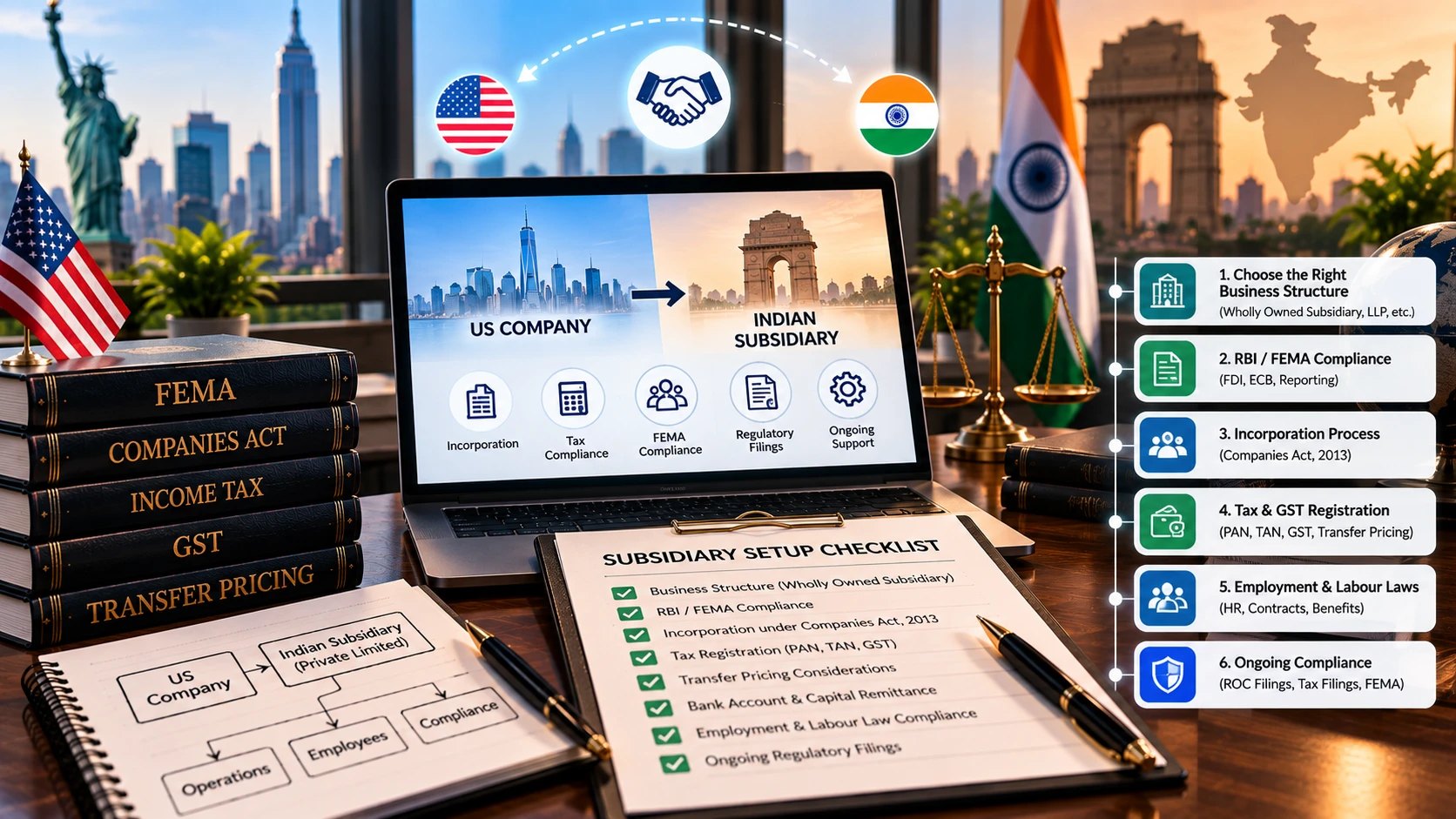
This guide explains how to set up an Indian subsidiary of a US company: choosing the structure, the incorporation process, foreign direct investment and FEMA rules, tax and transfer pricing, and the ongoing compliance calendar that many US founders underestimate. If you are still at the contractor stage, start with our guide to hiring contractors in India from the US.
Choosing the right structure
Most US companies set up their Indian subsidiary as a private limited company under the Companies Act, 2013. It’s the most familiar structure for investors, banks and employees, it can be wholly owned by the US parent, and it offers limited liability. A private company needs at least two shareholders, so the US parent typically holds almost all the shares with a nominal holding by an affiliate or individual, and at least two directors.
The other options are more limited. A limited liability partnership (LLP) offers flexibility and simpler compliance in some respects, but foreign investment in LLPs is permitted only in sectors with 100% automatic-route foreign investment and without performance-linked conditions, and LLPs are less familiar to US investors. A liaison or branch office, which requires RBI approval, suits narrow purposes such as representation or specific projects, but not a full operating team.
| Structure | Best for | Main limits |
|---|---|---|
| Private limited company (wholly owned subsidiary) | Software, IT services, back-office and capability centers | Needs two shareholders and two directors; full compliance calendar |
| LLP | Limited cases where investors accept it | Foreign investment only in 100% automatic-route sectors with no performance conditions |
| Liaison or branch office | Representation or specific projects | Requires RBI approval; not for a full operating team |
The choice of structure also affects how easily the Indian subsidiary can hire, open bank accounts, sign leases and win local customers, all of which are simpler for a private limited company. For software development, IT services, back-office operations and global capability centers, a wholly owned private limited company is the usual choice. Industry reporting from Nasscom and Zinnov puts the number of global capability centers in India above 2,000, most of them set up as subsidiaries of foreign companies.
Incorporation: directors, documents and timeline
Every Indian company must have at least one director who has stayed in India for at least 182 days in the previous calendar year, under Section 149(3) of the Companies Act. US companies typically appoint an Indian resident director, often a senior local employee or a trusted professional, alongside directors from the parent.
Incorporation is done online with the Ministry of Corporate Affairs. The steps include obtaining digital signature certificates and director identification numbers for the directors, reserving the company name, and filing the incorporation form with the memorandum and articles of association. Foreign directors and the US parent will need notarized and apostilled identity and corporate documents, which is often the slowest part of the process. With documents ready, incorporation itself commonly takes a few weeks.
Plan for banking early. Indian banks carry out detailed checks on foreign-owned companies, including on the US parent’s ownership and directors, so having apostilled corporate documents and beneficial ownership information ready will speed up opening the Indian subsidiary’s account. After incorporation, the company opens a bank account, obtains tax registrations (PAN and TAN, and GST if applicable), registers under the relevant labor and state laws, and receives the share capital from the US parent.
FDI and FEMA: bringing money into India
Investment by a US parent into its Indian subsidiary is foreign direct investment (FDI), governed by the Foreign Exchange Management Act, 1999 and the Non-Debt Instruments Rules. Most technology and services sectors allow 100% FDI under the automatic route, which means no prior government approval is needed. Some sectors have caps or require approval, so check your activity first.
The share capital must come through normal banking channels, and shares must be issued at a price not less than their fair value under FEMA pricing rules. After issuing shares to the US parent, the company must report the investment to the RBI through Form FC-GPR within 30 days of allotment. Late reporting can be regularized by paying a late submission fee, but avoid it.
Ongoing FEMA compliance includes the annual return on foreign liabilities and assets, and reporting of any further share issues or transfers. Funding the subsidiary through loans from the parent is also possible, under the external commercial borrowing framework, but it carries its own conditions. A parent that later wants to move its holding structure back to India should read our guide to reverse flipping in India and to fast-track mergers.
Tax, transfer pricing and compliance
An Indian subsidiary is an Indian taxpayer. New domestic companies can generally opt for a concessional corporate tax regime at an effective rate of about 25%, including surcharge and cess, without most deductions and exemptions. India replaced its 1961 income tax law with the Income-tax Act, 2025 from April 1, 2026, so check current section references with your adviser; see our guide to the Income-tax Act 2025 for startups.
Transfer pricing is the biggest tax issue for most US-owned subsidiaries. Transactions between the Indian subsidiary and the US parent, such as software development services, support services, IP licenses and cost reimbursements, must be priced at arm’s length. A typical captive development subsidiary is remunerated on a cost-plus basis, documented in an intercompany agreement and a transfer pricing study, with annual reporting. Getting this right early prevents expensive disputes later.
Employment law also applies from the first hire. An Indian subsidiary must follow India’s labor codes on wages, social security contributions such as provident fund, working hours and termination, and it should adopt Indian employment contracts rather than adapting US offer letters; see our guide to the new labour codes. Equity plans for Indian staff need Indian tax and FEMA review; see stock options for Indian employees.
The compliance calendar is real. Expect statutory audits, annual filings with the Registrar of Companies, board meetings, income tax returns and transfer pricing reports, monthly or quarterly GST and payroll withholding filings, labor code registrations and returns, and FEMA reporting. Missing filings can lead to penalties and, for directors, disqualification. Most US companies use a local professional firm to manage the calendar. If the subsidiary is ever wound down, see our guide to shutting down a startup legally, and for a first look at proposed relief, our note on the Corporate Laws Amendment Bill 2026.
Risks, remedies and quick answers
The most common problems with an Indian subsidiary of a US company are late FEMA filings, undocumented intercompany transactions, missed annual filings and employment-law gaps. Late FEMA reporting can usually be regularized with a late submission fee, and more serious contraventions can be compounded with the RBI. Missed company filings can be cured with additional fees, and director disqualifications addressed once the defaults are fixed. Transfer pricing disputes can be resolved through appeals or, for certainty, an advance pricing agreement. The best remedy is a clear compliance calendar from day one and an intercompany agreement signed before the first invoice.
Quick answers
Can a US company own 100% of an Indian subsidiary?
Yes, in most sectors including software and IT services, under the automatic route for foreign direct investment.
Does an Indian subsidiary need an Indian director?
Yes. At least one director must have stayed in India for at least 182 days in the previous calendar year.
What is FC-GPR?
The form used to report foreign investment in an Indian company’s shares to the RBI, due within 30 days of allotment.
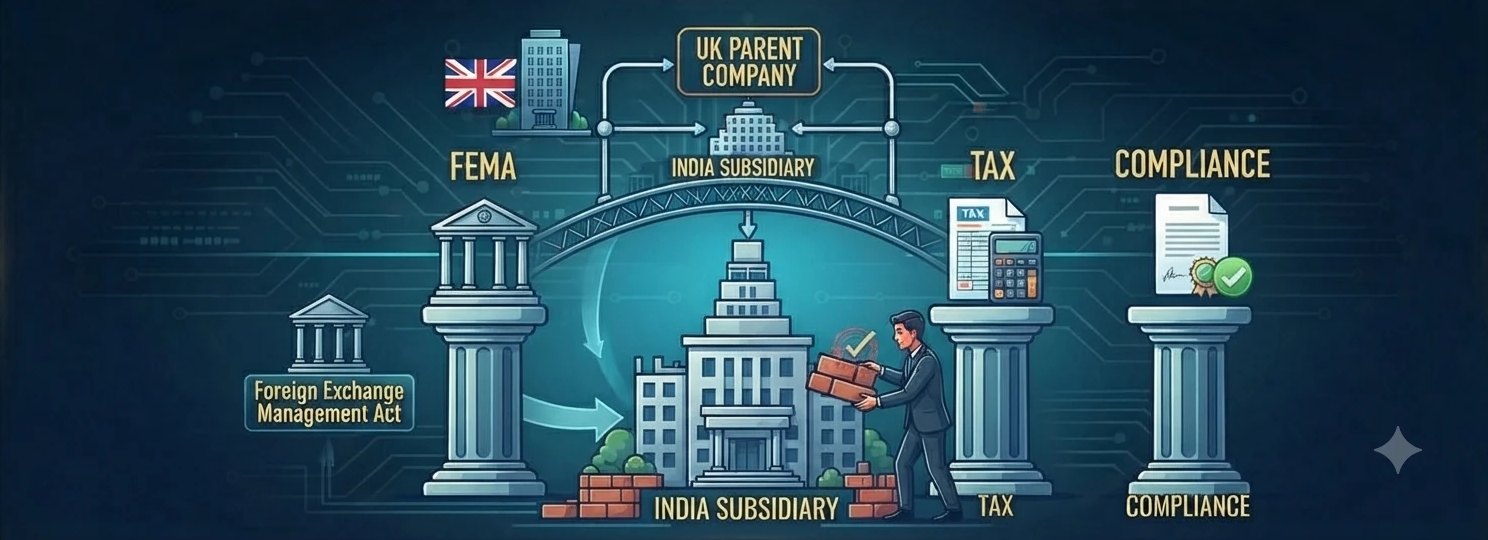
Related reading: reverse flip from Delaware to India and legal due diligence on Indian startups; also setting up a company in India from the UK; also setting up a Dubai crypto holding company; also licensing US software in India: withholding tax and royalties; also clearing a brand name for India before a US launch.
Final word
Halverton & Co. is an Indian law firm that advises on Indian law, including setting up and maintaining Indian subsidiaries, FEMA compliance and intercompany arrangements. We practice in Jharkhand, Maharashtra and before the Supreme Court of India, and we work alongside US counsel, who advise on US law. Halverton & Co.: Where tech needs law! If you have a question about Indian law, write to us at office@halvertonandco.com, or get in touch.
This article reflects developments reported up to early October 2026. It is for general information only, is not legal advice, and does not create an attorney-client relationship. Halverton & Co. is an Indian law firm and does not advise on US law.
Related practice area
Startups & Venture
From incorporation to term sheet. The documents a company needs to be fundable.
View the practice areaComments
No account needed. Comments are reviewed before they appear, so yours will show here once approved. Please do not share confidential details or describe your own legal matter: replies are general discussion, not legal advice, and do not create an advocate-client relationship. For your own situation, write to office@halvertonandco.com.