Key takeaways
- Section 14 of the Legal Services Act 2007 makes it an offence to carry on a reserved legal activity without being entitled to.
- Individuals and companies can commit it, and directors can be liable where the offence was committed with their consent or neglect.
- Defences are narrow, and commentary puts the maximum penalty on indictment at up to two years’ imprisonment.
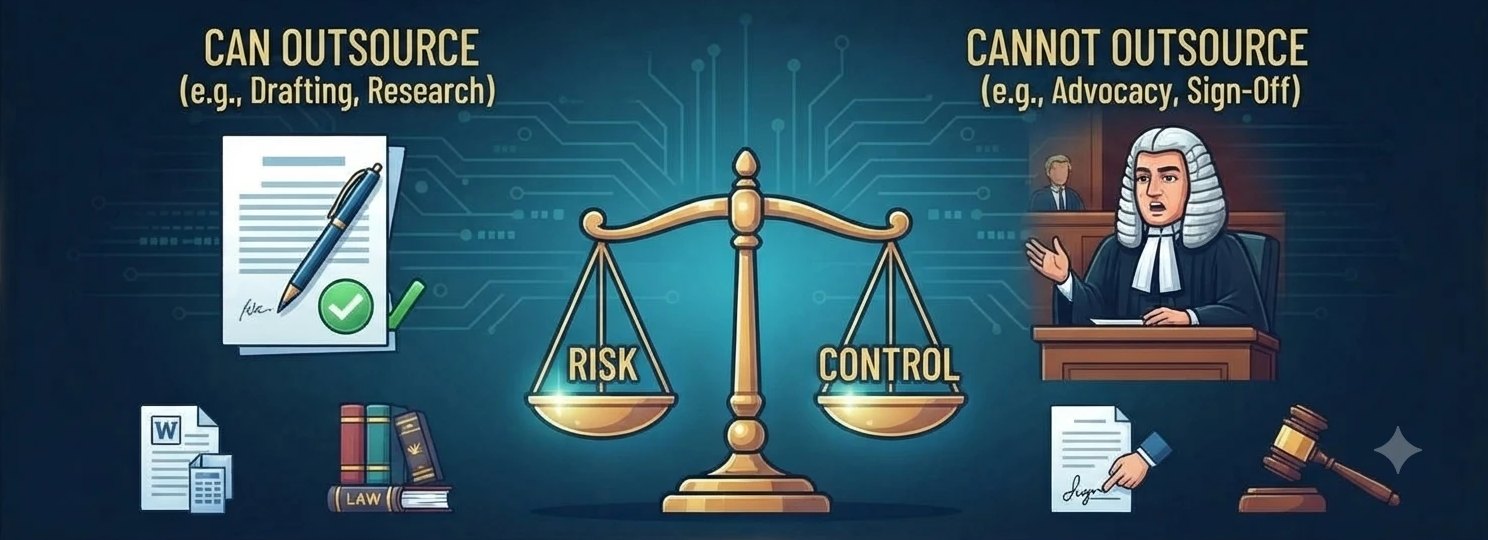
- Offshore providers should support only, under the control of a named authorised person.
The reserved legal activity offence is the part of the Legal Services Act 2007 that turns the list of reserved activities from a regulatory idea into a criminal matter. Section 14 says that if you carry on a reserved legal activity and you aren’t entitled to, you commit an offence. That sentence is short. The consequences, for firms that outsource and for the people they use, are not.
Our reserved-activities series looks at the list itself and at outsourcing. This piece takes the next step: what the offence covers, who can be caught, what defences exist, and how firms reduce risk. It is written by an Indian firm for UK readers who may be sending work offshore, and it is no substitute for UK advice. The reserved legal activity offence is a criminal matter, and Section 14 Legal Services Act 2007 offence wording is where it starts.
What Section 14 says
The six reserved legal activities are: exercising a right of audience, conducting litigation, reserved instrument activities, probate activities, notarial activities and administering oaths. Section 14 makes it an offence to carry on any of them without being entitled to. A closely linked offence deals with pretending to be entitled. The reserved legal activity offence in Section 14 applies to anyone who does carry on a reserved legal activity without entitlement.
Who is entitled? An authorised person, such as a solicitor or barrister regulated by the relevant approved regulator, or an exempt person, such as a litigant in person or an executor applying for probate on their own account. Everyone else is outside the club. Courts read the phrase pretending to be entitled reserved activity in the Act strictly.
So the question in any given case is not whether work is “legal” but whether it falls within one of the six activities and who did it. That distinction trips up many people who assume legal work needs a lawyer, or that it never does. The section 14 Legal Services Act 2007 offence is narrow, but it is real.
Who can commit the offence
Individuals can. A will writer who prepares probate papers for fee-paying clients is an example. So is a claims firm that conducts litigation on a client’s behalf without authorisation, or a paralegal who signs court documents as if they were a solicitor. Individuals can commit the reserved legal activity offence.
Companies can too. The Act has provisions dealing with offences by bodies corporate, and directors or officers can be personally liable where the offence was committed with their consent or neglect. A business model that depends on unauthorised people doing reserved work isn’t safe because there’s a company in the middle.
The offence applies to doing the work, wherever the person sits, if it is carried on in England and Wales. An offshore provider that does a reserved task for an English client isn’t beyond reach, and the English client or firm that instructed it may be too. Take advice on how far the offence extends to work done abroad, since jurisdiction can be a technical point. Wherever the provider sits, the reserved legal activity offence can reach work carried on in England and Wales.
Defences and penalties
The Act includes defences. One is that the person didn’t know and had no reason to suspect that the act was a reserved legal activity. Another covers people who were entitled but unaware they had to meet a condition. These defences are narrow and depend on facts, and the burden falls on the person relying on them.
| Task | Reserved? | Offshore provider role |
|---|---|---|
| Research and data entry | No | Can support under supervision |
| Drafting for review | No | Support, authorised person signs |
| Signing court documents | Yes (conduct of litigation) | Not for unauthorised persons |
| Preparing probate papers for clients | Yes | Not for unauthorised persons |
On penalties, commentary puts the maximum on conviction on indictment at imprisonment for up to two years, a fine, or both, with a lower ceiling for summary convictions. The penalty provisions sit in the same part of the Act, so check the current text. Separately, courts can restrain unauthorised activity, and regulators can take action against authorised people who help. The penalty for unauthorised reserved legal work is set in the Act, and the reserved legal activity offence carries imprisonment on indictment.
Practical consequences go beyond the criminal sentence. A client whose matter was handled by an unauthorised person may have a weak position in court, may need to start again and may have a claim against whoever instructed the provider. A firm’s insurer may also refuse cover for work that was outside the rules.
Where outsourcing creates risk
Outsourcing is lawful for unreserved work, and for reserved work done under the control and responsibility of an authorised person. The risk comes when a provider does more than support. A vendor that drafts a statement of case, signs a court document, handles a probate application for fee-paying clients or appears at a hearing may be conducting a reserved activity. The reserved legal activity offence matters most when an offshore provider does more than support.
A short test: who decides, who signs, who is responsible to the client and to the court. If an authorised person is genuinely supervising, reviewing and taking responsibility, support work stays support work. If the authorised person is a rubber stamp and the provider is effectively running the case, the line has been crossed.
Contracts should say what the provider may and may not do, name the supervising authorised person and ban the provider from holding itself out as entitled. Add audit and escalation. The reserved legal activity offence offshore provider arrangements risk is best managed by clarity in the first place, not by an indemnity after the fact. See our posts on the SRA’s outsourcing expectations and a legal outsourcing agreement for solicitors. An offshore provider reserved activity risk is best managed in the contract.
Questions people ask
Worth remembering: the offence protects clients, not the profession. A clear line about who does what is a benefit to a firm that wants to work with outsourced teams. The reserved legal activity offence protects clients.
Related reading: reserved legal activities and outsourcing to India, unreserved legal activities in England and Wales, who can apply for probate in England, is will writing a reserved activity, a legal outsourcing agreement for solicitors and the SRA AI warning notice; also whether lawyer is a protected title in the UK, authorised persons under the Legal Services Act and exempt persons under the Legal Services Act; also whether legal advice is a reserved activity.
Quick answers
What is the reserved legal activity offence?
Section 14 of the Legal Services Act 2007 makes it an offence to carry on a reserved legal activity if you aren’t entitled to, for example by being an authorised person. A related offence covers pretending to be entitled.
What are the penalties for carrying out reserved legal activities without authorisation?
Commentary says up to two years’ imprisonment, a fine or both on conviction on indictment, with lower limits on summary conviction. Check the current wording of the Act for exact penalties.
Can an offshore provider commit the offence?
It can if it carries on a reserved activity in England and Wales without entitlement, and the firm instructing it may face consequences too. Keep reserved work under the control of an authorised person.
Can an offshore provider commit the offence?
It can if it carries on a reserved activity in England and Wales without entitlement, and the instructing firm may face consequences too.
Final word
Halverton & Co. is an Indian law firm advising UK companies, founders, investors and law firms on Indian law, including Indian law support for UK law firms, with clear boundaries on reserved activities and supervision by UK solicitors. We practise in Jharkhand, Maharashtra and before the Supreme Court of India, and work alongside your UK solicitors, who advise on English law. Halverton & Co.: Where tech needs law! If you have a question about Indian law, write to us at office@halvertonandco.com, or get in touch.
This article reflects developments reported up to 31 October 2026. It is for general information only, is not legal advice, and does not create a solicitor-client relationship. Halverton & Co. is an Indian law firm, is not authorised or regulated by the Solicitors Regulation Authority, and does not advise on English law; UK-law points should be confirmed with UK advisers.
Sources
Related practice area
Startups & Venture
From incorporation to term sheet. The documents a company needs to be fundable.
View the practice areaComments
No account needed. Comments are reviewed before they appear, so yours will show here once approved. Please do not share confidential details or describe your own legal matter: replies are general discussion, not legal advice, and do not create an advocate-client relationship. For your own situation, write to office@halvertonandco.com.