Key takeaways
- A solicitor who outsources stays responsible for the work, so the agreement must give control and visibility.
- Commentary says contracts should preserve SRA access to information and records.
- Data protection terms and a lawful transfer mechanism are needed if data goes to India.
- Audit rights and exit assistance are often neglected but are the main way to test a supplier.
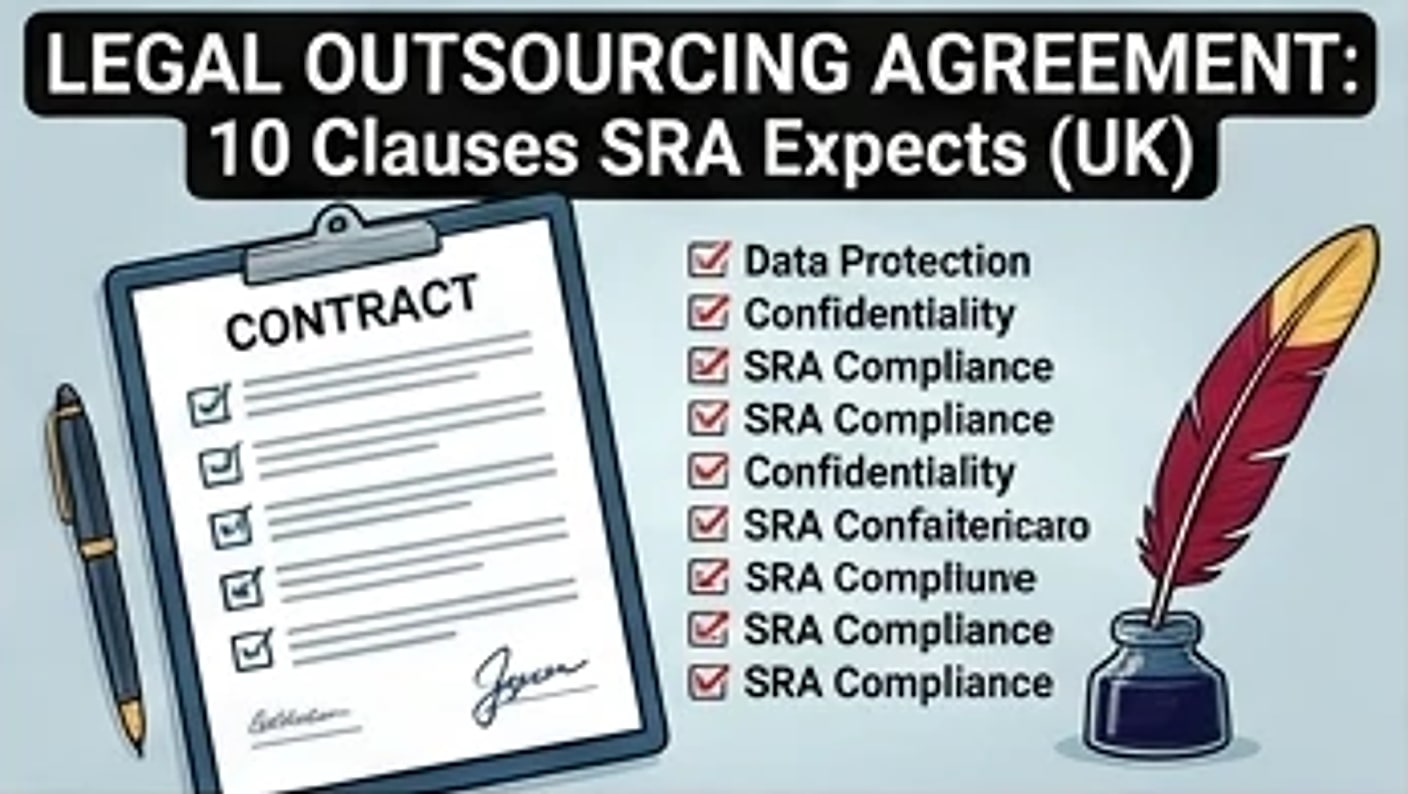
A solicitor who outsources work stays responsible for it. That principle shapes every good outsourcing agreement solicitors sign, whether the supplier is a UK legal process provider or an offshore team in India. The contract must give the firm enough control to meet its duties on confidentiality, supervision, client care and regulatory access. This guide sets out ten clauses that a legal outsourcing contract should include for a firm regulated by the SRA.
The list reflects points commonly made in SRA guidance and practitioner checklists: scope, access to records, confidentiality, data protection, security, supervision, conflicts, insurance, audit and exit. It is not a template and not a substitute for advice. It is written by an Indian law firm for UK readers. Check the current SRA Standards and Regulations and guidance on outsourcing before you rely on it. A good outsourcing agreement solicitors can rely on is short enough to read and specific enough to enforce.
Clauses 1 to 3: scope, control and records
Clause 1 defines scope. List the services, deliverables and service levels, and state what the supplier must not do, such as giving advice to clients or carrying on reserved activities. The firm remains responsible for the work. The contract should say that the supplier works under the firm’s direction and that nothing reduces the firm’s duties. The outsourcing agreement solicitors use should open with a scope that cannot be stretched by either side. These are the SRA outsourcing agreement clauses most often discussed by practitioners.
Clause 2 gives the firm control. Name a supervising solicitor, require instructions in writing, set review standards and give the firm the right to give directions and to require work to be redone. This supports the firm’s duty to supervise. A legal outsourcing contract template UK firms use should also state who can authorise changes and how disputes are escalated.
Clause 3 deals with access to records. The SRA expects that a firm can give the regulator information, and commentary says outsourcing contracts should include SRA rights to obtain information, inspect records and access premises. A clause on SRA access to records outsourcing arrangements should require the supplier to cooperate with the SRA and to keep records available. Without it, the firm cannot show compliance if asked.
Clauses 4 to 6: confidentiality, data and security
Clause 4 is confidentiality. Bind the supplier and its staff to keep client information confidential, use it only for the engagement, and return or destroy it on request. Record that client information is privileged where it is, and that the supplier will not disclose it except as required by law, with notice to the firm. Make confidentiality survive termination.
Clause 5 is data protection. Under UK GDPR, the supplier will usually be a processor, so the contract needs Article 28 terms and a lawful transfer mechanism if data goes to India or elsewhere outside the UK. A data protection clause offshore legal vendor agreements need should deal with instructions, security, sub-processors, assistance with rights requests, breach notice and deletion. Check the ICO’s guidance on transfers. Firms often forget that an outsourcing agreement solicitors sign with an offshore supplier is also a data transfer document.
Clause 6 requires security measures. Specify controls such as access through the firm’s systems, multi-factor authentication, encryption, restricted devices, staff screening, logging and incident response. Require disclosure of any AI tools used and prohibit use of client data to train third-party models without consent. The SRA’s 2026 warning on AI shows that regulators expect firms to know how suppliers use technology.
Clauses 7 to 9: conflicts, insurance and audit
Clause 7 manages conflicts. The supplier should disclose other clients that may conflict, maintain information barriers and not act for opposing parties without the firm’s consent. The firm should be able to run its own checks. A supplier that serves many firms must show how it keeps matters separate. The outsourcing agreement solicitors negotiate should give the firm a real way to test the supplier’s promises.
| Clause | What it does | Check |
|---|---|---|
| Scope and control | Defines tasks and supervision | Named supervising solicitor |
| Access to records | Lets the SRA and firm inspect | Regulator cooperation |
| Confidentiality and data protection | Binds supplier and staff | Article 28 terms and transfers |
| Security and AI | Controls and disclosure of tools | No training on client data |
| Conflicts, insurance, audit | Risk allocation and verification | Evidence of cover |
| Termination and exit | Handover and deletion | Certificate of deletion |
Clause 8 covers insurance and liability. Ask for professional indemnity and cyber insurance at appropriate levels, with evidence, and negotiate liability caps that reflect the risk, with no cap for breach of confidentiality or data protection where possible. Check that the firm’s own indemnity policy does not exclude outsourced work. The COLP should review these points, because COLP responsibility outsourcing arrangements create is real.
Clause 9 provides audit and inspection rights. The firm should be able to audit the supplier’s security, review logs, interview staff and receive regular reports on performance and incidents. Include rights for the firm’s insurer and, where relevant, the regulator. Audit rights are often neglected in negotiation, but they are the only way to verify that promises are kept.
Clause 10 and governance
Clause 10 covers termination and exit. Provide for termination for breach, insolvency, loss of insurance, change of control and regulatory request. Require transition assistance, return and deletion of data with a certificate, and step-in rights or help to move work to another provider. Plan for continuity so that client matters are not harmed if the relationship ends suddenly. Termination is the part of an outsourcing agreement solicitors hope never to use, so draft it carefully.
Governance matters as much as drafting. Carry out due diligence before signing, including checks on ownership, finances, security, staff, subcontractors and location. Consider whether clients should be told or asked for consent, in line with the SRA’s confidentiality guidance and your terms of engagement. Keep a risk assessment and review it each year.
Record decisions. The COLP and COFA should know about the arrangement, and it should appear in the firm’s risk register and compliance plan. Train staff on what may be sent to the supplier and what may not. A short written policy on outsourcing and AI, aligned with the contract, helps the firm to show that it manages risk.
Next steps and quick answers
Check your current outsourcing contracts against the ten clauses, close gaps, update your risk assessment and brief your COLP. If you are choosing a new supplier, send the list with your request for proposals. This is general information, not legal or regulatory advice.
Related reading: legal outsourcing for UK law firms and the SRA, UK GDPR and outsourcing to India: five clauses, UK GDPR transfers to India for offshore legal support, the SRA AI warning notice, paralegal support for solicitors offshore and choosing an offshore legal support partner; also the Section 14 reserved legal activity offence.
Quick answers
What clauses should an outsourcing agreement for solicitors include?
Scope and control, access to records and regulator cooperation, confidentiality, data protection and transfers, security, conflicts, insurance and liability, audit rights, and termination and exit support.
Does the SRA require access to records in outsourcing contracts?
Commentary says outsourcing contracts should give the SRA rights to obtain information, inspect records and access premises. Check the current SRA guidance for exact expectations.
Who is responsible if the supplier makes a mistake?
The solicitor and firm remain responsible to the client and the regulator, so the contract should give control, audit rights and appropriate indemnities.
Does the SRA require a written outsourcing agreement?
Check the current SRA guidance. Practitioner commentary strongly recommends one covering the clauses above.
Final word
Halverton & Co. is an Indian law firm advising UK companies, founders, investors and law firms on Indian law, including legal outsourcing agreements for UK law firms, offshore legal support from India, and cross-border data protection and confidentiality. We practise in Jharkhand, Maharashtra and before the Supreme Court of India, and work alongside your UK solicitors, who advise on English law. Halverton & Co.: Where tech needs law! If you have a question about Indian law, write to us at office@halvertonandco.com, or get in touch.
This article reflects developments reported up to 31 October 2026. It is for general information only, is not legal advice, and does not create a solicitor-client relationship. Halverton & Co. is an Indian law firm, is not authorised or regulated by the Solicitors Regulation Authority, and does not advise on English law; UK-law points should be confirmed with UK advisers.
Sources
Related practice area
Startups & Venture
From incorporation to term sheet. The documents a company needs to be fundable.
View the practice areaComments
No account needed. Comments are reviewed before they appear, so yours will show here once approved. Please do not share confidential details or describe your own legal matter: replies are general discussion, not legal advice, and do not create an advocate-client relationship. For your own situation, write to office@halvertonandco.com.