Key takeaways
- Executors named in a will, or next of kin where there is no will, can apply for probate themselves without a lawyer.
- Under the Legal Services Act 2007, preparing probate papers for others is a reserved legal activity.
- Estate administration tasks such as collecting assets and paying bills are not themselves reserved probate activities.
- Check any provider’s authorisation on the regulator’s register before paying for help.
Who can apply for probate? In England and Wales the short answer is: the executor named in the will, or a close relative if there is no will, can do it themselves, and nobody needs a lawyer. The long answer is about reserved probate activities, the work the Legal Services Act 2007 says only authorised people may do for others, for a fee. The line between those two answers matters to every family, and to every business that offers help with probate.
This is a point of detail that gets blurred in marketing. “We handle probate” can mean a regulated firm doing reserved work, or an unregulated company doing something quite different. Below we look at what counts as probate activity, who is entitled to do it, and where the risks are. It sits with our posts on reserved activities, outsourcing and the Section 14 offence.
What probate is and who applies
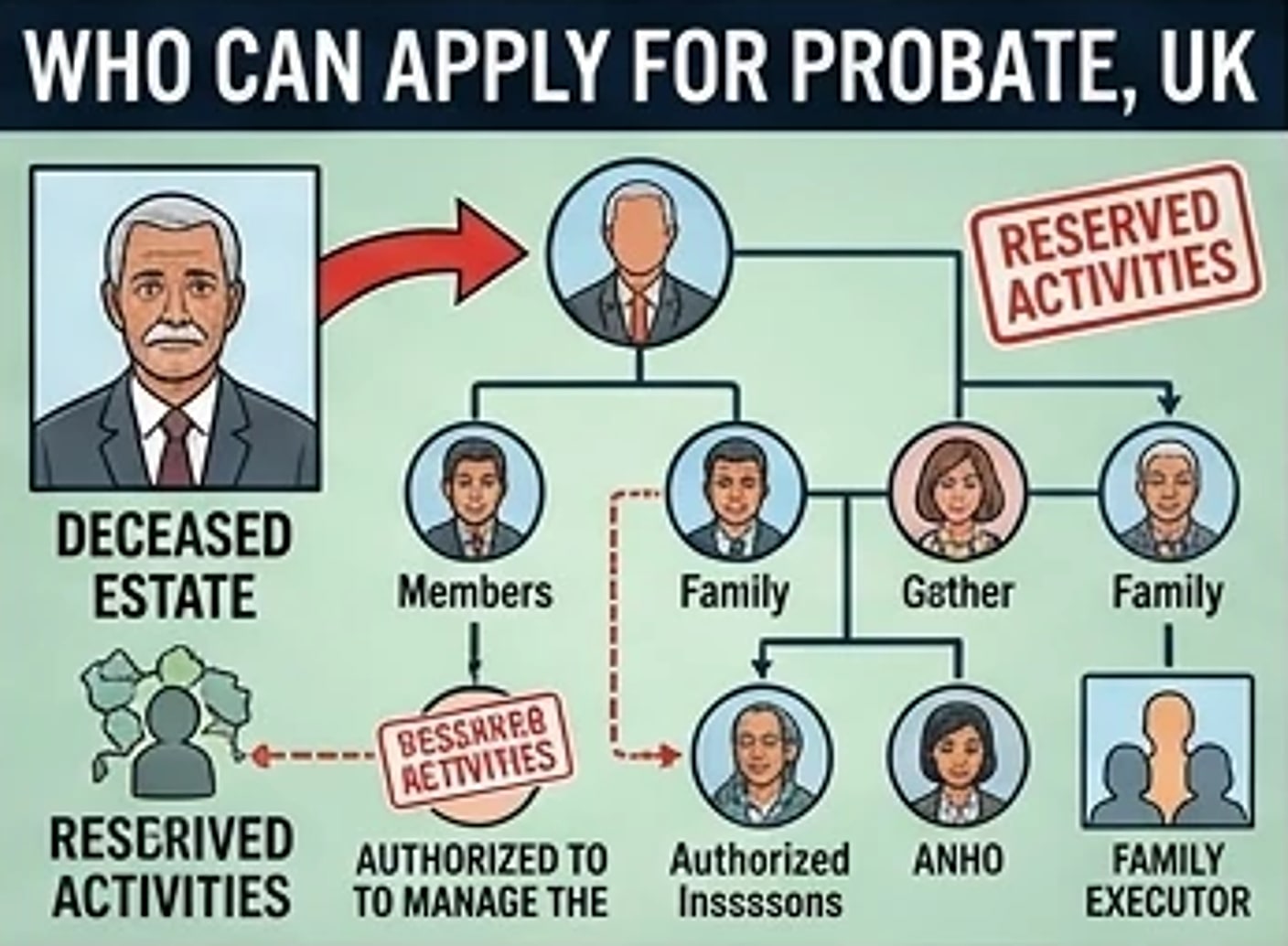
Probate is the legal process of getting authority to deal with a dead person’s estate. A grant of probate is issued to the executors named in the will. If there is no will, a grant of letters of administration goes to the next of kin. Either way, the person who gets the grant, a personal representative, then collects assets, pays debts and tax and distributes what is left. Whether reserved probate activities apply to a task depends on whether it is done for others.
Anyone who is entitled to the grant can apply on their own behalf through the government’s probate service. Many families do, particularly for simple estates. The question of who can apply for probate is therefore wide: the executors, the administrators, or a lawyer acting for them.
There is no rule that an estate needs a solicitor. Some do need one: a contested will, a complex tax position, overseas property, a missing relative. Others don’t. A person with a straightforward estate can safely handle it with care and patience.
What the Act reserves
Schedule 2 to the Legal Services Act 2007 reserves probate activities as one of six reserved legal activities. In broad terms, probate activities cover preparing papers on which to found a grant of probate or letters of administration, and papers relating to the resealing of a foreign grant, when done for others in connection with the grant. Commentary describes it as preparing the application for others. Reserved probate activities are defined by Schedule 2, and who can apply for probate depends on role.
That is a narrower thing than the whole of estate administration. Collecting in assets, paying bills, dealing with the bank, selling the house and handling tax are not themselves reserved probate activities. A firm that only does those tasks, without preparing the grant application for fee-paying clients, is not carrying on reserved work, though it may raise other regulatory issues.
Because probate activities Legal Services Act wording is technical, firms and clients alike can misjudge it. If you are unsure whether a task counts, ask for the provider’s authorisation details in writing.
Authorised practitioners and exemptions
Solicitors regulated by the SRA are authorised to carry on probate activities, as are members of other approved regulators that have a licensing role, including some probate practitioners regulated by CILEx and licensed conveyancers regulated by the Council for Licensed Conveyancers. Check the register of the relevant regulator rather than assuming from a job title. Reserved probate activities may be carried on by solicitors and other authorised persons. The authorised probate practitioners are listed on regulators’ registers.
| Person | Can apply for a grant? | Reserved activity? |
|---|---|---|
| Executor applying for themselves | Yes | No |
| Solicitor or authorised probate practitioner | Yes, for a client | Yes, they are authorised |
| Unregulated company for a fee | Not lawfully if preparing the application for others | Risk of offence |
| Offshore support under an authorised person | Support only | Authorised person responsible |
The Act also has exemptions. A person applying for a grant on their own behalf as personal representative isn’t carrying out a reserved activity, because they’re not doing it for others. That is why an executor applying for probate themselves is entirely lawful. Family members who help informally without a fee are also outside the offence, depending on how they do it.
The point for authorised practitioners is that they take regulatory responsibility. Insurance, client money rules, complaints procedures and a compensation fund come with regulation. That’s the real benefit of using an authorised practitioner, and the reason the law restricts the activity. Check whether the practitioner is among the authorised probate practitioners before you instruct them.
Where unauthorised services create risk
Some businesses offer to “fill in the probate forms” or “submit the application for you” for a fee, without being authorised. If that amounts to preparing the application for others, it may be reserved activity, and carrying it on without entitlement is an offence under Section 14 of the Act. Marketing that blurs the difference is a risk for the business and for the client.
Clients face practical risks as well. An unauthorised service doesn’t carry the insurance and compensation a regulated firm has. If the application is wrong, a grant may be delayed or an estate poorly administered. The unauthorised probate services risk is mostly about nobody being on the hook when something goes wrong.
For law firms using offshore or outsourced support, the line is whether the support is genuinely under the control of an authorised person. Research, data entry, drafting for review and tracking assets can be supported. Preparing and submitting the application is the part that should stay with the authorised person. Our legal outsourcing agreement post covers the contract side. Firms should keep reserved probate activities with the authorised person.
Questions people ask
If you remember only one thing: families can always do their own probate. What they need to watch is paying a stranger for work that only an authorised person may lawfully do. Reserved probate activities protect the public, and who can apply for probate is a separate matter.
Related reading: unreserved legal activities in England and Wales, is will writing a reserved activity, the Section 14 reserved legal activity offence, reserved instrument activities explained, paralegal support for solicitors offshore and NRIs in the UK: property and inheritance disputes in India.
Quick answers
Who can apply for probate in England and Wales?
An executor named in the will can apply, or if there is no will the next of kin can apply for letters of administration. A solicitor or other authorised probate practitioner can apply on their behalf.
What are reserved probate activities?
Under the Legal Services Act 2007, reserved probate activities include preparing papers for a grant of probate or letters of administration for others. Only authorised persons or exempt persons may do this.
Can an executor apply for probate themselves?
Yes. A personal representative applying on their own behalf isn’t carrying on a reserved activity, so no lawyer is required.
Can a family member help with probate?
Informal unpaid help is generally outside the reserved activity, but check how the help is organised.
Final word
Halverton & Co. is an Indian law firm advising UK companies, founders, investors and law firms on Indian law, including Indian law support on estates with Indian assets or heirs, alongside UK solicitors who advise on English probate. We practise in Jharkhand, Maharashtra and before the Supreme Court of India, and work alongside your UK solicitors, who advise on English law. Halverton & Co.: Where tech needs law! If you have a question about Indian law, write to us at office@halvertonandco.com, or get in touch.
This article reflects developments reported up to 31 October 2026. It is for general information only, is not legal advice, and does not create a solicitor-client relationship. Halverton & Co. is an Indian law firm, is not authorised or regulated by the Solicitors Regulation Authority, and does not advise on English law; UK-law points should be confirmed with UK advisers.
Sources
Related practice area
Startups & Venture
From incorporation to term sheet. The documents a company needs to be fundable.
View the practice areaComments
No account needed. Comments are reviewed before they appear, so yours will show here once approved. Please do not share confidential details or describe your own legal matter: replies are general discussion, not legal advice, and do not create an advocate-client relationship. For your own situation, write to office@halvertonandco.com.