Key takeaways
- A UK trade mark does not protect you in India, so clear the mark and file before you launch.
- Search exact, phonetic, plural, Hindi and device variants in your classes and related classes.
- Check unregistered use as well, since a prior user can rely on passing off against a later registration.
- File before announcing, because squatters watch launches.
A trade mark search India UK brand owners run before launch is the cheapest insurance you can buy. UK registration doesn’t extend to India, India works on a first to file basis with strong common law rights for prior users, and a clash found after launch means a rebrand, a legal fight or a settlement. A few days of checking before you spend on packaging and ads is a bargain.
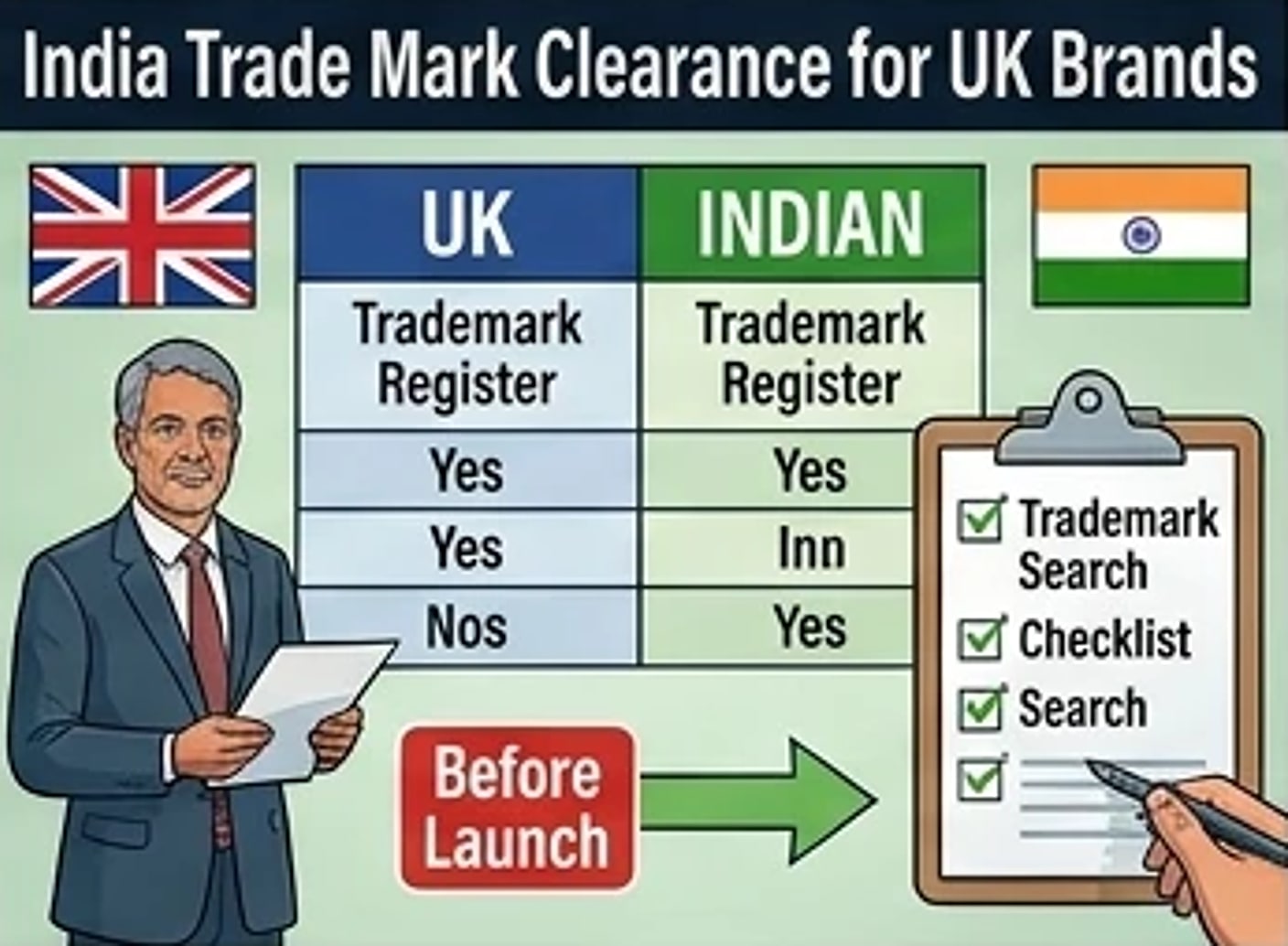
This is a checklist, in the order that tends to work: the register search, the variants most people forget, classes, unregistered rights, practical checks and the decision. It goes with our guides on Madrid versus national filing for UK brands and on squatting. Search tools and fees change, so treat the steps as a framework and confirm details on the IP India site. A trade mark search India UK brand owners run should follow a trade mark clearance India checklist like the one below.
Step 1: the register search
Start with the public search on the IP India website. Search for your exact name, then similar ones, in the classes you will use and the classes next to them. Note the application status, the owner and the date. Pending applications matter as well as registered marks, because an earlier filing can block yours. Your trade mark search India UK brand step one is the public register.
Search the Trade Marks Journal and recent filings too. The register search is only the first layer: results vary with spelling and the tool’s logic, and the database lags behind new filings by days or weeks. If you have a short list of names, ask an Indian attorney to run a full search. An IP India public search phonetic variants approach is more reliable than a single exact search.
Save every result with a screenshot and date. If a problem emerges later, you will want to show what you found and when, particularly if the conflict arises from a filing made after your search. Keep records of each trade mark search India UK brand results, with dates.
Step 2: variants, Hindi and sound-alikes
Indian examiners compare marks by sight, sound and meaning, and they take a broad view of similarity. Search for phonetic variants (K for C, PH for F, double letters), plural forms, prefixes and suffixes, and marks that share the dominant part. A mark with “EXPRESS” in it may be treated as sharing the distinctive element with another using the same word. A good trade mark search India UK brand check includes phonetic variants.
Check Hindi and regional spellings. A brand that sounds the same in Hindi, or whose transliteration matches an existing mark, can be refused or opposed. A Hindi transliteration trade mark check means writing your name in Devanagari and other scripts and searching for matches. Also search meanings: if your word translates to an existing brand in a local language, that can cause trouble.
Don’t forget the logo. A device mark can clash on its shapes even if the words differ. The Vienna classification is used for figurative elements, so a search by device codes can find lookalikes. If your brand relies on a logo, search for it.
Step 3: classes and goods
India uses the Nice Classification. Your clearance should cover each class you plan to file in and the related ones. A food brand needs classes 29, 30 and perhaps 32 and 43. A fashion brand needs 25, 18 and 35 for retail. Conflicts in related goods can block you even if the class numbers differ, so think about how the public would see the goods. Classes matter in a trade mark search India UK brand clearance.
India allows a multi-class application, but each class carries its own fee. Draft the specification carefully. A broad claim attracts more objections and may attract an opposition, while a narrow one leaves gaps. Match it to what you will actually sell in India in the next few years and be ready to narrow it if there is a conflict.
Consider timing. If your UK registration is recent, the Paris Convention gives a six month priority period to file in India with the same date. If you will use the Madrid route from a UK base mark, check what is needed. Our post on Madrid Protocol UK designate India explains the process and the choice between Madrid and a national filing.
Step 4: unregistered rights and practical checks
A registration search won’t show unregistered rights. In India, a prior user can stop a later registrant through passing off, and the Delhi High Court has protected common law rights against registered marks in many cases. Passing off prior use India searches involve checking marketplaces, social media, Google, trade directories and industry press for anyone already using the name or something close. No trade mark search India UK brand clearance shows unregistered rights, so check use too.
| Step | What to check | Tip |
|---|---|---|
| Register | IP India public search, exact and similar | Save screenshots |
| Variants | Phonetic, plural, Hindi spellings, devices | Use Vienna codes for logos |
| Classes | Your classes and related goods | Match the specification |
| Unregistered use | Marketplaces, social media, domains | Prior users can oppose |
Check domain names, social handles and company names at the Ministry of Corporate Affairs. A company name registered in India doesn’t give trade mark rights, but it can show an existing business using your name. Search app stores and e-commerce marketplaces. If your distributor or agent in India has already registered a similar mark or domain, you need to know before signing anything.
Then decide. A clean search lowers the risk but doesn’t remove it, so a mark with some conflicts may still be workable with a narrower specification, a coexistence agreement or a small change. A mark with a close prior user in your class is usually not worth the fight. Plan the budget for filing, the examination stage, and possible opposition, and file before announcing. Squatters watch for launches. After the trade mark search India UK brand owners should decide with the full picture.
Questions people ask
None of these steps is complicated. They just need doing in the right order, and before a launch date is fixed. A trade mark search India UK brand clearance is cheap compared with a rebrand.
Related reading: how to check a trade mark in India for free, registering a UK trade mark in India: Madrid or national, trade mark squatting in India for UK companies, trademark classes in India, customs recordal in India for UK brands and trademark opposition in India.
Quick answers
How do I do a trade mark search India UK brand owners need before launch?
Search the IP India public register for exact and similar marks in your classes, including phonetic and Hindi variants and device marks, check unregistered use online, and have an Indian attorney run a full search for important names.
Does a UK trade mark protect me in India?
No. Trade marks are territorial, so you need an Indian registration, through a national filing or a Madrid designation, and should clear the mark first.
Can unregistered use stop my Indian trade mark?
Yes. A prior user can rely on passing off and common law rights to oppose or challenge a later registration, so check for use as well as registrations.
Does a UK trade mark protect me in India?
No. Trade marks are territorial, so you need an Indian registration through a national filing or a Madrid designation.
Final word
Halverton & Co. is an Indian law firm advising UK companies, founders, investors and law firms on Indian law, including trade mark clearance, filing and enforcement in India for UK and other foreign brands. We practise in Jharkhand, Maharashtra and before the Supreme Court of India, and work alongside your UK solicitors, who advise on English law. Halverton & Co.: Where tech needs law! If you have a question about Indian law, write to us at office@halvertonandco.com, or get in touch.
This article reflects developments reported up to 31 October 2026. It is for general information only, is not legal advice, and does not create a solicitor-client relationship. Halverton & Co. is an Indian law firm, is not authorised or regulated by the Solicitors Regulation Authority, and does not advise on English law; UK-law points should be confirmed with UK advisers.
Sources
Related practice area
Intellectual Property
Trade marks, copyright, patents and designs. Searched, filed, licensed and enforced under Indian law.
View the practice areaComments
No account needed. Comments are reviewed before they appear, so yours will show here once approved. Please do not share confidential details or describe your own legal matter: replies are general discussion, not legal advice, and do not create an advocate-client relationship. For your own situation, write to office@halvertonandco.com.