Key takeaways
- A name must clear the Trade Marks Registry, the MCA company name rules and the domain and social handle space; passing one does not clear the others.
- Search the register, variants, Hindi script and unregistered users, and assess whether the name is distinctive.
- Check the company name, the .com and .in domains and social handles, and avoid restricted words.
- File the trade mark application in your own name before launch and keep dated search records.
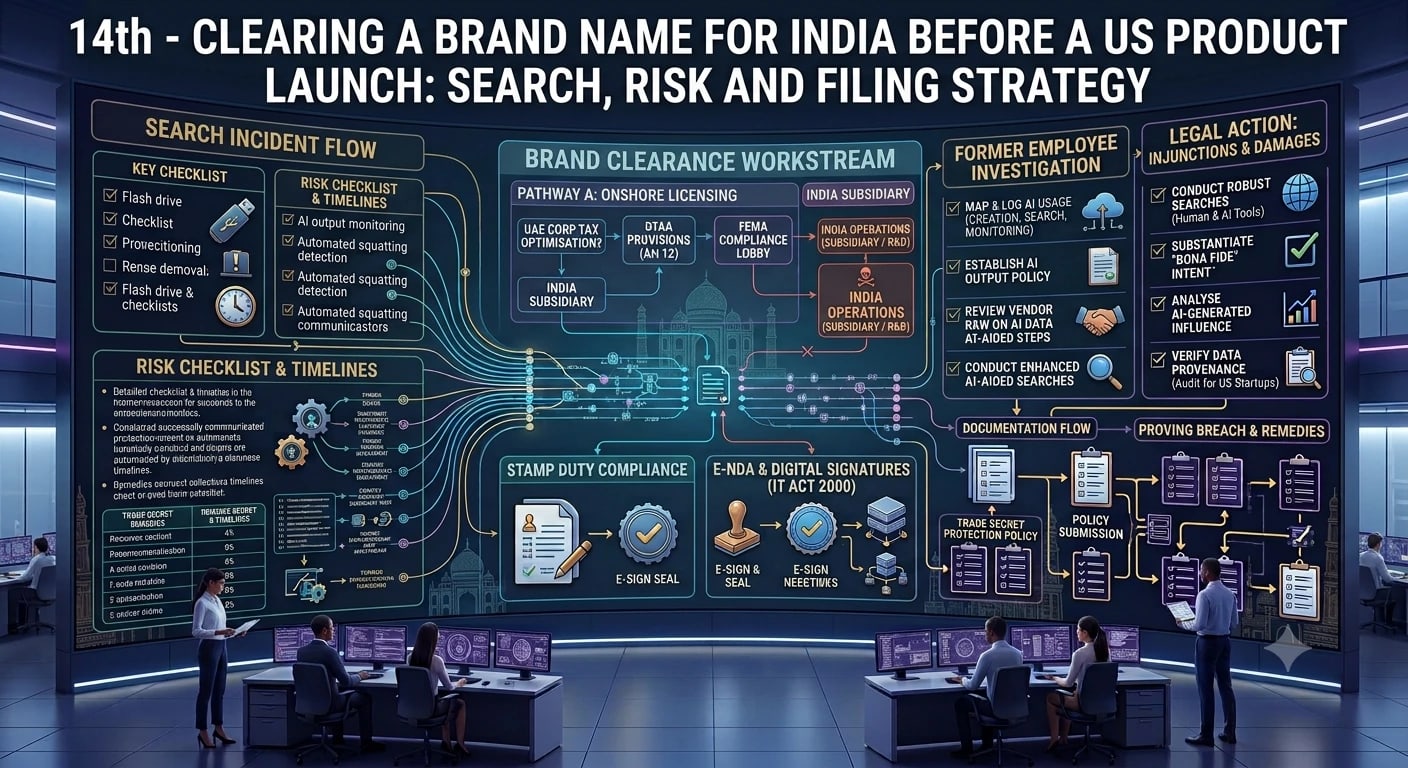
The best time to run a startup name trademark check India founders need is before you buy the domain, order the logo or announce the launch. A name must clear three separate systems in India: the Trade Marks Registry, the Ministry of Corporate Affairs company name rules, and the domain and social handle space. A name that passes one can fail another, and changing it later costs money, time and momentum.
This 2026 checklist gives the order to follow, what to check in each system, the common traps and what to do once a name is cleared. It is general information for founders at the naming stage. A professional trade mark search and opinion is worth the cost before you commit to a name that will carry your brand for years.
Why three checks, not one
Each system works on its own rules. A company name is approved by the Registrar of Companies through the Ministry of Corporate Affairs, mainly to avoid identical or too similar names on the company register. A trade mark is about brand identity in the market and is judged by the Trade Marks Registry and the courts. A domain name is a first-come-first-served registration with no check for trade mark conflicts.
Passing one test does not clear the others. A company name approved by the MCA can still infringe someone’s trade mark, and the owner of the trade mark can force a change under the company law rules or sue for infringement or passing off. A domain that is available may belong to a trade mark owner’s brand, and a registrar may be required to give it up under dispute policies. A startup name trademark check India therefore has to cover all three.
| System | Who decides | What it protects |
|---|---|---|
| Trade Marks Registry | Registrar of Trade Marks and the courts | Your brand identity in the market |
| Company register (MCA) | Registrar of Companies | A unique company name on the register |
| Domains and social handles | First come, first served | Online addresses, with no trade mark check |
The cost of getting it wrong is real. Founders who rebrand after launch lose their domain, printed material, search ranking, customer recognition and sometimes funding. Investors often check IP in diligence, and a brand conflict is a red flag. Doing the checks in a sensible order takes days, not months, and it protects the value you build. Treat the startup name trademark check India founders run as a launch gate.
Step 1: trade mark search
Start with the trade mark search, since it is the hardest conflict to fix. Search the Trade Marks Registry’s public database for your name and variations: spelling changes, plurals, phonetic versions and Hindi or regional script. Search the classes for your goods and services and related classes. Look at both registered marks and pending applications. IP India’s search tools include image and phonetic features, and you can also check the Trade Marks Journal.
Search beyond the register. Use a web search, app stores, marketplaces, social media and business directories to find businesses that use a similar name without registering. Unregistered users may have rights through passing off and can object to your use. Ask in your network whether the name is known. If your name is close to a famous brand, the risk is greater, because well-known marks get wide protection.
Assess the strength of the name too. A coined or arbitrary name is easier to register and defend than a descriptive one. A name that simply describes what you sell will face an objection under Section 9 of the Trade Marks Act, 1999. Weigh these points, and if the name is important, get a professional opinion. A careful startup name trademark check India saves more than it costs.
Step 2: company name and domain
Check the company name through the Ministry of Corporate Affairs’s name reservation process, which is part of the incorporation filings. The name must not be identical or too similar to an existing company or LLP name, or to a registered trade mark, and must not include restricted words without approval. Under the rules, the Registrar may refuse names that resemble a registered or pending trade mark of another person unless that person consents.
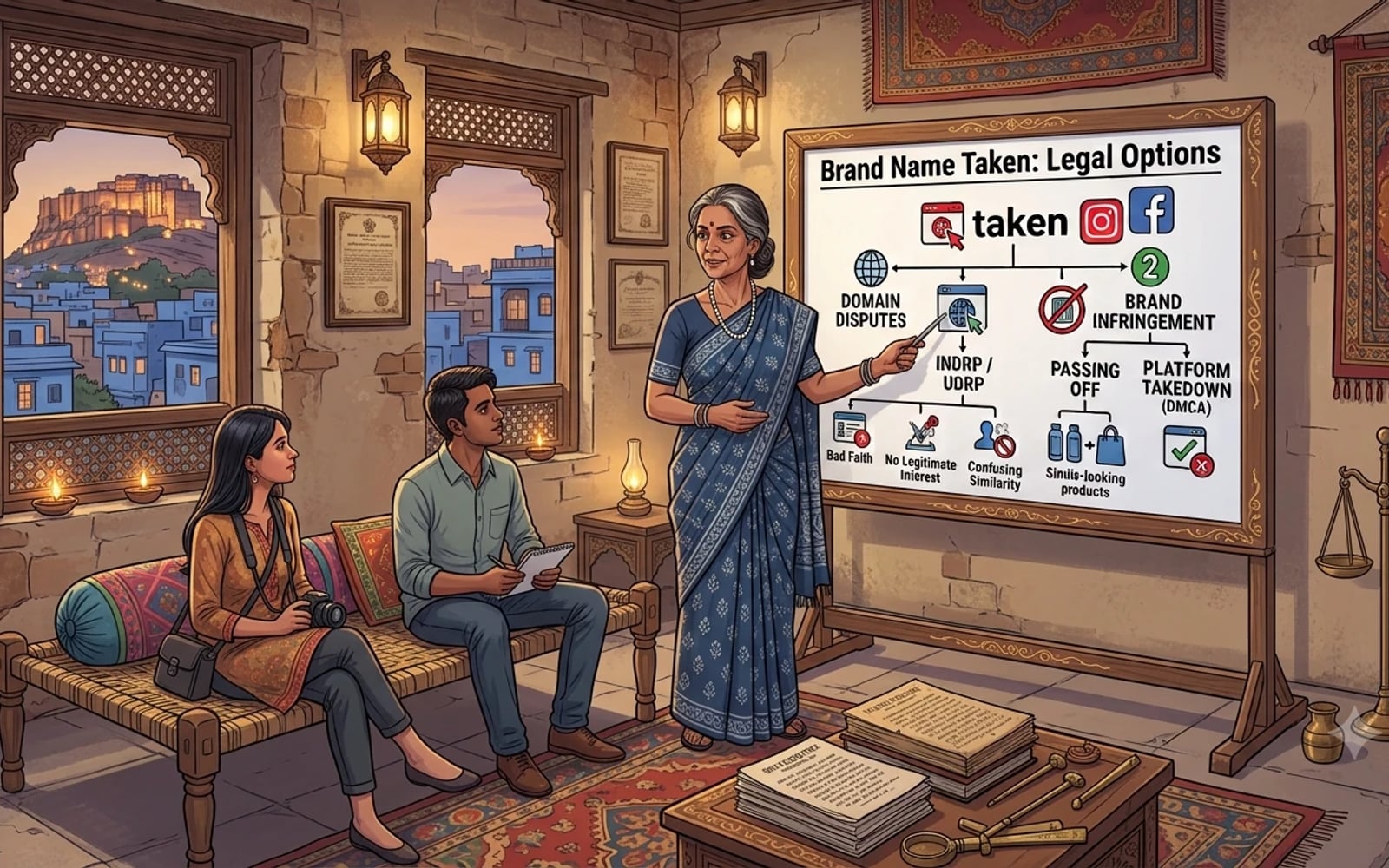
Next, check the domain. Search for the exact name in the .com and .in extensions, and variations that customers might type. Check the history of the domain and whether it is used by another business. If a good domain is taken by a squatter, consider another name rather than overpaying, because a dispute under the .IN Domain Name Dispute Resolution Policy or the UDRP takes time and is uncertain, and works best for owners of existing marks.
Register the domain and reserve the company name promptly once you have cleared the trade mark search, but avoid committing to a printed logo or major launch until you have filed the trade mark application. File the application in your own or your company’s name as early as possible. A pending application establishes your priority date and helps to deter others from filing. Finish the startup name trademark check India requires before you commit to branding spend.
Step 3: social handles and final clearance
Check your handles on the main platforms: Instagram, X, LinkedIn, YouTube, Facebook and any others relevant to your audience. Consistency across platforms helps customers to find you. If the exact handle is taken, check whether the account is active or squatted. Platforms have policies against impersonation and some allow trade mark complaints, but they are easier to use if you have a registration or a pending application.
Run a final pre-launch review. Confirm that the name has no unwanted meaning in Hindi or other Indian languages or in your target markets. Check that it does not suggest a government link, which is restricted under the Emblems and Names (Prevention of Improper Use) Act, 1950, or use words restricted by regulators for certain industries, such as bank or insurance. Check that your goods and services are described in the right classes.
Document the results. Keep dated screenshots of your searches, the search report if you ordered one, the company name approval, domain registration and the trade mark application receipt. This file helps with investors, with future disputes and with later filings. If you plan to expand to other countries, repeat the searches for those markets or use the Madrid Protocol once you have an Indian filing. Store the startup name trademark check India results with your incorporation file.
Next steps and quick answers
Use this order: shortlist three names, run a trade mark search, check company name and domain, check handles, take a professional opinion on the favourite, then file the trade mark and register the company and domain together. After filing, set a watch for similar marks and keep using the name consistently. This is general information, not legal advice.
Related reading: how to check a UK brand in India for free, IP India’s AI trade mark search, trade mark registration for startups in India, brand names, domains and social handles in India, why many trade mark applications fail in India, the fake filing sites warning and recovering a .in domain from squatters; also the trademark class list in India; also replying to a trademark infringement notice.
Quick answers
What should I check before choosing a startup name in India?
Check the trade mark register and unregistered use, the MCA company name rules, domain availability and social handles. Passing one check does not clear the others.
Is MCA name approval the same as trade mark clearance?
No. The MCA approves company names to avoid duplicates on the company register. It does not give you trade mark rights, and an approved name can still conflict with a trade mark.
When should I file the trade mark application?
As soon as you have chosen and cleared the name, before launch. A pending application gives you a priority date and a basis to act against squatters.
Do I need a trade mark if my company name is registered?
Yes, if you want brand protection. A company name registration does not give trade mark rights, and a later trade mark owner could still challenge your use.
Should I buy the domain before or after the trade mark search?
Search first. Once the name is cleared, register the domain and company name quickly and file the trade mark application before you spend on branding.
Final word
Halverton & Co. is an Indian law firm advising founders, startups, technology companies and investors on Indian law, including trade mark clearance and filing for startups, company incorporation and name compliance, and brand protection. We practise in Jharkhand, Maharashtra and before the Supreme Court of India, and act as fractional legal counsel for technology-driven businesses. Halverton & Co.: Where tech needs law! If you have a question about Indian law, write to us at office@halvertonandco.com, or get in touch.
This article reflects developments reported up to 31 October 2026. It is for general information only, is not legal advice, and does not create an advocate-client relationship. Halverton & Co. is an Indian law firm.
Sources
Related practice area
Intellectual Property
Trade marks, copyright, patents and designs. Searched, filed, licensed and enforced under Indian law.
View the practice areaComments
No account needed. Comments are reviewed before they appear, so yours will show here once approved. Please do not share confidential details or describe your own legal matter: replies are general discussion, not legal advice, and do not create an advocate-client relationship. For your own situation, write to office@halvertonandco.com.