Key takeaways
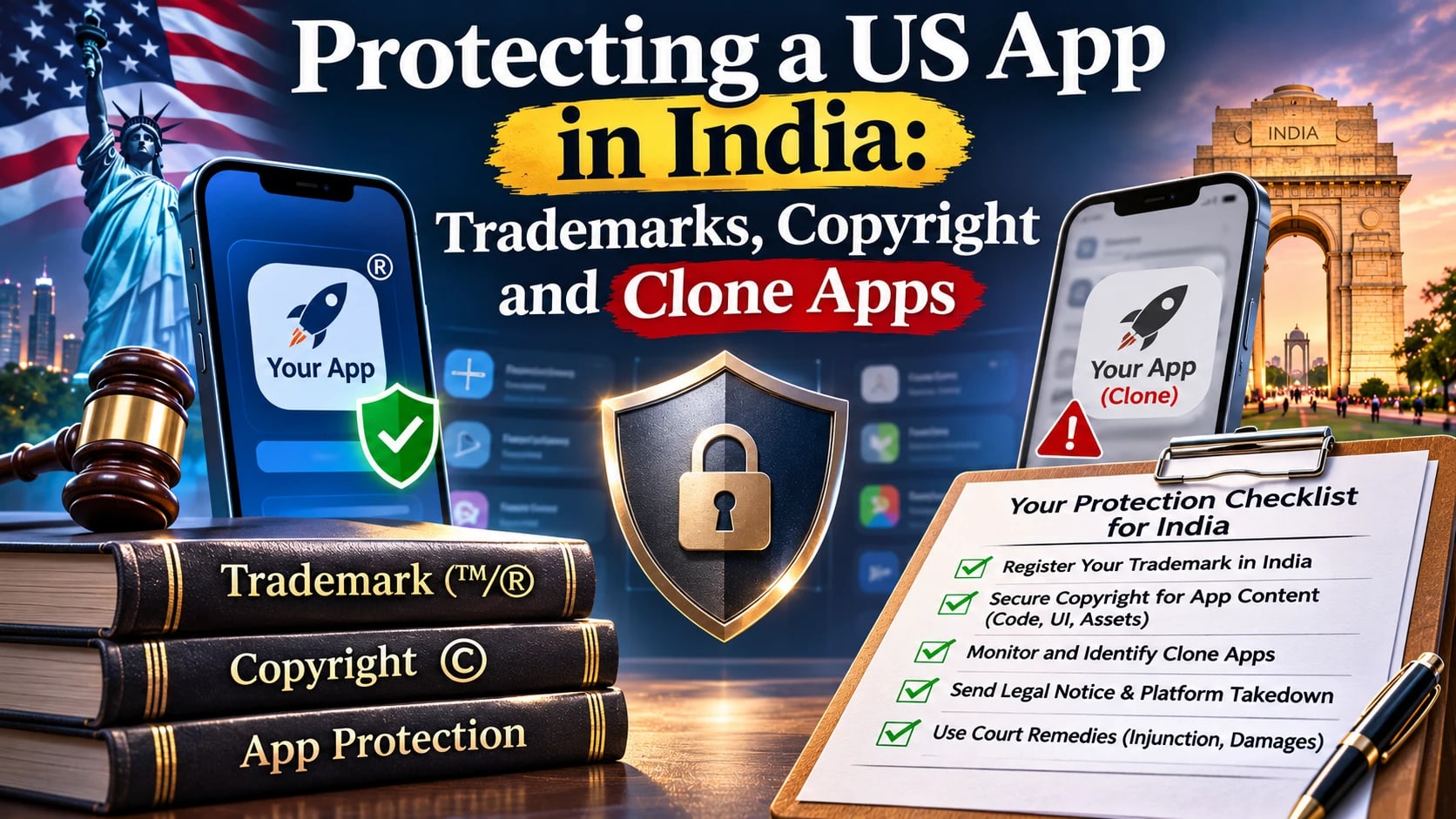
- An app is several rights: trade mark, copyright, possible design registration and trade secrets.
- India extends copyright protection to US works under the International Copyright Order, 1999, but a US trade mark does not protect your name in India.
- File the name and logo in classes such as 9, 42 and 35 and sign written assignments with Indian developers.
- Report clones to the stores, send a notice, use Rule 75 and go to court for serious cases.
If your US app is growing in India, copycats and name squatters are likely to follow. To protect app in India, a US company should secure the brand with a trade mark, document ownership of the code and design, register what is worth registering and have a plan to remove clone apps quickly. These are inexpensive steps compared with the revenue at risk, and most can be done before launch.
This guide explains what protects an app, which classes and rights to file, how copyright and design rules apply, how to remove clones from app stores and through courts, and a launch checklist. It is written by an Indian law firm for US readers. US IP points should be confirmed with US counsel.
What protects an app
An app is several rights in one. The name and logo are protected by trade mark law, the source code and documentation by copyright as literary works, the screens, icons and artwork by copyright and potentially by design registration, and the underlying inventions by patents where they meet the legal tests. Confidential know-how and algorithms are protected by contract and trade secret principles. No single right covers everything, so you need a stack of protections.
Rights in the US do not extend to India. A US trade mark registration protects you in the US only, and a US patent has no effect in India. Copyright is different: India is a Berne Convention member and the International Copyright Order, 1999 extends Indian copyright to US works, without registration. That helps against copying of code and artwork, but it does not protect your name or stop a local company from registering it. You need a plan to protect app in India that covers each right.
The practical risks are name squatting, clone apps that copy your look and feel, and former contractors who reuse code. Each needs a different tool. Plan the order: file trade marks first, because they take the longest and are the most exposed to squatters, then secure copyright records and contracts, then prepare enforcement. To protect app in India efficiently, start with the brand.
Trade marks: name, logo and classes
File for the app name and the logo in India before you launch. An app name trademark India filing can be done directly or through the Madrid Protocol from your US application. File the word mark and the logo separately. Search the Indian register first for conflicts, including in Hindi script, since a conflict can lead to an objection or opposition and delay or block your registration. This is the first step to protect app in India.
| Right | What to do | Timing |
|---|---|---|
| Trade mark | File name and logo in classes 9, 42 and 35 | Before launch |
| Copyright | Written assignments from all contributors | Before development ends |
| Design | Consider screens and icons | Before public release |
| Monitoring | Search app stores for clones monthly | Ongoing |
| Enforcement | Store report, legal notice, Rule 75, court | As needed |
Choose the right classes. For software and apps, the common classes are 9 for downloadable software and apps, 42 for software as a service and technology services, and 35 for business and online marketplace services, with others such as 36 for fintech, 41 for education and entertainment and 45 for social networking services where relevant. A trademark class 9 and 42 app India filing covers the core. Use clear descriptions of what the app does.
Use the mark consistently and keep evidence of use in India: download numbers, revenue, marketing and user data. If a squatter files first, evidence of earlier use helps in an opposition or rectification action, though it is harder to prove for a foreign brand. Trade marks also help with app store complaints and Brand Registry tools. Diarise the ten-year renewal and the four-month opposition window for conflicting applications.
Copyright, design and contracts
Copyright in code arises automatically. Keep a clean record of authorship: repositories with commit history, contributor lists, and written agreements with employees and contractors. For Indian developers, the Copyright Act, 1957 treats independent contractors as authors unless they assign their rights in writing, and an assignment must state the rights, duration and territory under Section 19. A US startup with an Indian team should confirm that assignments are signed and complete.
Registration of copyright in India is optional but useful as evidence. You can register software and artistic works with the Copyright Office. It can help in a dispute and in dealing with platforms. For screens and icons, design registration may also be available. Following a 2026 Calcutta High Court ruling and draft guidelines, graphical user interfaces and icons applied to articles such as a phone may be registrable as designs, subject to the final rules. App copyright registration India offers is optional but helpful as evidence.
Protect your code and know-how by contract. Use confidentiality agreements, restrict repository access, use licences for open-source components that you track and add terms of use for users. Include restrictions against reverse engineering and cloning in your terms, bearing in mind that terms bind only those who accept them. If you transfer data from India to the US, comply with India’s data protection law as it applies to your users.
Clone apps: takedowns and court
Search for clones regularly on Google Play, the Apple App Store and alternative stores. When you find one, document it with screenshots, version numbers, store links and a comparison to your app. An app store infringement report India developers file with Apple or Google should state which rights are infringed, give registration details for your trade mark and describe the copying. A clone app takedown India request is faster when you cite a registered mark and clear copying of assets. Monitoring is a core part of how you protect app in India.
Add Indian legal steps. Send a legal notice to the developer and publisher. Use Section 52(1)(c) of the Copyright Act and Rule 75 of the Copyright Rules, 2013, under which an intermediary that receives a proper written complaint can disable access for 21 days, and you must obtain a court order in that time. Make the complaint to the platform’s India grievance officer where relevant. Many clone operators remove apps after a firm notice.
For serious clones, go to court. The Delhi High Court has granted interim injunctions, John Doe orders and dynamic injunctions in app and website disputes, and has directed platforms to remove infringing apps in suitable cases. You will need proof of ownership, evidence of copying and urgency. Note that copyright does not protect ideas or features, so a clone that rewrites the code with a different look may not infringe. Trade mark and passing off claims fill gaps.
Next steps and quick answers
Before launch in India: search and file your marks, sign assignments with all contributors, register what you can and set up a monitoring routine for clones. After launch: report promptly and escalate serious cases. This is general information, not legal advice. Use this list each time you protect app in India for a new product.
Related reading: registering a US trade mark in India, what a US company pays for an Indian trade mark, software copyright protection in India, registering app screens and icons as designs, clone games and UK developers, who owns code written by Indian developers and clone apps copying a crypto brand; also ADA website liability for developers.
Quick answers
How do I protect my US app in India?
File the app name and logo as trade marks in India, in classes such as 9 and 42, secure written assignments for code, rely on India’s recognition of US copyright, consider design registration for screens and icons, and monitor app stores for clones.
Does a US trademark protect my app in India?
No. Trade mark rights are territorial. You need an Indian registration or a Madrid designation covering India, or proof of reputation in India.
How do I remove a clone app from Indian app stores?
Report to the store with evidence and your rights, send a legal notice, use Rule 75 for a 21-day disablement and go to court for serious cases. A registered Indian trade mark makes this faster.
Does a US trade mark protect my app in India?
No. You need an Indian registration or a Madrid designation covering India, or proof of reputation in India.
Can I register my app’s code in India?
Copyright arises automatically and registration is optional but useful as evidence.
Final word
Halverton & Co. is an Indian law firm advising US companies, founders, investors and law firms on Indian law, including trade mark, copyright and design protection for apps and software in India, takedowns and technology contracts. We practise in Jharkhand, Maharashtra and before the Supreme Court of India, and work alongside US counsel, who advise on US law. Halverton & Co.: Where tech needs law! If you have a question about Indian law, write to us at office@halvertonandco.com, or get in touch.
This article reflects developments reported up to 31 October 2026. It is for general information only, is not legal advice, and does not create an attorney-client relationship. Halverton & Co. is an Indian law firm and does not advise on US law; US-law points should be confirmed with US counsel.
Sources
Related practice area
Intellectual Property
Trade marks, copyright, patents and designs. Searched, filed, licensed and enforced under Indian law.
View the practice areaComments
No account needed. Comments are reviewed before they appear, so yours will show here once approved. Please do not share confidential details or describe your own legal matter: replies are general discussion, not legal advice, and do not create an advocate-client relationship. For your own situation, write to office@halvertonandco.com.