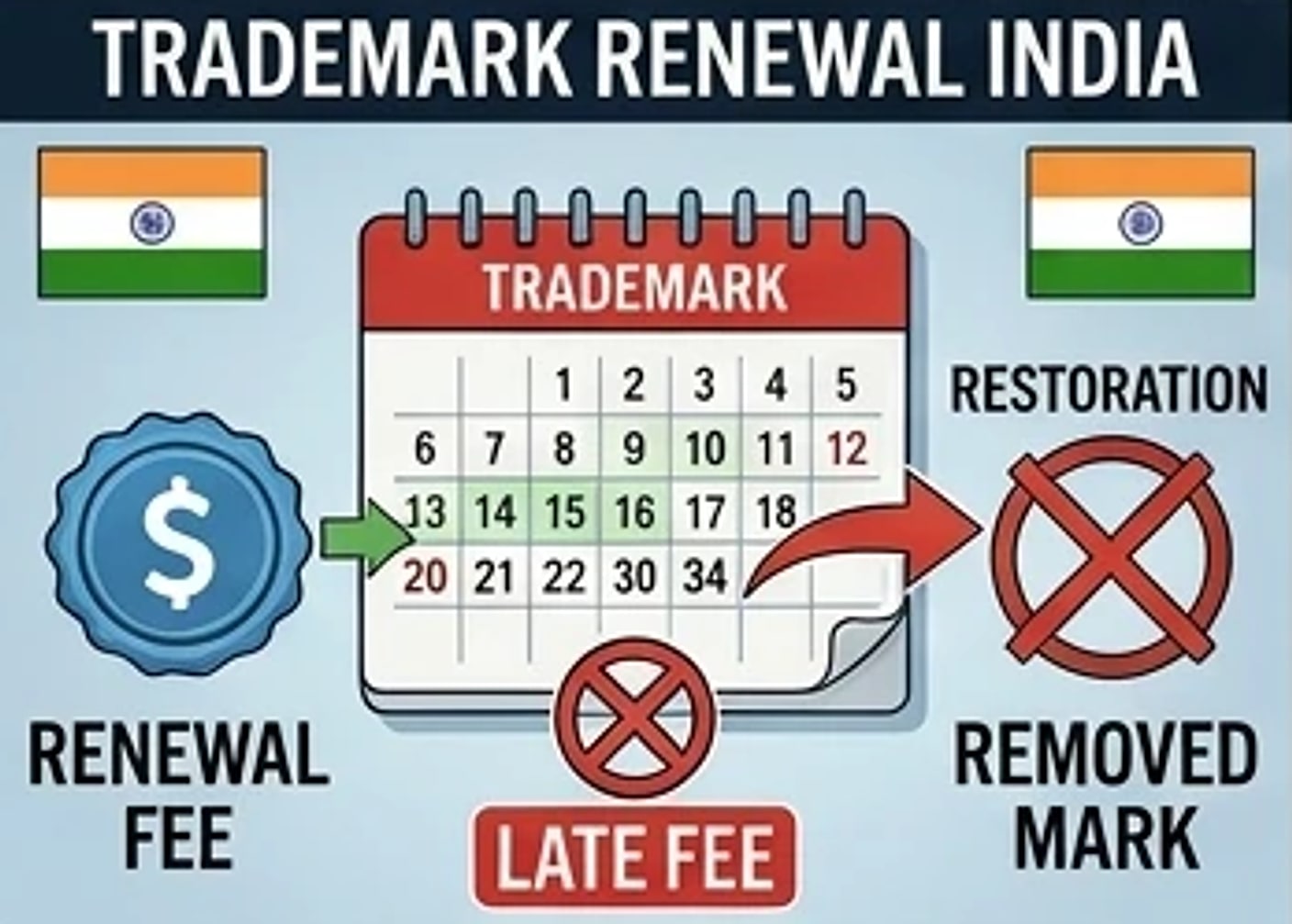
Key takeaways
- A registration lasts ten years from the date of application under Sections 23 and 25 of the Trade Marks Act, 1999 and is renewed on Form TM-R.
- A six-month grace period allows late renewal with a surcharge; fee amounts differ between sources.
- After that the mark can be removed from the register, and restoration is discretionary within a limited window.
- Calculate the true expiry date, set reminders and keep your agent’s contact details current.
A registered trade mark in India does not last forever. It is valid for ten years, and you must renew it to keep it alive. Missing the date can lead to removal of your mark from the register and to the loss of your rights, which is why trademark renewal India deadlines deserve a place in every brand owner’s calendar. The process is simple when done on time, and costly and uncertain when it is not.
This guide explains when a registration expires, the window for renewal, the fee structure, the grace period and surcharge, what happens if you miss both, how to restore a removed mark and a checklist. Fees are quoted from secondary sources that conflict, so check the current IP India fee schedule before you pay. This is general information, not legal advice.
When a registration expires
Under Section 25 of the Trade Marks Act, 1999, a registration lasts for ten years and can be renewed for further periods of ten years. The ten years are counted from the date of registration, which under Section 23 is the date of application, not the date the certificate was issued. A mark filed on 1 March 2016 therefore expires on 1 March 2026, even if the certificate arrived in 2018.
That surprises many owners. They assume they have ten years from the certificate. Check the date of application on your certificate or on the Registry’s public record, then add ten years. Mark the date and the six months before it on your calendar. If you hold several marks, make a table with the application date, classes and renewal date for each, because each registration has its own date.
The Registry used to send a reminder notice, but you should not rely on it. Notices can be missed, the address may be old and the Registry’s responsibility is limited. For foreign owners, the Indian address for service and the agent matter. Make sure the agent on record is reachable. A missed email about a trademark renewal India can cost you the mark.
How and when to renew
Renewal is done on Form TM-R through the IP India portal, with the prescribed fee for each class. Sources say you can file up to a year before expiry, and many advisers recommend filing at least six months ahead to avoid problems. Check the Trade Marks Rules, 2017 for the exact window. You do not need to prove use to renew, but you must hold the registration in the right owner’s name. Timely trademark renewal India filing is cheap compared with restoration.
Before you file, check the record. Confirm that the owner name, address and class details are correct, and file any change of name or address first if needed. If the mark has been assigned, the assignment must be recorded. Collect the registration number, class and application date. A form TM-R online renewal usually takes minutes if the details are right, and the Registry issues a renewal certificate and publishes the renewal in the Journal.
Renew all classes you want to keep. You can renew some classes and let others lapse, which saves money, but think about whether the lapsed classes protect you against competitors. If you are not using a class and do not plan to, it may be reasonable to let it go. Remember that a registration that is not used can also be challenged for non-use, so keep evidence of use for the classes you keep.
Fees, grace period and surcharge
The official fee is charged per class. Commercial guides disagree on the amounts: many cite ₹9,000 per class for e-filing, while others cite ₹10,000 for companies and ₹5,000 for individuals and startups. Because the sources conflict, treat these numbers as a guide and confirm the trademark renewal fee India per class in the current schedule before you pay. Professional fees are extra if you use an attorney. Budget for trademark renewal India fees across every class.
| Stage | What happens | Note |
|---|---|---|
| Up to a year before expiry | Renew on Form TM-R | Many advise filing six months ahead |
| Expiry date | Ten years from the date of application | Not from the certificate date |
| Six-month grace period | Renew with a surcharge | Fee and surcharge to be confirmed |
| After the grace period | Mark can be removed from the register | Restoration is discretionary |
If you miss the expiry date, there is a grace period. The mark stays on the register for six months after expiry, and you can renew by paying the renewal fee plus a surcharge. The trademark renewal grace period surcharge is quoted at between ₹4,500 and ₹5,000 per class in different sources. During the grace period your rights are generally treated as continuing, but do not rely on that, and renew as soon as you notice.
Do not let the surcharge tempt you to delay. Courts and the Registry deal strictly with deadlines, and a late renewal adds cost and risk. If you file after the grace period, a different and more expensive process applies. Keep a budget line for renewals and ask your attorney for a docket of dates. For startups with several marks, a yearly review of the portfolio avoids surprises.
If you miss the deadline
If you do not renew within the grace period, the Registrar can remove the mark from the register. Once a trademark removed from register India situation arises, your registration no longer exists, you lose the presumption of validity and the right to sue for infringement on the registration, and a third party can apply for the same or a similar mark. Your common law rights from use, such as passing off, may survive, but they are harder to prove.
Restoration may be possible. Sources say you can apply for restoration and renewal, again on Form TM-R, after the grace period and within one year of the expiry date, and the process involves the renewal fee and a restoration fee. Restoration is not automatic. The Registrar will consider your reasons and may refuse, and an intervening application by someone else can complicate things. Details of forms and fees differ between sources, so check the Rules. Trademark expired India restoration is discretionary, not automatic.
If the restoration window has passed, you generally need to file a new application. That means a new filing date, a fresh examination, the risk of an objection or opposition and a gap in protection. Check for conflicting marks filed in the meantime. A trademark expired India case can end in a long fight. The cheapest answer is to renew early and keep your attorney’s details up to date. A lapsed trademark renewal India case can force a new filing.
Next steps and quick answers
This week: list your registrations, compute the true expiry date from the date of application, set reminders at twelve and six months and decide which classes to renew. Confirm the current fees. This is general information, not legal advice. Make trademark renewal India dates part of your yearly compliance calendar.
Related reading: trade mark renewals and watching services, what a trade mark examination report is asking, trade mark registration for startups in India, why trade mark applications fail in India, what a US company pays for an Indian trade mark, Indian trade mark classes explained and preparing for a trade mark show cause hearing; also trademark renewal in India.
Quick answers
How long is a trademark valid in India?
Ten years, counted from the date of application, and renewable for further ten-year periods under Section 25 of the Trade Marks Act, 1999.
What happens if I miss the trademark renewal deadline in India?
You have a six-month grace period in which you can renew with a surcharge. After that the mark can be removed from the register, though restoration may be possible within a year of expiry at the Registrar’s discretion.
How much does trademark renewal cost in India?
Sources conflict, citing ₹9,000 to ₹10,000 per class for companies and lower for individuals and startups, with a surcharge of about ₹4,500 to ₹5,000 per class for late renewal. Check the current IP India fee schedule.
When does my Indian trade mark expire?
Ten years from the date of application, not the certificate date. Check the date on your certificate or the Registry record.
Which renewal fee is right?
Commercial sources conflict, citing ₹9,000 to ₹10,000 per class for companies and lower for individuals and startups. Check the current IP India fee schedule.
Final word
Halverton & Co. is an Indian law firm advising founders, startups, technology companies and investors on Indian law, including trade mark renewals, watching and portfolio management, and restoration and enforcement of marks in India. We practise in Jharkhand, Maharashtra and before the Supreme Court of India, and act as fractional legal counsel for technology-driven businesses. Halverton & Co.: Where tech needs law! If you have a question about Indian law, write to us at office@halvertonandco.com, or get in touch.
This article reflects developments reported up to 31 October 2026. It is for general information only, is not legal advice, and does not create an advocate-client relationship. Halverton & Co. is an Indian law firm.
Sources
Related practice area
Intellectual Property
Trade marks, copyright, patents and designs. Searched, filed, licensed and enforced under Indian law.
View the practice areaComments
No account needed. Comments are reviewed before they appear, so yours will show here once approved. Please do not share confidential details or describe your own legal matter: replies are general discussion, not legal advice, and do not create an advocate-client relationship. For your own situation, write to office@halvertonandco.com.