Key takeaways
- AI inventions are patentable in the US and India if they are new, inventive, useful and tied to a technical solution.
- The US uses the Alice test; India applies Section 3(k), which excludes computer programmes per se, algorithms and mathematical methods.
- Both countries require human inventors, and AI cannot be named as an inventor.
- File before public disclosure, draft for both systems and combine patents with trade secrets and contracts.
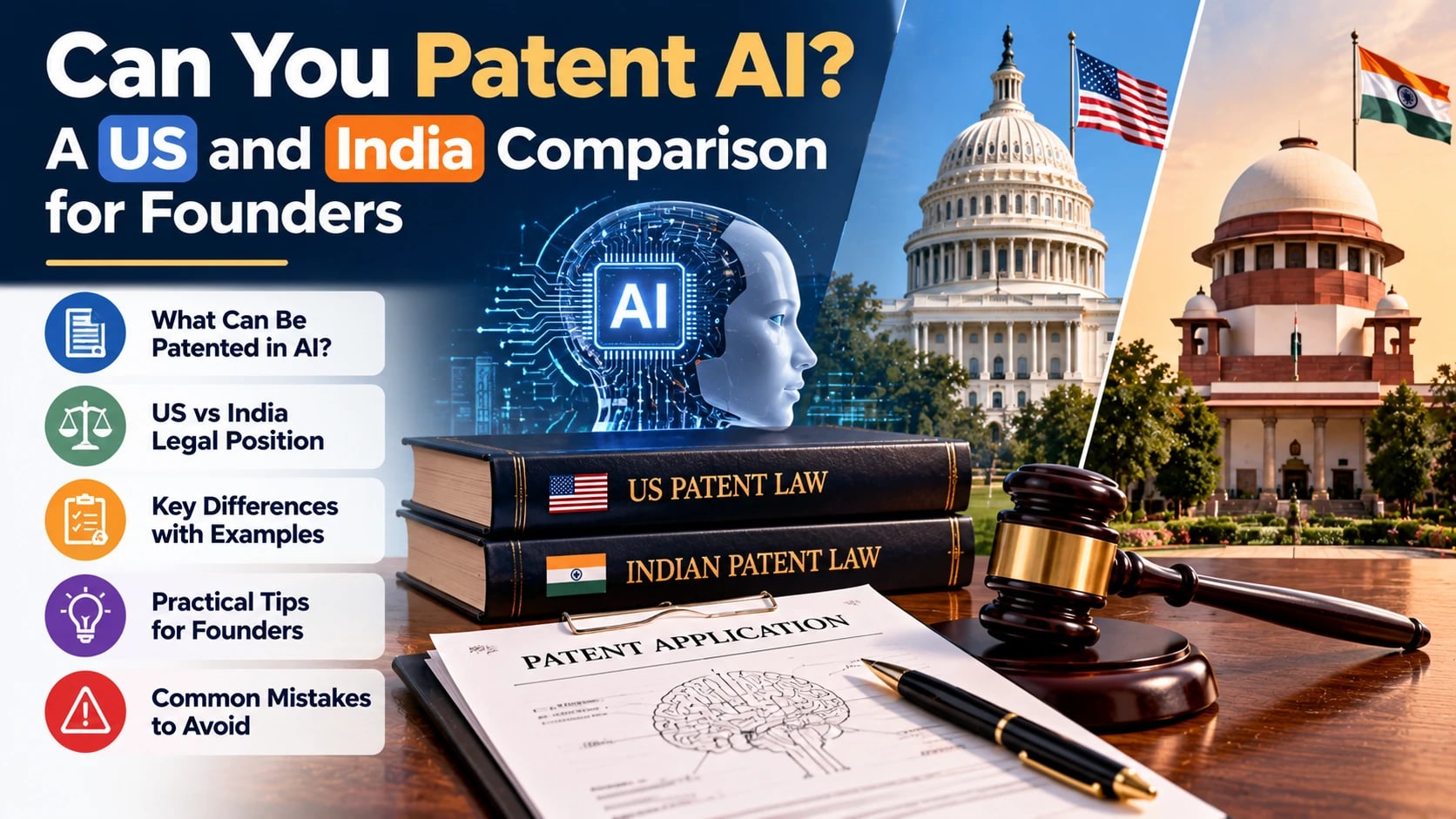
Can you patent AI? Yes, in both the United States and India, but not every AI idea qualifies. The law protects specific technical solutions, not abstract ideas, mathematical methods or software as such. In the US, courts apply the Alice test to decide whether a claim is directed to an abstract idea. In India, Section 3(k) excludes mathematical methods, business methods and computer programs per se. How you describe and claim the invention often decides the outcome.
This guide compares the two systems, explains what makes an AI invention patentable, deals with the question of whether an AI can be an inventor, and gives practical advice for founders on drafting, timing and strategy. It is written by an Indian law firm for US readers. US patent law points should be confirmed with a US patent attorney.
What counts as a patentable AI invention
Patent law protects inventions that are new, involve an inventive step or are non-obvious, and have industrial or practical use, and that fall within the subject matter allowed by law. For AI, the question is usually subject matter. A model, an algorithm or a method of data analysis, as an abstract idea, is not enough. A concrete technical application, such as improving how a medical scanner detects disease or how a vehicle controls braking, is more likely to qualify.
Think of three layers. The first is the core model or algorithm, which is the hardest to protect by itself. The second is the way the model is trained or adapted to solve a particular technical problem, for example a training method that reduces computing needs in a specific way. The third is the application of the model in a system or device that produces a technical effect. Claims that tie the AI to a technical result are stronger than claims to the idea alone.
Disclosure is also important. A patent must describe the invention in enough detail for a skilled person to carry it out. For AI, that means explaining the architecture, the data, the training and the results, and showing a credible technical effect. Trade secrets may suit parts that you do not want to disclose, such as training data and weights. A mixed strategy of patents and trade secrets is common, so can you patent AI is only one part of the question.
The US approach
In the US, patent eligibility is governed by Section 101 of the Patent Act and the two-step Alice test from the Supreme Court’s decision in Alice Corp. v. CLS Bank. First, is the claim directed to a judicial exception such as an abstract idea? Second, if so, does the claim add an inventive concept that amounts to significantly more? Mathematical algorithms and mental processes fall in the first category, and merely running them on a computer is not enough. That is the core of can you patent AI in the United States.
The USPTO has issued guidance on the eligibility of AI inventions, with examples that show when machine learning claims are eligible, for instance when they improve a technical process or the functioning of a computer, and when they are not. Claims that recite specific technical improvements and not just results have a better chance. Applicants should draft with the examples in mind and be ready to argue for the technical improvement.
On inventorship, US law requires a natural person as the inventor, confirmed in Thaler v. Vidal, where the Federal Circuit held that an AI system cannot be named an inventor. The USPTO’s guidance on AI-assisted inventions has been revised, and reports say a November 2025 update replaced earlier guidance and applies a single standard of conception to all inventions. Check the current text. The person who makes a significant contribution to conception can be an inventor even if AI tools assisted.
The Indian approach
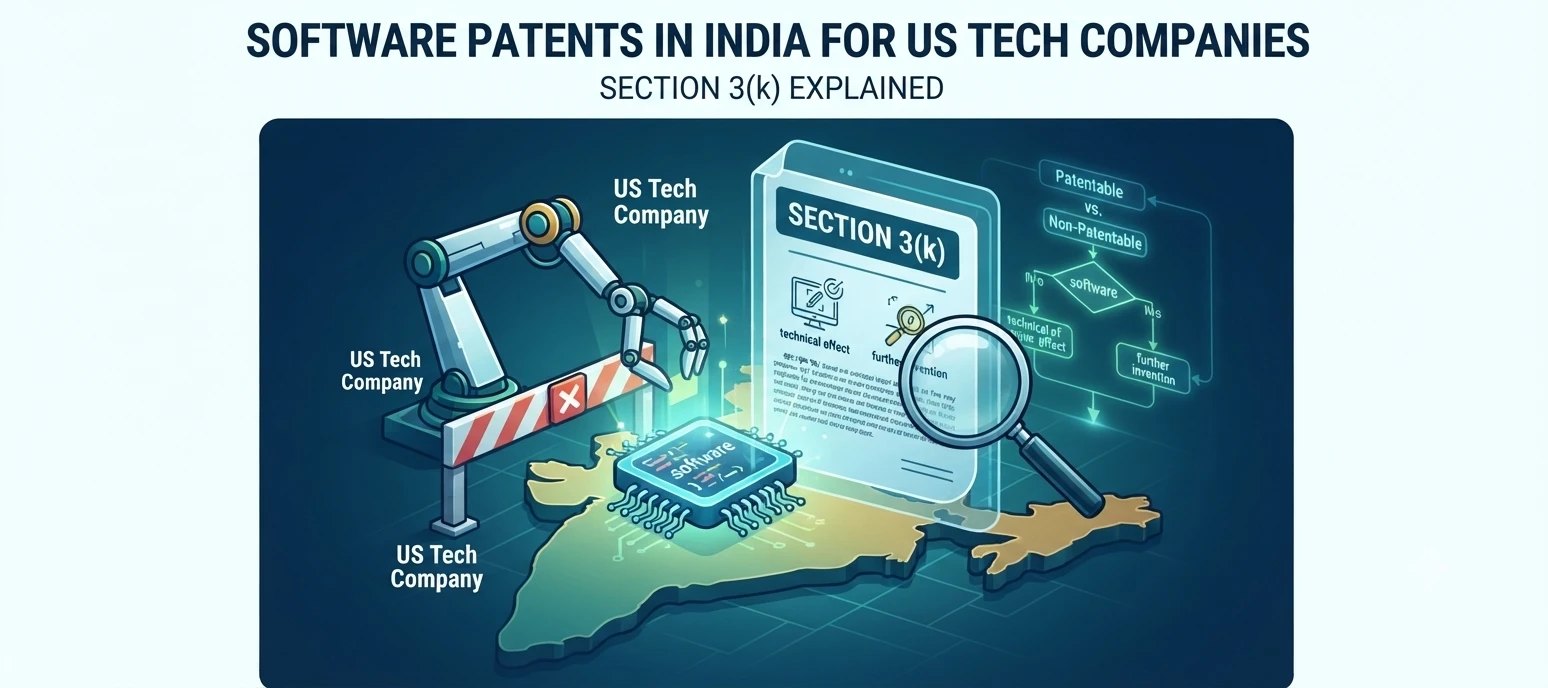
In India, Section 3(k) of the Patents Act, 1970 says that a mathematical or business method or a computer programme per se or algorithms are not patentable inventions. Courts have read it to allow software-related inventions that show a technical effect or contribution, as in Ferid Allani v. Union of India, a Delhi High Court decision of 2019. The Patent Office’s Guidelines for Examination of Computer Related Inventions were revised in 2025, reportedly replacing the 2017 guidelines and the earlier three-step test. That is the core of can you patent AI in India.
For AI, the practical test is whether the claim shows a technical effect beyond the normal operation of a computer. Reports say AI inventions are not categorically excluded, if they meet the requirements and show a technical contribution. Claims framed as a technical method or system, with details of the hardware or the real-world problem solved, fare better than claims framed as pure algorithms. Examination can involve objections under Section 3(k), and you should be ready to respond with technical arguments.
On inventorship, Indian law requires an inventor to be a person. The Patent Office has dealt with applications naming the DABUS AI system, and reports say that one was refused in April 2026, though that appears in a limited number of secondary sources and should be checked. Name human inventors, and explain how they contributed. For founders with a US-India setup, align inventorship in both countries.
Inventorship and practical strategy
File early. In both countries, public disclosure before filing can destroy novelty, with limited grace periods: one year in the US for the inventor’s own disclosure, and a narrow exception in India. A US provisional application gives a priority date, and under the Paris Convention you have twelve months to file abroad, including in India, and thirty-one months from the earliest priority date to enter the national phase under the Patent Cooperation Treaty in India.
| Point | United States | India |
|---|---|---|
| Main hurdle | Alice test under Section 101 (abstract ideas) | Section 3(k) (computer programmes per se, algorithms, mathematical methods) |
| What helps | Specific technical improvement | Technical effect or contribution, as in Ferid Allani |
| Inventor | Natural person only (Thaler v. Vidal) | Natural person; reports of a DABUS refusal in 2026 |
| Guidance | USPTO eligibility examples; AI-assisted inventorship guidance | CRI Guidelines revised in 2025, as reported |
| Grace period | One year for the inventor’s own disclosure | Narrow exceptions only |
Draft with both systems in mind. Describe the technical problem, the solution, the data and training, the system architecture, and the improvement shown by tests. Include several claim types, such as a method, a system and a medium. For India, emphasise the technical effect and hardware context to answer Section 3(k). For the US, emphasise the improvement to technology to answer Alice. Keep inventor records that show who conceived what.
Combine protections. Use patents for the technical advances that you can describe and that competitors can see, trade secrets for models, weights and data that you can keep secret, copyright for code and documentation, and contracts for ownership and confidentiality. Make sure that employees and contractors assign inventions in writing. Review your plan with a patent attorney in each country before public disclosure.
Next steps and quick answers
List your AI innovations, separate the technical improvements from the ideas, decide which to patent and which to keep secret, check for public disclosure, and file a provisional application if you have an invention worth protecting. Consult US and Indian patent counsel on claim drafting. This is general information, not legal advice. Revisit can you patent AI for each new feature.
Related reading: software patents in India and Section 3(k), software patents in India for US tech companies, filing a patent in India after a US provisional, Indian patent prosecution for US firms, trade secret remedies in India, blockchain: patent or trade secret? and can AI art be copyrighted?; also free patent search in India.
Quick answers
Can you patent AI?
Yes, if the invention is new, inventive, useful and tied to a technical solution. Abstract ideas and algorithms as such are not patentable in the US under the Alice test, or in India under Section 3(k).
Can an AI be named as an inventor?
No, not in the US or India. Both require a human inventor. The Federal Circuit held in Thaler v. Vidal that an AI cannot be an inventor, and Indian law requires a person.
Should I patent my AI model or keep it secret?
It depends. Patents suit technical advances that competitors can see and that you can describe. Trade secrets suit weights, data and methods you can keep confidential. Many companies use both.
Can I patent a machine learning model?
A model as an abstract algorithm is hard to patent. A claim tied to a specific technical improvement, system or device with a credible technical effect is more likely to qualify.
Should I keep my model weights secret instead?
Often yes. Many companies patent technical advances they can describe and keep weights, data and methods as trade secrets.
Final word
Halverton & Co. is an Indian law firm advising US companies, founders, investors and law firms on Indian law, including patent filing and prosecution in India for US companies, software and AI patent strategy, and IP assignment and trade secret protection. We practise in Jharkhand, Maharashtra and before the Supreme Court of India, and work alongside US counsel, who advise on US law. Halverton & Co.: Where tech needs law! If you have a question about Indian law, write to us at office@halvertonandco.com, or get in touch.
This article reflects developments reported up to 31 October 2026. It is for general information only, is not legal advice, and does not create an attorney-client relationship. Halverton & Co. is an Indian law firm and does not advise on US law; US-law points should be confirmed with US counsel.
Sources
Related practice area
Intellectual Property
Trade marks, copyright, patents and designs. Searched, filed, licensed and enforced under Indian law.
View the practice areaComments
No account needed. Comments are reviewed before they appear, so yours will show here once approved. Please do not share confidential details or describe your own legal matter: replies are general discussion, not legal advice, and do not create an advocate-client relationship. For your own situation, write to office@halvertonandco.com.