Key takeaways
- The IT Rules amendment reported as notified on 10 February 2026 defines synthetically generated information and requires labelling.
- Commentary reports a 3-hour takedown window and a shorter window for intimate imagery, but sources differ on what triggers the clock.
- Preserve evidence, report on the platform, file a complaint and escalate to the appellate committee or a court.
- Read the notified Rules before relying on any timeline.
Deepfake removal India now runs on a much faster clock than before. The Information Technology (Intermediary Guidelines and Digital Media Ethics Code) Amendment Rules, 2026, reported as notified on 10 February 2026 and in force from 20 February 2026, define synthetically generated information, require labelling and shorten takedown timelines. Commentary says the general window fell from 36 hours to 3 hours and that non-consensual intimate imagery has a 2-hour window, although sources differ on the exact trigger.
This guide explains the 2026 changes in plain terms and gives a step-by-step route to take a deepfake down: preserve evidence, use platform tools, escalate, file a complaint and, if needed, seek court orders. It is general information, not legal advice. Because sources differ on the trigger for the 3-hour clock, read the notified Rules and take advice for a live incident. A complaint for deepfake removal India platforms accept quickly should be specific, with URLs and a clear statement of harm.
What the 2026 rules changed
The amendment adds a definition of synthetically generated information, covering audio, visual or audio-visual content created or altered by artificial intelligence or algorithmic processes so that it appears real. Routine editing and good-faith document preparation are carved out. This definition, found in Rule 2(1)(wa) according to commentary, is the anchor for the new duties. Check the exact text, since summaries differ.
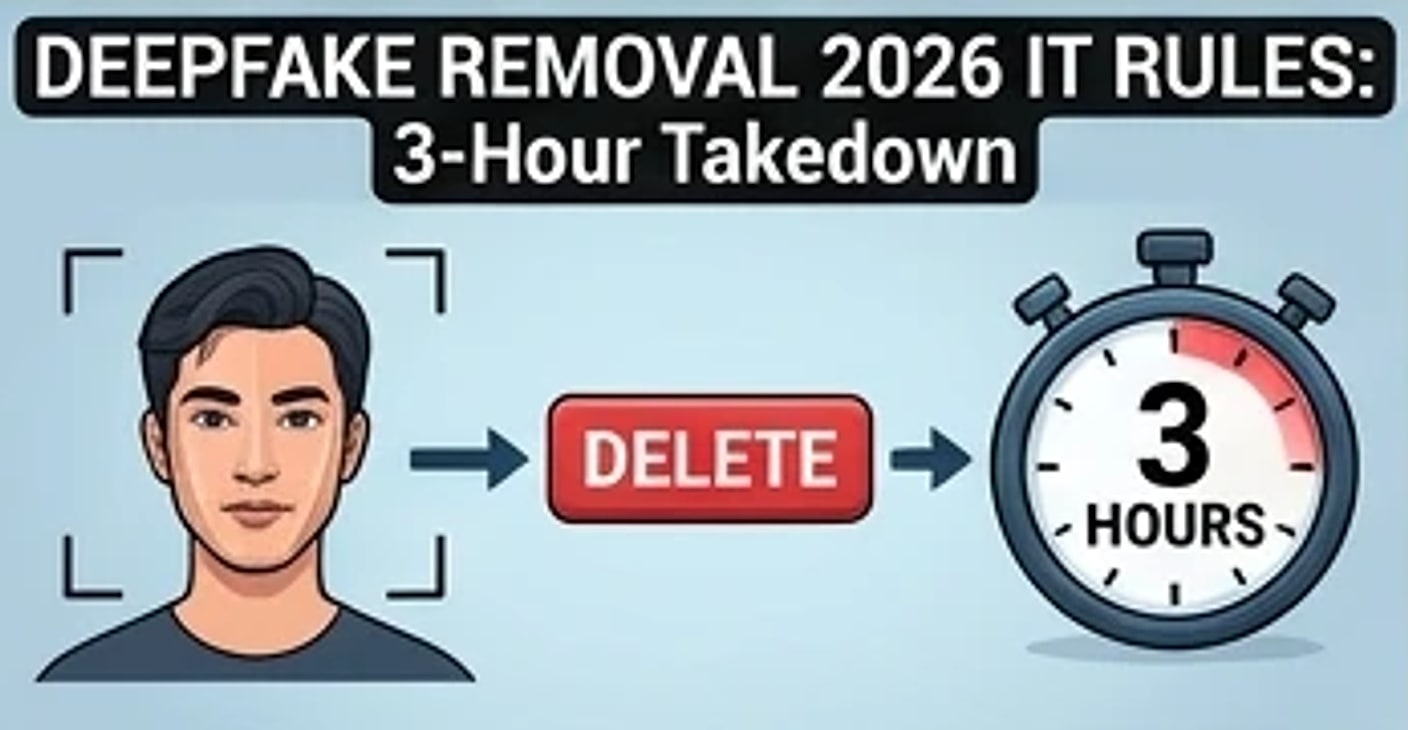
Platforms must require users to declare whether content is synthetic and take technical measures to verify the declaration and label content prominently. Significant social media intermediaries have extra duties. The 3-hour takedown IT Rules 2026 contain, according to law firm summaries, applies after the platform receives a court order or an appropriate government notification, while other summaries describe it as running from a takedown notice. Do not assume the shorter clock applies to every private complaint. The 3-hour takedown IT Rules 2026 describe is only part of the picture for deepfake removal India victims need.
For intimate imagery, reports say the removal window is two hours after a complaint, down from twenty-four. Non-consensual intimate imagery takedown 2 hours is the most urgent category and the platform must act quickly. Grievance redressal timelines are also reported to have been shortened. Platforms that fail risk losing safe harbour under Section 79 of the IT Act, which is why they now act quickly.
Step by step: the first hours
Step one is to preserve evidence. Save the URLs, take screenshots showing the account name, date and time, download the file if you can do so safely and note where you first saw it. Do not forward the content widely. If the deepfake is sexual, do not circulate it, and consider asking a trusted person to help collect evidence. Evidence helps with platform reports, police complaints and court.
| Step | Action | Time |
|---|---|---|
| Preserve evidence | URLs, screenshots, dates | First hour |
| Platform report | In-app report and grievance officer complaint | Same day |
| Cybercrime portal | File on cybercrime.gov.in | Same day |
| Escalate | Grievance Appellate Committee | If no action |
| Court | Injunction, personality rights, takedown order | As needed |
Step two is to report on the platform. Use the in-app report tool for impersonation, non-consensual intimate imagery or manipulated media, and send a written complaint to the platform’s grievance officer in India, whose details must be published. State that the content is synthetically generated, identify yourself, give the URLs, describe the harm and ask for removal. Keep the acknowledgement number and times. Platforms treat a clear request for deepfake removal India grievance officers can act on faster than a general report.
Step three is to file a complaint on the national cybercrime portal, cybercrime.gov.in, or call the helpline 1930 for financial fraud. Report deepfake cybercrime portal India filings can be made online and anonymously for some categories, and they create a record. For intimate imagery, specific reporting options exist. Note the complaint number and follow up with the local cyber cell or police station if needed.
Escalation: grievance officer, appeal and police
If the platform does not act within the time stated, escalate. The IT Rules provide for an appeal to the Grievance Appellate Committee against a grievance officer’s decision, and the appeal can be filed online. Escalate in writing, attach your first complaint and state the Rule that applies. Keep the language factual and short.
Consider a police complaint or FIR. Depending on the facts, offences may include identity theft and cheating by personation under Sections 66C and 66D of the IT Act, violation of privacy under Section 66E, obscenity provisions, and defamation, forgery or intimidation under the Bharatiya Nyaya Sanhita. Police can send notices to platforms and trace the creator. Ask for a copy of the FIR or acknowledgment.
If the deepfake is used for fraud, tell your bank immediately and use the financial fraud helpline. If it involves a company or brand, consider notifying customers and monitoring for copies. For minors, report to the platform and police at once and use child protection reporting channels. Support from family, school or employer matters.
Court remedies and personality rights
A court order is the strongest tool. Courts in Delhi and Bombay have granted personality rights deepfake Delhi High Court orders to public figures, restraining misuse of their name, image, voice and likeness and directing takedown and blocking. Reports in 2025 and 2026 describe orders for several actors and public figures. Private individuals can also seek injunctions for privacy and defamation. Courts are an important route for deepfake removal India law allows when platform steps fail.
A suit or application can ask for an ex parte interim injunction, a direction to platforms to take down specific URLs and disclose subscriber details, and orders against unknown persons. Courts may require evidence of the harm and of the URLs. Where the court issues a takedown order, platforms must comply within the shortened window, as commentary describes.
Be realistic about limits. Content can reappear on other sites, and enforcement against anonymous creators is hard. Combine legal action with monitoring, copy tracing tools and clear public statements where appropriate. Seek counselling or support if the content is distressing. Consider whether a criminal complaint, a civil case or both suit your situation.
Next steps and quick answers
Preserve evidence, report on the platform, file a cybercrime complaint, escalate to the appellate committee if needed and consider court action. Review the notified Rules for the trigger of the 3-hour window. This is general information, not legal advice. Keep a dated log of every step for deepfake removal India authorities or courts may later ask about. The definition of synthetically generated information Rule 2(1)(wa) is worth quoting in your complaint.
Related reading: AI-generated content labelling under the 2026 IT Rules, deepfakes and personality rights in India, the Sahyog portal and content takedowns, platform liability for deepfakes, binding MeitY advisories and safe harbour and fake domain and brand scams; also TAKE IT DOWN Act compliance for platforms built in India and deepfake law in the UAE and India.
Quick answers
How fast must a platform remove a deepfake in India?
Commentary says the general window is three hours after a court order or government notification, and two hours for non-consensual intimate imagery, but sources differ. Check the Rules.
Where do I report a deepfake in India?
Report on the platform, to its grievance officer, and on cybercrime.gov.in. Escalate to the Grievance Appellate Committee or the court if needed.
Can I get a court order against deepfakes?
Courts have granted injunctions, including personality rights orders, directing takedown and blocking. Facts and evidence decide each case.
How quickly must a platform remove a deepfake?
Commentary says three hours in some cases and two hours for intimate imagery, but the trigger differs between sources. Check the Rules.
Final word
Halverton & Co. is an Indian law firm advising founders, startups, technology companies and investors on Indian law, including online content removal, IT law, personality rights and platform compliance in India. We practise in Jharkhand, Maharashtra and before the Supreme Court of India, and act as fractional legal counsel for technology-driven businesses. Halverton & Co.: Where tech needs law! If you have a question about Indian law, write to us at office@halvertonandco.com, or get in touch.
This article reflects developments reported up to 31 October 2026. It is for general information only, is not legal advice, and does not create an advocate-client relationship. Halverton & Co. is an Indian law firm.
Sources
- S.S. Rana: Government notifies the Information Technology Amendment Rules 2026
- Khaitan & Co: MeitY notifies the IT Amendment Rules 2026
- Hogan Lovells: India introduces mandatory labelling for AI and 3-hour takedown
- Freshfields: India targets deepfakes and AI-generated content
- National Cyber Crime Reporting Portal
Related practice area
Technology & AI Law
Contracts, data protection and AI policies for products that handle other people’s data.
View the practice areaComments
No account needed. Comments are reviewed before they appear, so yours will show here once approved. Please do not share confidential details or describe your own legal matter: replies are general discussion, not legal advice, and do not create an advocate-client relationship. For your own situation, write to office@halvertonandco.com.