Key takeaways
- IP India’s draft guidelines on GUI and icon designs were reported as published on 1 October 2026, following a 2026 Calcutta High Court judgment that GUIs are not excluded from registration.
- A GUI is registrable when applied to a named article such as a phone or monitor, visible in normal use and new or original.
- The draft is reported to allow Class 14-04 and to treat each frame of an animated GUI as a separate design, without protecting the movement.
- A design lasts ten years, extendable by five, and works best together with copyright, trade marks and patents.
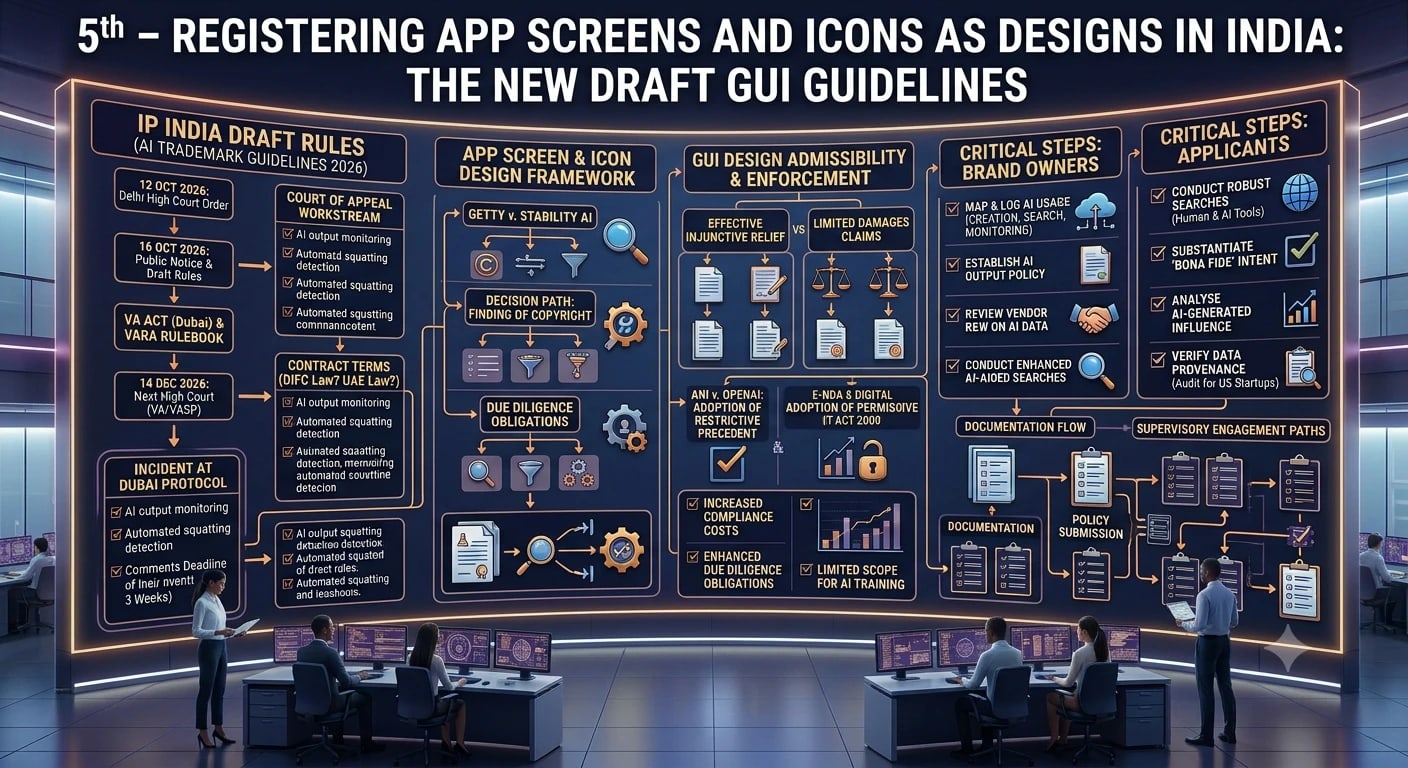
For years, an app’s screens and icons sat in an uncertain place in Indian law. Design applications for graphical user interfaces were often refused on the basis that a screen is not applied to an article. That is now changing. On 1 October 2026, IP India published draft guidelines on registering designs for GUIs and icons, building on a 2026 decision of the Calcutta High Court. For founders, the question of GUI design registration India is now a practical filing decision rather than a theory.
This guide explains what the draft says, how it fits the Designs Act, 2000, what can and cannot be registered, how to prepare an application and how a registration works with copyright, trade marks and patents. The guidelines are still a draft, so confirm the comment deadline and final text with IP India before you file.
What the draft guidelines say
The draft guidelines were issued by the Office of the Controller General of Patents, Designs and Trade Marks for comment, with a window of around 30 days. Reports say the notice was listed on 1 October 2026, though some commentary gives a different date, so check the official notice. The draft is examination guidance under the Designs Act, 2000 and the Designs Rules, 2001. It is not new legislation, and it does not change the statute. The consultation is the first formal step towards a settled GUI design registration India practice.
Reports of the draft say a GUI or icon is registrable only when it is applied to a named article, such as a smartphone, tablet or monitor, and when it is visible in normal use and new or original. The draft is said to allow classification in Class 14-04, ’screen displays and icons’, where the interface is the new feature, even if the device sits in another class. It is said to accept animated or transitional GUIs if each frame is filed as a separate design.
The draft follows a 2026 judgment of the Calcutta High Court in a group of appeals, which held that GUIs are not excluded from design registration merely because they are digital. That reversed the practice of blanket refusals. The decision matters because it gives the Controller a legal basis to accept GUI applications, and because it sets limits that applicants must respect. Read the judgment alongside the draft.
What can be registered and what cannot
Under Section 2(d) of the Designs Act, a design means features of shape, configuration, pattern, ornament or composition of lines or colours applied to an article by any industrial process, which appeal to the eye in the finished article and are judged by the eye alone. A GUI can meet this definition when its layout, icons and visual composition are shown as displayed on a device. The question the Registry will ask is what article carries the screen.
Some things fall outside design protection. A design does not protect the way an app works, its functions or the underlying code, which belong to patent or copyright law. Mere ideas, methods of operation and purely functional layouts are weak candidates. Section 4 bars designs that are not new or original, that were published before the filing date, or that are scandalous or obscene. A trade mark or a flag used as the main feature may also raise issues. Reading these limits early keeps a GUI design registration India filing realistic.
| Protectable | Not protected by design law | Better route |
|---|---|---|
| Layout, icons and visual composition applied to a device screen | How the app works and its functions | Patent, where there is a technical solution |
| Each frame of an animated GUI, filed as a separate design | The movement or transition itself | Copyright and confidentiality |
| New and original appearance published for the first time at filing | Designs published before the filing date | File before launch or public release |
| Icon sets that customers recognise | Names and logos as brand identifiers | Trade mark registration |
Animation is a special case. The draft is said to protect the individual frames as designs, not the movement between them. A transition effect, such as a swipe animation, is therefore hard to protect as a design. If a screen sequence is central to your product, file the key frames as separate designs and consider whether copyright and patent protection fill the gap. For GUI design registration India applicants, the choice of which screens to file is a strategic decision.
How to prepare a GUI design application
First, decide what is new. Identify the screens, icons or layouts that give your product its distinctive look and that a copycat would copy. Do not file every screen. Pick the home screen, the signature dashboard and the icon set that customers recognise. Check that none has been published, shown at a public event or released in an app store before your filing date, because earlier publication can defeat novelty under Section 4. This selection is the heart of GUI design registration India planning.
Second, prepare clear representations. Show the GUI on the article, such as a phone or monitor, in line drawings or high-quality screenshots, with a clear statement of the novel features. Use consistent views, and avoid showing unrelated content that could narrow the scope. State the article in the title, for example ’Icon for a mobile phone’, and file in the right class, with Class 14-04 where the draft allows it. Each frame of an animated sequence will need its own design.
Third, plan the timing. Indian designs are registered for ten years, extendable by five under Section 11, and Section 44 allows cancellation on grounds such as prior publication. If you have filed abroad, a Paris Convention priority claim must usually be made within six months of the first filing. File before launch where you can, and record who owns the design, since a design created by an employee or freelancer needs a clear assignment under your contracts.
How design rights work with other IP
Design registration is one layer in a stack. Copyright arises automatically in original artistic works such as icon artwork and screen layouts, but it can be hard to prove and enforce, and Section 15 of the Copyright Act limits copyright in registered designs that have been industrially applied more than fifty times. Trade marks protect names, logos and sometimes distinctive icons that identify your brand. Patents protect new technical solutions, not appearance.
A sound strategy often combines them. Register the app name and logo as trade marks, file the key screens and icons as designs, keep copyright records and source code under copyright and confidentiality, and consider a patent where there is a technical inventive step. Each right has a different strength, cost and duration, and together they give a competitor several obstacles instead of one.
Enforcement also differs. A registered design gives you the exclusive right to apply the design to articles in the class and to take action against piracy under Section 22, with remedies of damages and injunction in the district court or High Court. Without registration, you may have to rely on passing off, which needs reputation. For startups, registration provides a clear public record that investors and acquirers can see. A clear registration record also makes GUI design registration India more valuable in a funding round.
Next steps and quick answers
Over the next weeks, read the draft, note its comment deadline, and decide whether to submit views. Audit your product for screens and icons worth protecting, check that none has been published too early, and prepare filings with clear representations. Keep an eye on the final guidelines, as classification and animation rules may change. Take advice before filing, because a defective application can cost time and narrow protection.
Related reading: registering an industrial design in India for a US company, software copyright protection in India, trade mark registration for startups in India, software patents in India and Section 3(k), who owns code written by Indian developers, copyright and AI-generated content in India and IP India’s draft rules on AI and trade mark squatting; also USPTO’s DesignVision design search tool; also protecting a US app in India and clone games and UK developers in India.
Quick answers
Can I register an app screen as a design in India?
Following the Calcutta High Court ruling and the draft guidelines, a GUI can be registered if it is applied to an article, visible in normal use and new or original. The guidelines are still a draft.
Can I register an animation or transition?
The draft is reported to allow each frame of an animated GUI as a separate design, but it does not protect the movement itself. Consider copyright and patents for other aspects.
How long does a design registration last in India?
A design is registered for ten years and can be extended once for five years, a total of fifteen years, subject to renewal fees and the conditions of the Designs Act, 2000.
Is the GUI guideline final?
No. It is a draft examination guideline published for comment, reported as listed on 1 October 2026. Check the IP India notice for the deadline and final text.
Do I need to file before launching my app?
File before public release where you can. Earlier publication can defeat novelty under Section 4 of the Designs Act, 2000.
Final word
Halverton & Co. is an Indian law firm advising founders, startups, technology companies and investors on Indian law, including design, trade mark and copyright registration, technology and app law, startup IP strategy, and compliance. We practise in Jharkhand, Maharashtra and before the Supreme Court of India, and act as fractional legal counsel for technology-driven businesses. Halverton & Co.: Where tech needs law! If you have a question about Indian law, write to us at office@halvertonandco.com, or get in touch.
This article reflects developments reported up to late October 2026. It is for general information only, is not legal advice, and does not create an advocate-client relationship. Halverton & Co. is an Indian law firm.
Sources
Related practice area
Intellectual Property
Trade marks, copyright, patents and designs. Searched, filed, licensed and enforced under Indian law.
View the practice areaComments
No account needed. Comments are reviewed before they appear, so yours will show here once approved. Please do not share confidential details or describe your own legal matter: replies are general discussion, not legal advice, and do not create an advocate-client relationship. For your own situation, write to office@halvertonandco.com.