Key takeaways
- The Designs Act, 2000 protects the appearance of an article applied by an industrial process, and registration is the only way to get design protection in India.
- India applies absolute novelty: disclosure anywhere in the world before filing can defeat a design.
- A design application can claim priority if filed within six months of the first filing in a Paris Convention country.
- The initial term is ten years, extendable by five; sources differ on when the term starts, so check the Act.
A US company that sells a distinctive physical product in India, or sells to Indian customers through marketplaces, can find copycats quickly. Patent and trade mark protection do not always cover the shape or look of a product. Industrial design registration India US company owners should consider is a relatively fast and low-cost way to protect appearance, if the design is filed in time.
This guide explains industrial design registration India US company teams need: what the Designs Act, 2000 protects, the novelty rule that catches many US businesses, the six-month priority window, how to file, term and renewal, how designs interact with copyright, trade marks and patents, and how to enforce. It is general information. US design patent points belong to US counsel.
What Indian design law protects
The Designs Act, 2000 protects the features of shape, configuration, pattern, ornament or composition of lines or colours applied to an article by an industrial process, when those features appeal to and are judged by the eye. It protects appearance, not function. It excludes mere mechanical devices, trade marks and artistic works as defined in the Copyright Act. A product’s look can therefore be protected as a registered design while its technical method is protected by a patent.
The Act is a good fit for consumer products, packaging, furniture, devices, jewellery, toys and tools, and in some cases for graphic interface elements for display devices, although we recommend checking current Patent Office practice for software-related designs, because practice has developed over time. Designs are classified using the Locarno classification, which also helps when filing in several countries.
Industrial design registration India US company filings are examined by the Controller of Designs and, if registered, give the owner the exclusive right to apply the design to the article in the registered class and to stop copying. Registration is the only way to get design protection in India: there is no unregistered design right under the Act.
Novelty, priority and the deadlines that matter
A design must be new or original and must not have been disclosed to the public anywhere in the world, in a tangible form or by use or in any other way, before the date of filing. This is an absolute novelty standard. A US company that has launched the product, displayed it at a trade show, posted images on social media or sold it, even in the US, before filing in India may find the design no longer new.
Priority gives some relief. Under the Paris Convention, a design application filed in India within six months of the first filing in another member country can claim the earlier date. Sources describe this period as not extendable, so a US company that files a US design patent application should treat month six as a hard deadline for India. This differs from the twelve-month period for patents.
For industrial design registration India US company planning, the safest approach is to file in India before any public launch, or use the priority window if a US filing comes first. Remember also that Indian-resident designers have no separate foreign-filing permission requirement for designs in the same way as patents, but check the Act if a design was created in India. Keep a dated record of the design’s creation and first disclosure.
Marketplace sellers deserve a word. If you sell on Indian online marketplaces, a registered design can support complaints about lookalike products, and platforms often ask for registration details before acting on design claims. Without registration, your options depend on trade mark or passing off arguments, which require reputation or distinctiveness in India. Filing before launch gives the best position.
How to file and what it costs in time
An application is filed with the Design Office on Form 1, with representations of the design such as drawings or photographs showing the article from relevant views, a statement of novelty and the class. A foreign applicant needs an address for service in India and usually files through an Indian agent on a power of attorney. Each application normally covers one design in one class, so a product line may need several filings.
The Controller examines the application and raises objections if needed, which the applicant answers. If accepted, the design is registered and published. Registration is generally faster than a patent. Fees are modest compared with patents, and we found no confirmation of reduced fees for small entities or startups under recent rules, so check the current fee schedule on the Indian Patent Office website.
The initial term is ten years, extendable by five years on payment of an extension fee, for a maximum of fifteen years. Sources disagree on whether the ten years run from the filing or priority date or from registration, so check the Act and calendar the renewal. If the extension is missed, the registration ceases. Keep the extension deadline on a docket.
Design, copyright, trade mark and patent overlaps
Copyright and design interact. Under Section 15 of the Copyright Act, copyright in an artistic work ceases once the design has been applied industrially, to more than fifty articles by an industrial process, unless the design is registered. The consequence is that a product shape cannot rely on copyright alone once it is mass produced, so register the design if you want protection.
| Right | Protects | Key limit |
|---|---|---|
| Registered design | Appearance of an article applied by an industrial process | Must be registered, and absolute novelty applies |
| Copyright | Artistic works such as artwork | Ceases once a design is industrially applied beyond the Section 15 limit unless registered |
| Trade mark | Distinctive shapes and trade dress that act as a brand | Proof of distinctiveness is needed for shapes |
| Patent | How the product works | Protects function, not appearance |
Trade mark law can protect shapes and trade dress if they are distinctive and function as a brand, but registration for shapes is harder and requires proof of distinctiveness. Patents protect how a product works, while designs protect how it looks. A product that is both novel in function and distinctive in appearance can use both, subject to the timing of disclosure.
A US company that holds a US design patent has no automatic Indian right. It must file in India, within the priority window if it wants the US date. Coordinating design, patent and trade mark filings through one plan helps, and so does a consistent product naming and branding strategy. Industrial design registration India US company programmes work best when integrated with the rest of the IP strategy.
A multi-design strategy can help. Files can cover the product as a whole, key components, packaging and variations, each as a separate design in the right class. Consider what a copycat would copy and cover those features. Keep representations clear and consistent, because the scope of protection depends on what is shown. Reviewing drawings with a design professional before filing is cheaper than finding gaps in litigation.
Enforcement, remedies and quick answers
Section 22 of the Designs Act makes it unlawful, during the existence of copyright in a design, to apply it or an imitation to articles in the registered class for sale, or to import or sell such articles, without the proprietor’s consent. The registered proprietor can sue for infringement and seek an injunction and damages, and the Act also provides a statutory sum recoverable for each contravention, up to a limit per design. Check the current amounts in the Act. Courts, especially the Delhi High Court, also hear design disputes and grant interim injunctions on strong evidence of copying and a valid registration. A defendant can challenge validity on grounds such as prior publication and lack of novelty, so a registration is only as strong as its novelty record. Preserve evidence of copying, including purchased samples, marketplace listings and sales data, and use marketplace takedown programmes. Customs recordal can help for imports. Industrial design registration India US company holders should audit the portfolio each year, since renewal, extension and new variants all affect protection. If a rival registers your design first, consider cancellation on grounds of prior publication.
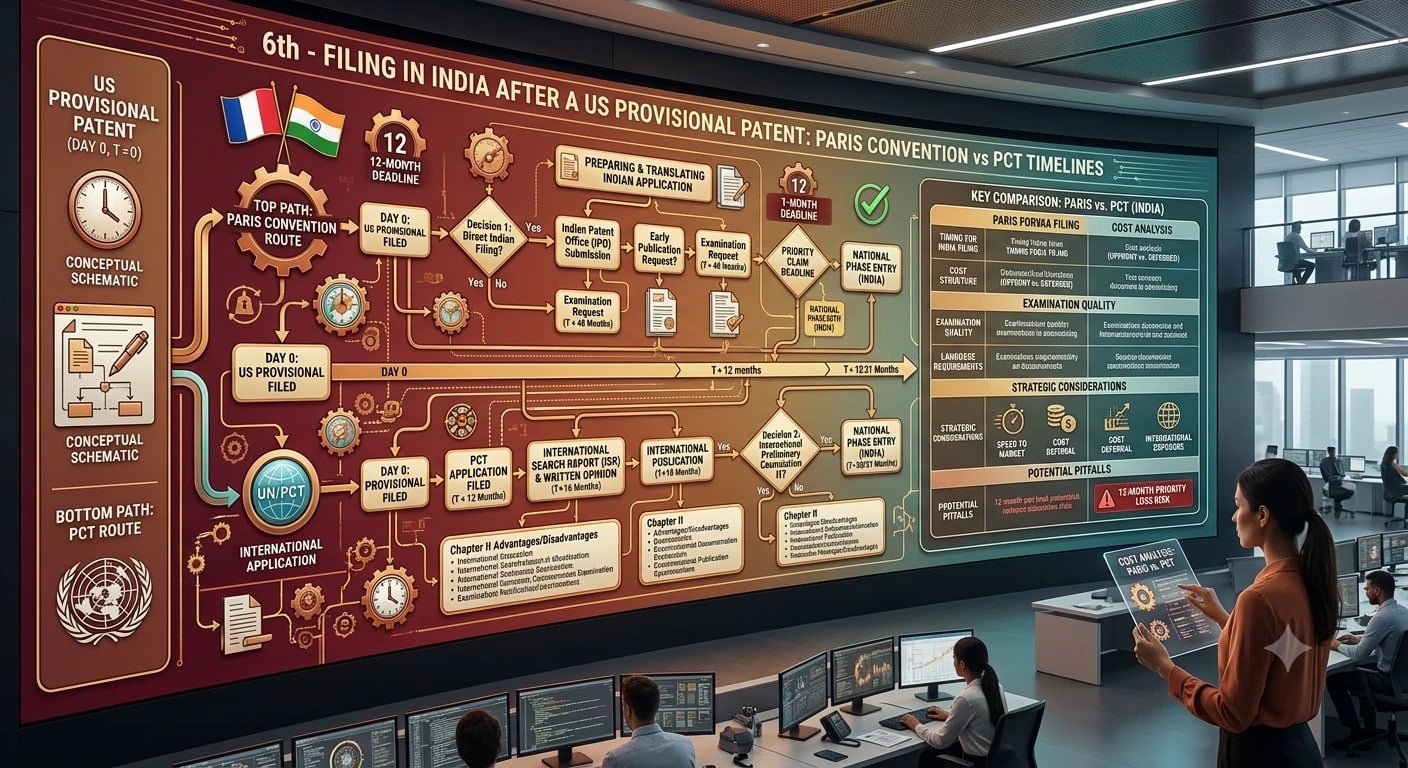
Related reading: filing in India after a US provisional patent, software copyright protection in India, trade mark registration for startups in India, registering a US trademark in India: Madrid vs direct, trademark squatting in India for US companies, software patents in India for US tech companies and Indian patent prosecution for US firms; also registering app screens and icons as designs in India; also USPTO’s DesignVision design search tool; also protecting a US app in India.
Quick answers
Do US companies need to register designs in India?
Yes, to get design protection there. India has no unregistered design right, and a US design patent has no effect in India unless a corresponding Indian application is filed.
How long does an Indian design registration last?
Ten years initially, extendable by five years, for up to fifteen years. Check the Act on when the term starts and calendar the extension.
What is the biggest risk for a US company filing an Indian design?
Prior disclosure. India applies an absolute novelty standard, so launching, publishing or displaying the product before filing can destroy novelty. Use the six-month priority window and file before launch.
Does a US design patent protect me in India?
Not automatically. India has no unregistered design right, so you need an Indian design registration, and the six-month Paris priority window matters if you want the US date.
Can I register a design after launching the product?
It is risky. India applies an absolute novelty standard, so a launch, publication or display before filing can destroy novelty. File before launch or use the priority window.
Final word
Halverton & Co. is an Indian law firm advising US companies, founders, investors and law firms on Indian law, including Indian design, trade mark and copyright filings and enforcement for US product companies. We practise in Jharkhand, Maharashtra and before the Supreme Court of India, and work alongside US counsel, who advise on US law. Halverton & Co.: Where tech needs law! If you have a question about Indian law, write to us at office@halvertonandco.com, or get in touch.
This article reflects developments reported up to late October 2026. It is for general information only, is not legal advice, and does not create an attorney-client relationship. Halverton & Co. is an Indian law firm and does not advise on US law; US-law points should be confirmed with US counsel.
Sources
Related practice area
Intellectual Property
Trade marks, copyright, patents and designs. Searched, filed, licensed and enforced under Indian law.
View the practice areaComments
No account needed. Comments are reviewed before they appear, so yours will show here once approved. Please do not share confidential details or describe your own legal matter: replies are general discussion, not legal advice, and do not create an advocate-client relationship. For your own situation, write to office@halvertonandco.com.