Key takeaways
- Many tech-company legal tasks are unreserved and can be supported offshore under supervision.
- Reserved activities such as litigation steps must stay with authorised persons.
- UK GDPR, confidentiality and privilege all need contract and process safeguards.
- Pilot a provider on defined tasks before scaling up.
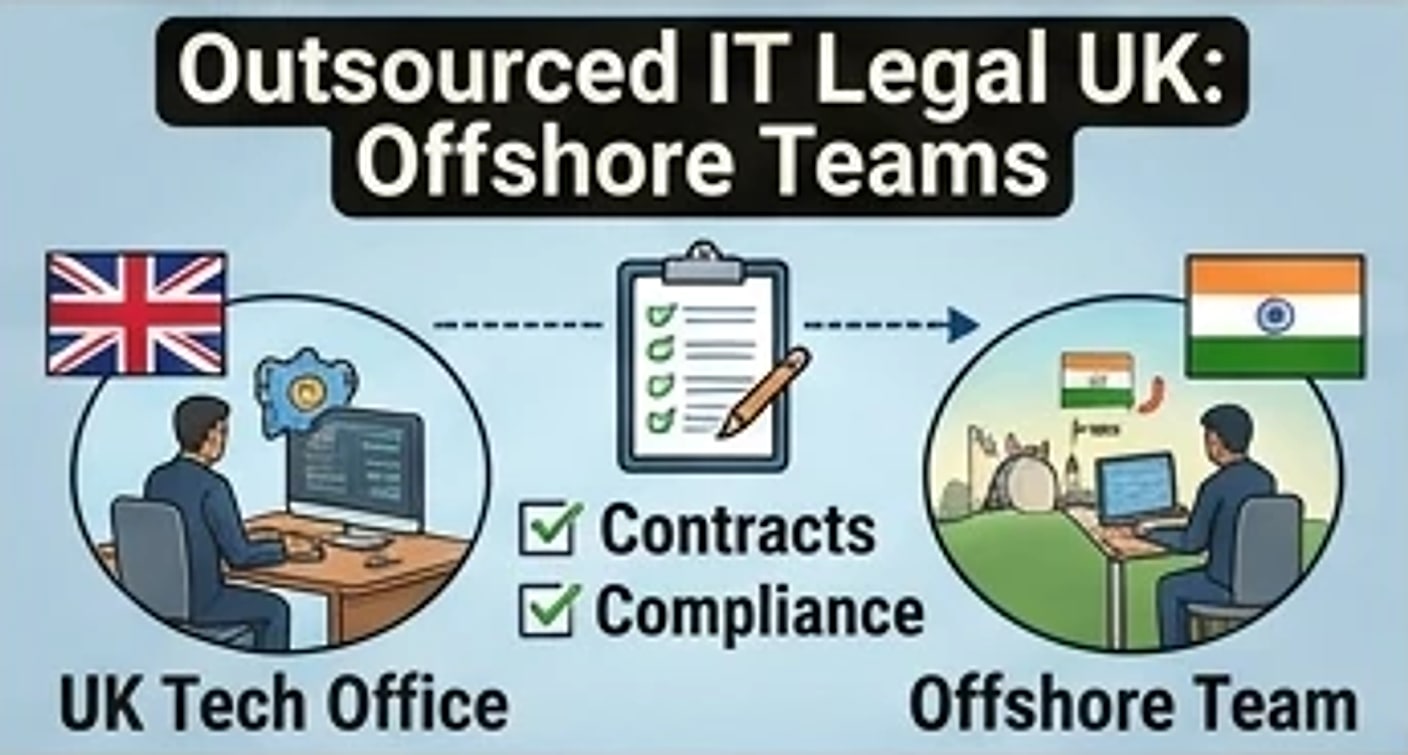
Outsourced IT legal UK arrangements have grown as tech companies try to keep legal costs under control while contracts, privacy questions and compliance tasks multiply. In-house teams are often small, and routine work such as contract review, data protection paperwork and regulatory tracking can pile up. Outsourced legal support, including from India, can handle some of that work, provided the structure respects UK regulation. Outsourced IT legal UK arrangements work best when tasks, supervision and data handling are written down.
This guide explains what outsourced legal support for UK tech companies can cover, where the limits lie under the Legal Services Act 2007, how supervision and confidentiality work in practice, and what to ask a provider. It is written by an Indian law firm for UK readers and is general information, not legal advice. Halverton & Co. does not advise on English law.
What can be outsourced
Outsourced legal support UK tech companies use tends to fall into repeatable tasks. Examples include first-pass review of customer and supplier contracts against a playbook, drafting from precedents such as NDAs and data processing agreements, preparing issue lists, tracking obligations, maintaining contract databases, helping with privacy records and compliance matrices and legal research on foreign law topics.
For a software company with Indian operations, an Indian provider can also advise on Indian law, such as the DPDP Act, IT Act, Indian contracts and employment in India, and coordinate with English counsel on cross-border issues. That split, English law with UK lawyers and Indian law with Indian lawyers, avoids stretching either beyond competence.
Overflow support is a common model. A UK in-house counsel overflow support arrangement sends defined tasks to a team that follows the company’s templates and escalation rules, and returns work for the in-house lawyer to review and sign off. The in-house lawyer stays responsible for advice given to the business. A well-run outsourced IT legal UK model keeps the in-house lawyer in charge of advice. Contract review offshore for UK startups is a common first project.
Where the limits are
The Legal Services Act 2007 reserves six activities to authorised persons: the exercise of a right of audience, the conduct of litigation, reserved instrument activities, probate activities, notarial activities and the administration of oaths. Most tech-company legal work, such as contract drafting and advice, is not reserved, but the line matters. Reserved legal activities limits mean that litigation steps, court filings or conveyancing should not be given to an unauthorised provider.
| Task | Suitable? | Condition |
|---|---|---|
| First-pass contract review | Yes | Against a playbook, then lawyer sign-off |
| Drafting from precedents | Yes | Reviewed by English-qualified lawyer |
| Privacy records and checklists | Yes | Data processing terms |
| Litigation steps | No | Reserved activity |
| English-law advice | Only by qualified lawyers | Clear allocation |
Unreserved work can be done by unauthorised persons, but the label solicitor and some regulated titles are protected, and an unauthorised provider should not hold itself out as regulated. Clients should understand that a provider that is not authorised by the Solicitors Regulation Authority does not give the protections that come with a regulated firm, such as compulsory indemnity insurance cover and the compensation fund.
Advice on English law should come from someone competent to give it. An Indian provider should not advise on English law unless it has qualified English-law capability, and should frame its work as support to English-qualified lawyers. Make the allocation of responsibility explicit in the contract. Outsourced IT legal UK providers should make clear which law they advise on.
Supervision, privilege and data
Supervision determines quality and risk. Set review points, define what the provider may and may not do and require escalation for judgment calls. A named in-house or external solicitor should sign off. Keep an audit trail of instructions and outputs. For regulated firms the SRA expects supervision and records, as its guidance on outsourcing discusses.
Privilege needs care. Communications between in-house lawyers and their employer can be privileged for legal advice, but not every communication with a vendor is. Routing work through the lawyer, limiting circulation and recording that the support is for the purpose of legal advice help to preserve privilege. For litigation, avoid sharing sensitive material with non-lawyers without advice.
Data protection applies to every transfer. Contract review often involves personal data in contracts, so the provider is a processor and UK GDPR terms, security and a transfer mechanism for India are needed. Data processing agreements support India teams provide is useful, but they must themselves be supported by a proper contract. Restrict access, use secure platforms and ban uploading to public AI tools.
Choosing a provider
Ask about experience with UK technology contracts, familiarity with your playbook and templates, staff qualifications, security certifications, conflicts management, insurance, subcontractors and exit terms. Ask for sample work and references. A short pilot with defined tasks and metrics shows whether quality and turnaround meet expectations.
Agree the commercial model. Options include fixed fees for task packages, monthly retainers, hourly rates or per-contract pricing. Fixed or capped models help budget certainty, but define scope and volume. Include service levels, escalation, change control and regular reviews. Clarify intellectual property in outputs and confidentiality.
Make sure the provider can scale up and down and maintain continuity if people leave. Cultural fit and time zone overlap matter for responsiveness. Check that the provider will not use client material to train AI models without consent and will tell you about any AI tools it uses. Judge outsourced IT legal UK providers on a pilot, not a pitch.
Next steps and quick answers
List the tasks that can be outsourced, decide supervision, check reserved activity limits, sign a data processing agreement and run a pilot. This is general information, not legal advice, and Halverton & Co. does not advise on English law. Start outsourced IT legal UK work with low-risk tasks and measure results.
Related reading: contract review outsourcing: a guide, legal outsourcing for UK law firms, reserved legal activities and outsourcing, hiring developers in India from the UK, SaaS terms for Indian users and unreserved legal activities in England and Wales.
Quick answers
Can UK tech companies outsource legal work to India?
Yes for many unreserved tasks, such as contract review and drafting support, under supervision by an English-qualified lawyer, with data protection and confidentiality safeguards.
What legal work cannot be outsourced to an unauthorised provider?
Reserved legal activities, such as conducting litigation and exercising rights of audience, must be done by authorised persons.
Does outsourced support protect legal privilege?
It can help if structured through a lawyer for the purpose of legal advice, but privilege is fact-specific. Take advice.
Can an Indian provider advise on English law?
Not unless it has qualified English-law capability. It should support English-qualified lawyers.
Final word
Halverton & Co. is an Indian law firm advising UK companies, founders, investors and law firms on Indian law, including Indian law advice and support to UK technology companies and law firms, including contract support, DPDP and data protection work. We practise in Jharkhand, Maharashtra and before the Supreme Court of India, and work alongside your UK solicitors, who advise on English law. Halverton & Co.: Where tech needs law! If you have a question about Indian law, write to us at office@halvertonandco.com, or get in touch.
This article reflects developments reported up to 31 October 2026. It is for general information only, is not legal advice, and does not create a solicitor-client relationship. Halverton & Co. is an Indian law firm, is not authorised or regulated by the Solicitors Regulation Authority, and does not advise on English law; UK-law points should be confirmed with UK advisers.
Sources
Related practice area
Startups & Venture
From incorporation to term sheet. The documents a company needs to be fundable.
View the practice areaComments
No account needed. Comments are reviewed before they appear, so yours will show here once approved. Please do not share confidential details or describe your own legal matter: replies are general discussion, not legal advice, and do not create an advocate-client relationship. For your own situation, write to office@halvertonandco.com.