Key takeaways
- The RBI issued Digital Payment Security Controls Directions on 31 July 2026, with separate versions for banks, small finance banks, payments banks, urban cooperative banks and credit-card NBFCs.
- Reported controls include authentication, device binding, encryption, transaction monitoring and penetration testing.
- Fintech startups are affected through regulated partners and outsourcing contracts even where they are not the addressee.
- We worked from secondary sources and did not read the RBI’s own texts, so check the directions for your entity type.
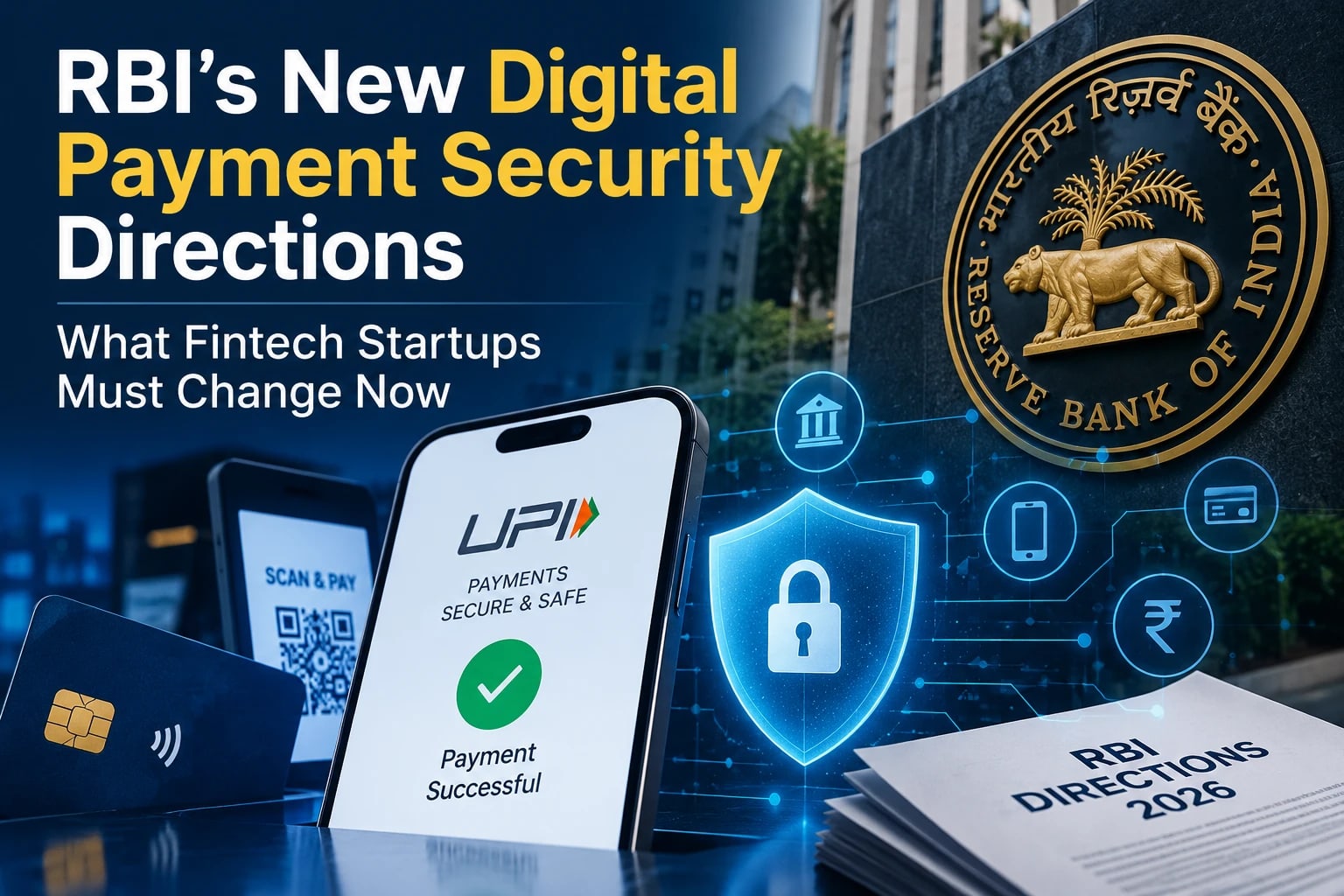
On 31 July 2026, the Reserve Bank of India issued a set of Digital Payment Security Controls Directions, with separate versions for different types of regulated entity. The RBI digital payment security directions 2026 replace earlier instructions and set out expected controls for governance, authentication, fraud risk, reconciliation, customer protection and card and mobile security. For a fintech startup, the first question is whether they apply directly or through a bank, NBFC or other partner.
This guide explains what we could confirm about the RBI digital payment security directions 2026, which entities they cover, what controls they describe, how fintech startups are affected even when they are not the addressee, and a practical plan for the next 90 days. We worked from secondary sources, not the RBI’s own PDFs, so check the directions that apply to you on the RBI website.
What the RBI issued on 31 July 2026
Reports describe separate Digital Payment Security Controls Directions, 2026 for commercial banks, small finance banks, payments banks, urban cooperative banks and credit-card-issuing non-banking financial companies. The commercial bank directions were issued under the Banking Regulation Act, 1949 and Chapter IV of the Payment and Settlement Systems Act, 2007 with immediate effect. Each set replaces earlier directions for its entity type, with earlier actions generally preserved.
KPMG reports that the RBI issued these alongside a separate framework of directions on cybersecurity, technology risk, resilience and assurance. Together they form a technology-focused set of Master Directions published on 31 July 2026. One secondary source gave an effective date of 2027 in a headline but 2026 in its text, and the other sources support immediate effect from 31 July 2026, so the 2026 date is more likely correct, but check the originals.
We did not find separate directions for payment aggregators, prepaid payment instrument issuers or third-party app providers in these results. Whether the RBI digital payment security directions 2026 apply to a particular startup therefore depends on its licence and its role, which should be confirmed from the RBI’s list of directions.
The RBI’s approach to technology regulation has been moving from general advice towards specific, auditable controls. The RBI digital payment security directions 2026 fit that trend, and the companion framework on cybersecurity, technology risk, resilience and assurance adds a wider expectation that regulated entities manage technology risk at board level. For a fintech team, the message is to treat security as a measurable control environment, with owners, metrics and evidence.
What the controls require
The directions are described as covering governance, authentication, fraud risk management, reconciliation, customer protection and security of card and mobile payments. For commercial banks, reports mention security controls such as encryption, web application firewalls, DDoS mitigation, multi-factor authentication, and vulnerability assessment and penetration testing.
The NBFC directions are reported to prescribe additional controls for web applications, mobile applications and card payment systems, including PCI standards, hardware security modules, transaction monitoring and device binding. Device binding links a customer’s account or credentials to a particular device, so that a stolen password alone is not enough to move money.
| Control | What it means |
|---|---|
| Authentication | Multi-factor authentication and strong checks on payment actions |
| Device binding | Credentials tied to a particular device so a stolen password alone is not enough |
| Encryption and application security | Encryption, web application firewall and DDoS mitigation (reported for commercial banks) |
| Testing | Vulnerability assessment and penetration testing |
| Card and mobile security | PCI standards, hardware security modules and transaction monitoring (reported for credit-card NBFCs) |
In substance, the RBI digital payment security directions 2026 move from general guidance to specific technical expectations. A regulated entity will need to evidence that controls exist and work, which means documented policies, tested systems, logs and board oversight. We have not reproduced the detailed clauses because we did not read them, so the text should be checked.
Why fintech startups are affected
Most fintech startups are not banks, but they depend on banks and NBFCs for licences, accounts, cards and settlement. When a regulated partner must meet the new controls, it will pass the requirements on through contracts, security questionnaires and audits. A startup that cannot show multi-factor authentication, device binding, encryption and fraud monitoring may lose a bank partner or be told to change its product.
Startups that are themselves regulated, for example as NBFCs issuing credit cards, will fall within the directions directly. Others may be covered by separate RBI directions for payment aggregators, prepaid instruments or other categories, which we have not reviewed. The RBI also has authentication mechanisms for digital payments, and we recommend checking the current text for the rules on additional factors and risk-based authentication.
Outsourcing rules matter too. A regulated entity remains responsible for activities it outsources, so the RBI digital payment security directions 2026 effectively reach technology vendors. Expect clauses on audit rights, incident reporting, data location, subcontracting and termination assistance in new and renewed agreements.
Startups that process card data should also review the card networks’ own rules and PCI standards, which the NBFC directions are reported to mention. Where you use a payment aggregator or a bank’s APIs, ask for their compliance statements and keep them. Ask each partner how the new directions affect your integration, since changes to authentication flows, token handling or logging can require product changes, not just policy updates.
A 90-day plan for fintech teams
Days 1 to 30: identify which directions apply to you and to each partner, and collect your partners’ new requirements. Run a gap assessment against the controls reported above: authentication, device binding, encryption, application and API security, fraud monitoring, reconciliation, logging and penetration testing. Record gaps, owners and dates.
Days 31 to 60: fix the highest risks first. Typical priorities are strong authentication for payment actions, device binding and risk-based checks, secrets and key management, secure mobile builds, rate limiting and anomaly detection, and reconciliation of settlement files. Update incident response, including the six-hour CERT-In reporting duty and any RBI reporting, and test it.
Days 61 to 90: update contracts and evidence. Revise vendor and partner agreements, collect third-party attestations such as PCI compliance where relevant, and prepare an evidence pack for audits. Brief the board. Align privacy notices and consent flows with the DPDP Act, since stronger authentication often means collecting device and behavioural data. Treat the RBI digital payment security directions 2026 as a product requirement, not only a compliance task.
Customer communication is part of the control set. Fraud alerts, clear transaction notifications, easy ways to block a card or device and quick dispute handling reduce losses and complaints. They also show a regulator that the control environment works for customers. When you make authentication stricter, test the user experience, because friction that drives users to insecure workarounds defeats the purpose.
Remedies, next steps and quick answers
Start with the facts: which licence do you hold, which partners do you rely on and which directions apply. Then prioritise customer-facing controls, since fraud losses and customer complaints are the first places regulators look. Keep a decision log showing why each control was chosen, because it helps in an inspection. If a partner issues a non-compliance notice, respond in writing with a remediation plan and dates. If a security incident occurs, follow your incident plan, report within the legally required periods and preserve logs. If the RBI raises findings, engage promptly and accurately and take advice before replying. Customers who lose money to fraud may claim under the RBI’s customer liability framework, so clear records and fast dispute handling reduce exposure. Keep watching the RBI site for FAQs and amendments to the RBI digital payment security directions 2026, since new regulations are often followed by clarifications.
Related reading: the CERT-In 6-hour rule for startups, DPDP Act compliance for startups, stablecoins in India: USDT and the ARC token, can a bank close your account for crypto, bank account frozen: UPI and crypto remedies, UK stablecoin rules for Indian payment startups and the RBI leaning towards prohibition.
Quick answers
Do the RBI digital payment security directions 2026 apply to every fintech startup?
Not directly. Reports describe separate directions for banks, small finance banks, payments banks, urban cooperative banks and credit-card-issuing NBFCs. Other startups are affected through regulated partners and outsourcing contracts, and some may be covered by other RBI directions.
What controls do the directions focus on?
Reports describe governance, authentication, fraud risk, reconciliation, customer protection and card and mobile security, including multi-factor authentication, encryption, device binding, transaction monitoring and penetration testing.
When did the directions take effect?
Sources say immediately from 31 July 2026, although one source’s headline gave 2027. Check the RBI’s published text for the entity type that applies to you.
Do the directions apply to payment aggregators?
We did not find separate directions for payment aggregators, PPI issuers or third-party app providers in our sources. Check the RBI’s list of directions for your licence.
When did they take effect?
Sources say immediately from 31 July 2026, although one source’s headline gave 2027. Check the published text for your entity type.
Final word
Halverton & Co. is an Indian law firm advising founders, startups, technology companies and investors on Indian law, including fintech regulatory compliance, payment and technology contracts, data protection and incident response for fintech startups. We practise in Jharkhand, Maharashtra and before the Supreme Court of India, and act as fractional legal counsel for technology-driven businesses. Halverton & Co.: Where tech needs law! If you have a question about Indian law, write to us at office@halvertonandco.com, or get in touch.
This article reflects developments reported up to late October 2026. It is for general information only, is not legal advice, and does not create an advocate-client relationship. Halverton & Co. is an Indian law firm.
Sources
Related practice area
Startups & Venture
From incorporation to term sheet. The documents a company needs to be fundable.
View the practice areaComments
No account needed. Comments are reviewed before they appear, so yours will show here once approved. Please do not share confidential details or describe your own legal matter: replies are general discussion, not legal advice, and do not create an advocate-client relationship. For your own situation, write to office@halvertonandco.com.