Key takeaways
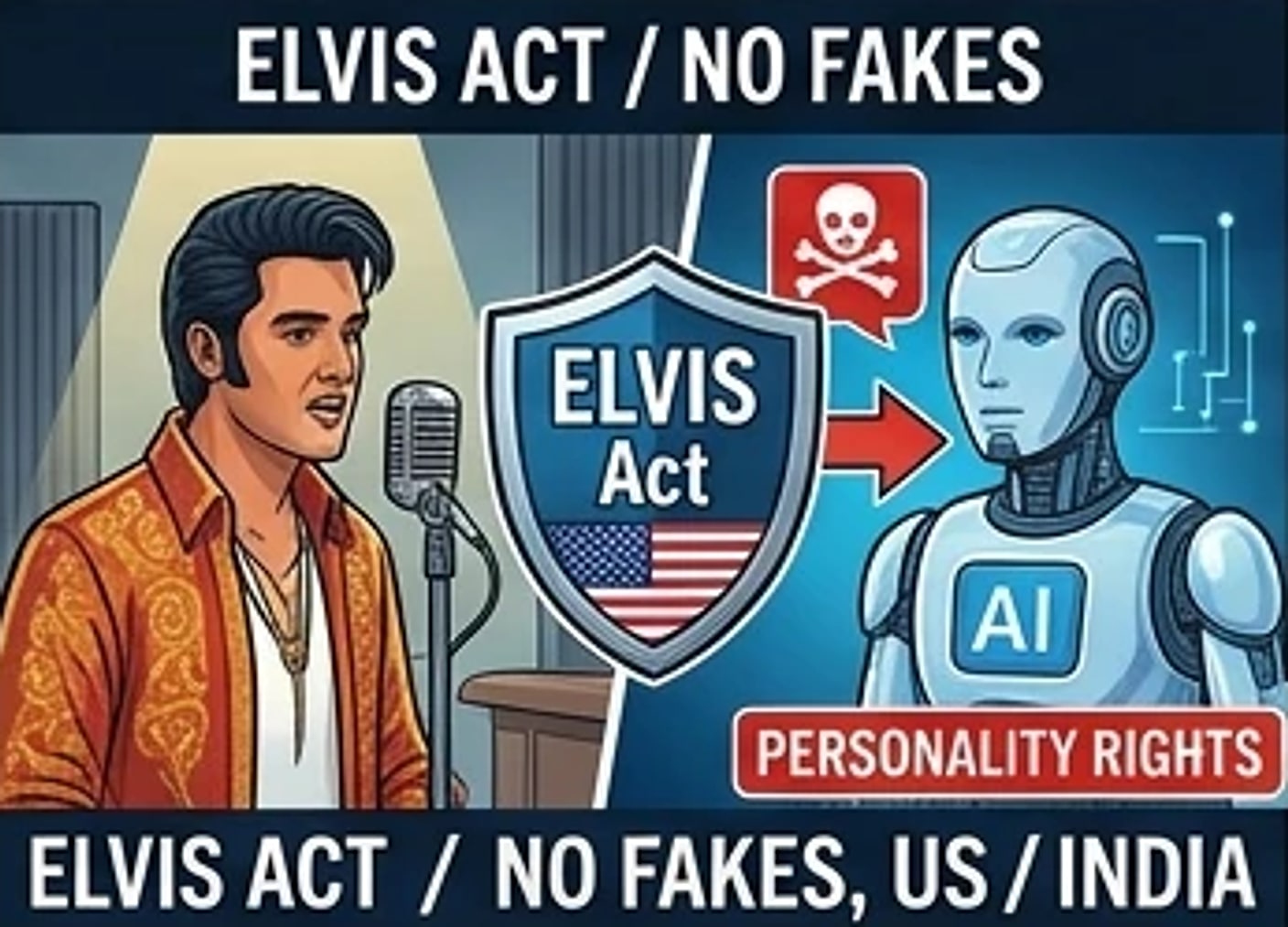
- Tennessee’s ELVIS Act, effective 1 July 2024, protects voice from unauthorised commercial use, including AI simulations.
- The NO FAKES Act was reintroduced in May 2026 and cleared the Senate Judiciary Committee in June, but later reports suggest it stalled.
- Indian courts have granted personality rights orders against AI voice cloning of well-known figures.
- Get written consent and licences for any voice or likeness, with scope, term and AI use stated.
AI voice likeness law is being written in three places at once. Tennessee passed the ELVIS Act in 2024, the first US statute aimed squarely at voice cloning. Congress keeps reintroducing the NO FAKES Act, a federal answer that has twice come close and not quite arrived. And in India, courts in Delhi and Bombay have been issuing personality rights orders against AI cloning of actors and singers for years.
A US company that makes or hosts AI voice or image tools has to deal with all three, since users and targets are everywhere. A US studio working with Indian vendors, or an Indian team building a voice product for US customers, meets the same patchwork. Here is how the three fit together, where they differ, and what a careful company does today. Bill status changes quickly, so check the latest before you rely on any statement about it. AI voice likeness law is a patchwork. Right of publicity AI deepfake US cases are mostly under state law.
The ELVIS Act in Tennessee
The Ensuring Likeness, Voice, and Image Security Act, known as the ELVIS Act, took effect in Tennessee on 1 July 2024. It treats a person’s voice as part of their protected identity and extends the state’s right of publicity to cover voice, including simulations. It makes it unlawful to use someone’s voice without permission in many commercial settings, and it can reach people who distribute tools whose main purpose is to make unauthorised voice clones. AI voice likeness law in Tennessee is the ELVIS Act, while Arijit Singh Codible Bombay High Court orders show the Indian approach.
That last point is what got attention. Liability can attach to the maker or distributor of an AI voice tool whose primary function is to create unauthorised copies of an artist’s voice, not only to the user. The act was written with Nashville’s music industry in mind, but the wording isn’t limited to musicians.
A Tennessee statute binds courts in Tennessee and affects anyone who does business there or targets Tennessee residents. Other states have their own right of publicity and AI laws, some adopted since. The ELVIS Act Tennessee voice protections are the model others cite, not a national rule. State by state, AI voice likeness law is still thin on the ground.
The NO FAKES bill and where it stands
The NO FAKES Act would create a federal property-like right to control digital replicas of a person’s voice and likeness, with a notice and takedown system for platforms. It was reintroduced in the Senate and House on 20 May 2026 (S.4591 and H.R.8915), and the Senate Judiciary Committee advanced it by a unanimous voice vote on 18 June 2026, the first time it cleared a committee. The federal AI voice likeness law that may come is the NO FAKES Act.
That’s the good news for its supporters. The less good: one report dated early October 2026 says the bill stalled in the Senate when a senator objected to a unanimous consent request. We have only seen the headline, so check the latest status on Congress.gov before you rely on any claim about where it stands. Bills like this can move fast or die quietly.
If it passes in anything like its current form, the NO FAKES Act digital replicas regime would set federal rules on consent, licensing and platform duties, and might sit alongside state laws rather than replace them. Companies should read the text, not summaries, when there’s a final version. Until then, AI voice likeness law relies on state statutes and contracts.
Personality rights in India
India has no statute on voice cloning, but courts have built a body of law on personality rights, relying on common law, passing off, privacy and, for performers, the Copyright Act. Delhi High Court orders protected Anil Kapoor’s name, image and voice against AI misuse in 2023, and other celebrities followed. The Bombay High Court restrained AI voice cloning of singer Arijit Singh in 2024 in a case against a company that offered tools to clone his voice. Indian AI voice likeness law is judge-made, built on personality rights.
| Regime | What it does | Status |
|---|---|---|
| Tennessee ELVIS Act | Protects voice and likeness, can reach cloning tools | In force from 1 July 2024 |
| NO FAKES Act | Federal right over digital replicas with notice and takedown | Reintroduced 2026, status uncertain |
| India personality rights | Court orders against cloning and misuse | Interim and fact-specific |
Those orders usually restrain defendants from using the person’s name, voice, likeness and signature traits commercially without consent, and direct platforms to take down offending content. They have been given to well-known figures, and the principle applies in theory to others who can show a reputation and harm. The personality rights India voice cloning orders are interim and fact specific, but the direction is clear.
The 2026 IT Rules add labelling and takedown duties for synthetic content, which helps in practice. Together, courts and rules give a person in India a fast route to remove cloned voice content from a platform, even without a statute that says “voice cloning”.
Practical steps for US and Indian teams
If you build or host voice or image tools, get consent and licences in writing for any voice or likeness you use. Pay attention to scope, term, territory, compensation and the right to revoke. For voice actors, update contracts to say whether AI training or cloning is allowed, and on what terms. A vague clause isn’t enough in light of laws like the ELVIS Act and state rights of publicity. Whatever the AI voice likeness law, get consent in writing.
Put controls in the product. Prevent cloning of public figures without proof of consent, add watermarks and labels to synthetic audio, keep logs of consent and uses, and have a takedown process that works across time zones. A US-run platform with Indian engineering needs a single process that meets US and Indian clocks. See our posts on takedowns and deepfake removal.
For disputes, think about where you may be sued. A US platform’s content can be challenged in an Indian court, and an Indian vendor’s tool can be challenged in Tennessee. Take advice in each country, record decisions, and be ready to remove content quickly. Courts treat prompt removal kindly. Platforms should treat AI voice likeness law as a design requirement.
Questions people ask
The one point all three regimes share is that consent counts. Whatever the final rules, a documented yes from the person whose voice or face it is will always help. AI voice likeness law will keep changing, so check the latest.
Related reading: AI voice cloning in India, deepfakes and personality rights in India, deepfake law in the UAE and India, deepfake removal in India, AI-generated content labelling in India and who owns code written with AI.
Quick answers
What does the ELVIS Act protect?
Tennessee’s ELVIS Act, effective 1 July 2024, protects a person’s voice as well as name and image from unauthorised commercial use, including AI simulations, and can reach those who distribute tools designed mainly for unauthorised voice cloning.
Is the NO FAKES Act law?
Not yet, as far as the sources reviewed show. It was reintroduced in May 2026 and cleared the Senate Judiciary Committee in June 2026, but a report from October 2026 says it stalled. Check Congress.gov.
Is AI voice cloning legal in India?
There is no specific statute, but Indian courts have granted personality rights orders against AI voice cloning, and the 2026 IT Rules add labelling and takedown duties for synthetic content.
Is the NO FAKES Act law?
Not yet, according to the sources reviewed. Check Congress.gov for current status.
Final word
Halverton & Co. is an Indian law firm advising US companies, founders, investors and law firms on Indian law, including personality rights, AI and media contracts in India for US and Indian technology and entertainment companies, alongside US counsel. We practise in Jharkhand, Maharashtra and before the Supreme Court of India, and work alongside US counsel, who advise on US law. Halverton & Co.: Where tech needs law! If you have a question about Indian law, write to us at office@halvertonandco.com, or get in touch.
This article reflects developments reported up to 31 October 2026. It is for general information only, is not legal advice, and does not create an attorney-client relationship. Halverton & Co. is an Indian law firm and does not advise on US law; US-law points should be confirmed with US counsel.
Related practice area
Technology & AI Law
Contracts, data protection and AI policies for products that handle other people’s data.
View the practice areaComments
No account needed. Comments are reviewed before they appear, so yours will show here once approved. Please do not share confidential details or describe your own legal matter: replies are general discussion, not legal advice, and do not create an advocate-client relationship. For your own situation, write to office@halvertonandco.com.