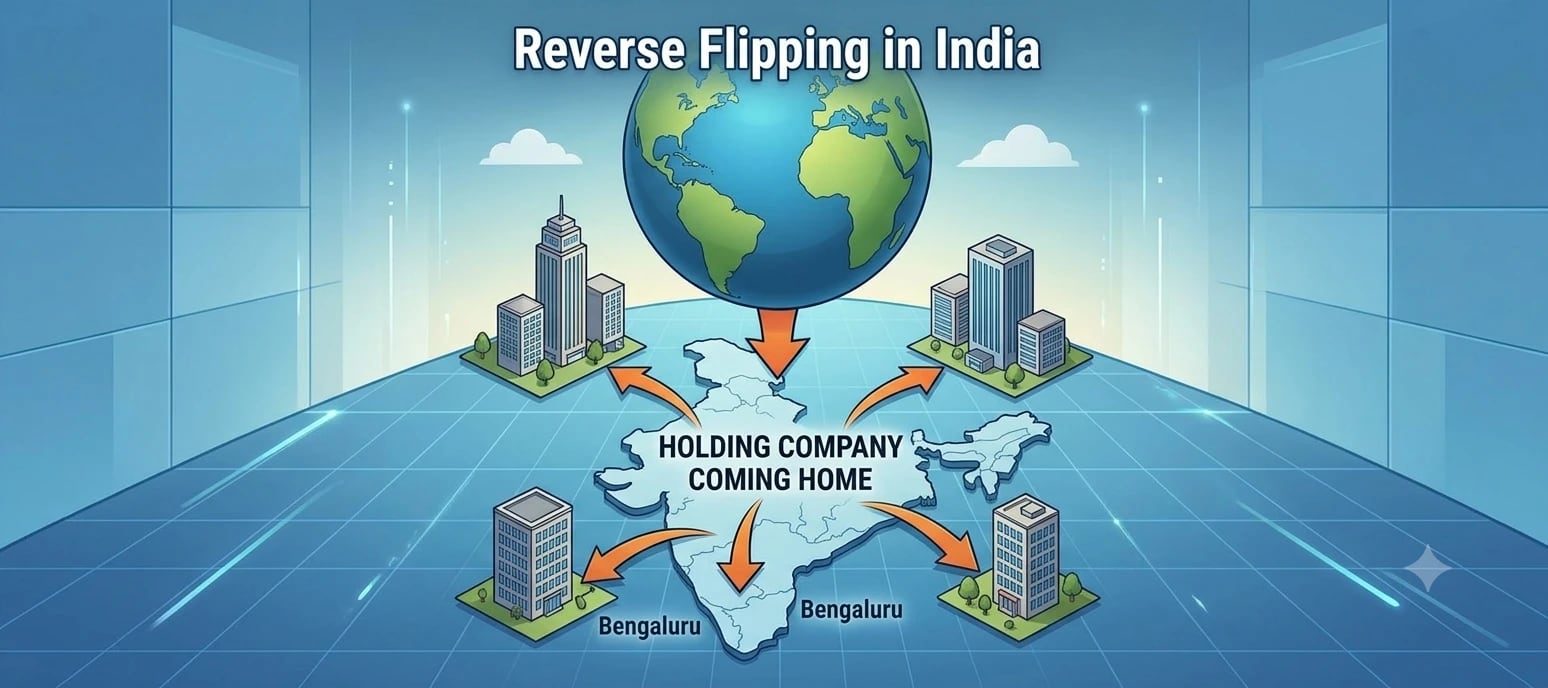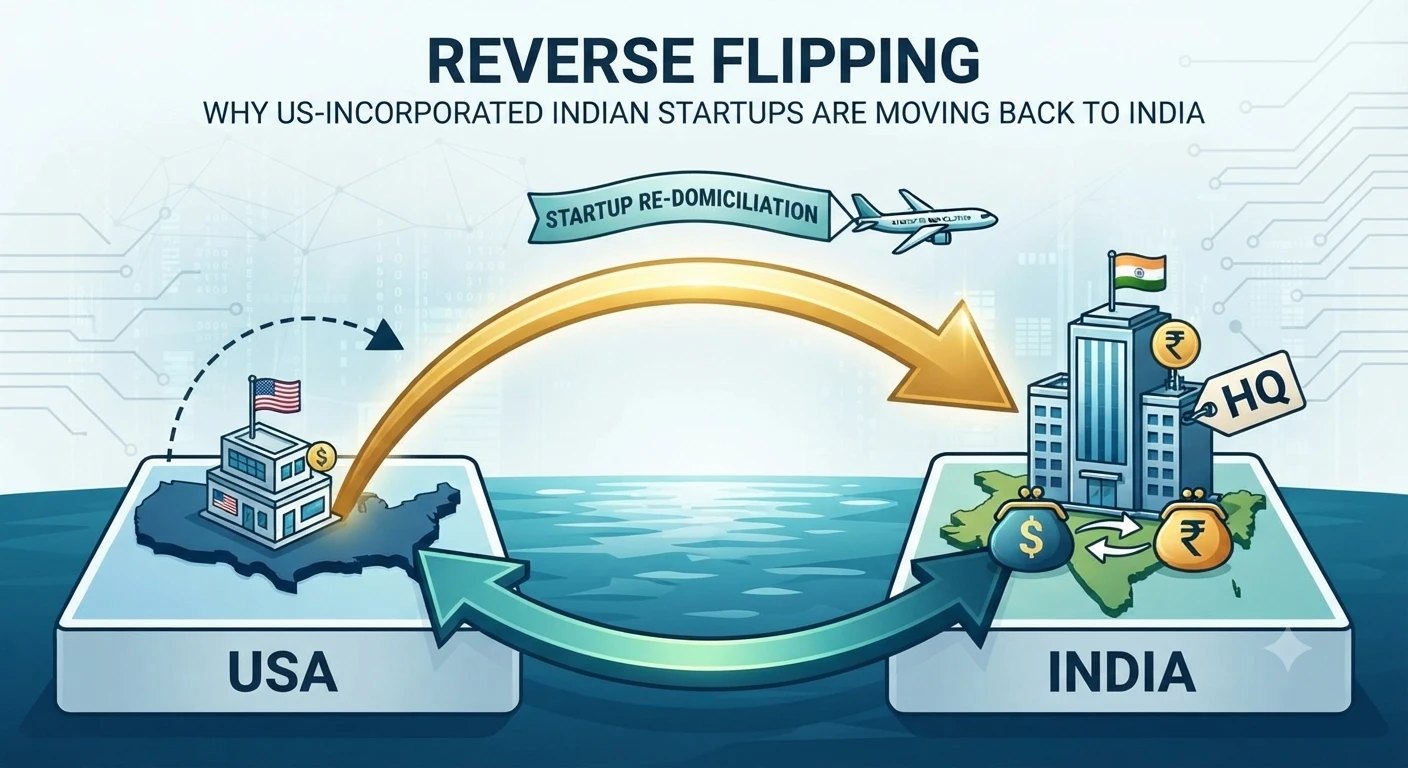
For years, ambitious Indian startups incorporated in Delaware to raise money from US venture capital. Now many are reversing that decision. Razorpay has been reported to have completed its move from the US to India in 2025, and several other well-known companies have moved home ahead of Indian stock market listings.
A reverse flip from Delaware to India is one of the most complex transactions a startup can undertake, combining Indian corporate and foreign exchange law with significant US tax issues. This guide explains why startups are doing it, how the Indian legal routes work, the tax considerations on both sides, and the practical steps involved. For the Indian-side basics, see our guide to reverse flipping in India.
Why startups are reverse flipping to India
The biggest driver is India’s public market. Indian exchanges have become a strong venue for technology IPOs, and listing in India generally requires an Indian company at the top of the structure. A Delaware parent can’t simply list in Mumbai.
Regulation is another factor. In sectors such as payments, fintech and data-intensive businesses, Indian regulators and customers increasingly prefer an Indian parent company. And the legal route has become easier. Since September 17, 2024, a foreign holding company can merge into its Indian wholly owned subsidiary through India’s fast-track merger procedure, approved by a government Regional Director rather than the National Company Law Tribunal, subject to RBI requirements. Commentary differs on whether prior RBI approval is still needed after the RBI’s May 2026 amendment, so confirm the current position; see our guide to fast-track mergers and the 2026 Bill.
Not every startup should flip, however. Companies without near-term Indian IPO plans, or with a largely US customer base, may be better served by staying in Delaware. Razorpay’s move was reported as completed in May 2025, and Groww, Meesho and Pine Labs listed in India after moving home. These examples have made a reverse flip from Delaware to India a mainstream option for late-stage startups.
The Indian legal routes
There are three main routes. The first is an inbound cross-border merger under Section 234 of India’s Companies Act, 2013 and the RBI’s Cross Border Merger Regulations, approved by the NCLT. The second is the fast-track inbound merger described above, available where the foreign holding company merges into its Indian wholly owned subsidiary. India’s merger rules were amended again in September 2025, and the RBI updated its cross-border merger regulations on May 29, 2026.
The third route is a share swap: the Delaware company’s shareholders exchange their shares for shares of the Indian company, which becomes the new parent. Share swaps are simpler to document but usually trigger tax for shareholders in one or both countries.
| Route | How it works | Main trade-off |
|---|---|---|
| Inbound cross-border merger (Section 234) | NCLT-approved merger of the foreign company into an Indian company | Longer, with court and RBI steps |
| Fast-track inbound merger | Foreign holding company merges into its Indian wholly owned subsidiary; Regional Director approval | Needs a wholly owned Indian subsidiary; RBI position to confirm |
| Share swap | Delaware shareholders exchange shares for shares of the Indian company | Simpler documents but usually taxable for shareholders |
The choice of route depends on the shareholder base, the tax analysis, the timeline to IPO and the regulatory approvals needed. Many companies spend several months modeling options before committing to a reverse flip from Delaware to India. On the US side, Delaware law permits a Delaware corporation to merge with a foreign corporation where the foreign law allows it, so the merger route can work at both ends. But the US tax consequences of the transaction need careful analysis before any route is chosen.
The tax questions: India and the US
In India, a merger can be tax-neutral for the merging company and its shareholders if the statutory conditions for an amalgamation are met, including that the amalgamated company is Indian. These provisions were carried into the Income-tax Act, 2025; see our guide to the Income-tax Act 2025 for startups. Share swaps are generally taxable.
The US side is often the harder part of a reverse flip from Delaware to India. Moving a US parent company abroad can engage the US anti-inversion rules in Section 7874 of the Internal Revenue Code, which in some cases treat a foreign acquirer of a US corporation as a US corporation for tax purposes, depending largely on how much of the new parent the former US company’s shareholders own. Section 367 can also require US shareholders to recognize gain on transfers to a foreign corporation. These rules can create significant US tax costs, and they should be analyzed by US tax counsel at the start of planning.
The practical lesson is that the reverse flip tax bill, in both countries, often decides the route and the timing. PhonePe’s investors were widely reported to have paid substantial tax when it moved from Singapore to India in 2022. Model the tax for every class of shareholder, including US funds, Indian founders and employees, before committing.
FEMA, IP, ESOPs and IPO readiness
Once the Indian company is the parent, foreign investors hold Indian shares as foreign direct investment, subject to FEMA pricing, sectoral rules and reporting. Investors from countries sharing a land border with India may need government approval under Press Note 3. Indian resident founders and employees who held shares in the Delaware parent may have overseas investment reporting gaps that should be regularized before the flip. See also our guide to setting up an Indian subsidiary.
Intellectual property, key contracts and licenses held by the Delaware company need to move to the Indian company, with proper assignments and stamp duty; see our guide to IP assignment in India. ESOPs over Delaware shares need to be replaced with an Indian ESOP plan that complies with the Companies Act, without creating unintended tax for employees; see ESOPs for Indian startups, stock options for Indian employees of a US startup and RSUs, SARs and phantom stock.
Communication matters too. Employees, customers, lenders and partners all need to understand what’s changing and why, and contracts with change-of-control or assignment clauses may need consents. If an IPO is the goal, align the timing with SEBI’s rules on promoter lock-in and minimum holding periods for shares offered in an IPO. Startups that plan a reverse flip from Delaware to India two or three years ahead of an IPO have far more options than those that start six months before filing. The Indian company law reforms now before Parliament are also relevant; see our overview of the Corporate Laws Amendment Bill 2026.
Risks, remedies and quick answers
If objections arise in the fast-track route, the Regional Director can refer the scheme to the NCLT, and NCLT orders can be appealed to the NCLAT. FEMA reporting delays can usually be regularized with late submission fees, and more serious contraventions compounded with the RBI. Tax disputes in India can be appealed through the usual channels, and advance rulings can provide certainty beforehand. Shareholder disagreements are generally governed by the shareholders’ agreement and resolved by arbitration. Because a reverse flip touches two legal systems, coordination between Indian counsel and US corporate and tax counsel from day one is the single most important success factor. Investors should read our legal due diligence checklist for US investors.
Related reading: setting up a Dubai crypto holding company.
Quick answers
Why are startups moving from Delaware to India?
Mainly to list on Indian stock exchanges, meet regulatory expectations, and take advantage of easier merger routes introduced in 2024.
Is a reverse flip from Delaware to India tax-free?
Not automatically. Indian amalgamation rules can provide relief, but US anti-inversion and outbound transfer rules can create significant US tax costs.
How long does a reverse flip take?
A fast-track inbound merger can take several months, but planning, tax analysis and approvals often take much longer.
Final word
Halverton & Co. is an Indian law firm that advises on Indian law, including reverse flips, inbound cross-border mergers, FEMA compliance and IPO readiness. We practice in Jharkhand, Maharashtra and before the Supreme Court of India, and we work alongside US counsel, who advise on US law. Halverton & Co.: Where tech needs law! If you have a question about Indian law, write to us at office@halvertonandco.com, or get in touch.
This article reflects developments reported up to early October 2026. It is for general information only, is not legal advice, and does not create an attorney-client relationship. Halverton & Co. is an Indian law firm and does not advise on US law.
Related practice area
Startups & Venture
From incorporation to term sheet. The documents a company needs to be fundable.
View the practice areaComments
No account needed. Comments are reviewed before they appear, so yours will show here once approved. Please do not share confidential details or describe your own legal matter: replies are general discussion, not legal advice, and do not create an advocate-client relationship. For your own situation, write to office@halvertonandco.com.