Key takeaways
- A freelancer owns the copyright in the code they write unless it is assigned in writing and signed, in both the UK and India.
- Under Section 19 of India’s Copyright Act, state rights, duration and territory, or the defaults of five years and India may apply.
- Use processor terms and a transfer mechanism if the freelancer handles personal data under UK GDPR.
- VAT reverse charge may apply to overseas services, IR35 rarely applies to an Indian freelancer working from India, and payments should go through banking channels.
If you hire a freelancer from India as a UK start-up, the work is easy to start and easy to get wrong. The risks are not about talent. They are about who owns the code, which law governs the contract, how personal data is protected, what you pay and how you pay it. This checklist covers the main points for UK businesses that hire freelancer from India UK teams rely on in 2026.
The guide explains how to structure the contract, how to secure the intellectual property under both UK and Indian law, what data protection and confidentiality terms you need, how VAT, tax and payments work, and how to settle disputes. It is written by an Indian law firm for UK readers. UK tax and employment points should be checked with UK advisers.
Start with the right contract
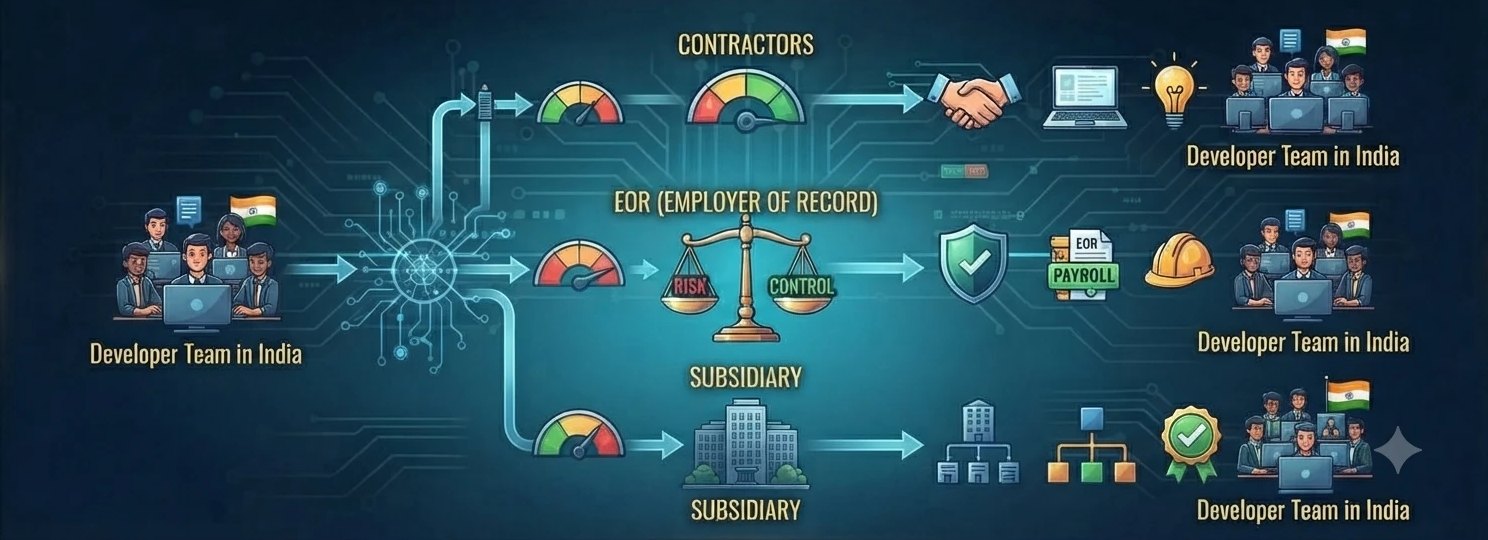
Use a written services agreement, not an informal chat. Describe the scope, deliverables, milestones, acceptance criteria and fees. State that the freelancer is an independent contractor who controls how and when work is done, uses their own equipment and may work for others. This helps to avoid claims of employment, though the real relationship matters more than the label. That is the base of the hire freelancer from India UK process.
Say who does the work. Prohibit sub-contracting without your written consent, and require the freelancer to make sure that anyone else involved signs the same confidentiality and IP terms. Include warranties that the work will be original, will not infringe third-party rights and will not include code under licences that would force disclosure of your source code, unless you agree. Ask for a list of open-source components.
Add practical protections. Specify code delivery, such as access to a repository you control from day one, instead of delivery at the end. Agree on testing, bug fixing, support, termination rights and what happens to unpaid work. A short, clear contract is better than a long template that nobody reads. If you hire freelancer from India UK start-ups often, keep a standard form and adapt it each time.
Secure the IP under UK and Indian law
Under the UK Copyright, Designs and Patents Act 1988, the author is the first owner of copyright, and a freelancer, unlike an employee, owns the copyright in code they write unless it is assigned. A UK assignment must be in writing and signed. The same principle applies in India, where the freelancer is the first owner, and an assignment of rights must be in writing and signed under the Copyright Act, 1957. Ownership of the code is the first legal question in the hire freelancer from India UK process.
Indian law adds drafting points. Under Section 19 of the Copyright Act, an assignment should state the work, the rights assigned, the duration and the territory. If the duration is not stated, it is treated as five years, and if the territory is not stated, it is presumed to be India. If the assignee does not use the rights within one year, the assignment may lapse, unless the contract says otherwise. So state worldwide territory, perpetual duration and no lapse.
| Point | UK | India |
|---|---|---|
| First owner of code | The freelancer, unless assigned | The freelancer, unless assigned |
| Form | In writing and signed | In writing and signed |
| Duration if silent | Not applicable | Five years under Section 19 |
| Territory if silent | Not applicable | India |
| Lapse if unused | Not applicable | One year, unless the contract says otherwise |
Cover other rights. Include an assignment of future work, a waiver of moral rights to the extent possible, a licence for pre-existing tools the freelancer uses, and an obligation to sign further documents. Add a clause on inventions. For a deeper discussion, see how IP assignment works for UK start-ups and Indian developers. Do this before work starts, because getting a signature later from a freelancer who has been paid is harder.
Data protection and confidentiality
If the freelancer will handle personal data, such as customer records, UK data protection law applies. The freelancer will usually be a processor, so you need processor terms with the points required by Article 28 of the UK GDPR: processing only on your instructions, confidentiality, security measures, sub-processor rules, help with data subject requests, deletion or return and audit. India has no UK adequacy regulation, so a transfer mechanism is also needed. Data terms are a standard part of the hire freelancer from India UK process.
The usual mechanism is the ICO’s International Data Transfer Agreement, or the UK Addendum to the EU standard contractual clauses, with a risk assessment. The Data (Use and Access) Act 2025 changed the transfer test in the UK, so check the current ICO guidance. Where possible, limit what the freelancer can see, give access through your own systems and avoid downloads to personal devices.
Add strong confidentiality terms, with a duty to keep your information and code secret, return or delete it at the end and report any leak quickly. Indian law protects confidential information through contract and equity, though there is no statute, and restraints on working for others after the contract ends are generally void under Section 27 of the Indian Contract Act. Rely on confidentiality and IP terms, not on a post-contract non-compete.
Tax, VAT and payments
For UK VAT, services supplied by an overseas freelancer to a UK business are generally subject to the reverse charge if you are VAT registered, so you account for the VAT yourself. The freelancer will not charge UK VAT. Check HMRC’s guidance for your own situation. Payments for development services are not the same as royalties, but if the contract includes a licence of existing IP, take advice on withholding. Tax and VAT planning belongs early in the hire freelancer from India UK process.
The UK off-payroll working rules, often called IR35, are mainly about workers who supply services through an intermediary to a UK client. They are concerned with UK workers and work, and an Indian freelancer working from India will usually fall outside them. If the freelancer works in the UK or through a UK agency, or the arrangement looks like employment, check HMRC guidance. Do not assume that the label of a contract is enough.
On the Indian side, the freelancer may invoice as an exporter of services, usually without charging GST under a letter of undertaking, and is paid through banking channels with a foreign inward remittance certificate. Agree the currency, invoice terms and who bears bank charges and exchange costs. Paying through licensed platforms or banks gives a record. Avoid paying to third parties or in cash, which can cause problems for both sides.
Next steps and quick answers
Before you start, confirm the freelancer’s identity and company status, sign the contract and IP assignment, agree the data terms, set up access to your repositories and plan payments. Choose a governing law and a dispute process: many UK businesses choose English law with arbitration in London, because a UK court judgment is enforceable in India as a reciprocating territory decree under the Civil Procedure Code, but an arbitral award is often simpler. This is general information, not legal advice. Keep the hire freelancer from India UK process on a repeatable checklist.
Related reading: IP assignment for UK startups and Indian developers, hiring developers in India from the UK, UK GDPR and outsourcing to India: five clauses, NDA enforceability in India, open-source licence audits, who owns AI model IP: UK startups and India and enforcing a UK judgment or award in India; also UK influencers working with Indian brands.
Quick answers
Who owns the code a freelancer in India writes for my UK company?
The freelancer owns it unless the copyright is assigned in writing and signed. Under Indian law the assignment should state rights, duration and territory, or the defaults of five years and India may apply.
Do I need a data protection agreement with a freelancer in India?
Yes, if they will handle personal data. You need processor terms under UK GDPR Article 28 and a valid transfer mechanism such as the IDTA or UK Addendum.
Does IR35 apply to an Indian freelancer?
Usually not for a freelancer who works from India for a UK client, because the rules focus on UK workers and work. If the freelancer works in the UK or through a UK agency, take advice.
Do I need to register my business in India to pay a freelancer?
No. You can pay an independent freelancer through banking channels. Take advice if the arrangement looks like employment or if you set up a local presence.
Should I choose UK or Indian law for the contract?
Many UK businesses choose English law with arbitration in London. A UK court judgment can be enforced in India as a reciprocating territory decree, but an arbitral award is often simpler.
Final word
Halverton & Co. is an Indian law firm advising UK companies, founders, investors and law firms on Indian law, including technology contracts, IP assignment, outsourcing and offshore development agreements, and cross-border data protection and tax structuring between India and the UK. We practise in Jharkhand, Maharashtra and before the Supreme Court of India, and work alongside your UK solicitors, who advise on English law. Halverton & Co.: Where tech needs law! If you have a question about Indian law, write to us at office@halvertonandco.com, or get in touch.
This article reflects developments reported up to 31 October 2026. It is for general information only, is not legal advice, and does not create a solicitor-client relationship. Halverton & Co. is an Indian law firm, is not authorised or regulated by the Solicitors Regulation Authority, and does not advise on English law; UK-law points should be confirmed with UK advisers.
Sources
Related practice area
Startups & Venture
From incorporation to term sheet. The documents a company needs to be fundable.
View the practice areaComments
No account needed. Comments are reviewed before they appear, so yours will show here once approved. Please do not share confidential details or describe your own legal matter: replies are general discussion, not legal advice, and do not create an advocate-client relationship. For your own situation, write to office@halvertonandco.com.