Key takeaways
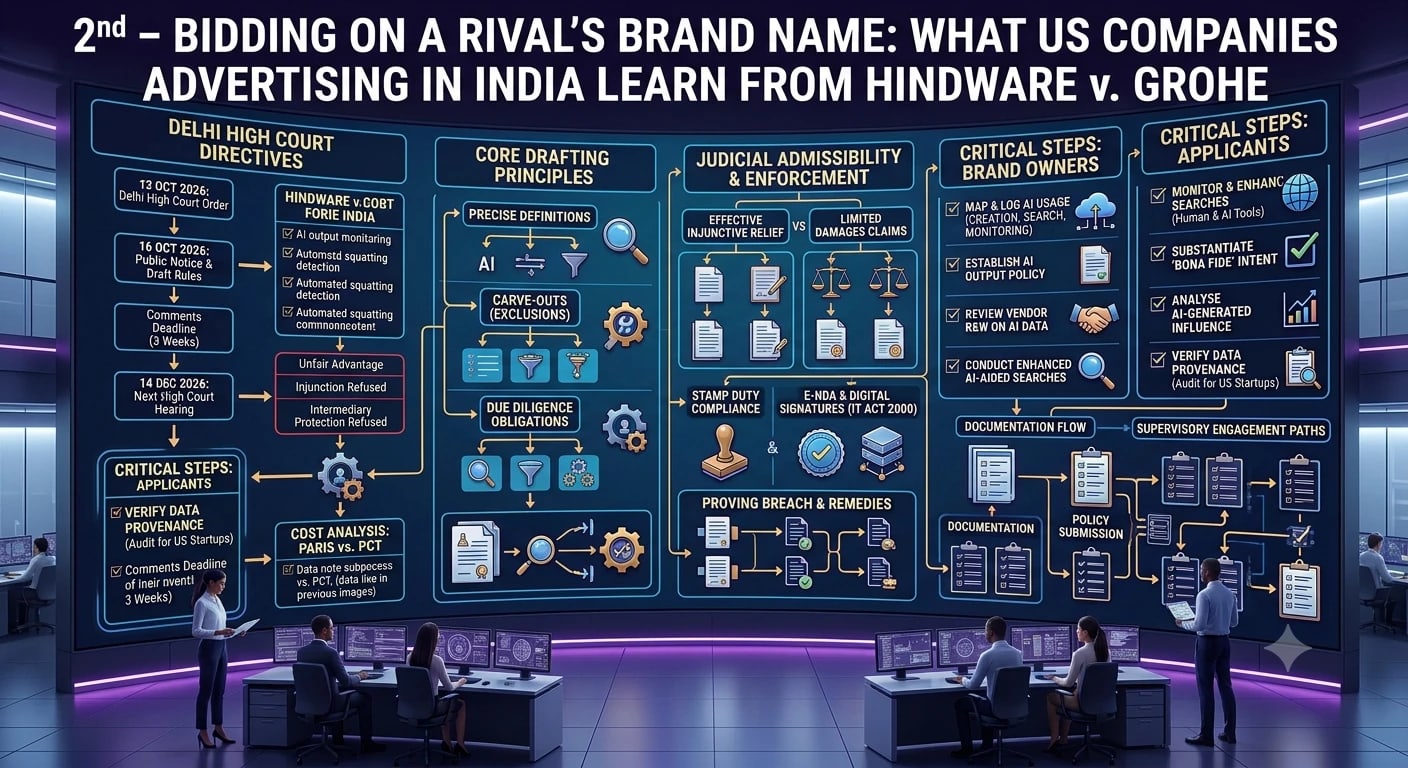
- In Hindware v. Grohe India (reported May 2026), the Delhi High Court held that using HINDWARE as an advertising keyword took unfair advantage of the mark under Section 29(8) of the Trade Marks Act.
- The court refused Google intermediary protection because it suggests, auctions and earns from keywords; Google’s appeal is reported to be pending.
- US courts ask mainly about consumer confusion, so a campaign that is lawful at home may be actionable in India.
- Audit keywords, add rivals’ marks as negative keywords for India and put restricted-terms and indemnity clauses in agency contracts.
A US company that buys a competitor’s brand name as a Google Ads keyword and aims its ads at India has a risk that it may not have faced at home. In Hindware v. Grohe India, the Delhi High Court held that using the HINDWARE mark as an advertising keyword took unfair advantage of the brand, and it refused to treat Google as a mere intermediary. The ruling is a key moment for keyword advertising trademark India and it is under appeal, so the law may still move.
This guide explains what the court decided and why, how Indian law differs from the US approach, who can be liable, and a practical checklist for US advertisers, agencies and platforms targeting India. It is written by an Indian law firm. US trade mark questions, including how your own campaigns are treated in the United States, should be confirmed with US counsel.
What Hindware v. Grohe decided
The Delhi High Court reportedly decided the case in May 2026. The claimant, Hindware, owns the HINDWARE mark for sanitaryware. The court held that the commercial use of that mark as a keyword in Google Ads took unfair advantage of the brand, under Section 29(8) of the Trade Marks Act, 1999, which treats advertising that takes unfair advantage of, or is contrary to honest practices relating to, a registered mark as infringement. Reports say it awarded costs or damages of about ₹30 lakh against Google. Check the order for the final figures. For any company running keyword advertising trademark India campaigns, the case is now the first reference point.
The court also refused to treat Google as a passive intermediary entitled to safe harbour under Section 79 of the Information Technology Act, 2000. Reports of the judgment say it rested this on Google’s active role: its tools suggest keywords, its auction sells them to the highest bidder and it earns money from each click. A platform that plays an active role in selling a trade mark as a keyword does not look like a neutral conduit.
Google’s appeal is reported to be pending before a Division Bench, and the Division Bench is reported to have refused an interim stay. Until it decides, the single judge’s reasoning is the leading view on keyword advertising trademark India. Earlier, in Google LLC v. DRS Logistics (2023), the Delhi High Court had held that using a mark as a keyword is a use in the course of trade, though it left questions of infringement to trial.
How Indian law differs from the US
US law has long treated keyword bidding as a question of consumer confusion. In cases such as Network Automation v. Advanced Systems Concepts (9th Cir. 2011), courts asked whether ads shown on a search for a rival’s brand confuse ordinary consumers about the source. Where the ad is labelled and the keyword is invisible, many US claims fail. A recent federal appeal reportedly held that bidding alone cannot infringe because the customer never sees the keyword. Confirm the current position with US counsel.
Indian law as applied in Hindware starts from a different place. The court did not need to find that consumers were confused. It treated the use of a registered mark as a keyword as taking unfair advantage of its reputation, which is a ground of infringement in its own right under Section 29(8). That makes keyword advertising trademark India a risk even where your ad text is clear and shows only your own brand.
For a US advertiser, the practical result is that a campaign lawful in the United States may be actionable in India. Geographic targeting matters: an ad aimed at users in India, using an Indian-registered mark as the trigger, falls within the reach of an Indian court. Indian courts have also shown they will grant injunctions and order platforms to block keywords across their Indian ad accounts.
Who can be liable
Several parties can face claims. The advertiser that chooses the keyword and sets the bid is the most obvious. An agency that manages campaigns can be named as a joint participant, particularly where it set the keyword list. A platform that actively suggests, auctions and monetises keywords can be sued, as the reported ruling shows, and cannot rely on Section 79 if it plays an active role.
Liability depends on facts. A brand that bids on its own name and common generic terms has no problem. A comparison campaign, where you bid on a rival’s name to show a message such as ’a better alternative’, is riskier. A reseller or repair shop that bids on a manufacturer’s name to describe genuine goods may have a defence of honest use, but it must still avoid suggesting an affiliation that does not exist.
Foreign advertisers sometimes assume that Indian courts cannot reach them. That is not safe. A suit can be filed in India where the ad is seen, and an interim order can require the platform to block the keyword, suspend your account in India or take down the ad. Orders against a US company can affect payment channels and bank accounts used for Indian campaigns, so treat an Indian notice as a serious matter.
A practical checklist for US advertisers
Audit your campaigns before you target India. Export the keyword and negative-keyword lists, and check each term against the Indian trade mark register and the Journal. Add rivals’ registered marks that you do not own as negative keywords for India, and disable broad match and dynamic keyword insertion for those terms. Ask your agency in writing to confirm the same. A clean audit trail will help if a rival complains. A written audit is the first control for keyword advertising trademark India risk.
Review ad copy. Do not use a rival’s mark in the headline or description unless it is needed to describe a genuine product, such as a compatible part, and then only in a plain, factual way. Avoid logos and stylised forms. Make clear who you are. Where you compare, make sure the comparison is true, current and fair, because misleading comparative advertising can also breach the Consumer Protection Act, 2019 and the Advertising Standards Council of India code.
Plan for complaints. Most platforms offer trade mark complaint forms, and a rival can use them in days. Decide who responds, what documents to keep and when to stop a campaign. Add contract clauses with agencies: a duty to follow a restricted-terms list, a warranty of compliance, cooperation in disputes and an indemnity for losses caused by their keyword choices. Insurance may cover some advertising injury, so check exclusions for trade mark claims.
| Step | What to do | Why it matters |
|---|---|---|
| Audit keywords | Export keyword and negative-keyword lists and check each term against the Indian register | Finds rivals’ registered marks before a complaint does |
| Block rival marks | Add rivals’ marks as negative keywords for India and turn off broad match and dynamic insertion for them | Reduces accidental use as a trigger |
| Check ad copy | Do not use a rival’s mark in headlines unless needed for a plain factual description | Avoids unfair advantage and suggestions of affiliation |
| Check comparisons | Keep comparative claims true, current and fair | Misleading advertising can breach consumer law and ASCI standards |
| Agency contract | Require compliance with a restricted-terms list, cooperation and an indemnity | Allocates the risk of keyword choices |
| Complaint plan | Decide who responds, what to keep and when to pause a campaign | Platform complaints can bite in days |
Remedies, next steps and quick answers
If you receive an Indian notice, do not ignore it. Pause the keyword in India, preserve campaign data, and have Indian counsel review the mark and the claim. A quick, reasoned reply often settles the matter. If you are the brand owner, record your marks, monitor rival ads from Indian locations and use the platform complaint process while keeping the court route in reserve. Watch for the Division Bench’s ruling on Google’s appeal, which may refine the law.
Related reading: ads inside AI answers and Indian advertising law, dark patterns and the CCPA guidelines, whether an AI product is an AI intermediary under Section 79, trade mark squatting in India for US companies, registering a US trade mark in India, clearing a brand name for India before a US launch and IP India’s draft rules on AI and trade mark squatting; also selling on Amazon India from the UK; also hiring Indian influencers for a US brand.
Quick answers
Is keyword advertising trademark India risky for US companies?
Yes, if you bid on a rival’s registered mark and target India. The Delhi High Court in Hindware v. Grohe treated this as taking unfair advantage of the mark, even without proof of consumer confusion. The ruling is under appeal.
Can Google be held liable for trade mark keywords in India?
The single judge held that Google could not claim safe harbour as a passive intermediary because it suggests, auctions and earns from keywords. Google has appealed, so the position may change.
Can I still bid on a competitor’s name for comparison ads in India?
It is risky. Use negative keywords, avoid the rival’s mark in ad copy unless needed for a factual description, and take Indian legal advice before running comparative campaigns.
Is Google’s appeal decided?
Reports say a Division Bench issued notice on Google’s appeal and refused a stay, and that the appeal is pending. Reports differ on listing dates, so check the court’s cause list.
Does this apply if my ad shows only my own brand?
The reasoning reported in Hindware turns on taking unfair advantage of the registered mark by using it as a keyword, so clear ad text alone may not remove the risk.
Final word
Halverton & Co. is an Indian law firm advising US companies, founders, investors and law firms on Indian law, including trade mark and brand protection, digital advertising and platform law, consumer protection law, and technology disputes. We practise in Jharkhand, Maharashtra and before the Supreme Court of India, and work alongside US counsel, who advise on US law. Halverton & Co.: Where tech needs law! If you have a question about Indian law, write to us at office@halvertonandco.com, or get in touch.
This article reflects developments reported up to late October 2026. It is for general information only, is not legal advice, and does not create an attorney-client relationship. Halverton & Co. is an Indian law firm and does not advise on US law; US-law points should be confirmed with US counsel.
Sources
Related practice area
Intellectual Property
Trade marks, copyright, patents and designs. Searched, filed, licensed and enforced under Indian law.
View the practice areaComments
No account needed. Comments are reviewed before they appear, so yours will show here once approved. Please do not share confidential details or describe your own legal matter: replies are general discussion, not legal advice, and do not create an advocate-client relationship. For your own situation, write to office@halvertonandco.com.