Key takeaways
- Section 9(3) CDPA gives 50 years of copyright to computer-generated works with no human author, treating the person who made the arrangements as author.
- The government’s March 2026 report on copyright and AI prefers repealing it while keeping protection for AI-assisted works with human creative choices.
- No legislation has been introduced and no timetable set, so section 9(3) remains in force.
- Keep records of how AI-generated content is made and do not rely on section 9(3) alone.
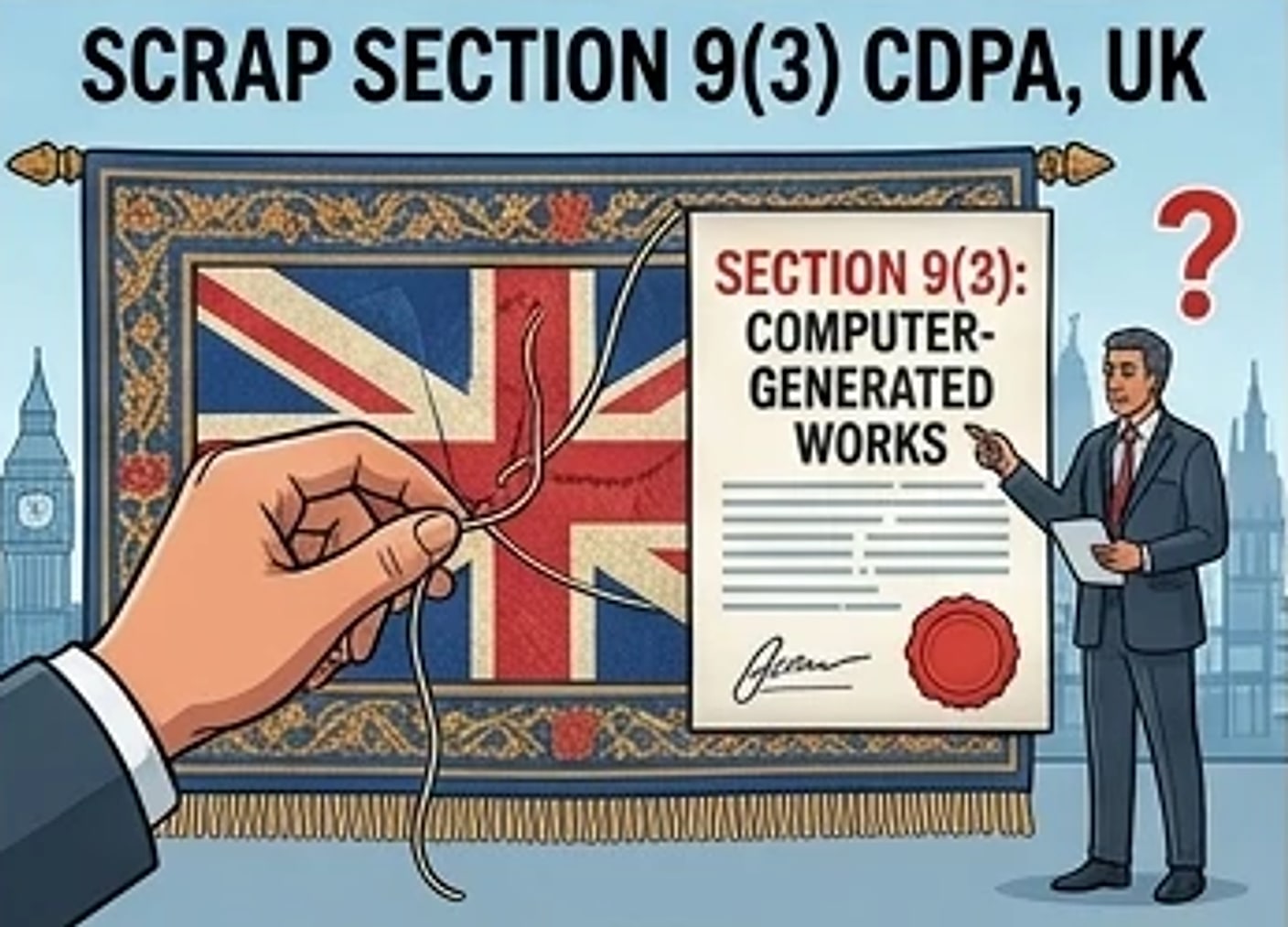
Section 9(3) CDPA AI is a tiny provision with a big role. It gives 50 years of copyright to a work generated by a computer where there is no human author, and says the author is the person who made the arrangements for its creation. Few countries have anything like it. India has a cousin in Section 2(d)(vi). The UK government now says it may be time to scrap it.
In March 2026 the government published its report on copyright and AI, a document Parliament required under the Data (Use and Access) Act 2025. Among its few firm proposals: remove protection for purely computer-generated works. For anyone selling AI output in the UK, or who uses AI to make content, here is what it says, what it doesn’t, and why nothing has changed yet. Section 9(3) CDPA AI debates start here: the provision is old, little used and now under review. Section 178 CDPA computer-generated works is the definition behind it.
What Section 9(3) does today
The Copyright, Designs and Patents Act 1988 protects original literary, dramatic, musical and artistic works, and normally the author is the person who creates them. For a computer-generated work, section 9(3) says the author is the person by whom the arrangements necessary for the creation are undertaken, and section 178 defines such a work as one generated by computer in circumstances where there is no human author. Section 9(3) CDPA AI cases have not yet reached any higher court.
That was drafted in the 1980s with programs in mind, such as software that produced maps or music from a set of rules. Courts rarely used it. In Nova Productions v Mazooma Games, the judge held that the author of video game frames was the programmer who set up the game, which gives a flavour of how arrangements are read. The result is that computer-generated works UK copyright law covers is a slender, little tested area.
Modern generative AI has put the clause under a spotlight. If a person writes a prompt and a model produces an image, who made the arrangements, and is there a human author after all? Lawyers have said the clause is unclear, and the term, 50 years from creation, is shorter than the usual author-life term.
What the March 2026 report proposes
The UK government published its report and an economic impact assessment on 18 March 2026, to meet the deadline set by the Data (Use and Access) Act 2025. The UK copyright and AI report March 2026 says the government has no preferred general reform on training data for now, ruling out a broad text and data mining exception with an opt-out and stepping back from earlier plans. Under Section 9(3) CDPA AI output could be protected only if the person arranging creation counts as author.
On computer-generated works, the position is firmer. Reports say the government’s preferred option is to repeal section 9(3) and remove copyright for works with no human author, while keeping protection for AI-assisted works where a human makes creative choices. It also said it would keep monitoring, and may extend a similar approach to computer-generated designs in design law reform.
Consultation responses mostly backed that split: no protection for purely machine-made output, protection for human-led work using AI tools. The report is not binding, and no bill has been introduced. No timetable has been set. The honest summary is that section 9(3) is on the way out in policy terms but still on the books. Section 9(3) CDPA AI had little case law until the debate on generative tools.
AI-assisted works and human choices
The distinction the government wants to preserve is between AI-generated and AI-assisted. If you use a tool to help, and your own decisions shape the result, such as selecting, editing, arranging, directing and refining, there is a human author and ordinary copyright rules apply. AI-assisted works human creative choices protect are not at risk under the proposal. The section 9(3) CDPA AI repeal would sit beside protection for AI-assisted works.
| Point | UK | India |
|---|---|---|
| Provision | Section 9(3) CDPA, 50 years | Section 2(d)(vi) Copyright Act |
| Author | Person making the arrangements | Person who causes the work to be created |
| Policy direction | Report prefers repeal, no bill yet | Registrar order on DABUS |
| AI-assisted works | Protected with human creative choices | Protectable if original |
Where it bites is the grey zone. A single prompt that produces a finished image may have no real human creative input. Is that “computer-generated” under section 178, or the product of a human author using a tool? Under current law, the claimant could argue they made the necessary arrangements. If section 9(3) goes, the claimant would have to show human authorship in the usual way.
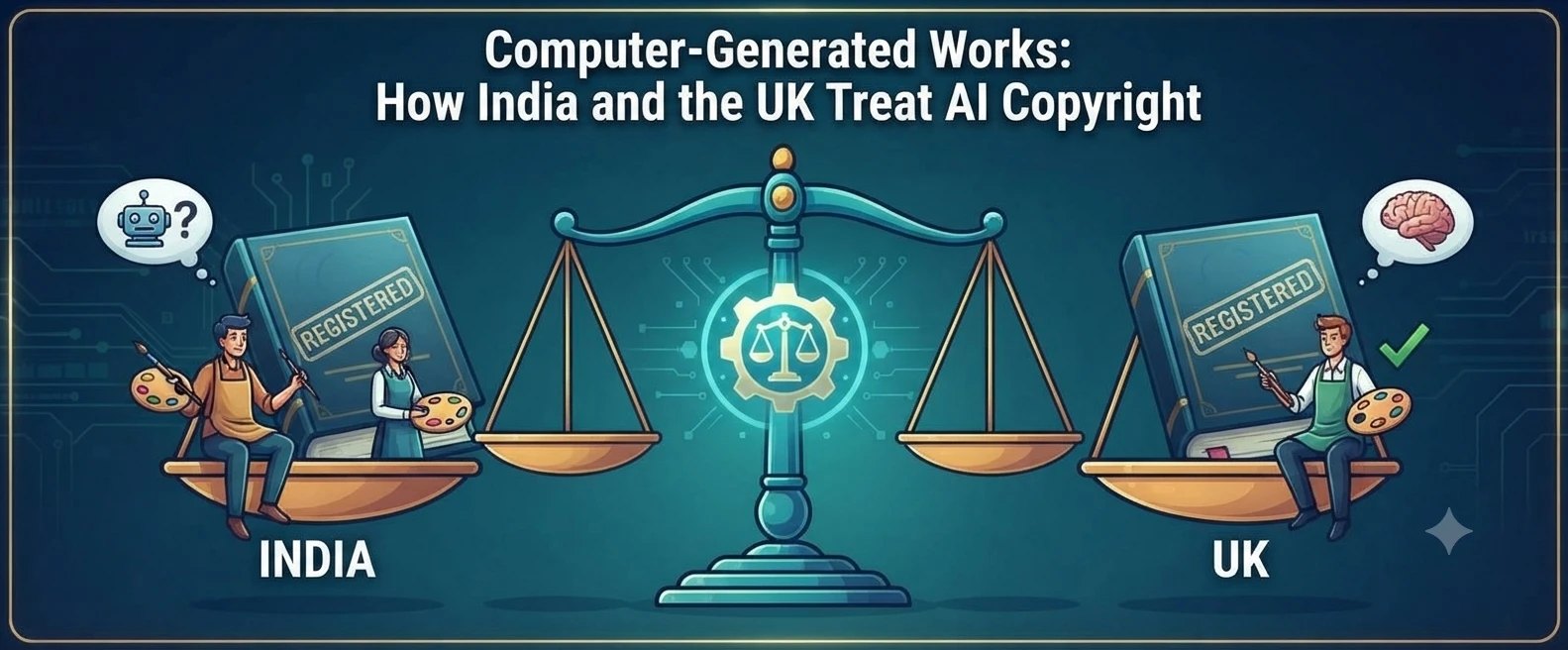
This is a different approach from India’s. The Indian provision says the author of a computer-generated work is the person who causes it to be created, and a recent Copyright Office order accepted that an AI-generated work could be original and named the person behind the tool. Businesses selling into both countries should note that the answers may diverge.
What changes now and what does not
Right now, nothing changes. Section 9(3) remains in force until Parliament acts. A work that qualifies today keeps its protection for its term. If repeal comes, the Act would probably say how existing works are treated, so keep records of how your AI-generated content was made. Section 9(3) CDPA AI repeal is a proposal for now.
Practically, avoid relying on section 9(3) as your only protection. If you commission AI-generated content, document the human input, use contracts that allocate ownership and warrant rights, and consider trade marks, confidentiality and contract rights as backup. These tools do not depend on copyright subsisting.
Watch for the next step. A government response, a bill, a consultation on design law, or a court case could change things quickly. And keep the training data question separate. The report left it open, and that debate continues. Our posts on computer-generated works in India and the UK, and on the DABUS order, give the comparative view. Keep records, because section 9(3) CDPA AI repeal could change how existing works are treated.
Questions people ask
It is worth reading the report itself, not just headlines. It is shorter than you might expect and more cautious than the coverage. On section 9(3) CDPA AI, read the report, not just headlines.
Related reading: computer-generated works: India and the UK, the DABUS order and AI authorship in India, AI-generated content and copyright in India, Getty v Stability AI and AI training, who owns code written with AI and AI copyright in India and the US compared; also AI-generated logos as UK trade marks.
Quick answers
What is section 9(3) CDPA AI creators should know about?
Section 9(3) of the Copyright, Designs and Patents Act 1988 gives 50 years’ protection to computer-generated works with no human author, treating the person who made the arrangements as author. The March 2026 report prefers repealing it.
Has section 9(3) been repealed?
No. The government’s report in March 2026 said repeal is its preferred option, but no legislation has been introduced and no timetable has been set. The provision remains in force.
Would AI-assisted work still be protected in the UK?
The government’s proposal would keep protection where a human makes creative choices, so AI-assisted works with real human authorship would continue to qualify.
Has section 9(3) been repealed?
No. The report prefers repeal but no bill has been introduced.
Final word
Halverton & Co. is an Indian law firm advising UK companies, founders, investors and law firms on Indian law, including copyright, AI and technology contracts for UK businesses with Indian operations, alongside UK solicitors who advise on English law. We practise in Jharkhand, Maharashtra and before the Supreme Court of India, and work alongside your UK solicitors, who advise on English law. Halverton & Co.: Where tech needs law! If you have a question about Indian law, write to us at office@halvertonandco.com, or get in touch.
This article reflects developments reported up to 31 October 2026. It is for general information only, is not legal advice, and does not create a solicitor-client relationship. Halverton & Co. is an Indian law firm, is not authorised or regulated by the Solicitors Regulation Authority, and does not advise on English law; UK-law points should be confirmed with UK advisers.
Sources
Related practice area
Intellectual Property
Trade marks, copyright, patents and designs. Searched, filed, licensed and enforced under Indian law.
View the practice areaComments
No account needed. Comments are reviewed before they appear, so yours will show here once approved. Please do not share confidential details or describe your own legal matter: replies are general discussion, not legal advice, and do not create an advocate-client relationship. For your own situation, write to office@halvertonandco.com.