Key takeaways
- A logo made with AI can usually be registered as a trade mark: the tests are distinctiveness and conflict with earlier marks, not authorship.
- Copyright needs human authorship in the US, so a logo made entirely by AI may have no copyright in its artwork.
- In India, copyright in AI-generated works is unsettled, and trade mark rights arise through use and registration.
- Search for conflicts, check the AI tool’s terms, add human design work and file in each key market.
You can usually trademark an AI-generated logo. Trade mark law protects a mark that identifies the source of goods or services, and it does not ask who drew the logo. But a logo made with AI may carry no copyright, may look too much like an existing mark and may be subject to the AI tool’s terms. So the answer to whether you can trademark an AI generated logo is yes, with three checks: distinctiveness, conflicts and ownership.
This guide compares the US and Indian positions, explains the difference between trade mark and copyright protection for an AI-made logo, sets out the risks, and gives a safe process for founders who design brand identities with AI. It is written by an Indian law firm for US readers. US trade mark and copyright points should be confirmed with US counsel.
The short answer: trade mark versus copyright
A trade mark is a sign that tells customers who stands behind a product. It is protected through use, registration or both, and the key tests are whether it is distinctive and whether it conflicts with another mark. How the logo was made is not one of the tests. A logo drawn by a person, bought from a designer or produced by an AI tool can function as a mark in the same way. That is the starting point for any trademark AI generated logo project.
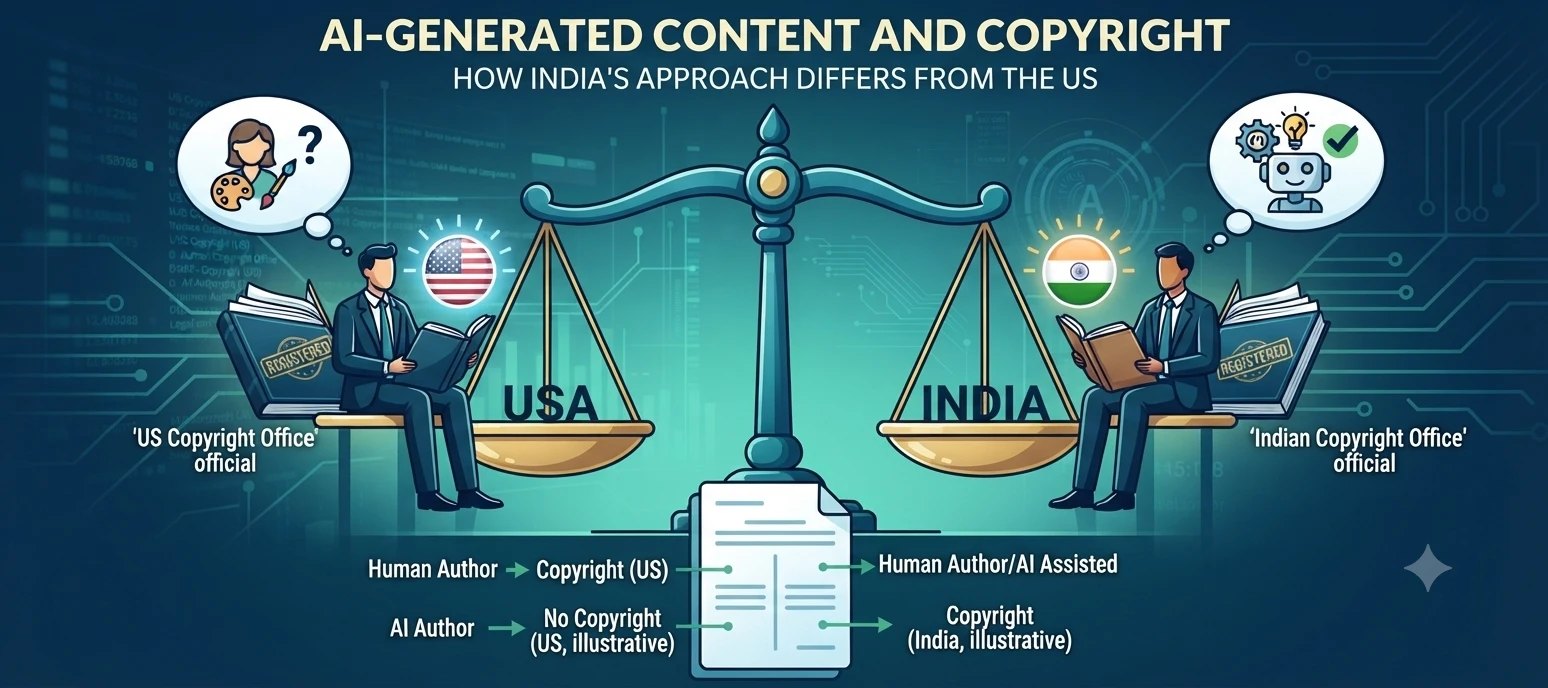
Copyright is different. It protects original creative works, and in the United States it requires human authorship. Following the Thaler v. Perlmutter litigation, and the Supreme Court’s refusal to hear it in March 2026, a work generated entirely by AI has no copyright. A logo made by an AI tool, with little human creative input, may therefore be a valid trade mark but have no copyright in its artwork.
That gap can matter. If someone copies your logo, you can sue for trade mark infringement if you have rights in the mark and there is a likelihood of confusion. You may not be able to sue for copyright infringement of the image. When you ask whether you can trademark an AI generated logo, think of trade mark as your main protection and copyright as a bonus that may not exist.
| Question | Trade mark | Copyright |
|---|---|---|
| Does AI authorship block protection? | No; tests are distinctiveness and conflicts | Yes if no human author (US) |
| How is it protected? | Use, registration or both | Automatically, but only with human authorship |
| Main risk | Looks like an existing mark | No protection for the artwork itself |
| Fix | Search and file in each market | Add real human design work and document it |
The US position
The US Patent and Trademark Office examines logos for registrability under the Lanham Act: whether the mark is distinctive, not merely descriptive, not deceptive and not confusingly similar to a registered or earlier mark. Commentators say that the USPTO does not currently require applicants to disclose whether a logo was created with AI, and AI involvement alone does not lead to refusal. Check the USPTO’s current practice for any change. A trademark AI generated logo application is examined like any other.
Ownership still matters. An applicant must be the owner of the mark, or have a bona fide intention to use it. Rights arise from use in commerce and, for a federal registration, from filing. If the AI tool’s terms restrict commercial use or ownership of outputs, that can complicate your claim. Read the terms, keep the licence, and keep records of how the logo was created and when you began using it.
On copyright, the Copyright Office says that human-authored elements may be protected, and that selection and arrangement of AI-generated material can be protected, but not the AI-generated content itself. To get a copyright in a logo, add real human work, such as drawing, redrawing or substantial editing, and document it. Take US counsel’s advice before relying on copyright for a logo that came mostly from a prompt.
The Indian position
In India, the Trade Marks Act, 1999 allows registration of a mark that is capable of distinguishing goods or services, including a shape, a colour combination and a graphic. A logo made with AI can be filed like any other. The Registry examines it under Sections 9 and 11 for distinctiveness and conflicts with earlier marks. Rights also arise from use through passing off, even without registration. An Indian trademark AI generated logo filing follows the same steps.
Copyright in India is under the Copyright Act, 1957, and the position on AI-generated works is unsettled. The Act has a provision treating the person who causes a computer-generated work to be created as its author, but its application to modern generative AI has not been settled by a court, and the Delhi High Court’s ANI v. OpenAI case concerns training, not logos. Treat copyright in an AI logo as uncertain, in India as in the US.
If you plan to sell in India, file there. A US registration gives no rights in India, and Indian squatters sometimes file foreign brands, including logos, before the owner arrives. File the word mark and the logo separately, in the right classes, and keep proof of first use. Check the Indian register and the Trade Marks Journal for similar logos before you commit. The question can you trademark an AI generated logo has the same basic answer in India as in the US. Filing a trademark AI generated logo in India early avoids squatting.
Risks and a safe process
The first risk is similarity. AI tools learn from many images, and they can produce a logo that looks close to an existing mark, even unintentionally. Run a search of trade mark registers and an image search before you adopt or file, in each country where you will use the logo. A logo that infringes another mark creates liability even if an AI produced it.
The second risk is weak distinctiveness. Generic shapes, stock-looking icons and common letter forms are hard to register and hard to enforce. Choose a distinctive design and a distinctive name, and consider adding human design work to make it unique. The third risk is the tool’s terms. Some tools grant you ownership of outputs, others give a licence with conditions, and free tiers may limit commercial use.
A safe process is simple. Generate options, choose one, have a designer refine or redraw it so that human authorship is added, search for conflicts, check the tool’s terms, file the trade mark in your own name in each key country, keep records of the creation process, and use clear brand guidelines. If you work with a freelancer, get an assignment of any rights. These steps protect you whether the logo started as a prompt or a sketch. Follow it for every trademark AI generated logo you adopt.
Next steps and quick answers
If you already use an AI-made logo, run a conflict search now, review the tool’s terms, add human design work if you want copyright, and file trade marks in your core markets. If you are about to choose a logo, build these checks into the design process. Revisit your position as the law on AI authorship develops. This is general information, not legal advice. Review each trademark AI generated logo against the checks above.
Related reading: can AI art be copyrighted after Thaler, AI-generated content and copyright in India, AI and copyright in India and the US compared, registering a US trade mark in India, trade mark squatting in India for US companies, clearing a brand name for India before a US launch and the startup name checklist for 2026.
Quick answers
Can you trademark an AI generated logo?
Generally yes. Trade mark law asks whether the logo is distinctive and does not conflict with other marks, not who or what created it. The logo may not be protected by copyright if it has no human author.
Does an AI-generated logo have copyright protection?
Not if it was generated entirely by AI with no human creative input. Human-authored changes and selection or arrangement may be protected. The position in India is unsettled.
What is the biggest risk of using an AI logo?
That it resembles an existing trade mark. Run a conflict search in each country, and check the AI tool’s terms for commercial use and ownership.
Does the USPTO ask whether my logo was made with AI?
Commentators say it does not currently require applicants to disclose AI use for a logo, and AI involvement alone does not lead to refusal. Check the USPTO’s current practice.
Should I redraw my AI logo?
Adding real human design work can help you claim copyright in the artwork and make the logo more distinctive. Document what you changed.
Final word
Halverton & Co. is an Indian law firm advising US companies, founders, investors and law firms on Indian law, including trade mark and brand protection in India, AI and IP law, and cross-border filing strategy for US companies. We practise in Jharkhand, Maharashtra and before the Supreme Court of India, and work alongside US counsel, who advise on US law. Halverton & Co.: Where tech needs law! If you have a question about Indian law, write to us at office@halvertonandco.com, or get in touch.
This article reflects developments reported up to 31 October 2026. It is for general information only, is not legal advice, and does not create an attorney-client relationship. Halverton & Co. is an Indian law firm and does not advise on US law; US-law points should be confirmed with US counsel.
Sources
Related practice area
Intellectual Property
Trade marks, copyright, patents and designs. Searched, filed, licensed and enforced under Indian law.
View the practice areaComments
No account needed. Comments are reviewed before they appear, so yours will show here once approved. Please do not share confidential details or describe your own legal matter: replies are general discussion, not legal advice, and do not create an advocate-client relationship. For your own situation, write to office@halvertonandco.com.